20 Native Shrubs of Iowa (With Growing Details)
Iowa’s landscape tells a story most people never learn in school. Tallgrass prairie once blanketed 70 to 80 percent of the state, according to the Iowa Department of Natural Resources. Today, less than 0.1 percent of that original prairie survives.
That loss makes every native shrub still growing here feel a little more valuable to me. These plants carry genetics shaped by Iowa’s brutal winters, humid summers, and unpredictable rainfall, long before any nursery got involved.
This guide walks through 20 native shrubs of Iowa. For each one, you’ll find mature size, light needs, soil preference, and practical uses.
20 Iowa Native Shrubs
1. American Hazelnut (Corylus americana)
American hazelnut forms dense, thicket-like clumps that reach about 15 feet tall at maturity. It grows at a medium pace and tolerates partial shade reasonably well.
This shrub thrives along woodland openings and borders, the same transitional zones found throughout Iowa’s remaining timber. It handles a range of soil types without much complaint.
Wildlife value here is exceptional. Squirrels, grouse, and other small mammals rely on the edible nuts this shrub produces every fall.
I like hazelnut for anyone wanting a natural hedge that also produces something you can harvest yourself.
2. Beaked Hazelnut (Corylus cornuta)
Beaked hazelnut stays smaller than its American cousin, typically reaching only 6 feet tall. Its name comes from the unusual, beak-shaped husk that covers each nut.
This shrub prefers north-facing wooded slopes and cooler microclimates, including Iowa’s rare algific talus slopes. Those specialized sites keep the soil cool even in summer heat.
Availability can be limited at standard nurseries, so specialty native plant growers are often your best source. It grows at a medium rate and handles partial shade well.
If you have a shaded, north-facing slope, this shrub fits that niche better than almost anything else on this list.
3. Gray Dogwood (Cornus racemosa)
Gray dogwood grows into a dense, thicket-forming shrub reaching about 10 feet tall. It tolerates shade better than most dogwoods, making it flexible for varied planting sites.
Flat clusters of small white flowers appear in late spring, and according to the USDA PLANTS Database, this species ranges across most of the eastern and central United States, including Iowa. White berries follow on distinctive reddish stalks.
This shrub does well in upland woods and disturbed areas alike. Birds strip the berries quickly once they ripen in late summer.
Gray dogwood spreads by suckering, so give it space if you want a naturalized thicket rather than a single specimen.
4. Red-Osier Dogwood (Cornus sericea)
Red-osier dogwood delivers its best show in winter, when bare stems glow deep red against snow cover. Few shrubs on this list offer that much cold-season interest.
According to Iowa DNR planting records, this fast-growing shrub reaches about 8 feet tall and tolerates shade far better than many wetland species. It naturally occurs along shores, pond margins, and fens.
Small white flowers appear in spring, followed by white berries that birds consume readily. Fall foliage turns a soft reddish-purple before dropping.
This shrub suits rain gardens, pond edges, and any low spot on your property that stays consistently damp.
5. Silky Dogwood (Cornus obliqua)
Silky dogwood grows into a rounded, multi-stemmed shrub around 10 feet tall. It earns its name from the fine, silky hairs found on the underside of its leaves.
This species handles wet thickets, low woods, and wet prairies with ease, tolerating standing water better than most upland shrubs. It grows at a medium pace and adapts well to partial shade.
White flower clusters in late spring give way to blue-tinted berries that migrating birds depend on heavily. Fall color runs toward deep maroon and purple tones.
Plant silky dogwood anywhere your yard tends to stay soggy after heavy Iowa rainstorms.
6. Rough-Leaf Dogwood (Cornus drummondii)
Rough-leaf dogwood gets its name from leaves with a distinctly sandpapery texture, unlike the smoother foliage of related dogwood species. It reaches about 8 feet tall at maturity.
This shrub grows naturally in moist woods and along streams, often forming dense thickets at woodland borders. It tolerates shade reasonably well and spreads readily once established.
Clusters of small white flowers bloom in late spring, followed by white berries that ripen through late summer. Wildlife, particularly songbirds, rely on this fruit heavily.
Use rough-leaf dogwood where erosion control matters, since its spreading root system holds streambank soil in place effectively.
7. Common Elderberry (Sambucus canadensis)
Common elderberry grows fast, often reaching 8 feet tall within just a few seasons. Large, flat-topped clusters of small white flowers appear in early summer, drawing pollinators from across the yard.
Those flowers eventually become clusters of small purple berries. Cooked, they go into jams, pies, and homemade syrups, though raw berries and other plant parts should never be eaten.
This shrub grows naturally along moist woodland edges, shorelines, and fencerows. It tolerates partial shade and adapts to a variety of soil conditions without much fuss.
Birds strip elderberries almost as fast as they ripen, so plant extra if you actually want to harvest some yourself.
8. Smooth Sumac (Rhus glabra)
Smooth sumac produces some of the most dramatic fall color of any Iowa native shrub, shifting to brilliant shades of red and orange each autumn. It reaches about 15 feet tall at maturity.
This shrub colonizes woodland openings, edges, and disturbed areas readily, spreading through underground roots to form dense colonies over time. It grows at a medium pace and tolerates partial shade.
Upright clusters of fuzzy red berries persist through winter, providing emergency food for birds when other options run out. The berries can also be steeped into a tart, lemonade-like drink.
Give smooth sumac plenty of room, since it spreads aggressively once it settles into a site.
9. Staghorn Sumac (Rhus typhina)
Staghorn sumac gets its name from the dense, velvety hairs covering its young branches, resembling deer antlers still in velvet. It grows taller than smooth sumac, reaching about 20 feet.
This shrub prefers dry, open sites, including rocky slopes and disturbed woodland edges where competition from other plants stays low. Fall color rivals smooth sumac, with vivid orange and scarlet tones.
Cone-shaped clusters of fuzzy red fruit persist through winter, feeding birds during the leanest months. Native Americans traditionally used the berries to make a tart, vitamin C-rich beverage.
Staghorn sumac works well on slopes and marginal land where little else will establish successfully.
10. Nannyberry (Viburnum lentago)
Nannyberry grows into a large, multi-stemmed shrub reaching about 15 feet tall, though it can be trained into a small single-trunked tree. It grows at a medium pace and tolerates partial shade.
This species thrives in upland woods across Iowa, forming a reliable backdrop shrub in mixed woodland plantings. Clusters of small white flowers bloom in spring.
Dark blue-black berries follow the flowers and persist well into winter, giving birds a dependable food source. Fall color shifts toward deep reddish-purple.
Nannyberry’s size and adaptability make it a strong choice for screening or naturalizing larger properties.
11. Blackhaw Viburnum (Viburnum prunifolium)
Blackhaw viburnum stays more compact than nannyberry, typically reaching 12 feet tall with a slow, steady growth habit. Its dense branching structure makes it function almost like a small tree.
This shrub grows naturally along woodland borders, tolerating partial shade while still flowering reliably. Clusters of white flowers appear in spring, followed by blue-black fruit.
Fall foliage turns deep reddish-purple, adding late-season color to an otherwise quiet corner of the garden. Birds and small mammals both rely on the fruit through autumn.
I recommend blackhaw viburnum for smaller yards where nannyberry would eventually outgrow the space available.
12. Wild Plum (Prunus americana)
Wild plum bursts into fragrant white bloom early each spring, often before the leaves fully emerge. Few native shrubs announce spring as dramatically as this one does.
This fast-growing shrub reaches about 20 feet tall and needs full sun to perform well, since it tolerates shade poorly. It thrives along fencerows, woodland edges, and open woods throughout Iowa.
Small, tart plums ripen by late summer, and wildlife from birds to deer eat them readily. Ripe fruit also works well in homemade jams and preserves.
Plant wild plum where it can spread naturally into a thicket, since it suckers freely once established.
13. Chokecherry (Prunus virginiana)
Chokecherry produces long, drooping clusters of small white flowers each spring, followed by dark red to nearly black cherries by late summer. It grows to about 20 feet tall.
This shrub is remarkably hardy, thriving in open woods, woodland borders, and rocky bluffs across the entire state. It needs full sun and struggles badly in shaded conditions.
Raw fruit tastes bitter and astringent, hence the name, but cooked chokecherries make excellent jelly and syrup. Birds and mammals eat the fruit without hesitation.
Watch for black knot disease, a common issue that can shorten this shrub’s overall lifespan in home landscapes.
14. American Witch Hazel (Hamamelis virginiana)
Witch hazel does something no other shrub on this list can manage: it blooms in late fall, well after most plants have gone dormant for winter. Thin, spidery yellow flowers unfurl even after frost.
This shrub reaches about 10 feet tall and grows at a medium pace, favoring moist, north-facing wooded slopes. It tolerates partial shade better than full sun exposure.
That unusual bloom time makes witch hazel a critical late-season resource for the handful of cold-tolerant insects still active in November. Extract from its bark and leaves is also used commercially as a skin astringent.
Plant witch hazel somewhere you’ll walk past in late autumn. The surprise of yellow flowers against bare branches is genuinely memorable.
15. Eastern Wahoo (Euonymus atropurpureus)
Eastern wahoo stays relatively modest in size, reaching about 15 feet tall, but its fall display makes up for its understated summer presence. Iowa DNR planting records simply describe it as “very attractive,” and that holds up.
This shrub thrives in moist woods and tolerates shade reasonably well, making it a solid understory choice. Small purple flowers in spring lead to distinctive pink, four-lobed seed capsules.
Those capsules split open in fall to reveal bright orange-red seeds inside, creating a striking two-tone display. Birds eat the seeds once the capsules open fully.
Eastern wahoo works beautifully as a specimen plant near a shaded patio, where its fall color becomes the seasonal focal point.
16. Prickly Ash (Zanthoxylum americanum)
Prickly ash carries sharp thorns along its stems, a trait that gives this otherwise unassuming shrub its common name. It reaches about 12 feet tall and grows slowly.
This shrub occupies woodland edges and openings across Iowa, tolerating shade poorly but adapting to a range of soil conditions. Crushed leaves release a strong, citrus-like aroma.
Small greenish flowers bloom before the leaves emerge in spring, and the plant’s thorny structure offers dense cover for nesting birds. Some pollinator species rely on this shrub as a larval host plant.
Site prickly ash carefully, ideally along a property line, where its thorns can double as a natural barrier.
17. Silver Buffaloberry (Shepherdia argentea)
Silver buffaloberry stands out immediately thanks to its distinctive silvery-gray foliage, a texture unlike almost any other Iowa native shrub. It reaches about 8 feet tall at a medium growth rate.
This tough shrub thrives on dry uplands, loess bluffs, and prairie-woodland edges, tolerating drought and poor soil far better than most ornamentals. It also fixes nitrogen in the soil through root-associated bacteria.
Tart red-orange berries ripen in late summer, and while sour raw, they make a traditional jelly once cooked with sugar. Birds and small mammals eat the fruit readily in the wild.
Because plants are typically either male or female, you generally need both to guarantee reliable fruit production.
18. Common Juniper (Juniperus communis)
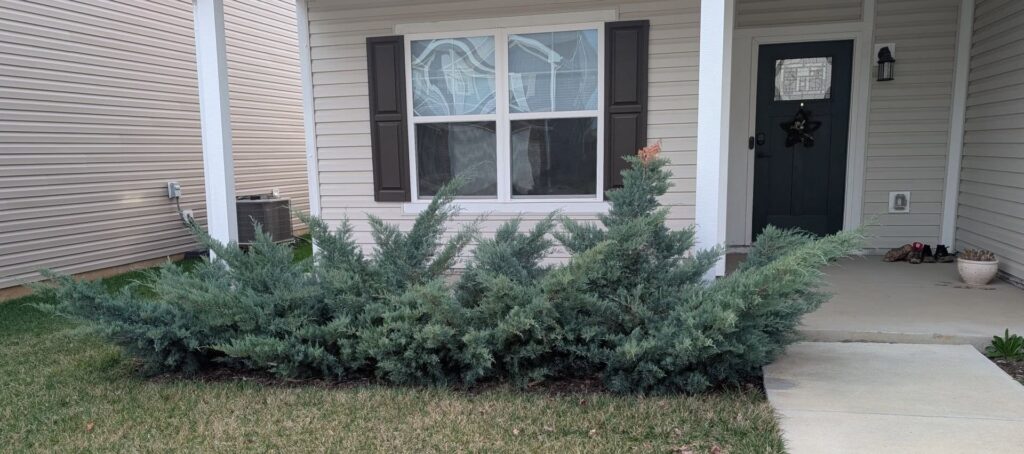
Common juniper is one of the few true evergreens native to Iowa, holding its blue-green, needle-like foliage through the harshest winter months. It reaches about 10 feet tall at a medium pace.
This shrub favors dry, wooded bluffs and rocky slopes, particularly across the Driftless Area and Loess Hills regions. It needs full sun and struggles in shaded, damp conditions.
Small, blue-gray, berry-like cones develop over two growing seasons and are traditionally used to flavor gin and various culinary dishes. Birds also rely on these cones as a winter food source.
Common juniper’s low, spreading form makes it a natural choice for rocky, exposed sites where other evergreens fail.
19. Canada Yew (Taxus canadensis)
Canada yew stays low and shrubby, rarely exceeding 3 feet in height, making it one of the smallest native shrubs on this list. It tolerates deep shade better than nearly any other Iowa species.
This evergreen conifer favors rocky bluffs and moist, wooded slopes, often growing in the deep shade of mature forest canopy. Its soft, flat needles stay green year-round.
Bright red, berry-like arils form around each seed in fall, though the seeds and foliage are toxic if ingested by people or livestock. Deer, however, browse this shrub heavily, which has eliminated it from many accessible sites.
If deer pressure is low on your property, Canada yew offers rare year-round structure for deep-shade plantings.
20. Leadplant (Amorpha canescens)
Leadplant might be the single most iconic shrub of Iowa’s vanishing tallgrass prairie. Its silvery, finely textured foliage and purple flower spikes once covered vast stretches of the state’s original grassland.
According to a USDA NRCS plant fact sheet, leadplant develops a deep, branching, woody root system used historically for erosion control projects. NC State University Extension notes those roots typically reach 4 feet deep or more, helping the plant survive both fire and drought.
This low, compact shrub rarely exceeds 3 feet tall and thrives in full sun and well-drained, even sandy, soil. Its fragrant purple blooms attract dozens of native bee and butterfly species each summer.
Ecologists consider leadplant an indicator of high-quality remnant prairie, since it rarely establishes in heavily disturbed ground. Finding one in the wild is a genuinely good sign for that patch of land.
Why Native Shrubs Matter for Iowa Landscapes
Native shrubs solve problems that imported ornamentals create. They need less irrigation, resist local pests naturally, and rarely escape into surrounding wild areas as invasive threats.
They also close a gap most nursery plants leave wide open. Non-native shrubs typically offer little food value for native insects, which means the birds that depend on those insects go hungry.
Iowa’s climate does not go easy on plants. Subzero winters, humid summers, and increasingly erratic rainfall test everything growing here.
Native shrubs have already survived that test for thousands of years, which is exactly why Iowa State University Extension and the Iowa DNR keep recommending them for home landscapes.
Final Thoughts
Twenty shrubs is a lot to absorb at once, so start small. Choose two or three species matched to your soil and sunlight, then expand once you see how they establish.
I always encourage people to plant something with a story attached, like leadplant or wild plum. Those species connect a backyard directly to the prairie and woodland that once defined this entire state.
Whatever you choose, you’re planting something that already belongs here. That is a quiet kind of satisfaction no imported shrub can quite replicate, and your local birds and bees will notice the difference too.
References
- Iowa Department of Natural Resources, “Trees & Shrubs Native in Iowa” — https://www.iowadnr.gov/media/7589/download
- Iowa Department of Natural Resources, “Prairie Resource Center” — https://www.iowadnr.gov/programs-services/prairie-resource-center
- Iowa State University Extension and Outreach, “Plants Native to Iowa” — https://yardandgarden.extension.iastate.edu/how-to/plants-native-iowa
- Iowa State University Extension and Outreach, “Summer-Blooming Shrubs for Iowa” — https://yardandgarden.extension.iastate.edu/how-to/summer-blooming-shrubs-iowa
- USDA Natural Resources Conservation Service, Plant Fact Sheet: Leadplant — https://plants.sc.egov.usda.gov/DocumentLibrary/factsheet/pdf/fs_amca6.pdf
- NC State University Extension Gardener Plant Toolbox, “Amorpha canescens” — https://plants.ces.ncsu.edu/plants/amorpha-canescens/
- USDA PLANTS Database, “Cornus racemosa” — https://plants.usda.gov/plant-profile/CORA6

Tim M Dave is a gardening expert with a passion for houseplants, particularly cacti and succulents. With a degree in plant biology from the University of California, Berkeley, he has vast experience in gardening. Over the years, he has cultivated a vast collection of desert plants and learned a great deal about how to grow and care for these unique companions.