25 Michigan Native Trees (With Growing Details)
Michigan does not do forests halfway. More than half the state sits under a tree canopy, stretching from the hardwood hills of the Lower Peninsula to the conifer stands of the Upper Peninsula.
The U.S. Forest Service reports Michigan holds 20.3 million acres of forest land, covering 54 percent of the entire state. That makes Michigan one of the most heavily forested states in the Midwest and Northeast combined.
I grew up thinking of Michigan as a place defined by lakes. Spend enough time here, though, and the trees start to feel just as central to the state’s identity.
There are 14.1 billion live trees across Michigan’s forest land, according to Forest Inventory and Analysis data. That works out to roughly 695 trees for every single acre.
This guide profiles 25 trees native to Michigan, covering towering pines, sugar-producing maples, and quiet understory species most people walk past without noticing.
A Quick Snapshot of Michigan’s Forests
Before diving into individual species, a few numbers help frame the bigger picture.
- Sugar maple, American beech, and yellow birch together form Michigan’s most common forest type, covering 19 percent of all forest land.
- Aspen ranks second among forest types, covering 12 percent of the state’s forested acreage.
- Michigan’s wood-products and paper industries directly employ nearly 35,000 workers, generating roughly $10.2 billion annually.
- 63 percent of all trees on Michigan’s forest land are hardwoods, with the remaining share made up of conifers.
With that context in mind, here are the 25 native trees that shape Michigan’s landscape.
1. Sugar Maple (Acer saccharum)
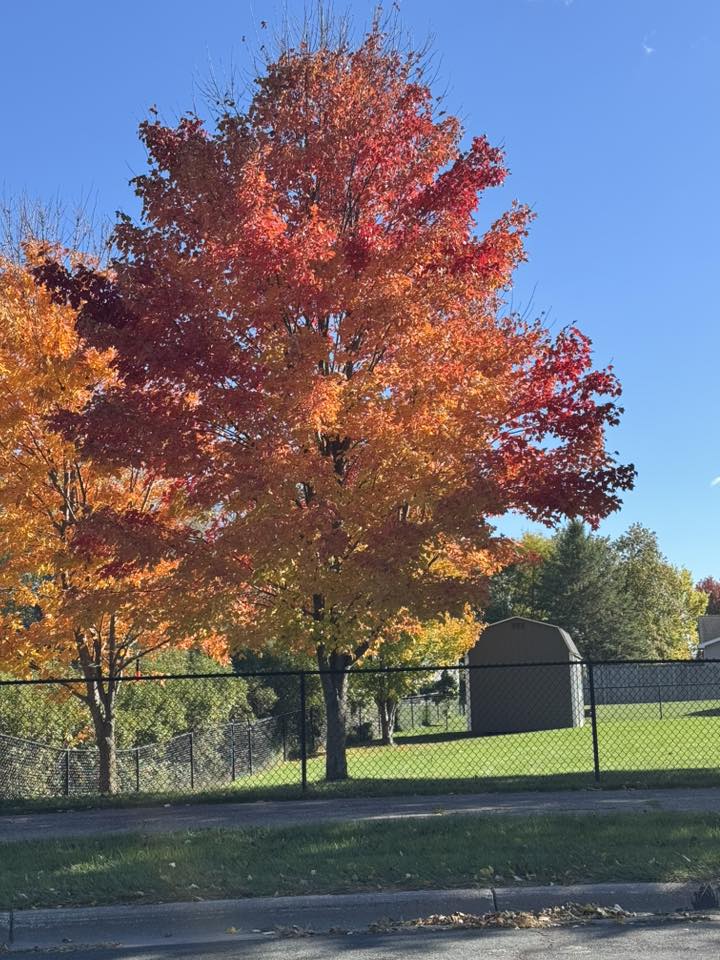
Sugar maple is the backbone of Michigan’s hardwood forests, anchoring the sugar maple/beech/yellow birch forest type that covers nearly a fifth of the state’s woodland. It typically reaches 60 to 75 feet tall.
This tree is the primary source of Michigan’s maple syrup industry, tapped each spring when sap begins flowing before the buds break.
Its leaves turn brilliant shades of orange, red, and gold each autumn, making it one of the most recognizable fall trees in the state.
Sugar maple prefers rich, well-drained soil and tolerates shade better than almost any other hardwood, allowing seedlings to persist for years beneath a full canopy.
2. Red Maple (Acer rubrum)
Red maple is one of Michigan State University Extension’s top recommendations for native landscaping, prized for being easy to grow and tolerant of both wet and acidic soils.
It typically grows 40 to 60 feet tall, with reddish flowers appearing in early spring before the leaves emerge.
Fall color is outstanding, often shifting to deep scarlet earlier than most other maples in the landscape.
Numerous named cultivars exist, but straight native-seed trees remain widely available through nurseries that specialize in regional native plants.
3. Silver Maple (Acer saccharinum)
Silver maple grows fast, often reaching 50 to 80 feet within a few decades, with a broad, spreading crown and deeply furrowed bark on mature trunks.
Its leaves have a distinctive silvery-white underside, which flashes visibly whenever wind moves through the canopy.
It favors moist, low-lying ground, commonly found along riverbanks and floodplains throughout the state.
Because of its rapid growth and brittle wood, it works better in naturalized areas than close to structures or power lines.
4. Eastern White Pine (Pinus strobus)
Eastern white pine is Michigan’s official state tree, historically the backbone of the state’s 19th-century logging economy. It can reach 80 feet or taller in favorable conditions.
Its soft, blue-green needles grow in bundles of five, a reliable way to distinguish it from red and jack pine.
This species tolerates a wide range of soils but grows best in well-drained sandy or loamy ground, especially across northern Michigan.
Old-growth specimens can live for centuries, and a handful of protected stands still remain in state and national forest land today.
5. Red Pine (Pinus resinosa)
Red pine gets its name from the reddish-orange bark that develops as the tree matures, forming distinctive plate-like scales. It typically reaches 50 to 80 feet.
Needles grow in bundles of two, longer and stiffer than white pine needles, and snap cleanly when bent double.
This species was heavily planted across Michigan through public reforestation programs in the mid-20th century, and red pine plantations remain common on state and national forest land today.
It favors dry, sandy soils and full sun, making it well suited to much of the northern Lower Peninsula.
6. Jack Pine (Pinus banksiana)
Jack pine thrives where few other trees can, favoring poor, sandy, and nutrient-depleted soils across northern Michigan. It rarely exceeds 50 feet in height.
Its cones are serotinous, meaning they often require the heat of a wildfire to open and release seeds, a reproductive strategy tied to naturally fire-prone landscapes.
This species holds special conservation importance as the primary nesting habitat for the Kirtland’s warbler, a rare songbird once found almost exclusively in Michigan’s jack pine stands.
Needles are short, twisted, and grow in bundles of two, giving mature trees an irregular, wind-worn appearance.
7. Eastern Hemlock (Tsuga canadensis)
Eastern hemlock is a shade-loving conifer, often found growing beneath taller hardwoods in cool, moist ravines and along northern lakeshores. It can reach 60 to 70 feet.
Its short, flat needles are arranged in a delicate, feathery pattern, with two pale stripes visible on the underside.
This species is highly sensitive to soil moisture and prefers acidic, well-drained sites, often growing alongside yellow birch and sugar maple.
Hemlock wood was historically used for tanning leather, since its bark contains high concentrations of tannin.
8. Northern White-Cedar (Thuja occidentalis)
Northern white-cedar, sometimes called arborvitae, forms dense stands in Michigan’s wetlands and swamp forests. It typically grows 40 to 50 feet tall, though wetland specimens are often smaller.
According to Forest Inventory and Analysis data, northern white-cedar is the state’s most abundant softwood forest type, found heavily in the eastern Upper Peninsula.
Its flattened, scale-like foliage grows in fan-shaped sprays with a mild, aromatic scent when crushed.
Deer rely heavily on cedar swamps for winter shelter, since the dense canopy blocks wind and traps less snow than open hardwood forest.
9. Tamarack (Larix laricina)
Tamarack stands apart from other Michigan conifers because it is deciduous, dropping its soft needles completely each autumn after turning golden yellow.
It grows in Michigan’s bogs and poorly drained wetlands, often alongside black spruce, typically reaching 40 to 60 feet.
Needles grow in small, dense clusters along the branches, giving the tree a delicate, feathery texture through the growing season.
This species tolerates standing water and acidic peat soils better than nearly any other tree native to the state.
10. Black Spruce (Picea mariana)
Black spruce grows in Michigan’s coldest, wettest sites, often forming stunted stands in bogs and poorly drained lowlands. Height rarely exceeds 40 feet in harsh conditions.
Its shallow root system adapts to shallow, saturated soils, though this also makes mature trees vulnerable to windthrow during storms.
Small, dark cones persist on the branches for years, a helpful identification trait during winter months.
This species has experienced a documented decline in sapling numbers since 2009, largely linked to shifting water table levels in its preferred wetland habitat.
11. White Spruce (Picea glauca)
White spruce grows across Michigan’s northern counties, favoring well-drained upland soils rather than the wetlands preferred by black spruce. Mature trees typically reach 60 to 70 feet.
Needles have a sharp point and a somewhat unpleasant odor when crushed, a useful identification trick in the field.
This species has shown consistent gains in both number and volume since 1980, according to long-term forest inventory data.
Its dense, conical crown makes it a popular windbreak species on farms across the northern Lower Peninsula.
12. Balsam Fir (Abies balsamea)
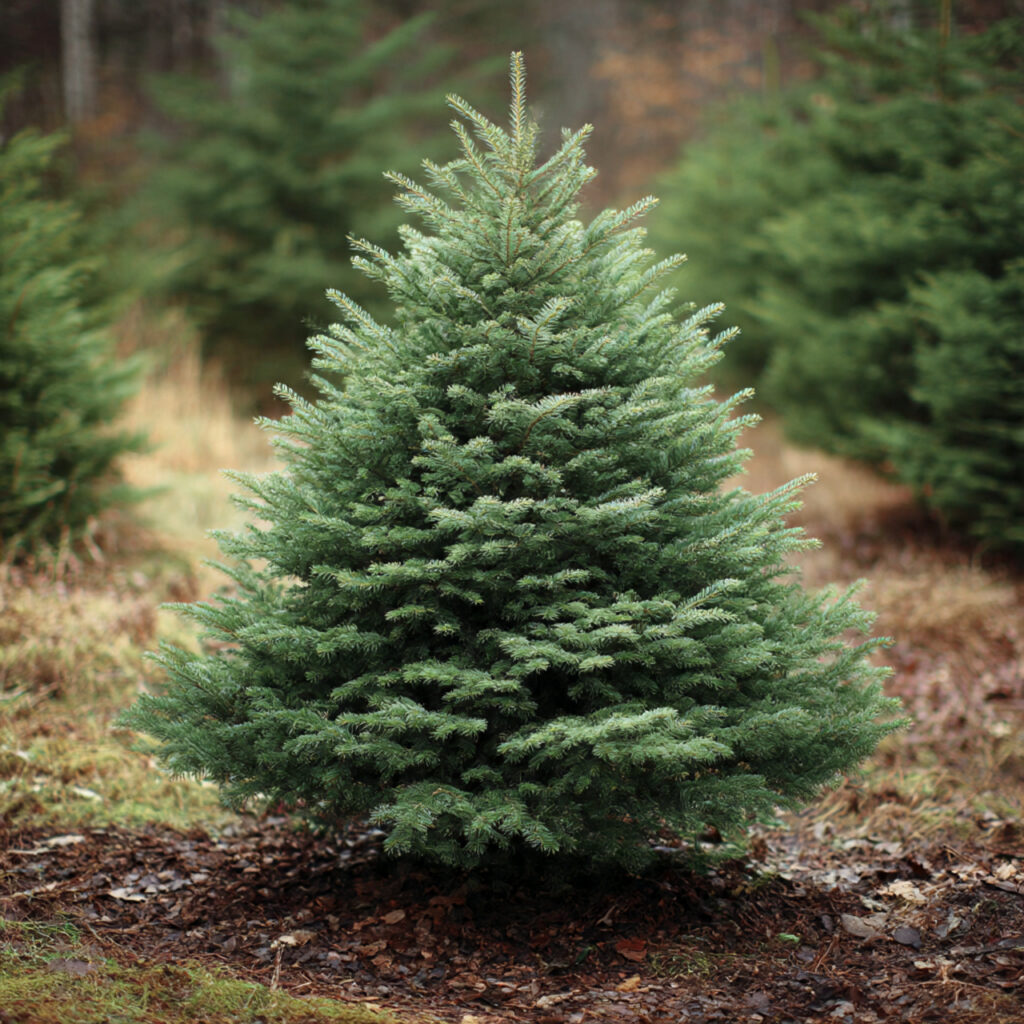
Balsam fir is easy to identify by its flat, fragrant needles and smooth, resin-blistered bark on young trees. It typically grows 40 to 60 feet tall.
This species produces more saplings than any other tree species in Michigan, according to state forest inventory figures, though it struggles to reach large sawtimber size.
Its aromatic scent has made it a popular Christmas tree species for decades, alongside dedicated plantation-grown balsam fir.
Balsam fir is vulnerable to the native spruce budworm, a recurring pest that periodically damages large stands across the northern half of the state.
13. American Beech (Fagus grandifolia)
American beech is a defining member of Michigan’s most common forest type, alongside sugar maple and yellow birch. It typically reaches 60 to 80 feet.
Its smooth, pale gray bark remains unusually consistent throughout the tree’s life, making it one of the easiest hardwoods to identify at any age.
Beechnuts provide an important late-summer food source for squirrels, chipmunks, turkeys, and black bears across the state.
Unfortunately, beech bark disease has caused a documented, multi-year increase in mortality among Michigan’s beech population, a trend forest managers continue to monitor closely.
14. Paper Birch (Betula papyrifera)
Paper birch is instantly recognizable by its peeling white bark, which curls away from the trunk in thin, papery sheets. It typically grows 50 to 70 feet tall.
Indigenous communities across the Great Lakes historically used birch bark for canoes, containers, and shelter coverings, a practice tied closely to this species’ natural range.
This tree depends on wildfire and open, disturbed ground to regenerate successfully, since it cannot tolerate deep shade as a seedling.
Because wildfire has been actively suppressed for decades, paper birch numbers have been gradually declining across Michigan’s forest inventory.
15. Yellow Birch (Betula alleghaniensis)
Yellow birch has shimmering, yellowish-bronze bark that peels in thin curls, distinguishing it clearly from the bright white bark of paper birch. It typically reaches 60 to 75 feet.
This species usually regenerates in canopy gaps, sprouting where a fallen tree has opened space and light within the forest floor.
Its wood is prized for furniture and flooring, valued for both strength and an attractive, fine grain pattern.
Without active forest management to create canopy openings, yellow birch numbers are expected to continue a slow, long-term decline across the state.
16. Quaking Aspen (Populus tremuloides)
Quaking aspen is one of the most widespread native trees in North America, and it forms Michigan’s second most common forest type at 12 percent of forested land.
Its leaves flutter constantly in even the slightest breeze, thanks to flattened leaf stems that allow easy movement.
This species spreads through root suckering, meaning entire connected groves can share a single genetic identity beneath the soil.
Fall color turns bright gold, creating some of the most photographed roadside scenery across northern Michigan each October.
17. Bigtooth Aspen (Populus grandidentata)
Bigtooth aspen closely resembles quaking aspen but has larger, more coarsely toothed leaves, giving the species its name. It typically reaches 50 to 70 feet.
Bark on younger trees is smooth and greenish-gray, darkening and developing furrows with age.
This species has shown consistent gains in sawtimber-size trees since 1980, reflecting a broader statewide maturation of Michigan’s aspen forest type.
Like quaking aspen, it depends on full sun and disturbed ground for successful seedling establishment.
18. Northern Red Oak (Quercus rubra)

Northern red oak is the most widespread oak species in Michigan, typically growing 60 to 75 feet tall with a broad, rounded crown at maturity.
Its leaves have pointed, bristle-tipped lobes, distinguishing it from the rounded lobes found on white oak leaves.
This species has posted strong, sustained volume increases since 1980, driven largely by increases in the number of large sawtimber-size trees.
Acorns take two growing seasons to mature and provide a critical fall food source for deer, turkey, and squirrels across the state.
19. White Oak (Quercus alba)
White oak is a slower-growing, longer-lived species than red oak, often reaching 60 to 80 feet with light gray, scaly bark.
Its leaves have smooth, rounded lobes rather than the pointed bristle tips found on red oak foliage.
White oak wood is highly valued for barrel-making, flooring, and furniture, prized for its tight grain and natural water resistance.
This species is concentrated heavily in the southern Lower Peninsula, where it forms a defining part of the white oak/red oak/hickory forest type.
20. American Basswood (Tilia americana)
American basswood, also called linden, typically grows 60 to 70 feet tall with large, heart-shaped leaves and a straight, uniform trunk.
Its fragrant, pale yellow flowers bloom in early summer, drawing large numbers of native bees and producing a distinctly flavored honey.
This species tolerates a wide range of soils but grows best in rich, moist bottomland alongside sugar maple and beech.
Basswood wood is notably lightweight and soft, historically favored for carving and hand-crafted furniture pieces.
21. Black Cherry (Prunus serotina)
Black cherry is Michigan’s largest native cherry species, capable of reaching 60 to 80 feet in ideal forest conditions.
Its bark on mature trees breaks into small, dark, flaky plates, often compared to burnt potato chips by field guides.
Small white flowers bloom in drooping clusters each spring, followed by dark purple-black fruit that ripens by late summer.
This species has more than doubled in volume statewide since 1980, one of the strongest sustained gains among Michigan’s native hardwoods.
22. Eastern Hophornbeam, Also Called Ironwood (Ostrya virginiana)
Ironwood is a small, understory tree, rarely exceeding 30 to 40 feet, known for unusually dense and heavy wood that gives the species its common name.
Its fruit resembles small clusters of hops, hanging in papery, inflated pouches through late summer and fall.
Michigan State University Extension notes this species is regarded as difficult to transplant but easy to maintain once properly established.
Ironwood tolerates deep shade exceptionally well, often persisting for decades beneath a full hardwood canopy.
23. Kentucky Coffeetree (Gymnocladus dioicus)
Kentucky coffeetree is a bold, coarse-textured tree, reaching 60 to 75 feet with thick, curling seed pods that persist through winter.
It leafs out later than almost any other Michigan native tree in spring and drops its leaves earlier in fall, giving it a notably short growing season.
Early settlers once roasted its large seeds as a coffee substitute, though the raw pods and seeds are considered toxic before processing.
This species has become an increasingly popular landscape choice, valued for its unusual winter silhouette and strong tolerance for urban conditions.
24. American Elm (Ulmus americana)
American elm once formed one of Michigan’s most iconic street tree canopies, prized for its graceful, vase-shaped crown reaching 60 to 80 feet.
Dutch elm disease devastated much of the state’s mature elm population through the mid-20th century, dramatically reducing the species’ presence in urban forests.
Disease-resistant cultivars have since been developed, allowing American elm to slowly return to street tree plantings across the state.
Wild elms still persist in floodplains and wetland forests, where they continue producing seed despite ongoing disease pressure.
25. Shagbark Hickory (Carya ovata)
Shagbark hickory is instantly recognizable by its loose, curling bark plates, which peel away from the trunk in long, shaggy strips at maturity.
It typically grows 60 to 80 feet tall, favoring the rich upland forests of Michigan’s southern Lower Peninsula.
Its nuts are edible and sweet, historically gathered by both Indigenous communities and early settlers as a reliable fall food source.
This species is a defining member of the white oak/red oak/hickory forest type, one of the most productive and species-diverse hardwood communities in southern Michigan.
Frequently Asked Questions
What is Michigan’s official state tree? Eastern white pine holds this title, reflecting its historic importance to the state’s 19th-century logging industry.
What is the most common tree species in Michigan? Sugar maple leads by volume and number, anchoring the sugar maple/beech/yellow birch forest type that covers roughly 19 percent of the state’s forest land.
Are there any endangered native trees in Michigan? No native tree species is currently federally endangered, though American elm and ash species face serious, ongoing disease and pest pressure.
Which Michigan tree is best for wet, swampy ground? Northern white-cedar and tamarack are two of the most reliable native trees for consistently wet, poorly drained soils.
Final Thoughts
Michigan’s native trees tell the story of the state itself, shaped by glaciers, wildfire, and more than a century of changing land use. Some, like sugar maple, quietly define entire regions of the state’s identity.
Others, like jack pine, depend on fire and disturbance most people barely notice happening. Both matter equally to the health of Michigan’s forests.
I hope this list changes how you see the trees around you, whether on a hiking trail, a city block, or your own backyard. Michigan’s forests are still recovering from a difficult history, and they remain one of the state’s greatest natural resources.
Next time you walk beneath a Michigan canopy, you will have 25 good reasons to look a little closer.
References
- Michigan State University Extension, Native Plants for Michigan Landscapes: Part 1 – Trees — https://www.canr.msu.edu/news/native_plants_for_michigan_landscapes_part_1_trees
- Michigan State University Extension, Going Native: Michigan Trees, The Michigan Landscape — https://www.canr.msu.edu/hrt/uploads/535/78626/GoingNative.pdf
- USDA Forest Service, Northern Research Station, Michigan Forests 2014 — https://www.fs.usda.gov/nrs/pubs/rb/rb_nrs110.pdf
- Michigan Department of Natural Resources, Plants & Trees — https://www.michigan.gov/dnr/education/michigan-species/plants-trees
- Michigan Natural Features Inventory, Michigan’s Natural Communities — https://mnfi.anr.msu.edu/communities/
- U.S. Fish & Wildlife Service, Michigan Natural Features Inventory Partner Page — https://www.fws.gov/partner/michigan-natural-features-inventory
- Michigan State University Extension, Smart Gardening: Using Native Plants Is a Smart Choice for Michigan Landscapes — https://www.canr.msu.edu/resources/going_native_can_be_a_smart_choice_for_michigan_landscapes

Tim M Dave is a gardening expert with a passion for houseplants, particularly cacti and succulents. With a degree in plant biology from the University of California, Berkeley, he has vast experience in gardening. Over the years, he has cultivated a vast collection of desert plants and learned a great deal about how to grow and care for these unique companions.