15 Best Companion Plants for Winter Squash (Butternut, Acorn, Pumpkin & More)
Winter squash asks for patience. It sits in the ground for 80 to 110 days, sprawling further every week, and by the time you finally cut a butternut loose in October, the plant has usually survived a full gauntlet of beetles, mildew, and wilting scares along the way.
That long season is exactly why companion planting matters more here than with any other cucurbit. A summer zucchini is in and out of the garden in eight weeks. Winter squash lives with its neighbors for a third of the year.
Utah State University Extension has run field trials showing that certain trap crop plantings measurably reduce squash bug populations on the main crop over a full season.¹ That kind of season-long protection is worth understanding before you plant.
I have grown butternut in beds that barely got a second glance from pests, and I have grown Hubbard squash that turned into a beetle magnet by August. The difference nearly always traced back to what was planted nearby and how early I paid attention to it.
This guide covers 15 companion plants for winter squash, how each one earns its place, and how to work around the plant’s biggest challenge: its sheer size.
Short on time? Here is the summary.
The strongest companions for winter squash are nasturtium, marigold, borage, radish, corn, pole beans, dill, buckwheat, sunflowers, oregano, zinnia, calendula, sweet alyssum, parsley, and catnip.
Together, they draw in pollinators, act as trap crops for cucumber beetles and squash bugs, and keep the soil healthy enough to feed a plant that will still be producing fruit in early fall.
1. Nasturtium
Nasturtium remains one of the most trusted companions for any cucurbit, winter squash included.
Its peppery scent can mask the chemical signals squash bugs use to find host plants, and its foliage draws aphids away from your squash leaves. Several gardeners also report vining nasturtium varieties helping deter squash bugs specifically around winter squash beds.
Planting tip: Let nasturtium trail along the outer perimeter of where your vines will eventually spread, rather than crowding it near the base of the plant.
2. Marigold
French marigold is a dependable addition to almost any vegetable bed, and winter squash benefits from the same effects as its summer cousins.
Its roots can suppress root-knot nematodes over time, and its scent adds another layer of confusion for pest insects hunting by smell. Its blooms also draw in ladybugs and hoverflies that prey on aphids and beetle larvae.
Planting tip: Plant a dense marigold border rather than a scattered handful of plants. Coverage matters more than exact placement here.
3. Borage
Borage may be the single most valuable flower you can add to a winter squash bed.
It blooms constantly from early summer through frost, and bees treat its star-shaped blue flowers as a reliable nectar source throughout the entire growing window winter squash needs.
Planting tip: One or two borage plants near the center of activity is usually enough. It self-seeds readily, so it often returns the following year without replanting.
4. Radish
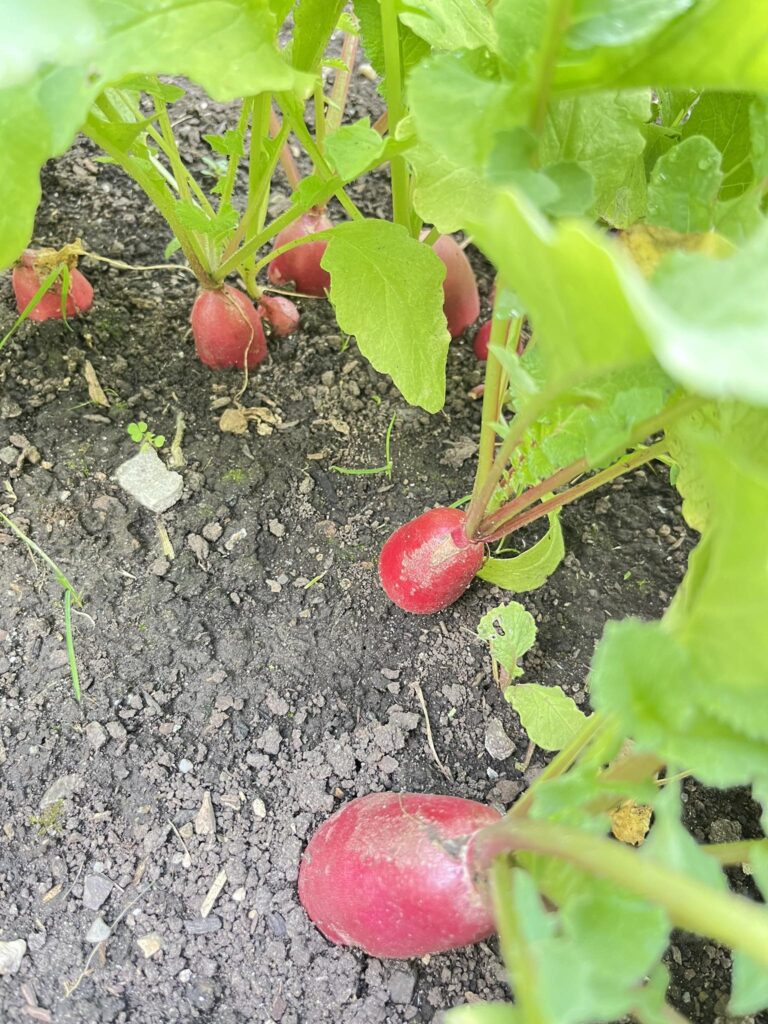
Radish works as a fast, low-cost trap crop for beetles that target young seedlings.
Both flea beetles and cucumber beetles are drawn to radish foliage, and the crop matures in under a month, clearing space before winter squash vines expand to fill it.
Planting tip: Sow radish directly around new squash seedlings, since this early stage is when plants are most vulnerable to beetle feeding.
5. Corn
Corn earns its place through the traditional Three Sisters system, developed by Indigenous farmers across North America generations ago.
West Virginia University Extension recommends heirloom winter squash varieties such as Patty Pan, Delicata, and Cushaw as ideal choices for this planting method, since their sprawling habit fits naturally into the layout.⁵
Planting tip: Plant corn first, add pole beans once it reaches about 6 inches tall, then plant winter squash a week or two later around the outer ring.
6. Pole Beans
Beans handle the nitrogen side of the Three Sisters equation.
Their roots host bacteria that convert nitrogen from the air into a form other plants can use, which matters for winter squash given how long the plant stays in the ground drawing on soil nutrients. The USDA National Agricultural Library describes how beans supplied nitrogen while corn offered structure and squash provided ground cover in this traditional system.⁶
Planting tip: Choose pole beans over bush varieties so they climb the corn rather than tangling into sprawling squash vines.
7. Dill
Dill’s flat, umbrella-shaped flower clusters attract several beneficial predator insects.
Parasitic wasps, hoverflies, and tachinid flies all visit dill blooms, and multiple gardeners report it helping deter squash bugs when planted directly among squash beds.
Planting tip: Allow some dill to bolt and flower rather than harvesting it all for the kitchen. The flowers carry the real benefit for pest control.
8. Buckwheat
Buckwheat is an underused companion that works quietly through the whole season.
Its small white flowers attract hoverflies, whose larvae feed on aphids and other soft-bodied pests, and it grows fast enough to double as a temporary living mulch along open pathways.
Planting tip: Broadcast buckwheat seed thinly between squash rows and let it flower before it sets seed and self-sows too aggressively.
9. Sunflowers
Sunflowers offer two benefits at once: pollinator support and light structure.
Their large blooms pull in bees, and their height provides mild wind protection for sprawling vines during storms. Some gardeners also use them as a sacrificial aphid magnet, since aphids cluster heavily on sunflower stalks.
Planting tip: Place sunflowers on the north edge of the bed so their height does not shade squash foliage during peak growing hours.
10. Oregano
Oregano works as a living ground cover rather than a direct pest deterrent.
Planted along the outer edge of a winter squash bed, it shades exposed soil, helps retain moisture during the long growing season, and adds another aromatic layer to the mix of scents pests must work through.
Planting tip: Keep oregano trimmed low so it never competes with squash for light as vines expand outward.
11. Zinnia
Zinnias bloom reliably from planting through the first frost, matching winter squash’s long season almost perfectly.
They show resistance to root-knot nematode damage and their open, flat blooms are excellent at drawing butterflies and native bees throughout the entire summer and into early fall.
Planting tip: Stagger zinnia colors along a border row for continuous bloom well into the curing period, when squash still benefits from nearby pollinator activity.
12. Calendula
Calendula, or pot marigold, is frequently confused with true marigold but belongs to a different plant family entirely.
It shares a similar reputation for deterring pests and produces bright orange and yellow blooms that attract beneficial insects throughout the season.
Planting tip: Direct-sow calendula along garden pathways near your squash bed. It tolerates partial afternoon shade better than most flowering companions.
13. Sweet Alyssum
Sweet alyssum is small, but its impact on pest management is outsized.
Its tiny blooms are especially attractive to hoverflies and parasitic wasps, both effective natural predators against aphids and beetle larvae.
Planting tip: Use sweet alyssum as a low living border around the bed’s perimeter. It stays short enough to avoid being smothered once vines start spreading.
14. Parsley
Parsley performs quietly alongside dill, drawing in similar beneficial insects when allowed to flower.
Left to bolt in its second growth phase, it attracts parasitic wasps, hoverflies, and swallowtail butterflies, none of which pose any threat to squash.
Planting tip: Tuck parsley into shaded corners near the bed’s edge, since it tolerates partial shade from expanding squash leaves reasonably well.
15. Catnip
Catnip carries a strong reputation in gardening circles, and it deserves an honest assessment rather than an oversell.
Many garden blogs claim catnip repels squash bugs outright. University extension entomologists are more cautious, generally treating such claims as largely anecdotal rather than confirmed by controlled field research.
That said, its flowers do attract pollinators, and it is a low-maintenance perennial once established. Treat it as a supporting player, not a guaranteed shield.
Planting tip: Grow catnip in a container near the bed. Left in open soil, it spreads aggressively and can be difficult to remove later.
Plants to Avoid Near Winter Squash
A handful of common garden plants work against winter squash rather than for it.
Potatoes compete heavily for nutrients and can raise disease pressure when grown too close to a long-season crop like winter squash.
Fennel releases root compounds that can inhibit the growth of many neighboring vegetables.
Other cucurbits planted too close together, including cucumbers and melons, concentrate the same pests and diseases in one area. Given how long winter squash occupies its space, this crowding risk compounds over the season.
Space cucurbit plantings at least 3 to 4 feet apart, and ideally further for the largest winter squash varieties.
Why Winter Squash Has Different Needs Than Other Squash
Winter squash is not just a bigger version of zucchini. It behaves differently in three important ways.
First, the vines run long. Many varieties spread 8 to 15 feet, which changes where companions can realistically go. Second, the fruit needs to cure on the vine for weeks before harvest, so the plant stays exposed to pests far longer than fast-maturing summer squash.
Third, winter squash is a favorite target for cucumber beetles, which do more than chew leaves. Clemson Cooperative Extension explains that cucumber beetles transmit bacterial wilt, a disease that lives in the beetle’s gut over winter and spreads to healthy plants as the beetle feeds.²
Penn State Extension also notes that squash vine borer damages most winter squash types, with butternut and green-striped cushaw standing out as the main exceptions.³ That single fact should shape which varieties you choose if borers have been a problem before.
Pollination adds one more layer. Winter squash flowers are unisexual, and the USDA Agricultural Research Service describes squash overall as a half-billion-dollar crop in the United States that depends entirely on bees to move pollen from male to female blooms.⁴
ALSO READ: 10 Effective Squash Vine Borer Prevention Strategies That Actually Works
How Much Space Does Winter Squash Actually Need?
Before choosing companions, it helps to be honest about space.
A single winter squash hill can occupy 50 to 100 square feet by the end of the season. That is far more room than most companion planting guides account for.
This changes the strategy. Instead of ringing the plant closely, most companions for winter squash work best along the outer edge of where the vines will eventually reach, not right at the base of the seedling.
Vertical training helps too. Training vines up a sturdy trellis, with slings supporting heavier fruit, frees up ground space for low-growing companions like radish and sweet alyssum that would otherwise get buried under sprawling foliage.
Soil health also matters more here than with quick-turnaround crops. Winter squash draws on the same patch of soil for three to four months straight, so companions that build nitrogen or add organic matter, like pole beans and buckwheat, pay off in ways a fast summer crop rarely notices.
The Cucumber Beetle and Bacterial Wilt Problem
Cucumber beetles deserve special attention in a winter squash bed, since the stakes are higher than with faster-growing crops.
Clemson HGIC explains that these beetles feed on all parts of the plant, including flowers and fruit, and can severely slow or kill young plants before they establish.² The bacterial wilt they transmit survives winter inside the beetle itself, ready to reinfect the next season’s crop.
Utah State University Extension trials found that planting Blue Hubbard squash as a perimeter trap crop drew significantly more squash bug adults, nymphs, and eggs away from the main harvest crop compared to plots without a trap crop.¹ The same principle applies to cucumber beetles, which also favor Hubbard-type squash over many other varieties.
If beetles have been a recurring problem, consider planting a small perimeter row of Blue Hubbard alongside your main winter squash crop, then monitoring and removing pests from those sacrificial plants regularly.
Timing the trap crop matters as much as planting it. Blue Hubbard should go in the ground one to two weeks before your main squash crop, since overwintering squash bug adults emerge and search for host plants earlier in the season than most gardeners expect.
A trap crop planted too late offers little advantage, because the pests have already settled onto the main crop by the time it matures.
ALSO READ: 20 Types of Winter Squash: Variety With Pictures
Quick-Reference Companion Chart
| Companion Plant | Main Benefit | Ideal Placement |
| Nasturtium | Trap crop, pest masking | Outer vine perimeter |
| Marigold | Nematode suppression, beneficial insects | Dense bed border |
| Borage | Pollinator magnet | Center of activity |
| Radish | Beetle trap crop | Around new seedlings |
| Corn | Structure, Three Sisters layout | Center of mound |
| Pole beans | Nitrogen fixation | Three Sisters layout |
| Dill | Beneficial predator attraction | Bed edge |
| Buckwheat | Hoverfly attraction, living mulch | Open pathways |
| Sunflower | Pollinator draw, windbreak | North side of bed |
| Oregano | Living ground cover | Outer bed edge |
| Zinnia | Nematode-resistant, long bloom | Border row |
| Calendula | Beneficial insects | Pathway edges |
| Sweet alyssum | Aphid predator habitat | Low living border |
| Parsley | Beneficial wasp attraction | Shaded corners |
| Catnip | Mild pollinator support | Contained pot |
Frequently Asked Questions
What is the best trap crop for winter squash pests? Blue Hubbard squash is the most researched option. University trials show it reliably draws squash bugs and cucumber beetles away from the main crop when planted along the perimeter.
How far apart should companion plants be from winter squash? Because winter squash vines can stretch 8 to 15 feet, plan companions for the eventual edge of the vine’s spread rather than close to the original seedling.
Does companion planting protect against bacterial wilt? Not directly. Bacterial wilt comes from cucumber beetle feeding, so the real defense is trap cropping and monitoring beetle populations closely during the growing season.
Can I still use the Three Sisters method with winter squash? Yes, and winter squash is actually the traditional choice for this system. Heirloom varieties like Delicata and Cushaw handle the layout better than modern hybrid summer squash.
Which winter squash variety resists pests best? Butternut squash consistently shows more resistance to both squash vine borer and squash bugs than Hubbard, acorn, or pumpkin varieties.
Is it worth the extra garden space to grow winter squash with companions? Generally, yes. The long growing season means companion plants have more time to establish, bloom, and provide season-long pest support before harvest.
Should I remove companion plants once winter squash starts curing on the vine? Not necessarily. Flowers like zinnia and calendula continue supporting pollinators and beneficial insects right up until frost, which can still benefit any late-setting fruit on the vine.
Final Thoughts
Winter squash rewards a different kind of planning than its faster-growing relatives.
The season is longer, the vines are bigger, and the pests, particularly cucumber beetles and bacterial wilt, carry higher stakes because the plant is exposed to them for months rather than weeks. Companion planting will not remove that risk entirely, and I would rather say so plainly than oversell it.
What it does deliver is steadier pollination, a real trap-cropping defense, and better soil health across a genuinely long growing window. Start with nasturtium, marigold, and borage, then add a Blue Hubbard trap row if beetles have troubled your garden before.
Every garden carries its own mix of soil, climate, and pest pressure. Treat this list as a working foundation, and adjust it season by season based on what your own winter squash bed actually needs.
If a companion is not earning its space after a season, do not hesitate to swap it out. A well-chosen handful of proven neighbors will always outperform a crowded bed planted with every option at once, and winter squash, more than any other cucurbit, rewards a gardener who pays attention across the full length of the season rather than just at planting time.
References
- Utah State University Extension — Trap Crops to Control Squash Bugs https://extension.usu.edu/planthealth/news/squash-bug-trap-crops
- Clemson Cooperative Extension, Home & Garden Information Center — Cucumber, Squash, Melon & Other Cucurbit Insect Pests https://hgic.clemson.edu/factsheet/cucumber-squash-melon-other-cucurbit-insect-pests/
- Penn State Extension — Insect Pests Affecting Squash Plants https://extension.psu.edu/insect-pests-affecting-squash-plants
- USDA Agricultural Research Service — Squash Pollination https://www.ars.usda.gov/pacific-west-area/logan-ut/pollinating-insect-biology-management-systematics-research/docs/squash-pollination/
- West Virginia University Extension — Three Sisters Gardening Method https://extension.wvu.edu/lawn-gardening-pests/news/2022/08/01/three-sisters-gardening-method
- USDA National Agricultural Library — The Three Sisters of Indigenous American Agriculture https://www.nal.usda.gov/collections/stories/three-sisters
- Utah State University Extension — Squash Bug https://extension.usu.edu/vegetableguide/cucurbits/squash-bug

Tim M Dave is a gardening expert with a passion for houseplants, particularly cacti and succulents. With a degree in plant biology from the University of California, Berkeley, he has vast experience in gardening. Over the years, he has cultivated a vast collection of desert plants and learned a great deal about how to grow and care for these unique companions.