10 Effective Squash Vine Borer Prevention Strategies That Actually Works
The squash vine borer (Melittia cucurbitae) is one of the most destructive insect pests targeting cucurbit crops in North America. It attacks zucchini, summer squash, winter squash, and pumpkins often causing complete plant loss before gardeners even realise something is wrong.
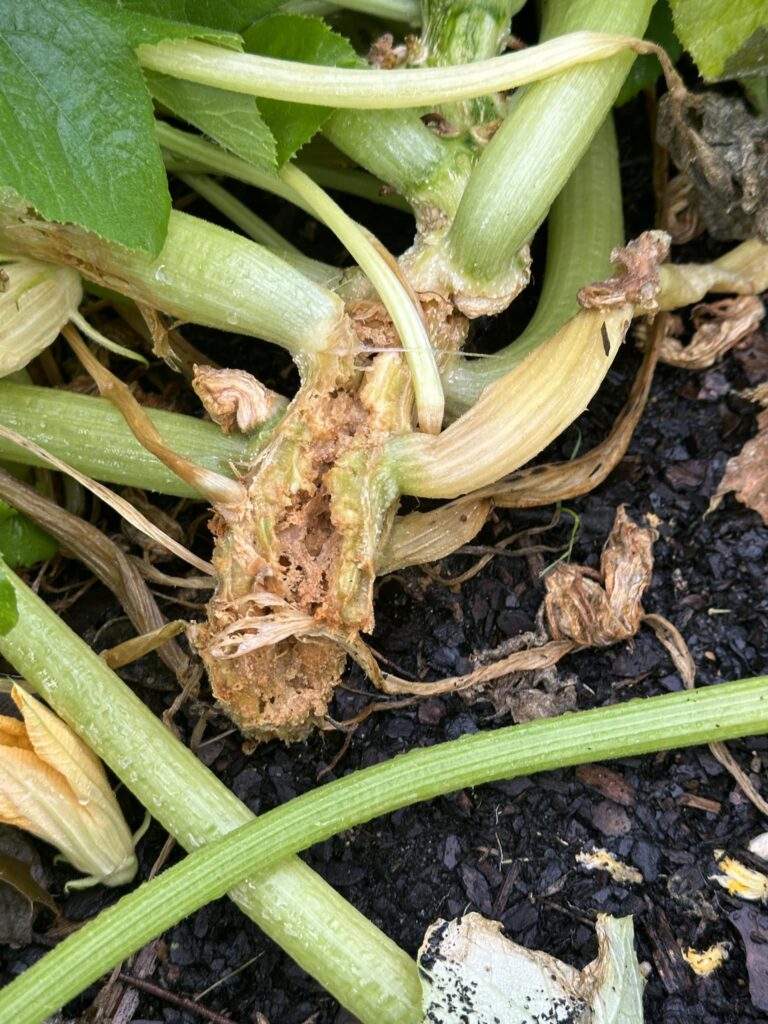
Unlike many garden pests that chew leaves or damage fruit from the outside, the squash vine borer works invisibly from within. The larva bores directly into the stem of the squash plant and feeds on the inner tissue effectively killing the plant from the inside out.
The frustrating truth is that by the time visible symptoms appear, significant internal damage has already occurred. That is why prevention, not treatment, is the only reliable strategy against this pest.
This guide covers everything you need to know to protect your squash crop before the borer ever gets a chance to settle in.
Understanding the Enemy: The Life Cycle of the Squash Vine Borer
To prevent squash vine borers effectively, you first need to understand how they live and reproduce. Prevention strategies that are timed incorrectly — even by just a week or two — can fail entirely.
Stage 1: Overwintering Pupae
The squash vine borer spends the winter as a pupa buried in the soil, typically within the top five centimetres of the ground near where squash was grown the previous season.
This is why garden location and crop rotation matter so much — the pest is quite literally waiting in the soil of last year’s squash bed.
Stage 2: Adult Moth Emergence
In late spring to early summer — typically late May through July, depending on your region — the adult moth emerges from the soil. This is not the typical grey or brown moth you might picture.
The adult squash vine borer moth is striking: it has an orange-red abdomen with black spots, clear hind wings, and metallic green forewings. It is often mistaken for a wasp or clearwing moth, which is an effective form of mimicry.
Adult moths are active during the day, unlike most moths. They fly quickly and purposefully from plant to plant, laying eggs individually on the stems and leaf stalks of squash plants. The eggs are small, flat, reddish-brown, and look almost like tiny seeds pressed against the stem.
Stage 3: Egg Hatching and Larval Boring
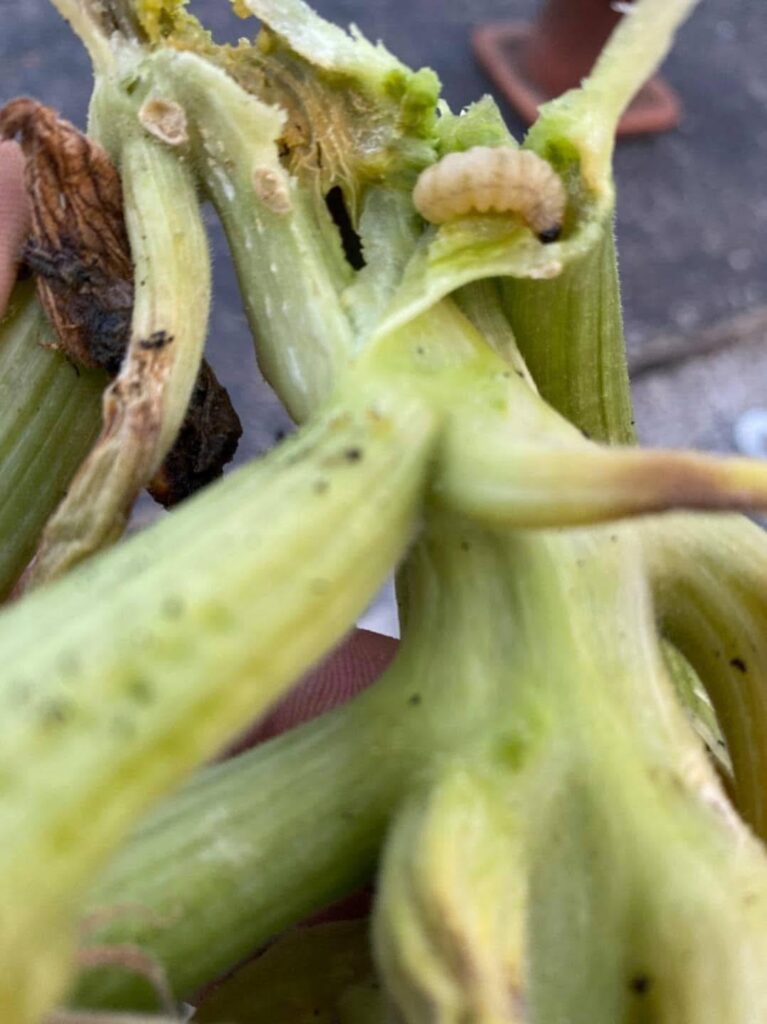
Eggs hatch within one to two weeks. The newly hatched larva wastes no time — it immediately bores into the nearest stem and begins feeding inside the plant. From this point on, the larva is protected within the plant tissue and is largely unreachable by contact pesticides.
The larva grows over four to six weeks, consuming the interior of the vine. It produces a sawdust-like frass (excrement) that often collects around the entry hole — this is frequently the first visible sign of infestation. Entry holes are typically located near the base of the plant.
Stage 4: Pupation and Overwintering Again
When the larva is fully grown, it exits the plant, burrows into the soil, and forms a pupal case. It then remains dormant until the following spring. In warmer southern regions, there may be two generations per year, which significantly increases the damage potential.
Understanding this cycle is essential because most prevention strategies target either the adult moth (before egg-laying) or the soil-stage pupae (before emergence). Missing either window makes protection far more difficult.
When Does the Squash Vine Borer Strike? Timing Your Defence
One of the most important — and most often overlooked — aspects of squash vine borer prevention is timing.
Adult moths typically begin laying eggs when squash plants start producing their first true leaves and vines begin to elongate. In most of the United States, this corresponds to late May through mid-July. In the South, moths may emerge as early as April.
In northern regions with shorter growing seasons, the window may be narrower but no less dangerous.
A useful indicator used by extension services is monitoring local plantings of squash, or watching for the first adult moth sightings in your area. Some gardeners use yellow sticky traps positioned near garden beds to detect adult moth activity. Once moths are present, the egg-laying period begins almost immediately.
The risk window is roughly six to eight weeks long. After mid-summer, adult activity generally declines and newly planted squash are at lower risk — a fact that forms the basis of one of the most effective prevention strategies discussed below.
How to Prevent Squash Vine Borers
Prevention requires multiple approaches working together. A single strategy, however well executed, rarely provides complete protection. The following methods are organised from the most fundamental to the most targeted.
1. Rotate Your Crops Every Year — Without Exception
Crop rotation is the foundational prevention step, and skipping it makes every other strategy harder.
Because squash vine borer pupae overwinter in the soil near previous-year host plants, growing squash in the same bed year after year guarantees an expanding resident population. Move your squash crops to a new location every season — ideally at least 30 metres (100 feet) from where they grew previously.
If your garden is small and true long-distance rotation is impossible, even rotating to the opposite end of the garden reduces local moth emergence compared to planting in exactly the same spot.
Pair rotation with digging and disturbing the soil in old squash beds in late autumn and early spring — this exposes overwintering pupae to predators and cold.
2. Time Your Plantings Strategically
This is one of the cleverest and most underused prevention tactics available. It takes advantage of the squash vine borer’s predictable seasonal window.
You have two planting timing options:
Option A — Plant very early. In zones where the growing season allows, start squash indoors and transplant as soon as frost risk has passed. Early plantings can establish and begin producing before adult moths emerge.
With luck and timing, you can harvest a significant portion of your crop before borer activity peaks.
Option B — Plant late. In most regions, if you delay planting until mid-summer (late June or early July), the main egg-laying period will have passed by the time your plants are establishing their vulnerable young vines.
Late-planted squash often escape borer pressure entirely, since adult moths are largely finished by the time the plants are large enough to attract attention.
Summer squash grown from a late June planting in most of the US can still produce a full harvest before autumn frost.
3. Use Row Covers — The Physical Barrier That Actually Works
Floating row covers are arguably the most reliable non-chemical prevention method available to home gardeners.
Row covers are lightweight, translucent fabric that can be draped over plants and sealed at the edges with soil, rocks, or fabric pins. When correctly installed, they create a complete physical barrier that adult moths cannot penetrate to lay eggs.
Install row covers at planting or transplanting time, before any borer activity begins. Seal the edges carefully — any gap large enough for a moth to pass through undermines the entire system.
The critical trade-off is that row covers also exclude pollinators. Squash require pollination to set fruit, so you have two options:
- Remove covers briefly each morning during flowering to allow pollinator access, then re-cover in the afternoon
- Hand-pollinate using a small paintbrush or by picking a male flower and touching it to the female flower’s centre
Many experienced gardeners find that hand-pollination is actually quite quick once you get the rhythm of it, and the trade-off is well worth the protection row covers provide.
4. Apply Kaolin Clay to Stems
Kaolin clay is a naturally occurring mineral used as a physical repellent in organic and integrated pest management systems. When mixed with water and applied to plant surfaces, it dries to a white film that deters adult moths from landing and laying eggs because it disrupts their sensory cues.
Apply kaolin clay solution to the stems, leaf stalks, and lower vine of squash plants, starting when plants are young. Reapply after rain or irrigation, as it washes off over time.
This is not a complete solution on its own, but it is an excellent complement to row covers and other physical barriers — particularly during the gap periods when covers must be removed for pollination.
5. Monitor for Eggs and Remove Them by Hand
Once you know what squash vine borer eggs look like — small, flat, reddish-brown, roughly 1mm across, found singly on stems and leaf petioles — you can make a real difference through regular monitoring and manual removal.
Check your squash plants two to three times per week during the six-to-eight-week risk window. Examine the stems near the base and the underside of leaf stalks.
Scrape off any eggs you find with your fingernail or a small knife. This is painstaking work but genuinely reduces the population of larvae that establish.
I will admit that the first time I found borer eggs, I felt a strange combination of alarm and triumph — alarm because they confirmed the pest was active in my garden, and triumph because catching them early meant I had a real chance to intervene.
Check your plants often. Catching eggs before they hatch is the most direct form of prevention available.
6. Use Beneficial Nematodes in the Soil
Beneficial nematodes — microscopic roundworms available through garden supply companies — can help reduce overwintering squash vine borer populations in the soil. Steinernema carpocapsae is the species most frequently recommended for this pest.
Apply nematodes to the soil in late summer or early autumn, after the growing season, to target pupae that have burrowed in to overwinter. Apply again in spring before adult moths emerge.
Nematodes require moist soil and soil temperatures above 10°C (50°F) to be active, so timing applications to suitable conditions is important.
Nematodes are safe for people, pets, and beneficial insects, making them a sound choice for organic gardens. Results vary depending on soil conditions and application technique, but they form a useful part of a comprehensive prevention plan.
7. Wrap Stems in Aluminium Foil
This simple, low-cost technique is surprisingly effective. Wrapping the lower 15 to 20 centimetres of the squash vine stem in aluminium foil creates a physical barrier that discourages adult moths from landing on the stem and laying eggs. The reflective surface appears to confuse and deter the moths.
Wrap loosely enough that the foil does not constrict the growing stem. Check periodically as the plant grows and re-wrap or extend the foil as needed. This works best in combination with other methods, particularly for protecting the most vulnerable basal section of the vine.
8. Choose Resistant or Less-Preferred Varieties
Not all cucurbits are equally attractive to squash vine borers. Understanding which plants are most at risk — and which are naturally less susceptible — helps you plan a more resilient garden.
Plants most at risk:
- Zucchini (Cucurbita pepo)
- Acorn squash (Cucurbita pepo)
- Delicata squash (Cucurbita pepo)
- Pumpkins (Cucurbita pepo)
Plants with lower susceptibility:
- Butternut squash (Cucurbita moschata) — its harder stems and denser vine tissue are less hospitable to larvae
- Hubbard squash (Cucurbita maxima) — similarly, the maxima species shows reduced susceptibility compared to pepo types
- Cucumbers, melons, and most Cucurbita argyrosperma varieties — generally not preferred hosts
If squash vine borers are a serious recurring problem in your garden, consider shifting your squash growing toward butternut varieties. You will sacrifice some versatility, but butternut is a productive, highly useful winter squash that is significantly more resistant to borer damage.
9. Apply Bacillus thuringiensis (Bt) as a Preventive Spray
Bacillus thuringiensis var. kurstaki (Btk) is a naturally occurring soil bacterium that produces proteins toxic to many lepidopteran (moth and butterfly) larvae. It is approved for use in organic gardening and has no toxicity to humans, mammals, birds, or beneficial insects when used as directed.
Bt works only on larvae — not eggs or adult moths. Its most effective use in squash vine borer prevention is as a preventive stem drench or injection applied during the egg-laying and early hatching period.
Applying Bt at the base of the stem and along the lower vine can kill newly hatched larvae before they are able to bore deeply into plant tissue.
Bt breaks down quickly in sunlight, so it must be reapplied every five to seven days during the risk window, or after rain. It is not a standalone solution but works well in combination with physical barriers and monitoring.
10. Dig and Disturb the Soil After the Season
In autumn, after squash plants have been removed, dig the soil in former squash beds to a depth of 10 to 15 centimetres. This disrupts and exposes overwintering pupae to predatory birds, beetles, and cold temperatures, reducing the population available to emerge the following spring.
Repeat this process in early spring — a shallow cultivation of the soil before planting time serves the same purpose. While this will not eliminate all pupae, it meaningfully reduces the local population when done consistently over several seasons.
What to Do If Borers Get Through: Rescue Strategies
Even with the best prevention, borers sometimes breach your defences. If you spot frass (grainy, sawdust-like material) at the base of a squash stem, a borer is already inside. Here are your options.
Stem surgery
Locate the entry hole and carefully make a small lengthwise slit in the stem above it using a sharp, clean knife. Extract the larva — it will be a creamy-white, wrinkled grub — and destroy it.
Cover the wound and any exposed stem section with damp soil to encourage adventitious rooting. Many plants recover from this if it is done early enough.
Bury the stem
If the vine is long enough, bury a section of the stem in soil beyond the point of damage. Squash vines root readily from nodes, and this can allow the plant to bypass the damaged section and continue growing from new roots.
Remove severely damaged plants promptly
A plant that is more than 70 percent damaged is unlikely to recover meaningfully. Remove it cleanly from the garden and destroy it — do not compost it, as larvae may still be inside.
Building a Season-Long Prevention Calendar
A structured approach makes prevention manageable. Here is a simple seasonal framework.
- Late Winter / Early Spring: Dig and disturb soil in previous squash beds. Apply beneficial nematodes if soil temperature allows. Plan crop rotation and identify new planting locations.
- 4 to 6 Weeks Before Planting: Prepare new planting areas. Purchase row covers, kaolin clay, and Bt if using them. Consider starting squash transplants indoors for early planting strategy.
- At Planting / Transplanting: Install row covers immediately. Wrap lower stems in aluminium foil if row covers are not being used. Begin monitoring for adult moth activity.
- During the 6 to 8 Week Risk Window: Monitor stems two to three times per week for eggs. Manage row covers for pollination. Apply Bt weekly. Reapply kaolin clay after rain.
- Mid-Summer Onwards: Risk typically declines. Consider a late planting of fast-maturing varieties. Begin allowing plants to progress without intensive borer monitoring.
- After the Growing Season: Remove all squash plant debris. Dig the soil. Apply beneficial nematodes. Note any areas of high borer pressure for next year’s rotation planning.
Frequently Asked Questions
Does companion planting help prevent squash vine borers?
The evidence here is mixed, but some gardeners report success planting blue Hubbard squash as a trap crop on the perimeter of the garden. The moths are strongly attracted to it, concentrating egg-laying on the trap plants rather than your main crop. The trap plants are then monitored closely and removed once infested.
Can I use pesticides to prevent squash vine borers?
Chemical pesticides such as permethrin and carbaryl can be effective if applied correctly and at the right time. However, these chemicals also harm pollinators, including the bees your squash plants depend on. If used, apply in the evening when pollinators are less active.
For most home gardens, the combination of physical barriers, monitoring, and Bt provides effective prevention without chemical risk.
Are some climates worse for squash vine borers?
Yes. Gardeners in the eastern United States and the Midwest face the most severe squash vine borer pressure. The pest is less problematic in the Pacific Northwest and parts of the Mountain West, though it is present in those regions.
In the Deep South, two generations per year are possible, making prevention more intensive and important. Know your local risk level by consulting your regional extension service.
Final Thoughts
The squash vine borer is a genuinely challenging pest, and I think it is important to be honest about that. Even experienced gardeners with strong prevention systems in place sometimes lose plants.
Start with rotation and row covers. Add timing strategy. Monitor obsessively during the risk window. Over two or three seasons, you will develop a sense of when the moths appear in your specific garden, which plants are most vulnerable, and which combination of tactics works best for your conditions.
The squash vine borer rewards attentive gardeners and punishes passive ones. But with the right knowledge and consistent practice, a productive squash harvest is absolutely within reach — even in high-pressure areas.

Tim M Dave is a gardening expert with a passion for houseplants, particularly cacti and succulents. With a degree in plant biology from the University of California, Berkeley, he has vast experience in gardening. Over the years, he has cultivated a vast collection of desert plants and learned a great deal about how to grow and care for these unique companions.