25 Different Types of Christmas Trees (Popular Varieties, With Pictures)
Choosing a Christmas tree feels simple until you actually stand in a lot full of green options. Firs, spruces, pines, cypresses — they all start to blur together after the fifth row.
I have spent enough holiday seasons wandering tree farms to know the difference matters. The wrong tree drops needles by December 20. The right one still smells like a forest on New Year’s Day.
This guide breaks down 25 popular types of Christmas trees, grouped by family, so you can match a tree to your home, your budget, and your patience for vacuuming needles.
ALSO READ: 50 Types of Christmas Flowers and Plants: Identification With Pictures
Why the Species You Choose Actually Matters
Not all Christmas trees behave the same way indoors. Some hold their needles for six weeks. Others start shedding within days of heated air.
The U.S. Department of Agriculture notes that the most commonly marketed Christmas tree species include Douglas fir, Balsam fir, Fraser fir, Noble fir, Grand fir, White fir, and several pines and spruces, each graded under federal quality standards. Trees graded U.S. Premium must meet specific requirements for shape, defects, and handle length.
That grading system exists for a reason — buyers genuinely notice the difference between species. Scent, needle shape, branch strength, and color vary widely across the conifer family.
Here is a fact that surprised me: close to 350 million real Christmas trees are currently growing on U.S. farms at any given moment, cultivated across all 50 states. That is a lot of variety to choose from.
Let’s walk through the most popular options, organized by fir, spruce, pine, and cypress families.
Fir Trees: The Classic Christmas Tree Family
Firs dominate the Christmas tree market for good reason. Their needles are soft, their shape is naturally symmetrical, and most hold up well indoors.
1. Fraser Fir
Fraser fir is arguably the most beloved Christmas tree in America. It has glossy, dark-green needles, a pleasant citrus-pine aroma, and branches strong enough for heavy ornaments.
It is native to the Appalachian Mountains and grows best at high elevations. North Carolina alone produces roughly 96% of its Christmas tree crop as Fraser fir.
Needle retention is excellent, which is why it ships well across long distances. If you want a tree that survives a cross-country delivery, this is it.
2. Balsam Fir
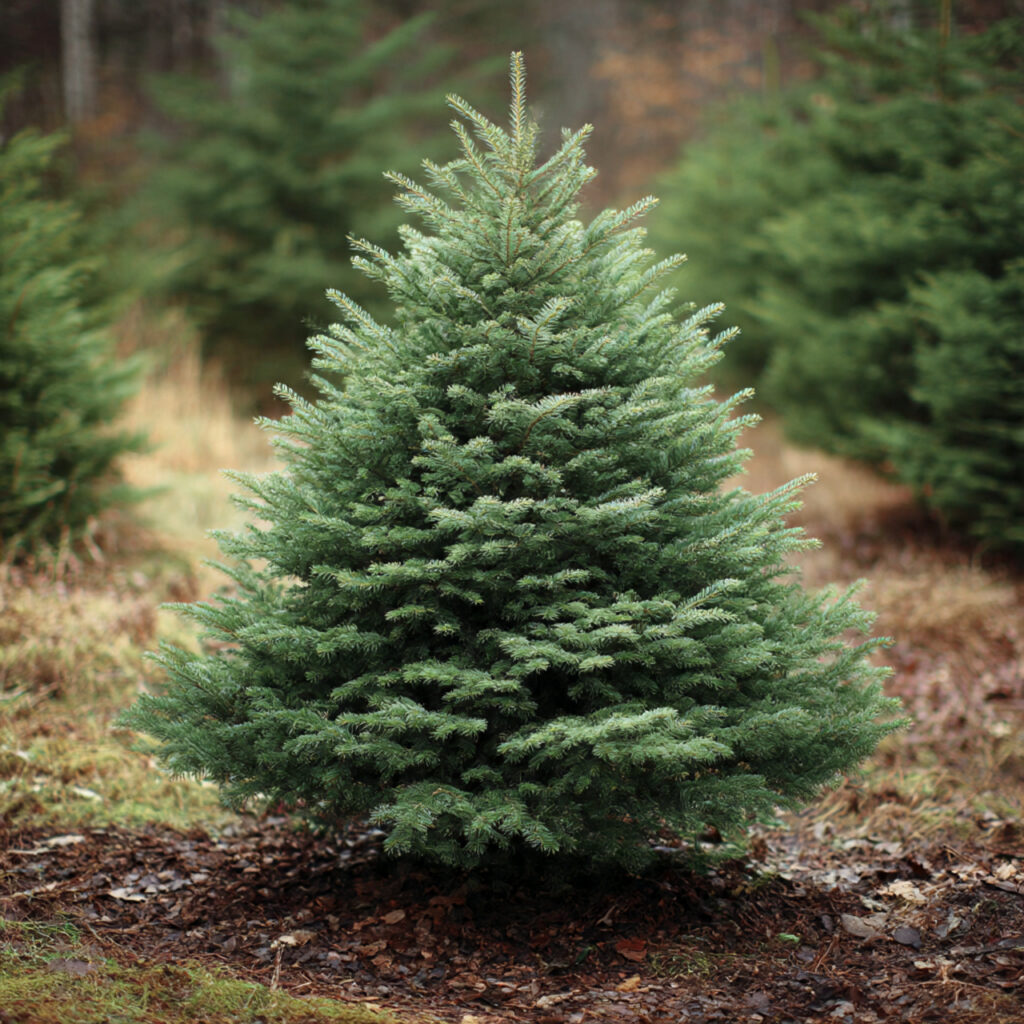
Balsam fir carries that classic “Christmas tree smell” many people grew up with. Its needles are flat, dark green, and stay attached for weeks.
This tree has a narrow, pyramid-like shape, which makes it a favorite for smaller rooms. It grows naturally across the northeastern United States and Canada.
I find balsam fir’s scent the most nostalgic of the entire list. It genuinely fills a room without air fresheners.
3. Douglas Fir
Douglas fir has been America’s most popular Christmas tree since the 1920s, according to Oregon agricultural education resources. Its soft, dark-to-blue-green needles radiate in all directions from the branch.
When crushed, the needles release a sweet, slightly citrusy fragrance. The branches are moderately stiff, though not the strongest for very heavy ornaments.
Technically, Douglas fir is not even a true fir botanically — that is why the name is hyphenated as “Douglas-fir” in scientific writing.
4. Noble Fir
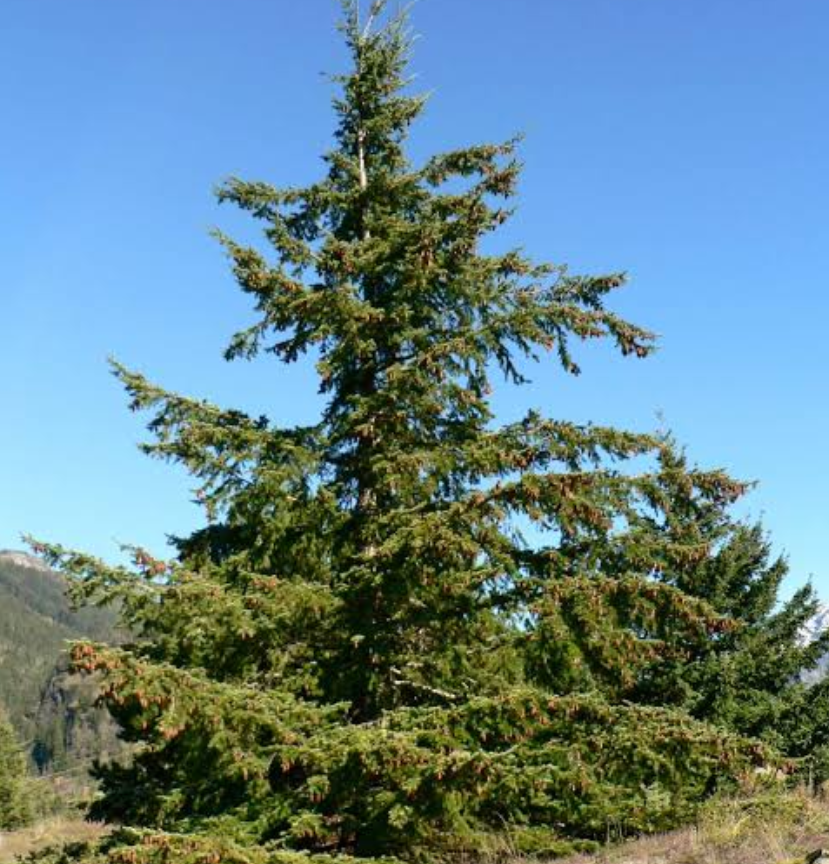
Noble fir is the top choice in Oregon, which happens to be the largest Christmas tree-producing state in the country. The Douglas fir and Noble fir together account for a large share of national market share, with Noble fir prized for its sturdy, evenly spaced branches.
Its needles curve upward, exposing silvery-blue undersides that give the tree a frosted look. Branches are stiff enough to hold the heaviest glass ornaments without sagging.
Noble fir also keeps fresh longer than most other species, making it ideal if you decorate early.
5. Grand Fir
Grand fir is known for having the strongest fragrance of all Christmas fir species. Its glossy, dark-green needles are arranged in two flat, horizontal rows.
It grows natively from British Columbia down through California and inland to Montana. Grand fir is a major species in Idaho and Montana, though a minor one in Oregon.
Expect to wait eight to ten years before a Grand fir reaches marketable size.
6. Concolor Fir (White Fir)
Concolor fir, often called White fir, has soft, blue-green needles with a citrus scent some compare to orange peel. Its color is one of the most strikingly blue-toned of any Christmas tree.
This species handles heat and drought better than many other firs, which makes it a rising choice in warmer climates. It is grown in North Carolina alongside Fraser fir.
If you like a soft, almost bluish tree with a fruity fragrance, this is worth seeking out.
7. Nordmann Fir
Nordmann fir originates from Turkey, Georgia, and the Russian Caucasus region, but it is now grown commercially in Oregon and parts of Europe. Its glossy, dark-to-lime-green needles are not particularly fragrant when crushed.
What makes Nordmann special is its exceptional needle retention — it can stay fresh through the entire month of December if kept watered.
Its dense, symmetrical shape also makes it popular for formal, uniform-looking displays.
READ MORE ON: 8 Nordmann Fir Tree Problems: Causes and Solutions
8. Canaan Fir
Canaan fir, sometimes called West Virginia balsam fir, is a relative newcomer to commercial production. It is native to remote mountain pockets of West Virginia and Virginia.
This tree combines characteristics of both Fraser fir and Balsam fir — soft needles, good form, and a pleasant fragrance. Growers appreciate its adaptability to different soil types.
It has been gaining ground in the Mid-Atlantic Christmas tree market over the past two decades.
9. Turkish Fir
Turkish fir is another Eurasian import gaining traction in the Pacific Northwest, alongside Nordmann and Trojan firs. Oregon State University’s Christmas tree breeding program maintains dedicated seed orchards for this species.
Its needles are dark green and glossy, with excellent needle retention similar to Nordmann fir. Growers are testing it partly for its resilience to drought and heat.
If climate-adapted trees interest you, keep an eye on Turkish fir in coming years.
10. Corkbark Fir
Corkbark fir, a variety of subalpine fir, is a lesser-known option grown in smaller volumes across the western United States. Its bark has a distinctive light, corky texture, and its needles carry a soft blue-gray hue.
It is more commonly used in landscaping than mass Christmas tree production. Still, specialty tree farms occasionally offer it for buyers wanting something unusual.
Its narrow, spire-like form suits tight corners and smaller living rooms.
Spruce Trees: Sharp Needles, Striking Color
Spruces are known for their strong branches and rich color, though their needles are sharper and shed a bit faster than firs.
11. Blue Spruce (Colorado Blue Spruce)
Blue spruce is instantly recognizable by its silvery-blue needles, a color that looks almost frosted year-round. Its branches are extremely stiff, making it excellent for heavy ornaments and lights.
The needles are sharp to the touch, so gloves help during decorating. It also holds a strong, natural pine scent.
Needle retention is moderate — better with proper watering, but it will not last as long indoors as Fraser or Nordmann fir.
12. Norway Spruce
Norway spruce is one of the oldest cultivated Christmas tree species in history. It has dark green needles and a classic, full pyramidal shape that many people picture when they imagine “a Christmas tree.”
Historically, Norway spruce was the very first species planted commercially in the United States, back in 1901 by farmer W. V. McGalliard in New Jersey.
Its main downside is faster needle drop compared to firs, so it suits people who buy their tree close to the holiday itself.
13. White Spruce
White spruce has short, stiff, blue-green needles and a strong, somewhat pungent odor when crushed — some describe it as slightly skunky. It is extremely cold-hardy and grows across the northern United States and Canada.
Its dense branching creates a very full, compact appearance. It is a solid budget option in colder growing regions.
Needle retention is decent if the tree is kept well watered from day one.
14. Red Spruce
Red spruce made headlines when it was chosen as the National Christmas Tree displayed near the White House, sourced from national forests in Virginia. It grows only at the highest elevations of the Appalachian Mountains.
Its needles are short, sharp, and dark green, with a naturally dense, conical shape. Red spruce trees can live for hundreds of years and grow over 130 feet tall in the wild.
Together with Fraser fir, red spruce forms the backbone of the rare Southern Appalachian Spruce-Fir Forest ecosystem.
15. Engelmann Spruce
Engelmann spruce is a high-elevation species found across the Rocky Mountains, often harvested under Forest Service Christmas tree permits in states like Colorado. Its needles are soft for a spruce, with a pale blue-green color.
It has a narrow, symmetrical shape suited to tight spaces. Because it grows in wild, unmanaged forests, no two trees look exactly alike.
This makes it a favorite for families who enjoy cutting their own tree on public land.
Pine Trees: Long Needles, Full Branches
Pines bring long, soft needle clusters and a fuller, bushier look than firs or spruces.
16. Scotch Pine
Scotch pine has historically been the most widely planted Christmas tree species in America, according to Michigan State University Extension research. It holds its needles exceptionally well, even after drying out completely.
Its needles are stiff, twisted, and medium-to-dark green, growing in bundles of two. The branches are strong and evenly spaced.
Because it rarely drops needles, Scotch pine remains a practical choice for households that decorate early.
17. Eastern White Pine
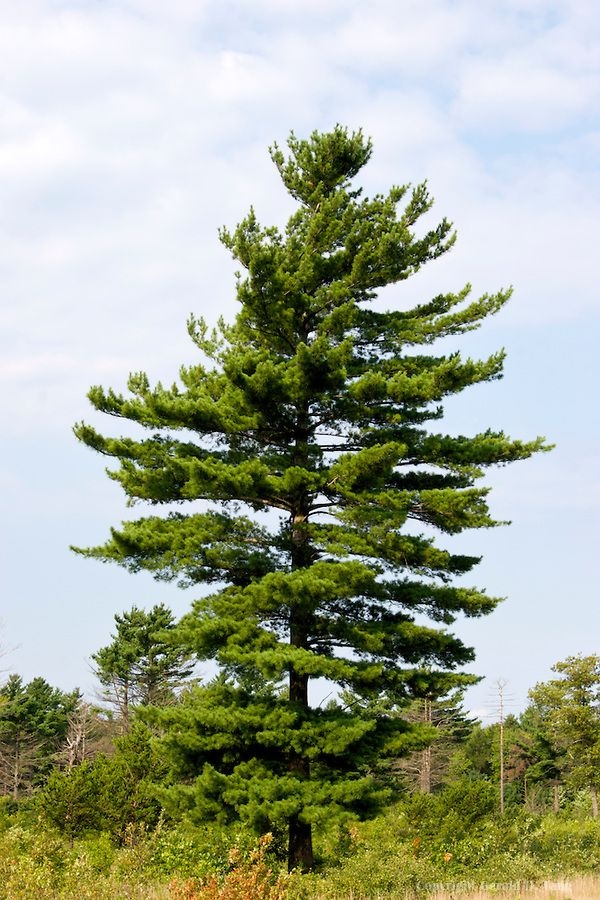
Eastern White Pine has soft, flexible, blue-green to silver-green needles bundled in groups of five. Its texture feels almost feathery compared to the stiffer needles of firs and spruces.
This species carries very little natural fragrance, which suits people sensitive to strong pine scents. It is also popular as a living, balled-and-burlapped Christmas tree that can later be planted outdoors.
Its branches are somewhat flexible, so lighter ornaments generally work best.
18. Virginia Pine
Virginia pine is a Southern favorite, especially on farms in the Piedmont and Coastal Plain regions where Fraser fir does not grow well. Its needles are twisted, medium-length, and yellow-green in color.
It has a dense, full branching habit that shears into a traditional Christmas tree shape nicely. It also tolerates heat far better than most fir species.
For growers in warmer, lower-elevation areas, Virginia pine is often the most practical option.
19. Austrian Pine
Austrian pine is a hardy, adaptable species with long, dark green needles in pairs. It tolerates poor soil, drought, and urban pollution better than most Christmas tree species.
Its form is less naturally symmetrical, so it typically requires more shearing during cultivation. The needles are stiffer than Eastern White Pine.
It remains a minor but steady presence in Midwestern Christmas tree lots.
20. Lodgepole Pine
Lodgepole pine grows wild across the Rocky Mountains and is a common option for cut-your-own permits on national forest land in states like Oregon and Colorado. Its needles are short, in pairs, and yellow-green.
Because it grows without cultivation or shearing, its shape tends to be thinner and more open than farm-grown trees. Many families enjoy this rustic, natural look.
It is typically found at lower elevations alongside Ponderosa pine.
21. Ponderosa Pine
Ponderosa pine has long needles, often three to a bundle, with a distinctive vanilla-like scent detectable in the bark. It grows across much of the western United States, including areas around Bend, Oregon.
Its open branch structure gives it a looser, more natural silhouette compared to tightly sheared farm trees. It thrives in flatter, lower-elevation terrain.
Families who cut their own tree on Forest Service land often encounter Ponderosa pine as a budget-friendly, accessible choice.
Cypress, Cedar, and Arborvitae: The Non-Traditional Choices
These species offer softer foliage and a different silhouette from typical needle-bearing conifers, and they are gaining popularity, especially in warmer regions.
22. Leyland Cypress
Leyland cypress has become one of the most popular non-fir Christmas trees in the southeastern United States. Its foliage is soft, feathery, and nearly needle-free, which makes it comfortable for households with young children.
It has almost no natural fragrance, a plus for people sensitive to strong pine or fir scents. Its dense, full form fills out beautifully when sheared.
It also tolerates heat and humidity far better than any true fir, which explains its popularity in the South.
23. ‘Carolina Sapphire’ Arizona Cypress
This cultivar of Arizona cypress has striking silvery-blue, feathery foliage and a light citrus scent when crushed. It is one of over a dozen species grown commercially in North Carolina alongside Fraser fir.
Its color makes it stand out dramatically from the deep greens of firs and spruces. It also grows well in warmer, drier soils where firs struggle.
For a genuinely different-looking tree, this is one of the more eye-catching options on this list.
24. Eastern Red Cedar
Eastern red cedar is one of the oldest traditional Christmas tree species in the American South, used long before Fraser fir became dominant. Its foliage is scale-like rather than needle-like, and it carries a strong, spicy cedar aroma.
It has a naturally dense, narrow shape and does not require heavy shearing. Its branches, however, are less sturdy than firs, so it suits lighter ornaments.
It is also a native species, which appeals to buyers interested in supporting local wildlife habitat.
25. ‘Green Giant’ Arborvitae
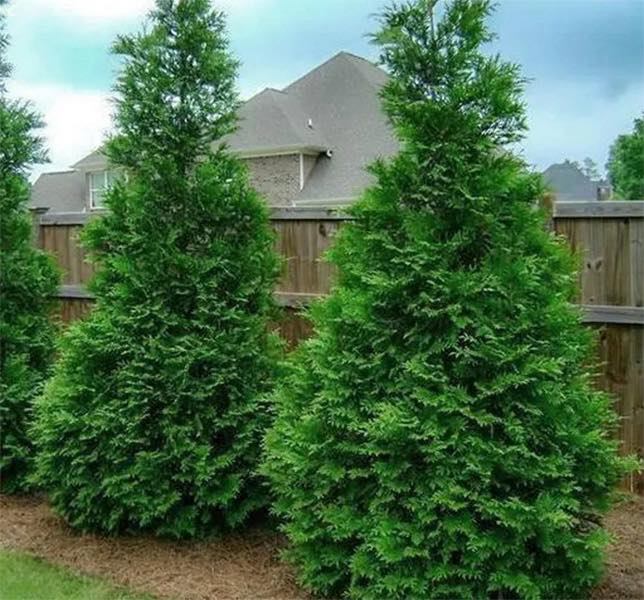
‘Green Giant’ Arborvitae rounds out the list as one of the newer options in commercial production. It has soft, scale-like, deep green foliage and a naturally pyramidal shape that needs little shaping.
It grows quickly, tolerates a wide range of soils, and holds up well as a living tree that can be replanted after the holidays. Fragrance is minimal, which some buyers prefer.
It is currently grown alongside Fraser fir and other species in North Carolina’s diversified tree farms.
ALSO READ: Thuja Green Giant Arborvitae Spacing: How to Get It Right When Planting
How to Choose the Right Tree for Your Home
With 25 species to consider, narrowing down your choice comes down to three practical questions.
Ask yourself how long you need the tree to last. Fraser fir, Nordmann fir, and Scotch pine hold needles the longest. Norway spruce and White pine tend to drop needles fastest.
Consider your ornaments. Heavy glass or ceramic pieces need stiff branches like Noble fir or Blue spruce. Lighter ornaments suit Eastern White Pine or Leyland cypress just fine.
Think about scent sensitivity. Balsam fir and Douglas fir smell strongly of pine. Leyland cypress and White pine carry almost no fragrance at all.
A Quick Look at the Numbers
The real Christmas tree industry is bigger than most people assume. Here are a few figures worth knowing before you shop.
Between 25 and 30 million real Christmas trees are sold in the United States every single year. That demand is spread across more than 15,000 farms nationwide.
Oregon and North Carolina together supply more than half of all cut Christmas trees harvested in a typical year, with Michigan, Washington, Pennsylvania, and Wisconsin rounding out the top producing states.
A cut Christmas tree takes roughly seven years, on average, to reach a sellable height, though slower-growing species like Fraser fir can take a decade or more.
For every real tree harvested, growers typically plant one to three seedlings the following spring, keeping the cycle renewable.
Frequently Asked Questions
Which Christmas tree lasts the longest indoors? Fraser fir and Nordmann fir are widely regarded as the longest-lasting species, often staying fresh for four to six weeks with regular watering.
What is the most fragrant Christmas tree? Grand fir and Balsam fir are generally considered the most fragrant, with strong, classic pine scents that fill a room.
Which tree is best for heavy ornaments? Noble fir and Blue spruce have the stiffest branches and can support heavier glass or ceramic decorations without sagging.
Are all Christmas trees real evergreen conifers? Yes. Real Christmas trees come from evergreen conifer species — firs, spruces, pines, cypresses, cedars, and arborvitae — all of which retain green foliage year-round.
Final Thoughts
Twenty-five species is a lot to take in, but the decision usually comes down to a handful of traits: scent, needle retention, branch strength, and color.
I always tell people to touch the needles before buying. Soft needles mean easier decorating; stiff needles usually mean stronger branch support.
Whichever species you pick, a real, farm-grown Christmas tree supports a renewable, recyclable agricultural industry rooted in American soil for over a century.
References
- United States Department of Agriculture, Agricultural Marketing Service. “Christmas Trees Grades and Standards.” https://www.ams.usda.gov/grades-standards/christmas-trees-grades-and-standards
- USDA Forest Service. “Finding the $5 Christmas Tree.” https://www.fs.usda.gov/about-agency/features/finding-5-christmas-tree
- USDA Forest Service. “A Holiday Spirit of Resilience.” https://www.fs.usda.gov/about-agency/features/holiday-spirit-resilience
- NC State Extension. “Christmas Tree Species.” https://content.ces.ncsu.edu/christmas-tree-species
- NC State Extension. “North Carolina Christmas Trees by the Numbers.” https://christmastrees.ces.ncsu.edu/christmastrees-nc-christmas-trees-by-the-numbers/
- Penn State Extension. “Tips for Selection and Care of Cut Christmas Trees.” https://extension.psu.edu/tips-for-selection-and-care-of-cut-christmas-trees
- Oregon State University Extension Service. “Developing Quality Christmas Trees in the Pacific Northwest.” https://extension.oregonstate.edu/catalog/pnw-684-developing-quality-christmas-trees-pacific-northwest-0

Tim M Dave is a gardening expert with a passion for houseplants, particularly cacti and succulents. With a degree in plant biology from the University of California, Berkeley, he has vast experience in gardening. Over the years, he has cultivated a vast collection of desert plants and learned a great deal about how to grow and care for these unique companions.