25 Trees Native to Massachusetts (With Growing Details)
Massachusetts surprises people. It is one of the most densely populated states in the country, yet also one of the most forested.
Forests cover about 60 percent of Massachusetts, roughly 3 million acres, according to the state’s Department of Conservation and Recreation. Some towns in the western part of the state reach 90 percent forest cover.
I find that contrast striking every time I drive west from Boston. Within an hour, dense suburbs give way to unbroken hardwood ridges that feel a world away from the city.
This guide covers 25 trees native to Massachusetts, chosen to represent the state’s coastal pine barrens, its central hardwood forests, and the cooler Berkshire highlands to the west. Whether you’re landscaping a yard or hiking the Berkshires, this list has you covered.
Let’s get started.
Why Native Trees Matter in Massachusetts
A quick note before the list begins.
Massachusetts is home to roughly 82 recorded tree species growing across its forests, according to state wildlife surveys. That is a meaningful range for a state this size, shaped by the meeting of northern and southern forest types.
Choosing native species also makes practical sense. Trees native to Massachusetts provide benefits to insects and wildlife that imported ornamentals typically cannot match, and they already tolerate the region’s soils, salt spray, and cold winters.
Now, on to the trees themselves.
25 Trees Native to Massachusetts
1. American Elm (Ulmus americana)
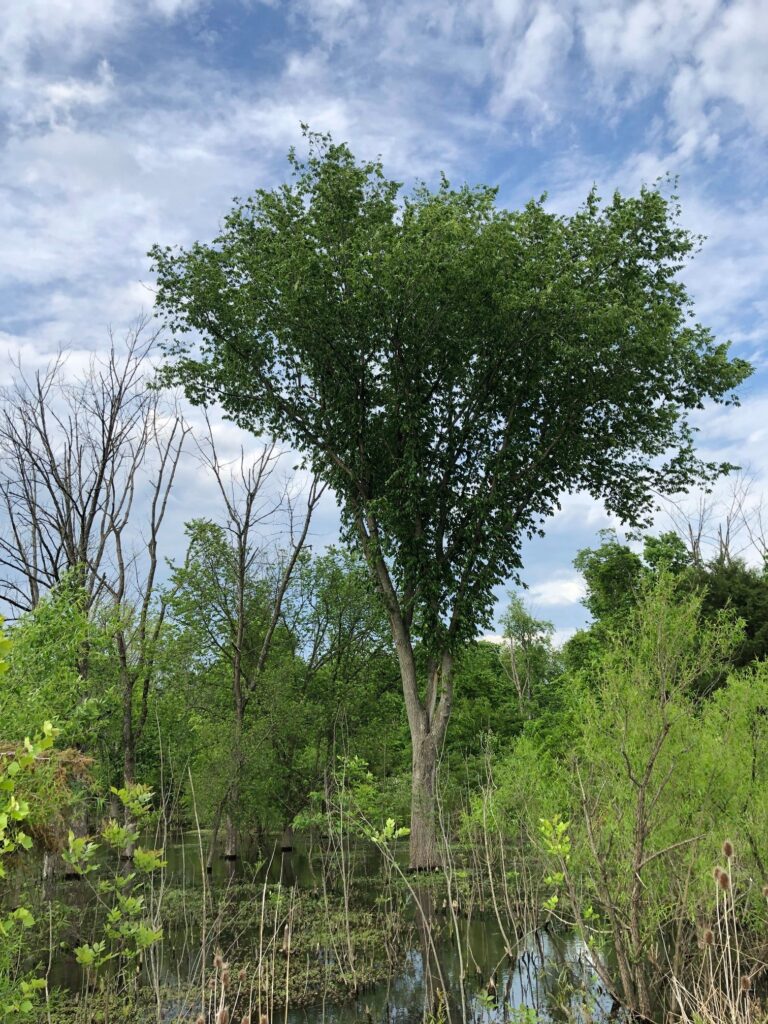
American elm is Massachusetts’s official state tree, designated in 1941 to commemorate George Washington taking command of the Continental Army beneath one on Cambridge Common in 1775.
Its graceful, vase-shaped canopy once shaded town squares and streets throughout the Commonwealth, making it the most widely planted shade tree in the country during its heyday.
Dutch elm disease, introduced from Europe, has since killed the vast majority of the state’s mature elms. Amherst’s famous Grayson Elm remains one of the few large survivors still standing today.
Disease-resistant cultivars developed through decades of research have slowly reintroduced elm to public plantings, though anyone planting one today should choose a certified resistant variety.
2. Sugar Maple (Acer saccharum)
Sugar maple defines much of the Berkshires’ autumn spectacle, with leaves turning brilliant orange, gold, and red every October across the state’s central and western hills.
This species grows slowly but can live for centuries, and its dense, strong wood has long supported flooring, furniture, and, of course, maple syrup production.
Sap collection typically starts in late winter, when nighttime temperatures dip below freezing but daytime highs climb above it, a pattern the Berkshires and Worcester Hills experience reliably.
Give sugar maple deep, well-drained soil and some patience. It rewards property owners with generations of dependable shade and color.
3. Red Maple (Acer rubrum)
Red maple grows in nearly every habitat Massachusetts offers, from coastal swamps to mountain slopes, making it one of the most abundant native trees in the state by number of individual trees.
Its red flowers appear in late winter, well before the leaves, followed by fall foliage that often rivals sugar maple for brilliance across suburban neighborhoods.
State foresters actually note that red maple is somewhat overplanted in many Massachusetts communities, so consider a different native species if your town already has plenty.
This tree tolerates wet soil exceptionally well, making it a smart choice for low, poorly drained yard sections where other species tend to struggle.
4. Eastern White Pine (Pinus strobus)
Eastern white pine is one of the two most abundant trees in Massachusetts by total wood volume, recognized by its soft, blue-green needles bundled in groups of five.
This conifer can exceed 100 feet in height on good sites, and it dominates much of the state’s second-growth forests that regrew after nineteenth-century farmland abandonment.
Historically, colonial shipbuilders prized straight white pines for ship masts, some even reserved by the British Crown before the Revolution, a detail worth remembering on your next hike.
White pine grows fast for a conifer and tolerates a range of soils, which is why it remains popular for windbreaks and quick reforestation across the Commonwealth.
5. Eastern Hemlock (Tsuga canadensis)
Eastern hemlock grows in Massachusetts’s cool, shaded ravines and along stream banks, often forming dense, quiet groves that feel noticeably cooler than surrounding forest.
Its short, flat needles and small drooping cones distinguish it from the state’s pines, and old-growth specimens can live for centuries in undisturbed conditions.
Massachusetts still holds patches of true old-growth forest, some estimated at over 400 years old, and hemlock frequently anchors these rare, ancient stands.
The invasive hemlock woolly adelgid has devastated hemlock populations across New England, so the DCR Forest Health Program actively monitors surviving stands for signs of infestation.
6. Pitch Pine (Pinus rigida)
Pitch pine defines the sandy, fire-adapted pine barrens of Cape Cod and southeastern Massachusetts, thriving where few other trees can survive the poor, well-drained soil.
Its dark, deeply furrowed bark and stiff, twisted needles in bundles of three give it a rugged, weathered look compared to the state’s other native conifers.
This species tolerates fire remarkably well and can resprout directly from its trunk after burning, a trait tied closely to the fire ecology of the coastal plain.
Pitch pine barrens support rare plant and insect communities found almost nowhere else in the state, making conservation of these habitats a genuine priority for state ecologists.
7. White Oak (Quercus alba)
White oak is one of the most valued hardwoods across Massachusetts, recognized by its rounded leaf lobes and pale gray, scaly bark, and often reaching impressive age.
Mature trees can live several hundred years, and the species anchors much of the oak-hardwood forest type found throughout the state’s central uplands.
White oak acorns are sweeter than red oak acorns, making them a preferred winter food source for deer, wild turkey, and squirrels across Massachusetts woodlands.
Because it grows slowly and spreads wide, white oak needs generous open space, so plant it away from structures if you want it to reach full form.
8. Northern Red Oak (Quercus rubra)
Northern red oak grows across Massachusetts’s uplands and forms a major component of the state’s oak-hardwood forests, tolerating a wider range of soils than white oak.
Its pointed, bristle-tipped leaves distinguish it from white oak, and fall color runs from deep red to rich russet-brown across the Commonwealth each October.
This species grows faster than white oak and produces strong, straight timber, which is why it remains a popular choice for both street trees and forestry programs.
Red oak transplants more easily than many oaks, explaining its frequent appearance on municipal shade tree lists throughout Massachusetts cities and towns.
9. Scarlet Oak (Quercus coccinea)
Scarlet oak delivers some of the most vivid fall color of any Massachusetts native tree, with leaves turning a deep, glossy red that often holds for weeks.
It favors dry, sandy, or rocky soils, and grows well on the same well-drained terrain that supports pitch pine along parts of the state’s coastal plain.
The deeply cut leaves, with C-shaped notches between the lobes, help separate scarlet oak from the state’s other red oak relatives during a walk in the woods.
Because it tolerates poor soil so well, scarlet oak appears on the state’s own list of recommended large shade trees for challenging urban planting sites.
10. Swamp White Oak (Quercus bicolor)
Swamp white oak thrives in Massachusetts’s wetter lowlands and floodplains, tolerating poorly drained soil far better than most other oaks native to the region.
Its two-toned leaves, dark green above and pale, almost silvery beneath, flash noticeably in the wind, giving the tree a distinctive appearance from a distance.
The Massachusetts DCR specifically recommends swamp white oak as a large shade tree for streetscapes with adequate rooting space and no overhead obstructions.
This species also supports a wide range of native insects and birds, making it a strong ecological choice for restoration projects near wetlands and rain gardens.
11. Pin Oak (Quercus palustris)
Pin oak is easy to recognize by its distinctive branching pattern: upper branches point upward, middle branches stretch horizontally, and lower branches droop toward the ground.
This species tolerates wet, poorly drained soil better than most oaks, which is why Massachusetts communities often plant it in low-lying parks and along streets.
Its deeply lobed, bristle-tipped leaves turn a rich bronze-red in autumn, and the small, round acorns feed woodpeckers, blue jays, and squirrels through winter.
Pin oak grows relatively fast for an oak, giving property owners meaningful shade sooner than slower-growing species like white oak.
12. American Beech (Fagus grandifolia)
American beech is easy to spot thanks to its smooth, silver-gray bark, a surface that unfortunately tempts too many hikers to carve initials into the trunk.
Found throughout Massachusetts’s upland hardwood forests, beech often holds onto its pale, papery leaves through much of winter, a trait known as marcescence.
Beechnuts provide critical fall nutrition for black bears, deer, and wild turkey, and historically supported enormous flocks of the now-extinct passenger pigeon.
Beech bark disease and the newer beech leaf disease have begun affecting parts of the state, so anyone planting this species should monitor nearby stands closely.
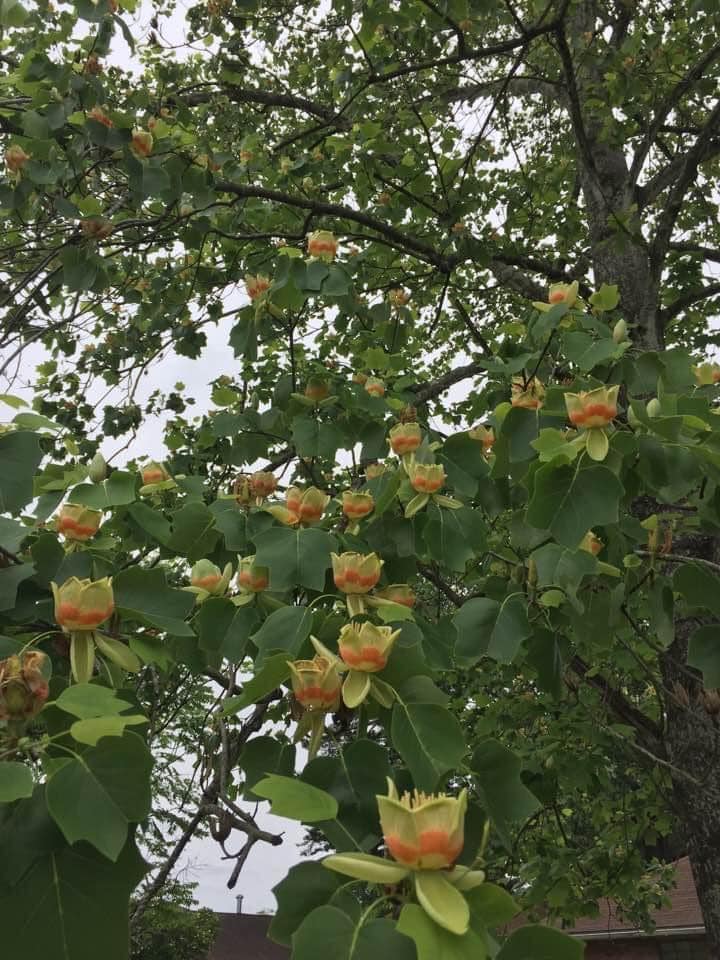
13. Tulip Tree (Liriodendron tulipifera)
Tulip tree, also called tulip poplar, is one of the tallest native hardwoods found in Massachusetts, though it grows mainly in the warmer, southeastern parts of the state.
Its distinctive four-lobed leaves and greenish-yellow, tulip-shaped spring flowers make it an elegant addition to larger landscapes with room to spare.
This species grows remarkably fast for a hardwood, often adding several feet of height per year while young, which is why the state recommends it for large shade tree plantings.
Given deep, moist, well-drained soil, tulip tree can eventually tower well above the surrounding canopy in the right Massachusetts setting.
14. American Sycamore (Platanus occidentalis)
American sycamore lines Massachusetts’s rivers and floodplains, instantly recognizable by bark that peels away in patches, revealing a mottled white, gray, and tan pattern beneath.
This tree grows to an enormous trunk diameter, often larger than any other native hardwood in the state, and thrives along the Connecticut River valley in particular.
Its extensive root system helps stabilize eroding riverbanks, making sycamore a valuable choice for stream buffer and floodplain restoration projects statewide.
Because of its size, sycamore fits parks and large properties far better than small residential lots, where it can quickly outgrow the available space.
15. River Birch (Betula nigra)
River birch is one of the few native birches genuinely comfortable in Massachusetts’s warmer, wetter bottomland soils, thriving along creeks, ponds, and low-lying yards.
Its peeling, salmon-pink to reddish-brown bark provides striking year-round visual interest, particularly against winter snow when most other trees look bare.
This species resists the bronze birch borer far better than paper or European white birch, making it a more resilient landscape choice across the Commonwealth.
The state’s own tree-selection guidance lists river birch among its recommended large shade trees for streets and yards with adequate rooting space.
16. Yellow Birch (Betula alleghaniensis)
Yellow birch grows across Massachusetts’s cooler upland forests, particularly in the Berkshires, often alongside sugar maple, American beech, and eastern hemlock.
Its shiny, yellowish-bronze, peeling bark curls in thin papery strips, and crushed twigs release a faint wintergreen scent, a handy trick for identification on the trail.
This tree can live remarkably long, and its wood, valued for its heavy, hard character, has long been used in furniture and veneer applications.
Yellow birch prefers cool, moist, well-drained sites and struggles in warmer, drier conditions, which limits it mostly to the state’s higher elevations.
17. American Basswood (Tilia americana)
American basswood, sometimes called American linden, is a large shade tree known for its fragrant, pale yellow summer flowers, which beekeepers prize for exceptional honey.
The heart-shaped, lopsided leaves are distinctive, and the soft, light-colored wood has long been favored by carvers for its fine, even grain.
Massachusetts’s own tree-selection guidance recommends basswood as a large shade tree, particularly for sites with rich, moist soil and ample room to grow.
This species also supports a wide range of pollinators, making it a valuable addition to plantings focused on native bee populations.
18. Black Gum (Nyssa sylvatica)
Black gum, also called black tupelo, is often overlooked despite offering some of the earliest and most reliable fall color of any Massachusetts native tree.
Its glossy, oval leaves and distinctive horizontal branching pattern turn deep scarlet by early September, well ahead of most surrounding hardwoods.
This tree thrives in moist bottomlands and swampy areas across the state, and its small, dark fruit provides an important late-season food source for migrating birds.
The Massachusetts DCR lists black gum among its recommended large trees for community forests, prized for both its color and its wildlife value.
19. Shagbark Hickory (Carya ovata)
Shagbark hickory earns its name from bark that peels away from the trunk in long, curling strips, making mature trees identifiable even from a moving car.
This slow-growing species appears throughout the state’s hardwood forests and can live well past 200 years once established in undisturbed woodland settings.
Its sweet, edible nuts have fed wildlife and people for generations, and the wood remains a favorite for smoking meat because of its distinctive, rich flavor.
State guidance recommends shagbark hickory as a park tree, suited to sites with ample space away from pedestrian and vehicle traffic.
20. Black Walnut (Juglans nigra)
Black walnut grows across Massachusetts’s richer valley soils, valued by furniture makers for its dark heartwood and by foragers for its edible, if labor-intensive, nuts.
The tree releases a chemical compound called juglone into the surrounding soil, which suppresses growth in many nearby plants, including tomatoes and certain fruit trees.
Its large compound leaves and thick, deeply furrowed bark make identification straightforward, especially once round, green-husked nuts begin dropping each autumn.
Before planting one near a garden, research juglone-sensitive species first, since several common vegetables and fruit trees react poorly to its presence.
21. Eastern Redbud (Cercis canadensis)
Eastern redbud brings early spring color to Massachusetts landscapes, covering bare branches in vivid magenta-pink blooms weeks before most other trees stir.
Though native to the eastern United States broadly, redbud performs reliably in Massachusetts’s milder valleys and is officially recommended by the state as a small ornamental tree.
Its heart-shaped leaves and graceful, vase-shaped form make it a favorite choice for smaller yards that still want dependable early-season color.
Redbud develops a deep taproot early on, so it establishes best when planted young rather than transplanted once the root system has matured.
22. Flowering Dogwood (Cornus florida)
Flowering dogwood is a small understory tree that brightens Massachusetts forest edges each spring with white or pink bracts many mistake for flower petals.
It thrives in the partial shade beneath larger oaks and maples, and remains a popular choice for smaller yards throughout the state.
In fall, dogwood offers a second performance: scarlet foliage paired with clusters of red berries that feed migrating songbirds passing through New England.
At just 15 to 25 feet tall, flowering dogwood fits comfortably into most home landscapes, including compact suburban lots around Boston and its surrounding towns.
23. Sweetbay Magnolia (Magnolia virginiana)
Sweetbay magnolia grows naturally near the northern edge of its range in southeastern Massachusetts, favoring swamps, bogs, and low-lying woods with consistent moisture.
Its creamy white, lemon-scented flowers bloom through much of the summer, offering a longer bloom period than most native flowering trees found in the region.
The state’s own tree guidance lists sweetbay magnolia among its recommended small trees, well suited to smaller yards and low or poorly drained spots.
This compact, fragrant species fits well into naturalized wetland plantings, particularly across Cape Cod and the South Shore.
24. American Hophornbeam (Ostrya virginiana)
American hophornbeam, also called ironwood, is a modest understory tree with famously dense, hard wood historically used for tool handles and fence posts.
Its shaggy, gray-brown bark peels in narrow vertical strips, and its papery seed clusters resemble hops, which is exactly where the tree’s common name comes from.
Because it tolerates shade well, hophornbeam thrives beneath larger oaks and hickories, quietly filling the mid-story layer of Massachusetts’s mature hardwood forests.
The state recommends it as a medium tree suitable for planting near power lines, given its modest mature height and slow, manageable growth.
25. American Hornbeam (Carpinus caroliniana)
American hornbeam, sometimes called musclewood for its smooth, sinewy bark, is a small understory tree found in the moist woods and stream banks of Massachusetts.
Its fluted, muscle-like trunk makes it one of the more visually distinctive native trees in New England, easy to identify even without leaves present.
This species tolerates shade and occasional flooding well, making it a strong choice for naturalized plantings near ponds, streams, or low-lying garden beds.
Massachusetts guidance recommends hornbeam as a medium tree appropriate for smaller spaces, including sites near overhead wires with some caution.
Quick Tips for Planting Native Massachusetts Trees
A few practical notes before you head to the nursery.
- Match the tree to your region. Pitch pine and sweetbay magnolia favor the sandy coastal plain, while yellow birch and sugar maple prefer the cooler Berkshires.
- Avoid overplanted species. State foresters note that red maple, while native, is already overused in many Massachusetts communities, so consider diversifying your choice.
- Watch for invasive pests. Hemlock woolly adelgid, Dutch elm disease, and the Asian longhorned beetle have already reshaped parts of the state’s forests, so monitor new plantings closely.
Final Thoughts
Twenty-five trees only begin to capture what grows across Massachusetts’s nearly 3 million forested acres. But this list covers the species you are most likely to encounter, plant, or simply want to name correctly on your next walk.
I hope it deepens your appreciation for the Bay State’s forests, and perhaps inspires you to plant one of these natives at home this season.
References
- Massachusetts Department of Conservation and Recreation (DCR) — Forestry in Massachusetts: https://www.mass.gov/guides/forestry-in-massachusetts
- Massachusetts Department of Conservation and Recreation (DCR) — Selecting Trees for Your Urban and Community Forest (Fact Sheet PDF): https://www.mass.gov/doc/selecting-trees-for-your-urban-and-community-forests-fact-sheet/download
- Massachusetts Department of Conservation and Recreation (DCR) — Bureau of Forest Fire Control and Forestry: https://www.mass.gov/orgs/bureau-of-forest-fire-control-and-forestry
- Massachusetts Department of Conservation and Recreation (DCR) — Massachusetts Legacy Tree Program: https://www.mass.gov/guides/massachusetts-legacy-tree-program
- USDA Forest Service — Forests of Massachusetts, 2021 (Resource Update FS-369): https://www.fs.usda.gov/nrs/pubs/ru/ru_fs369.pdf
- USDA Forest Service — Forests of Massachusetts (Resource Update FS-239): https://www.fs.usda.gov/nrs/pubs/ru/ru_fs239.pdf
- Massachusetts Department of Conservation and Recreation (DCR) — Assessment of the Forest Resources of Massachusetts: https://www.mass.gov/doc/assessment-of-forest-resources-of-massachusetts/download

Tim M Dave is a gardening expert with a passion for houseplants, particularly cacti and succulents. With a degree in plant biology from the University of California, Berkeley, he has vast experience in gardening. Over the years, he has cultivated a vast collection of desert plants and learned a great deal about how to grow and care for these unique companions.