26 North Carolina Native Trees (With Growing Details)
North Carolina packs an unusual amount of tree diversity into one state. Forests cover roughly 18.7 million acres, about 61 percent of the state’s total land area, according to the North Carolina Forest Service. That’s the fourth-largest forested acreage of any state in the country.
I’ve hiked both ends of North Carolina, and it still surprises me how different they feel. Spruce-fir forest near Mount Mitchell smells like Canadian boreal woods. Two hundred miles east, live oaks draped in Spanish moss line the coast like something out of a completely different country. Few states offer that kind of range within a single day’s drive.
This guide covers 26 trees genuinely native to North Carolina, spanning all three of the state’s major regions: the mountains, the piedmont, and the coastal plain.
Why North Carolina’s Forests Matter
A little context helps before diving into the list. North Carolina’s forests aren’t just scenery. They’re a genuine economic engine and an ecological bridge between northern and southern species.
Oak-hickory forest is the state’s dominant forest type, covering about 38 percent of North Carolina’s timberland, followed by loblolly-shortleaf pine at roughly 31 percent, according to the North Carolina Forest Service.
Nearly all of that land stays productive. About 96 percent of North Carolina’s forests qualify as commercial forestland, capable of producing marketable timber, and forestry remains the state’s top manufacturing sector, contributing an estimated $40.5 billion to the economy and supporting around 144,000 jobs.
Ownership tells its own story here. The majority of the state’s forested land, some 15.5 million acres, sits in nonindustrial private ownership, meaning individual landowners shape the future of North Carolina’s forests more than any single agency does.
The 26 Native Trees of North Carolina
The list below moves from high-elevation mountain conifers through the state’s iconic hardwoods and down to its distinctive coastal species.
1. Tuliptree (Liriodendron tulipifera)

Tuliptree, often called tulip poplar, is North Carolina’s official state tree and its tallest native hardwood, regularly exceeding 150 feet in the cove forests of the western mountains.
Its distinctive, squared-off leaves look almost like a cat’s silhouette, and the tree produces large, tulip-shaped yellow-green flowers each spring that most people never notice from the ground.
Despite the common name, it’s not related to poplars or tulips at all. It’s actually part of the magnolia family, which explains the showy, cup-shaped blooms.
I always find it a little funny that the state tree isn’t even the species most people picture when they think “North Carolina forest.” It just quietly happens to be the tallest one.
2. Longleaf Pine (Pinus palustris)
Longleaf pine once dominated tens of millions of acres across the Southeast, but habitat loss has reduced its range to a fraction of its historical extent, making surviving stands ecologically significant.
Its needles are the longest of any native pine, often stretching 10 to 15 inches, bundled in groups of three around a thick, fire-adapted trunk.
This species evolved alongside frequent, low-intensity fire, and its “grass stage” seedlings can sit almost invisible at ground level for years before shooting up rapidly once established.
3. Loblolly Pine (Pinus taeda)
Loblolly pine is the workhorse of North Carolina’s timber industry, fast-growing and widely planted across the coastal plain and piedmont for pulpwood and lumber.
Its gray, scaly bark and dark green needles, bundled in groups of three, help distinguish it from the state’s other native pines, though it commonly hybridizes and grows alongside shortleaf pine.
The name comes from an old Southern term for a mudhole, since this species thrives in the moist, low-lying ground where it was historically most common.
4. Shortleaf Pine (Pinus echinata)
Shortleaf pine grows across a wider range of soil conditions than loblolly pine, tolerating drier upland sites throughout the piedmont and mountains foothills.
Small resin pockets visible on the bark, along with shorter needles bundled in twos or threes, help separate it from loblolly and longleaf pine in the field.
This species can resprout from the base after fire or damage, a trait unusual among southern pines that helped it survive historical logging and burning cycles.
5. Table Mountain Pine (Pinus pungens)
Table Mountain pine grows almost exclusively on dry, rocky, high-elevation ridges in the southern Appalachians, giving it one of the most restricted ranges of any native North Carolina conifer.
Its stout, heavily armed cones carry sharp, curved spines on each scale, among the most distinctive cone armor of any pine species in the eastern United States.
Like longleaf pine, this species depends on periodic fire to open its serotinous cones and clear competing vegetation from the exposed ridgelines it favors.
6. Eastern White Pine (Pinus strobus)
Eastern white pine grows throughout North Carolina’s mountains and upper piedmont, often reaching impressive heights in sheltered coves and valleys.
Look for soft needles bundled in fives, blue-green in color, along with long, slender cones that hang rather than stand upright on the branch.
This species once supplied massive, arrow-straight timber for ship masts during the colonial era, and old-growth remnants still stand in a handful of protected mountain forests.
7. Fraser Fir (Abies fraseri)
Fraser fir grows naturally only at the highest elevations of the southern Appalachians, making North Carolina’s mountaintops essentially its entire native range worldwide.
Its short, flat needles and upright, cylindrical cones are the classic Christmas tree silhouette, since this species is the primary source for the state’s substantial Fraser fir farming industry.
Wild populations remain threatened by an invasive insect called the balsam woolly adelgid, which has killed a significant share of mature trees across Roan Mountain and other high peaks.
8. Red Spruce (Picea rubens)
Red spruce forms the backbone of North Carolina’s rare spruce-fir forest, a cold, high-elevation ecosystem that first developed after the last ice age.
Its short, sharply pointed needles and reddish-brown, scaly bark distinguish it from the state’s more common pines growing at lower elevations.
Logging and fire severely reduced these forests during the early 20th century, and ongoing conservation efforts in the Southern Blue Ridge Mountains are slowly restoring surviving stands.
9. Eastern Hemlock (Tsuga canadensis)
Eastern hemlock once formed dense, shaded stands along North Carolina’s mountain streams, valued for the cool microclimate it created for fish and aquatic insects.
Short, flat needles with two white lines underneath, arranged unevenly along the twig, distinguish this species from the state’s true firs and spruces.
An invasive insect called the hemlock woolly adelgid has devastated populations across the mountains in recent decades, making healthy, mature hemlock stands increasingly rare to encounter.
10. Atlantic White Cedar (Chamaecyparis thyoides)
Atlantic white cedar grows almost exclusively in the acidic, waterlogged pocosin wetlands of North Carolina’s coastal plain, a habitat type found in relatively few other places.
Its scale-like, blue-green foliage and thin, fibrous, reddish-brown bark closely resemble northern white-cedar, though the two species occupy very different climates.
Historically prized for boat building and shingles due to its rot resistance, wild stands have declined significantly from drainage and past logging of coastal wetlands.
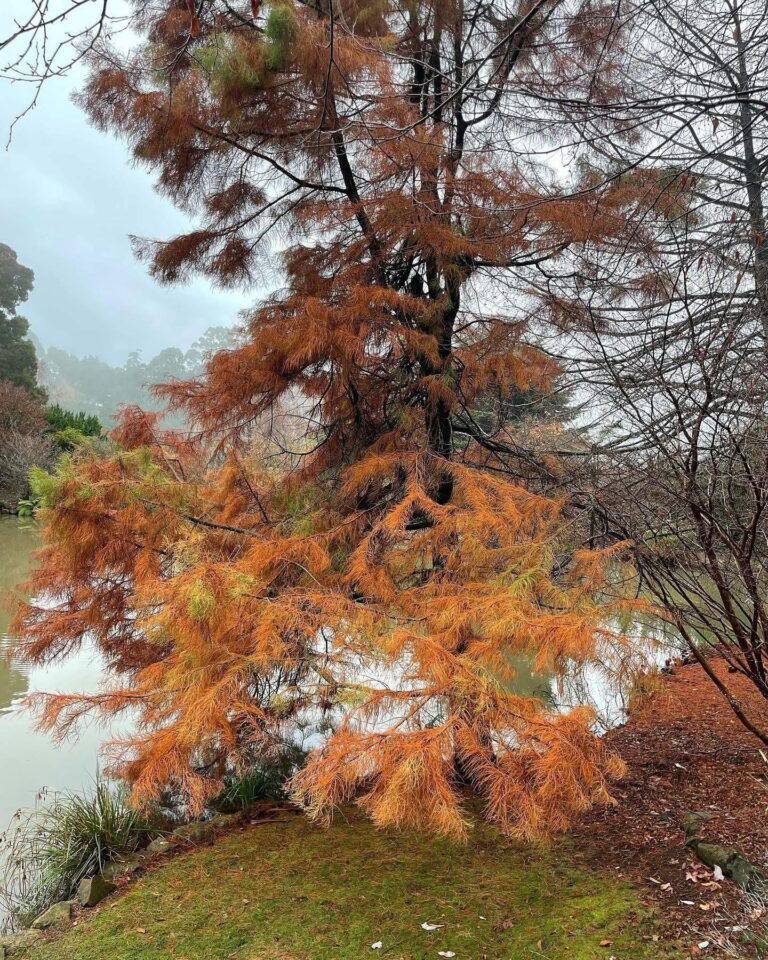
11. Bald Cypress (Taxodium distichum)
Bald cypress grows in the swamps, rivers, and blackwater wetlands of eastern North Carolina, often forming striking, knee-studded groves along slow-moving water.
It’s a deciduous conifer, dropping its soft, feathery needles each fall, unlike most other cone-bearing trees native to the state.
Some old-growth bald cypress trees along North Carolina’s coastal rivers are estimated to be well over a thousand years old, among the oldest living things in the eastern United States.
12. Eastern Redcedar (Juniperus virginiana)
Eastern redcedar isn’t a true cedar botanically, but it grows across nearly every region of North Carolina, from dry piedmont fields to coastal dune edges.
Small, bluish, berry-like cones cover female trees in fall and winter, providing an important food source for wintering birds when other options grow scarce.
This species has expanded significantly since colonial times, since it readily colonizes abandoned farmland and pastures across the state’s interior.
13. White Oak (Quercus alba)
White oak ranks among North Carolina’s most valuable native hardwoods, prized for tight-grained lumber used in furniture, flooring, and whiskey barrels.
Look for rounded, finger-like lobes on the leaves, without the sharp bristle tips found on red oak family members, along with light gray, flaky bark.
North Carolina is home to at least two dozen native oak species, and white oak often serves as the anchor species in mature upland hardwood forests statewide.
14. Southern Red Oak (Quercus falcata)
Southern red oak thrives in the drier, sandier soils common across the piedmont and coastal plain, tolerating conditions that would stress many other oak species.
Its leaves show a distinctive bell-shaped base with deeply cut, pointed lobes, a helpful identifying feature once you know what to look for.
This species grows relatively fast for an oak and provides an important acorn food source for deer, turkey, and squirrels throughout its North Carolina range.
15. Willow Oak (Quercus phellos)
Willow oak stands out immediately among the state’s oaks, since its narrow, unlobed leaves look nothing like the classic oak leaf shape most people expect.
The long, slender leaves resemble willow foliage, which is exactly how the tree earned its common name despite being a true oak botanically.
Widely planted as a street and shade tree across North Carolina cities, it also grows naturally in the moist bottomlands of the coastal plain and piedmont.
16. Live Oak (Quercus virginiana)
Live oak defines the visual character of coastal North Carolina, with massive, sprawling limbs that often stretch wider than the tree is tall, frequently draped in Spanish moss.
Its small, smooth-edged, evergreen leaves stay green year-round, unusual among the state’s native oaks, most of which drop their leaves every fall.
This species tolerates salt spray and sandy soil remarkably well, making it a defining feature of maritime forests along North Carolina’s Outer Banks and southern coast.
17. Shagbark Hickory (Carya ovata)
Shagbark hickory is instantly recognizable, even from a moving car, thanks to bark that peels away in long, curling plates that seem to hang loosely off the trunk.
Its compound leaves typically have five leaflets, and the tree produces a sweet, edible nut historically gathered by Indigenous communities and early settlers alike.
North Carolina is home to roughly ten native hickory species, and shagbark remains one of the easiest to identify thanks to its dramatic bark texture.
18. Sugar Maple (Acer saccharum)
Sugar maple grows mainly in North Carolina’s mountains and upper piedmont, producing some of the state’s most vivid fall color displays each October.
Its leaves have five pointed lobes with smooth edges between the points, turning brilliant orange, red, and yellow before dropping in autumn.
Small amounts of maple syrup are still produced from mountain sugar maples each late winter, though North Carolina’s production remains modest compared to northern states.
19. Red Maple (Acer rubrum)
Red maple tolerates a remarkably wide range of soil and moisture conditions, growing everywhere from mountain coves to coastal swamps across North Carolina.
Look for small red flowers in early spring, appearing well before the leaves emerge, followed later by winged seed pairs that spin like helicopters when they fall.
Its adaptability has made it one of the most common trees in the entire eastern United States, and it’s a frequent choice for native landscaping across North Carolina.
20. American Sycamore (Platanus occidentalis)
American sycamore is one of the largest native hardwoods in North Carolina, commonly reaching massive girths along rivers and streams throughout the piedmont and coastal plain.
Its mottled, peeling bark reveals patches of white, gray, and greenish inner bark, creating a distinctive camouflage pattern visible from a considerable distance.
Old, hollow sycamores historically provided shelter for wildlife, since a single mature trunk can hollow out into a surprisingly spacious cavity over time.
21. Black Walnut (Juglans nigra)
Black walnut grows throughout North Carolina’s piedmont and mountains, most abundant in the low-lying areas with rich, moist soil where it grows fastest.
Its compound leaves contain up to 23 leaflets, and crushed foliage or husks release a strong, distinctive citrus-like odor unmistakable once you’ve smelled it.
Historically prized for shipbuilding and fine cabinetry due to its durability, this species remains one of North Carolina’s most commercially valuable native hardwoods today.
22. Flowering Dogwood (Cornus florida)
Flowering dogwood grows as a small, shade-tolerant understory tree across nearly all of North Carolina, blooming with showy white flowers each spring before the leaves fully emerge.
Its “flowers” are actually modified leaf bracts surrounding a small cluster of true flowers at the center, a detail most casual observers never notice.
Bright red berries in fall provide an important food source for migrating birds, and the tree’s horizontal branching pattern makes it a favorite for landscape design statewide.
23. Eastern Redbud (Cercis canadensis)
Eastern redbud is one of the first native trees to bloom each spring across North Carolina, covering its bare branches in vivid pink-purple flowers before the leaves even emerge.
Its heart-shaped leaves unfurl shortly after the flowers fade, giving the tree a completely different look through the rest of the growing season.
This small understory tree grows naturally along woodland edges throughout the piedmont and mountains, and it’s become one of the most popular native ornamentals for home landscaping.
24. Sourwood (Oxydendrum arboreum)
Sourwood is a genuine Appalachian specialty, best known for producing the nectar behind North Carolina’s prized sourwood honey, harvested each summer across the mountain region.
Its drooping clusters of small, white, bell-shaped flowers bloom in mid to late summer, later than most other native flowering trees in the state.
Fall color is exceptional, with leaves turning deep scarlet red weeks before most surrounding hardwoods, making sourwood easy to spot on a mountain hillside in early autumn.
25. American Beech (Fagus grandifolia)
American beech grows across North Carolina’s mountains and piedmont, forming dense, shade-tolerant stands often mixed with sugar maple and tuliptree.
Its smooth, light gray bark stays remarkably unmarked even on mature trees, an easy identifying feature that has unfortunately also made it a popular target for carved initials.
Younger beech trees often hold their tan, papery leaves through winter, a trait called marcescence that makes them easy to spot against a bare winter forest.
26. American Holly (Ilex opaca)
American holly grows as a native evergreen understory tree across most of North Carolina, from mountain coves to coastal maritime forests.
Its stiff, spiny, dark green leaves stay glossy year-round, and female trees produce the bright red berries traditionally associated with winter holiday decorations.
This species tolerates shade well and grows slowly, often persisting for generations in the understory of larger hardwood and pine forests across the state.
Where to See These Trees in the Wild
You don’t need to travel far to see a solid cross-section of this list. A handful of well-known North Carolina destinations concentrate an outsized share of the state’s tree diversity.
Great Smoky Mountains and Pisgah National Forest offer the best look at high-elevation species like Fraser fir, red spruce, and Table Mountain pine, alongside classic cove hardwoods like tuliptree and sugar maple.
The Croatan National Forest and Alligator River area on the coastal plain protect longleaf pine savanna, Atlantic white cedar pocosins, and bald cypress wetlands, all genuinely rare habitat types today.
For coastal live oak and maritime forest, Cape Lookout National Seashore and the Outer Banks still hold some of the state’s finest examples of salt-tolerant coastal woodland.
A Quick Note on Identification
If you’re trying to identify a tree in the field, start with three things: leaf shape, bark texture, and elevation. Mountain species like Fraser fir and red spruce look nothing like the loblolly pine and live oak found near sea level.
Bark alone solves a surprising amount of confusion in winter, when leaves aren’t available. Sycamore’s mottled trunk and shagbark hickory’s peeling plates are nearly unmistakable from a distance.
Region matters more in North Carolina than in most states, given the dramatic elevation change from the coast to the mountains. Knowing which of the three physiographic zones you’re standing in narrows the possibilities considerably.
Frequently Asked Questions
What is North Carolina’s official state tree? Tuliptree, also called tulip poplar, chosen for its height, abundance, and importance across the state’s forests.
How many native tree species does North Carolina have? Botanical inventories put the number at roughly 300 native tree species statewide, reflecting the state’s unusual range of elevation and climate. This guide covers 26 of the most significant and widely recognized ones.
Which North Carolina tree is found almost nowhere else? Fraser fir grows naturally only at the highest elevations of the southern Appalachians, making North Carolina’s mountaintops essentially its entire native range worldwide.
Are all conifers in North Carolina native? No. Some landscaped conifers, including certain spruces and cedars planted around homes and businesses, were introduced from other regions and aren’t native to the state.
References
- North Carolina Forest Service — About Our Forests — https://www.ncagr.gov/divisions/nc-forest-service/forest-health/about-our-forests
- U.S. Forest Service, Southern Research Station — Forests of North Carolina, 2022 (Resource Update FS-479) — https://www.srs.fs.usda.gov/pubs/ru/ru_fs479.pdf
- NC State Extension — Identification of Common Trees of North Carolina — https://content.ces.ncsu.edu/identification-of-common-trees-of-north-carolina
- NC State Extension — NC Tree Identification — https://gardening.ces.ncsu.edu/news/nc-tree-identification/
- NC State Extension — Trees Resource Page — https://gardening.ces.ncsu.edu/gardening-plants/trees-3/
- NC State Extension — Plant Identification Tools and Resources — https://extensiongardener.ces.ncsu.edu/news/plant-identification-tools-and-resources/
- North Carolina Digital Collections, N.C. Department of Natural and Cultural Resources — Identification of Common Trees of North Carolina — https://digital.ncdcr.gov/Documents/Detail/identification-of-common-trees-of-north-carolina/5817880

Tim M Dave is a gardening expert with a passion for houseplants, particularly cacti and succulents. With a degree in plant biology from the University of California, Berkeley, he has vast experience in gardening. Over the years, he has cultivated a vast collection of desert plants and learned a great deal about how to grow and care for these unique companions.