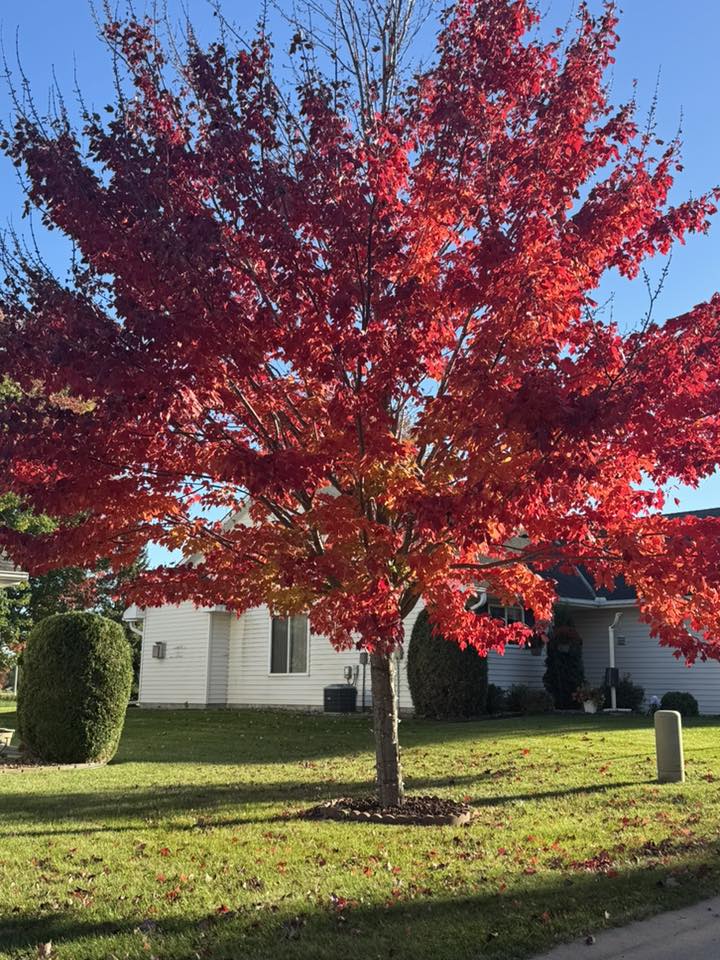
25 Trees Native to Washington State (With Growing Details)
Washington earned its “Evergreen State” nickname honestly. Forests cover roughly 22.5 million acres, or about half of the state’s total land area, and hold an estimated 9.4 billion live trees, according to the U.S. Forest Service’s Forest Inventory and Analysis program.
That’s not a small forest. That’s an entire ecosystem stretching from rain-soaked coastal valleys to dry, sunbaked shrub-steppe on the other side of the Cascades.
I’ve spent enough time hiking both halves of this state to notice something: no two forests here look alike. The coast smells like salt and cedar. The eastern slopes smell like dust and ponderosa bark, almost like vanilla if you get close enough. That contrast is exactly why Washington supports such a wide range of native tree species.
This guide walks through 25 trees that are truly native to Washington, not just commonly planted here. Each one played a role in shaping the region’s ecology, its Indigenous cultures, and its modern timber economy.
Why Washington’s Forests Matter
Before jumping into the list, a little context helps. Washington’s forests aren’t just scenery. They’re working ecosystems and, in many counties, working economies.
Conifers dominate the landscape west of the Cascades, while broadleaf trees like oak, aspen, and cottonwood take over drier or riparian zones east of the mountains and along river corridors statewide.
Elevation changes everything here. A single mountainside can shift from lowland Douglas-fir forest to subalpine fir stands within a few thousand feet of climbing.
The Washington State Department of Natural Resources manages millions of acres of this forestland and actively replants native seedlings after harvest, which is part of why native species dominate the working forest instead of introduced ones.
That policy matters for biodiversity, and it’s part of why this list stays accurate today.
The 25 Native Trees of Washington State
Here are the 25 species, organized roughly from the tall coastal conifers to the hardier broadleaf trees found across the state.
1. Western Hemlock (Tsuga heterophylla)
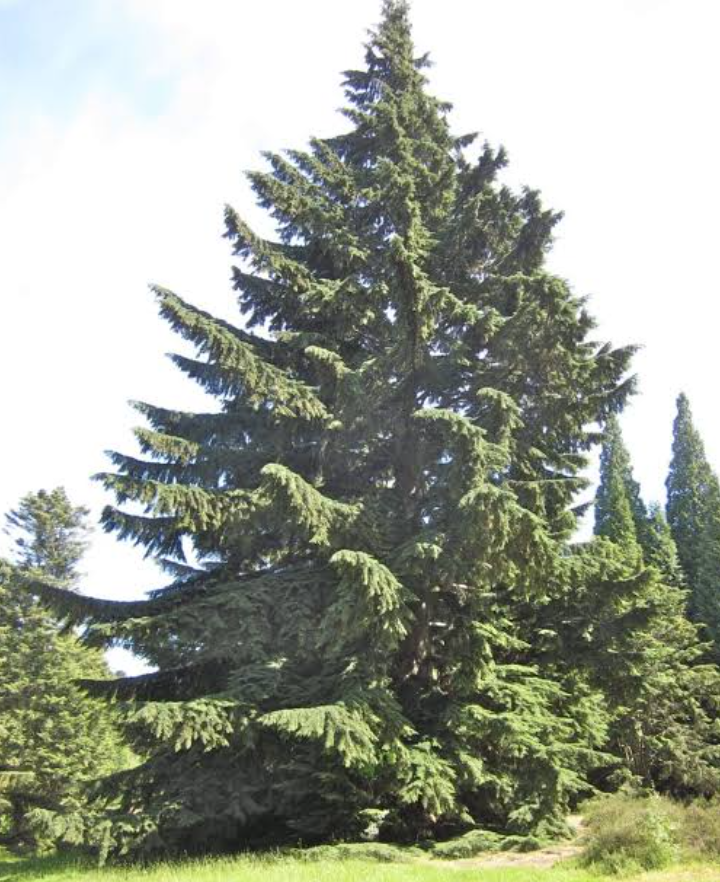
Western hemlock is Washington’s official state tree, and it earns that title through sheer abundance. You’ll find it blanketing moist, shaded forests from the coast to mid-elevation slopes.
Look for the droopy leader at the top of the tree, a soft, nodding tip that never grows straight up. The needles are short, flat, and uneven in length, arranged almost like a feather along the twig.
This tree tolerates deep shade better than almost any conifer in the region, which lets it dominate the understory long after other species have claimed the canopy. Indigenous communities historically used its wood for tools and its bark for tanning and dye.
I always find it a little humbling that the “state tree” isn’t the flashiest one here. It’s just the one that quietly outcompetes everything else.
2. Douglas fir (Pseudotsuga menziesii)
Douglas fir isn’t a true fir at all, which trips up a lot of beginners. Its scientific name even reflects the confusion, since it’s been reclassified multiple times.
The easiest identifier is the cone, which has distinctive three-pointed bracts sticking out between the scales. Locals sometimes joke they look like the back legs and tail of a mouse diving into the cone.
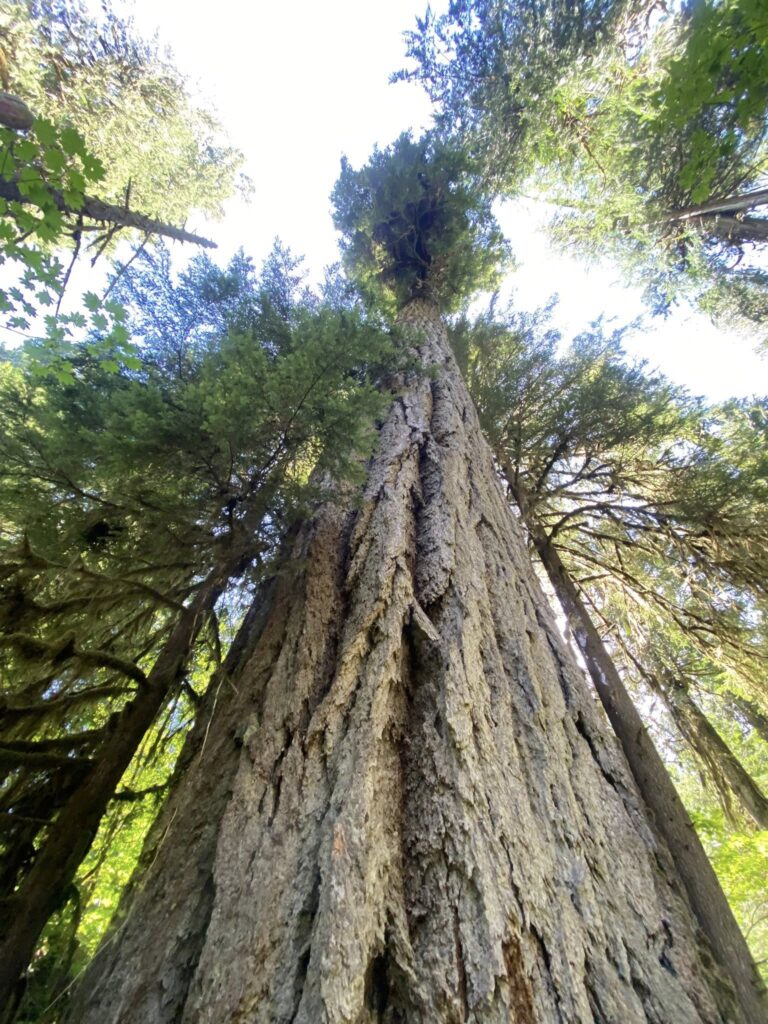
This species grows across nearly every forest region in the state and remains the backbone of Washington’s timber industry because of its strength and fast growth. Mature trees regularly exceed 200 feet in coastal stands.
3. Western Redcedar (Thuja plicata)
Western redcedar holds deep cultural significance across the Pacific Northwest, often described as the “tree of life” among coastal Indigenous nations. Canoes, longhouses, baskets, and clothing were all made from its wood and fibrous bark.
Identify it by the scale-like, flattened foliage that forms drooping, fan-shaped sprays, along with reddish-brown, stringy bark that peels in long vertical strips.
Redcedar thrives in wet soils and often grows alongside western hemlock and Sitka spruce in lowland forests. Some individual trees living today are many centuries old.
4. Sitka Spruce (Picea sitchensis)
Sitka spruce grows largest along the immediate coast, where fog and rain keep humidity high year-round. It’s one of the tallest tree species in North America.
The needles are sharp and stiff, almost painful to grab a branch bare-handed, which is a quick way to tell it apart from the softer-needled hemlock growing nearby.
Its strong, lightweight wood was historically prized for aircraft frames and is still used today in musical instrument soundboards, including many acoustic guitars.
5. Pacific Silver Fir (Abies amabilis)
Pacific silver fir occupies the cool, snowy mid-to-upper elevations of the Cascades and Olympics, often forming dense, shaded stands.
Its needles curve upward in a distinctive way and show two white stripes underneath, while the bark stays smooth and gray-blue even on mature trees.
This species handles heavy winter snowpack well, which is part of why it thrives in zones that would damage less flexible conifers.
6. Grand Fir (Abies grandis)
Grand fir is one of the more graceful conifers in Washington, with needles arranged in a flat, comb-like spray along the branch.
Crush a needle and you’ll notice a citrusy scent, one of the more reliable ways to separate it from similar-looking firs in the field.
It grows in both western lowlands and drier interior valleys, making it one of the more widely distributed true firs in the state.
7. Subalpine Fir (Abies lasiocarpa)
Subalpine fir grows near the tree line, where wind and snow shape it into a narrow, spire-like form built to shed heavy loads.
Its tight, upright cones sit near the top of the crown, a classic identifying trait shared with most true firs, unlike hanging cones on hemlock or spruce.
This is often the last tree standing before alpine meadows take over entirely, marking the practical edge of Washington’s forest ecosystems.
8. Noble Fir (Abies procera)
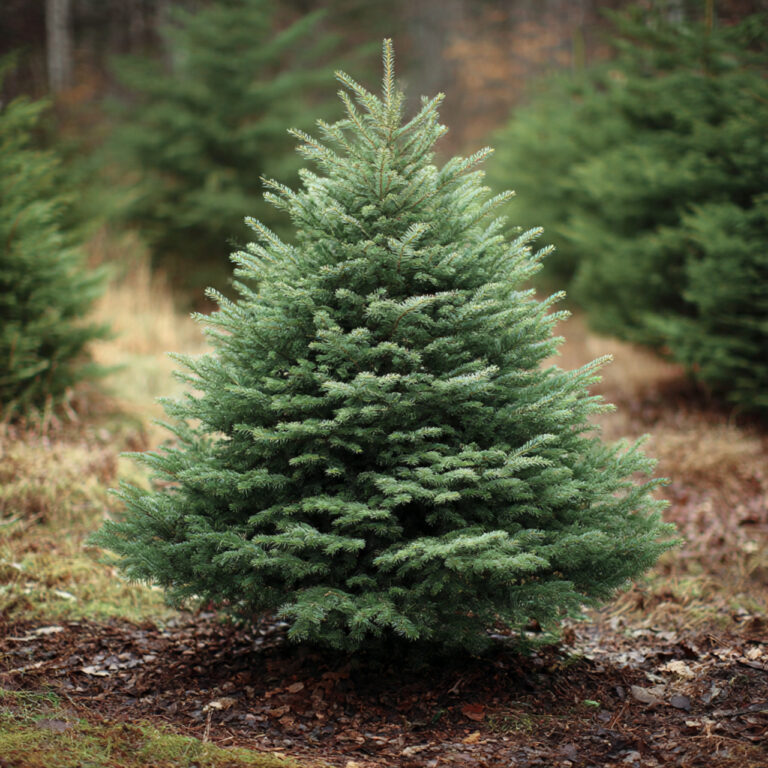
Noble fir grows at higher elevations in the Cascades and is widely known outside the region for a very different reason: it’s one of the most popular Christmas tree species in the country.
Its stiff, upward-curving needles and large, bracted cones make it visually distinct from other native firs.
Wild noble fir stands are protected in many areas, so most of the trees sold commercially come from managed plantations rather than native forest.
9. Western White Pine (Pinus monticola)
Western white pine was once far more common across Washington before an introduced fungal disease, white pine blister rust, devastated populations in the 20th century.
Look for soft, blue-green needles bundled in groups of five, along with long, slender cones that can stretch close to a foot.
Breeding programs have developed rust-resistant strains, and this species is slowly recovering in parts of its former range through active restoration.
10. Ponderosa Pine (Pinus ponderosa)
Ponderosa pine dominates the dry, sun-exposed forests of eastern Washington, where fire has historically shaped the landscape more than rainfall has.
The bark on mature trees breaks into orange-brown puzzle pieces, and yes, it really does smell like vanilla or butterscotch if you lean in close on a warm day.
This species evolved with frequent, low-intensity fire, which cleared underbrush without killing the thick-barked adult trees. Fire suppression over the last century has changed that dynamic significantly.
11. Lodgepole Pine (Pinus contorta)
Lodgepole pine grows in both coastal and interior forms across Washington, often colonizing areas after fire or logging disturbance.
Its cones can stay tightly sealed for years, only opening under intense heat, a trait called serotiny that helps the species regenerate quickly after wildfire.
Thin, straight trunks made this tree a favorite building material for Indigenous lodges, which is where the common name comes from.
12. Whitebark Pine (Pinus albicaulis)
Whitebark pine grows in the harshest high-elevation sites in the Cascades, often twisted into gnarled, wind-shaped forms near the alpine zone.
Its seeds depend heavily on the Clark’s nutcracker bird for dispersal, since the cones don’t open on their own and rely on the bird cracking them apart.
This species is currently declining due to blister rust and mountain pine beetle pressure, and it’s now considered threatened in much of its U.S. range.
13. Western Larch (Larix occidentalis)
Western larch is Washington’s only deciduous conifer, meaning it drops its needles every fall after turning a brilliant gold. According to the Washington Department of Natural Resources, mature trees can reach 140 to 180 feet tall with trunks 3 to 4 feet in diameter.
Watch for that autumn color change on the eastern slopes of the Cascades, where entire hillsides briefly glow yellow before winter.
Its thick, fire-resistant bark helped this species survive frequent historical wildfires in its native range.
14. Subalpine Larch (Larix lyallii)
Subalpine larch, sometimes called alpine larch, grows only in a narrow high-elevation band, mostly on the east side of the Cascade crest in Washington.
It’s even hardier than its lowland cousin, tolerating some of the harshest, rockiest alpine sites in the entire state.
Because it’s restricted to remote, high-elevation basins, seeing one usually requires a genuine mountain hike rather than a roadside stop.
15. Engelmann Spruce (Picea engelmannii)
Engelmann spruce grows in cold, high-elevation forests, typically mixing with subalpine fir in what botanists call the “ESSF” zone across the Cascades.
Its needles are four-sided and sharply pointed, roll easily between your fingers, and give off a somewhat skunky smell when crushed.
This species tolerates short growing seasons and heavy snow loads, making it a reliable component of Washington’s subalpine forest belt.
16. Pacific Yew (Taxus brevifolia)
Pacific yew usually grows as a small, shade-tolerant understory tree, easy to overlook beneath taller conifers.
Its bark became famous as the original source of Taxol, one of the most widely used natural cancer-fighting drugs in the United States, extracted from the tree’s dark, scaly bark.
Traditionally, its dense wood was used for bows, canoe paddles, and tool handles because of its strength and flexibility.
17. Rocky Mountain Juniper (Juniperus scopulorum)
Rocky Mountain juniper grows in the dry, rocky terrain of eastern Washington, often on exposed slopes where few other trees can establish.
Its scale-like foliage and small, bluish, berry-like cones make it easy to identify, even from a distance.
Wildlife rely heavily on this species for winter cover and food, since the “berries” persist on the tree well into colder months when other food sources thin out.
18. Bigleaf Maple (Acer macrophyllum)
Bigleaf maple produces the largest leaves of any maple species in North America, sometimes spanning close to a foot across.
Look for thick moss and licorice fern often carpeting its limbs, a common sight in the wet forests of western Washington where humidity supports epiphytic growth.
This tree provides valuable shade and produces a light-colored, tightly grained wood used in furniture and musical instruments.
19. Vine Maple (Acer circinatum)
Vine maple usually grows as a sprawling, multi-stemmed understory shrub or small tree, often arching gracefully toward available light gaps.
Fall color is the main attraction, with leaves turning vivid shades of orange and red that stand out sharply against evergreen conifers.
It thrives in the shaded understory of western Washington forests and along streambanks, where its flexible branches tolerate occasional flooding.
20. Red Alder (Alnus rubra)
Red alder is the largest native hardwood in the Pacific Northwest and one of the fastest-growing trees in the region, often pioneering disturbed or logged sites first.
A key feature is nitrogen fixation: red alder partners with root bacteria to enrich depleted soils, which helps other species establish after it.
Its bark shows a smooth, gray, blotchy appearance, and the inner bark turns reddish-orange when exposed, which is how the tree got its name.
21. Black Cottonwood (Populus trichocarpa)
Black cottonwood is the largest native poplar in North America and commonly grows along rivers and floodplains throughout Washington.
Its sticky, resinous buds release a sweet, balsamic fragrance in early spring, one of the more distinctive smells of a Northwest riverbank in April.
Fast growth and deep roots make it valuable for stabilizing riverbanks and providing shade over salmon-bearing streams.
22. Quaking Aspen (Populus tremuloides)
Quaking aspen grows in scattered groves across eastern Washington, often near wetlands, meadows, or seasonal water sources.
Its leaves tremble constantly in even light wind, thanks to flattened leaf stems, which gives the species both its common name and a distinctive rustling sound.
Aspen groves often connect underground through shared root systems, meaning a whole grove can technically be a single living organism.
23. Pacific Madrone (Arbutus menziesii)
Pacific madrone stands out immediately among Washington’s native trees thanks to its smooth, reddish, peeling bark that reveals pale green new bark underneath.
It’s broadleaf but evergreen, an unusual combination in this climate, with glossy, leathery leaves that stay green year-round.
Madrone favors sunny, well-drained slopes near saltwater, especially around Puget Sound, and struggles badly with soil disturbance around its roots.
24. Oregon White Oak (Quercus garryana)
Oregon white oak, also called Garry oak, forms rare prairie-oak woodlands in south Puget Sound and parts of the Columbia River Gorge.
These oak woodlands have shrunk dramatically since settlement due to development and fire suppression, making surviving stands ecologically important conservation priorities today.
The tree’s deeply lobed leaves and thick, furrowed bark support a wide range of specialized insects, birds, and understory wildflowers found nowhere else in the local ecosystem.
25. Oregon Ash (Fraxinus latifolia)
Oregon ash is the only native ash species in Washington, typically found in wet bottomlands, seasonal wetlands, and along slow-moving streams.
Its compound leaves, made of five to seven leaflets, distinguish it easily from the state’s maples and alders growing in similar wet habitats.
Populations have faced growing pressure from emerald ash borer, an invasive insect spreading through the Pacific Northwest, making healthy native ash stands worth watching closely in the years ahead.
Where to See These Trees in the Wild
You don’t need a botany degree to see most of this list in person. A handful of well-known destinations pack in an outsized share of Washington’s native tree diversity.
Olympic National Park protects some of the finest old-growth forest left in the country, with Sitka spruce, western hemlock, Douglas-fir, western redcedar, and bigleaf maple all growing together in the same rain-soaked valleys, according to the National Park Service.
The eastern Cascade slopes near Wenatchee and Winthrop are a better bet for ponderosa pine, western larch, and lodgepole pine, especially in autumn when the larch needles turn gold.
For prairie-oak habitat, south Puget Sound near Olympia still holds some of the last significant Oregon white oak woodlands in western Washington, a landscape that’s become genuinely rare.
A Quick Note on Identification
If you’re trying to identify a tree in the field, start with three things: needle or leaf shape, bark texture, and habitat. Coastal, wet-forest species look very different from the dry, eastern-slope trees on this list, even within the same genus.
Cone shape solves most conifer confusion instantly. Bark color and texture solve most broadleaf confusion. Combine that with elevation and moisture, and you’ll narrow down the species fairly quickly, even without a field guide in hand.
Frequently Asked Questions
What is Washington’s official state tree? Western hemlock, chosen for its abundance and importance across the state’s forest ecosystems.
How many native tree species does Washington have? Botanists generally count around 30 to 35 native tree species statewide, depending on how subspecies and rare high-elevation trees are classified. This guide covers 25 of the most significant and widely recognized ones.
Which Washington tree grows the tallest? Sitka spruce and Douglas-fir both regularly exceed 200 feet in favorable coastal conditions, ranking among the tallest tree species anywhere in North America.
Are all conifers in Washington native? No. Many landscaped and urban conifers, including some spruces, pines, and cedars, were introduced from other regions or countries and aren’t native to the state.
References
- U.S. Forest Service — Washington’s Forest Resources, 2007–2016: 10-Year Forest Inventory and Analysis Report — https://research.fs.usda.gov/treesearch/58048
- Washington State Department of Natural Resources — Plant the Right Tree Seedlings — https://dnr.wa.gov/forest-resources/webster-forest-nursery/plant-right-tree-seedlings
- National Park Service — Forests of Olympic National Park — https://www.nps.gov/olym/learn/nature/forests.htm
- Washington State University Extension — Trees of Washington — https://pubs.extension.wsu.edu/trees-of-washington
- Washington State University Extension Forestry — Forestry Resources by Topic — https://forestry.wsu.edu/resources/
- Washington State Magazine, Washington State University — Native Trees of Western Washington — https://magazine.wsu.edu/2015/08/16/native-trees-of-western-washington/
- University of Washington Herbarium, Burke Museum — Burke Herbarium Image Collection — https://www.burkeherbarium.org/

Tim M Dave is a gardening expert with a passion for houseplants, particularly cacti and succulents. With a degree in plant biology from the University of California, Berkeley, he has vast experience in gardening. Over the years, he has cultivated a vast collection of desert plants and learned a great deal about how to grow and care for these unique companions.