25 California Native Shrubs (With Growing Details)
Trees get most of the attention in California’s landscape. But spend a few hours hiking any coastal trail or chaparral hillside, and you will notice something else entirely: the shrubs are doing most of the work.
They hold the soil together, feed the birds, perfume the air after rain, and survive fires that would level almost anything else. I have brushed past black sage on a warm afternoon and caught its scent for the rest of the day.
This guide covers 25 California native shrubs worth knowing, whether you garden, hike, or just want to understand what is growing around you.
Why California Native Shrubs Matter
California’s chaparral and coastal scrub habitats are considered among the most biodiverse shrubland ecosystems in North America
Native shrubs need far less water than ornamental imports once established. Many species thrive on rainfall alone after their first year or two in the ground.
They also anchor entire food webs. Birds, pollinators, and small mammals depend on native shrub berries, seeds, and flowers in ways that ornamental plants simply cannot replace.
Several species below are also fire-adapted, meaning they have evolved specific strategies to survive or even benefit from California’s natural wildfire cycles.
Let’s get into the list.
25 California Native Shrubs
1. Toyon (Heteromeles arbutifolia)
Toyon is sometimes called California holly because of its clusters of bright red berries that ripen in winter. Spanish settlers reportedly used it to decorate homes for Christmas, and some historians link the name “Hollywood” to the abundance of this shrub in the hills above Los Angeles.
This evergreen shrub can grow up to 10 to 25 feet tall, with leathery, tooth-edged leaves that stay green year-round. It produces clusters of small white flowers in early summer before the berries form.
Toyon berries are an important winter food source for cedar waxwings, robins, and mockingbirds, among other native bird species. The plant is also highly fire-resistant once established, making it a popular choice in fire-conscious landscaping.
2. Manzanita (Arctostaphylos species)
Few shrubs are as instantly recognizable as manzanita, with its smooth, mahogany-red bark and twisted branches. California is home to roughly 60 manzanita species and subspecies, more than any other state, and many exist nowhere else on Earth.
The name manzanita means “little apple” in Spanish, referring to its small, round fruit that resembles miniature apples. Species range from low, ground-hugging mats to tree-like shrubs over 20 feet tall.
Manzanita flowers appear as small, urn-shaped blooms in late winter, providing one of the earliest nectar sources for native bees each year. The bark sheds naturally each summer, revealing fresh red wood underneath.
3. California Lilac (Ceanothus species)
Despite the common name, California lilac is unrelated to true lilacs. California hosts roughly 50 to 60 native Ceanothus species and varieties, ranging from low groundcovers to shrubs over 15 feet tall.
In spring, entire hillsides can turn shades of blue and purple when Ceanothus blooms en masse, a sight that stops most hikers in their tracks. The tiny, fragrant flower clusters attract enormous numbers of native bees and butterflies.
Ceanothus roots host nitrogen-fixing bacteria, which means the plant actually improves soil fertility as it grows. This makes it a favorite among native plant gardeners looking to restore depleted soil.
4. California Sagebrush (Artemisia californica)
This soft, silvery-gray shrub defines the scent of California’s coastal scrub, especially after rainfall, when its aromatic oils intensify. It is not a true sage, despite the name, but belongs to the same family as wormwood.
California sagebrush typically grows 2 to 5 feet tall, forming loose, rounded mounds along coastal bluffs and inland hillsides. Its thin, thread-like leaves help the plant conserve water during California’s dry summer months.
This species provides critical habitat for the California gnatcatcher, a threatened songbird that depends almost entirely on coastal sage scrub for nesting and survival.
ALSO READ: 60 California Native Flowers (With Growing Details)
5. Coyote Brush (Baccharis pilularis)
Coyote brush is one of the most widespread native shrubs in California, growing from the coast to inland foothills across nearly the entire state. It comes in two distinct forms: an upright shrub and a low, spreading groundcover variety.
Male and female flowers grow on separate plants, with female plants producing fluffy, white seed heads in late summer and fall that can blanket entire hillsides. This trait makes coyote brush easy to identify from a distance.
This tough, adaptable shrub is often one of the first native species to recolonize disturbed land, making it valuable for erosion control and habitat restoration projects.
6. California Buckwheat (Eriogonum fasciculatum)
This shrub produces clusters of small, pinkish-white flowers that slowly fade to a rusty rose color as summer progresses. It blooms for an unusually long stretch, often from late spring through fall.
California buckwheat rarely exceeds 3 feet in height, forming dense, rounded mounds across dry slopes and desert edges throughout the state. Its narrow, wooly leaves help minimize water loss in intense heat.
This plant is considered one of the most valuable native nectar sources in California, supporting dozens of native bee species along with the endangered El Segundo blue butterfly, which depends on it exclusively.
7. Chamise (Adenostoma fasciculatum)
Chamise is the single most dominant shrub in California’s chaparral ecosystem, sometimes forming vast, nearly pure stands across entire hillsides. Chaparral habitat, which chamise defines more than any other species, covers a significant share of California’s wildland acreage.
This shrub has tiny, needle-like leaves clustered tightly along its branches, an adaptation that reduces water loss during long, dry summers. Small white flower clusters appear in late spring, giving otherwise dull-green hillsides a brief, frosted appearance.
Chamise is highly flammable and strongly fire-adapted, resprouting quickly from its root crown after wildfire passes through. This trait has shaped California’s entire chaparral fire cycle for thousands of years.
8. Salal (Gaultheria shallon)
Salal grows along California’s northern coast, thriving in the cool, moist understory beneath redwood and Douglas fir forests. Its thick, leathery, oval leaves are a favorite among florists for greenery arrangements worldwide.
This shrub produces small, urn-shaped pink or white flowers in spring, followed by dark purple berries that ripen by late summer. Indigenous coastal communities historically used salal berries as a significant food source, often dried into cakes for winter storage.
Salal can form dense thickets several feet tall, providing excellent cover for small mammals and ground-nesting birds in coastal forest habitats.
9. Blue Elderberry (Sambucus nigra ssp. caerulea)
Blue elderberry is one of California’s fastest-growing native shrubs, capable of reaching 20 feet tall in favorable conditions within just a few years. Its clusters of tiny white flowers appear in broad, flat-topped groups each spring.
By late summer, these flowers give way to clusters of small, powdery blue-black berries that are an important food source for dozens of bird species. The berries are toxic raw but have historically been cooked into jams, syrups, and traditional medicines.
Blue elderberry thrives near streams and in valley woodlands, and it is frequently used in habitat restoration projects due to its rapid growth and wildlife value.
10. California Wild Rose (Rosa californica)
This is one of the few native rose species found throughout much of California, typically growing along streambanks and in moist canyon bottoms. Its pink, five-petaled flowers bloom from late spring into summer, filling the air with a light, familiar rose scent.
California wild rose spreads through underground runners, often forming dense thickets 3 to 8 feet tall. Its stems are covered in curved thorns, offering excellent protective cover for nesting birds.
By fall, the plant produces bright red rose hips, rich in vitamin C, which were historically used by Indigenous communities for food and medicinal teas.
11. California Fuchsia (Epilobium canum)
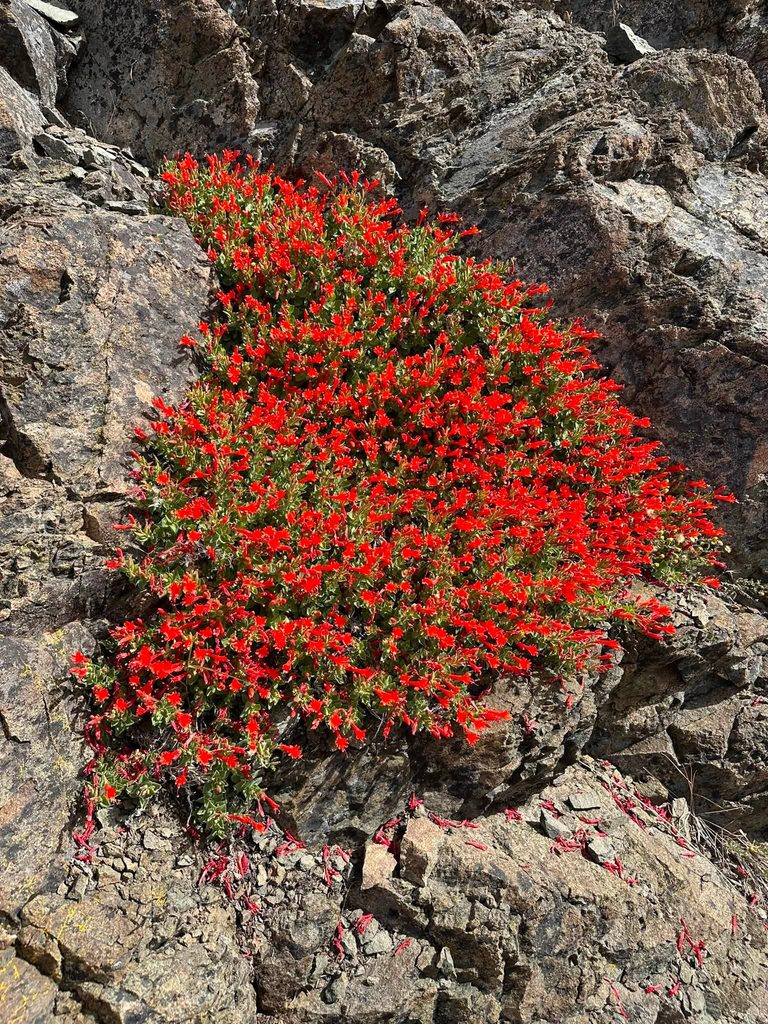
This shrub produces brilliant, tubular red-orange flowers that bloom heavily from late summer into fall, exactly when most other native plants have finished flowering for the year. This late bloom time makes it an essential late-season nectar source.
California fuchsia rarely grows taller than 2 feet, spreading in a loose, sprawling habit across dry, rocky slopes. Its narrow, gray-green leaves help the plant tolerate extended drought without supplemental water.
Hummingbirds rely heavily on this species during fall migration, and gardeners frequently plant it specifically to attract them into native landscaping.
12. Bush Poppy (Dendromecon rigida)
Bush poppy stands out with its bright, satiny yellow flowers, each resembling a slightly larger version of California’s official state flower, the golden poppy. Unlike the state flower, however, this species is a true woody shrub.
This plant typically reaches 3 to 10 feet tall, with narrow, blue-green leaves and a strongly branching form. It often appears as one of the first shrubs to recolonize slopes following wildfire.
Bush poppy flowers can bloom as early as late winter, providing an early nectar source for native pollinators emerging after the cold season.
13. Deerweed (Acmispon glaber)
Deerweed is a small, fast-growing shrub common across dry slopes and disturbed areas throughout California. Despite its modest size, rarely exceeding 4 feet, it plays an outsized ecological role.
Its tiny yellow flowers, which often turn reddish-orange as they age, bloom for an extended period and support numerous native butterfly species, including several whose caterpillars feed exclusively on this plant.
Like Ceanothus, deerweed fixes nitrogen in the soil through its root system, helping restore fertility to burned or disturbed landscapes far faster than many other pioneer species.
14. Coffeeberry (Frangula californica)
Coffeeberry gets its name from its round, berry-like fruit, which resembles coffee beans as they mature and darken from green to red to black. Despite the resemblance, the fruit is unrelated to true coffee.
This adaptable evergreen shrub grows from 3 to 15 feet tall, depending on the variety and growing conditions, and tolerates everything from full coastal sun to partial forest shade. Its glossy, oval leaves stay attractive throughout the year.
Coffeeberry fruit ripens in stages, meaning a single branch can display green, red, and black berries simultaneously, which extends its usefulness as a food source for birds across several months.
ALSO READ: 25 California Native Trees (With Growing Details)
15. Black Sage (Salvia mellifera)
Black sage is one of the defining scents of California’s coastal sage scrub, especially noticeable on warm afternoons after light rain. Its name comes from the dark, almost black appearance of its dried flower stalks in summer.
This shrub typically grows 3 to 6 feet tall, with wrinkled, gray-green leaves and pale lavender-blue flower spikes appearing in spring. Bees are so strongly drawn to black sage that beekeepers in Southern California have historically prized it for high-quality honey production.
Black sage is highly drought-tolerant once established and requires little to no supplemental irrigation in most native garden settings.
16. White Sage (Salvia apiana)
White sage is instantly recognizable by its pale, silvery-white leaves, which reflect intense sunlight and help the plant survive extreme heat. It grows primarily across Southern California’s dry foothills and coastal scrub.
This shrub can reach 3 to 8 feet tall, sending up tall flower spikes in late spring covered in small white to pale lavender blooms. The scent is strong, resinous, and immediately identifiable to anyone familiar with the coastal chaparral.
Due to its cultural and ceremonial significance to Indigenous communities, along with heavy commercial harvesting pressure in recent years, conservation groups have raised concerns about overharvesting of wild white sage populations.
17. Bladderpod (Peritoma arborea)
Bladderpod is named for its unusual seed pods, which are inflated and papery, resembling small balloons hanging from the branches. It is one of the more unusual-looking native shrubs in the state.
This shrub grows 3 to 8 feet tall and produces bright yellow, four-petaled flowers almost continuously throughout the year in mild climates. It thrives in desert washes, coastal bluffs, and disturbed soils where few other plants can establish.
Bladderpod has a somewhat unpleasant odor when its leaves are crushed, which is reflected in one of its lesser-used common names, though this does not deter the pollinators that regularly visit its flowers.
18. Birchleaf Mountain Mahogany (Cercocarpus betuloides)
This shrub is not related to true mahogany but earns its name from the reddish, dense wood inside its trunk. It grows across dry slopes and canyons throughout much of California, often blending into surrounding chaparral.
Its most distinctive feature appears in fall, when small seeds develop long, silvery, twisted tails that catch the light and drift on the wind, aiding seed dispersal. Mature shrubs can reach 10 to 20 feet tall under good conditions.
Birchleaf mountain mahogany is extremely long-lived and drought-tolerant, often persisting in poor, rocky soils where competing vegetation struggles to survive.
19. Redberry Buckthorn (Rhamnus crocea)
Redberry buckthorn is a dense, spiny evergreen shrub found across dry chaparral and woodland slopes throughout California. Its small, holly-like leaves and tangled branching make it an effective natural barrier plant.
In fall, the shrub produces small, bright red berries that provide an important food source for numerous bird species heading into winter. Mature plants typically stay under 10 feet tall, forming dense, rounded thickets.
This species is considered highly fire-resistant compared to many chaparral shrubs, and it regenerates readily from its root crown after fire passes through.
20. Poison Oak (Toxicodendron diversilobum)
No honest list of California native shrubs can skip this one, even if most people would rather avoid it entirely. Poison oak grows throughout California in a wide range of habitats, from shaded forests to open chaparral.
Its leaves, always in clusters of three, turn brilliant shades of red and orange in fall, which makes it one of the most visually striking native shrubs despite its reputation. Contact with its oil, called urushiol, causes an itchy rash in an estimated 50 to 75 percent of people exposed.
Despite the discomfort it causes humans, poison oak berries are an important food source for birds and deer, and the plant provides valuable erosion control and habitat structure in native ecosystems.
21. Matilija Poppy (Romneya coulteri)
Nicknamed the “fried egg flower” for its bright yellow center surrounded by crinkled white petals, this shrub produces one of the largest flowers of any California native plant. Individual blooms can measure up to 9 inches across.
Matilija poppy grows in dry washes and disturbed soils across Southern California, often reaching 6 to 8 feet tall in a single growing season. Its blue-green, deeply lobed leaves contrast sharply with its oversized white flowers.
This species can be notoriously difficult to establish from nursery stock, since it strongly resents root disturbance, but once settled, it spreads vigorously through underground rhizomes.
22. Flannel Bush (Fremontodendron californicum)
Flannel bush produces some of the most vivid, saturated yellow flowers found on any California native shrub, often described as glowing against its dark green foliage. Flowering typically peaks in late spring.
This shrub can grow 6 to 20 feet tall, with leaves covered in fine, fuzzy hairs that can irritate skin and eyes if handled carelessly, giving the plant its common name. It thrives on dry, rocky slopes with excellent drainage.
Flannel bush is considered one of the showiest native shrubs available for California gardens, though it strongly dislikes summer irrigation once established in the landscape.
23. Pink-Flowering Currant (Ribes sanguineum)
This deciduous shrub produces cascading clusters of deep pink to red flowers in late winter, well before most other native shrubs begin blooming for the year. It grows along the northern and central California coast, often in partial shade beneath larger trees.
Mature plants typically reach 6 to 12 feet tall, with soft, maple-like leaves that emerge shortly after the flowers fade. Its early bloom time makes it one of the most important nectar sources for migrating hummingbirds each year.
By summer, the plant produces small, dark blue berries, edible but generally considered bland, that provide food for various native bird species.
24. Yerba Santa (Eriodictyon californicum)
Yerba santa translates to “holy herb” in Spanish, a name given by early missionaries after learning of its traditional medicinal uses from Indigenous communities. It grows across dry, rocky slopes throughout much of California.
This shrub typically reaches 3 to 8 feet tall, with narrow, sticky, resin-coated leaves that give off a distinct herbal fragrance, especially in warm weather. Clusters of pale lavender, funnel-shaped flowers appear in late spring.
Yerba santa spreads through underground rhizomes and is often among the first species to resprout following wildfire, making it a valuable component of post-fire habitat recovery.
25. Hollyleaf Cherry (Prunus ilicifolia)
Hollyleaf cherry is one of the largest native shrubs on this list, capable of growing 15 to 25 feet tall and taking on a small tree-like form in favorable conditions. Its glossy, spiny-edged leaves resemble true holly, hence the common name.
Small white flower clusters appear in spring, followed by small, dark red to purple cherries by late summer. The fruit has a thin layer of edible flesh surrounding a large seed, historically processed by Indigenous communities to remove naturally occurring toxins before consumption.
This species is extremely long-lived and drought-tolerant, often persisting for decades in chaparral and coastal sage scrub habitats with minimal water once fully established.
Final Thoughts
California’s native shrubs rarely get the recognition its towering redwoods and sequoias receive, yet they do far more of the daily ecological work across the state’s wildlands. They feed the birds, hold the hillsides together, and burn and regrow in ways that keep entire ecosystems functioning.
If you are planning a native garden, match your shrub choices to your specific microclimate. A coastal species like salal will struggle badly inland, while a desert-adapted plant like bladderpod may rot in a foggy coastal yard.
Spend enough time around these plants, brushing past black sage or watching hummingbirds work through a stand of currant, and you start noticing California differently. I know I did.

Tim M Dave is a gardening expert with a passion for houseplants, particularly cacti and succulents. With a degree in plant biology from the University of California, Berkeley, he has vast experience in gardening. Over the years, he has cultivated a vast collection of desert plants and learned a great deal about how to grow and care for these unique companions.