25 Arizona Native Trees (With Growing Facts)
Arizona holds one of the most surprising tree landscapes in the country. Forests cover roughly 27% of the state, spanning over 19 million acres, and that land supports 37 species of coniferous and hardwood trees.
Most people picture cactus and sand when they think of Arizona. I did too, until I hiked from the Sonoran Desert floor up into the pines above the Mogollon Rim in a single afternoon and watched the entire landscape transform.
That elevation range is exactly why Arizona’s native trees are so diverse. A desert willow blooming at 2,000 feet has almost nothing in common with a quaking aspen shimmering at 9,000 feet, yet both call this state home.
This guide walks through 25 native trees you’ll actually encounter, whether you’re landscaping a backyard in Phoenix, hiking the Sky Islands near Tucson, or exploring ponderosa forests near Flagstaff.
Why Native Trees Matter in Arizona
Native trees cope with Arizona’s climate extremes far better than imported species. The Arizona Department of Forestry and Fire Management specifically recommends native trees over non-native ones, since natives handle drought, heat, and poor soils without constant intervention.
Non-native species often demand more water and maintenance, which strains an already limited desert water supply. Native trees, by contrast, evolved alongside Arizona’s monsoon patterns and rocky soils for thousands of years.
Planting native also supports local wildlife. Birds, bats, and pollinators across the state depend on specific native trees for food and shelter that non-native ornamentals simply can’t replace.
With that context established, here are the 25 native trees that define Arizona’s landscape.
1. Blue Palo Verde (Parkinsonia florida)
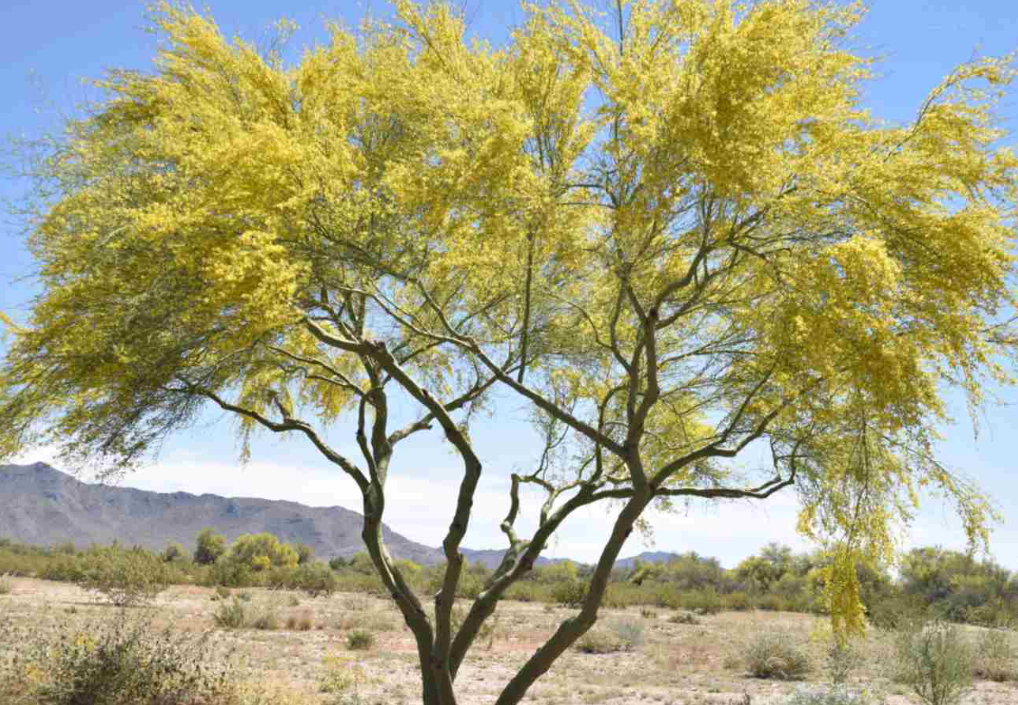
Blue palo verde is Arizona’s official state tree, and it earns that honor through sheer visual drama. Each spring, its green bark and branches disappear completely beneath a canopy of brilliant yellow flowers.
This tree photosynthesizes through its bark, not just its leaves, which is why it can survive with minimal foliage during the driest months. That adaptation lets it thrive in washes and desert flats where rainfall is scarce and unpredictable.
Blue palo verde typically grows 15 to 30 feet tall with a wide, spreading canopy. Its thorny branches provide nesting cover for desert birds, while its seed pods feed rodents and other small mammals.
I’ve never seen a desert bloom quite like a hillside of palo verde in full flower. For about two to three weeks each April, entire valleys turn gold.
2. Foothill Palo Verde (Parkinsonia microphylla)
Foothill palo verde, sometimes called yellow palo verde, is the blue palo verde’s close cousin, and the two are often confused by casual observers. This species grows at slightly higher, drier elevations along rocky foothills and bajadas.
Its bark carries a more yellow-green tint compared to blue palo verde’s blue-green shade, which is the easiest way to tell them apart. The flowers also bloom slightly later in spring, extending the desert’s golden season by a few weeks.
Foothill palo verde grows more slowly and lives longer than its blue cousin, sometimes reaching several centuries in age. It serves as a classic nurse plant, sheltering young saguaro cacti beneath its canopy until they’re established.
3. Velvet Mesquite (Prosopis velutina)
Velvet mesquite is one of the most important trees in Sonoran Desert ecosystems, providing food, shade, and shelter for dozens of wildlife species. Its deep taproots can reach groundwater more than 100 feet below the surface.
This tree produces sweet seed pods that Indigenous communities in Arizona have harvested and ground into flour for centuries. The tradition continues today among foragers who mill mesquite pods into a naturally sweet, gluten-free flour.
Velvet mesquite grows 20 to 30 feet tall with a broad, umbrella-like canopy. Its fine, feathery leaves provide dappled shade that’s cooler than open sun but still allows understory plants to grow beneath it.
4. Desert Ironwood (Olneya tesota)
Desert ironwood grows exclusively within the Sonoran Desert, making it one of Arizona’s most geographically restricted native trees. Its wood is so dense that it sinks in water, a rarity among trees.
This species can live for over 800 years, making it one of the longest-lived trees in North America’s deserts. Like palo verde, it acts as a critical nurse plant for young saguaros, protecting them from frost and intense sun.
Desert ironwood produces lavender-pink flowers in late spring, followed by seed pods that javelina and other desert mammals eat readily. Its slow growth and extreme hardness have made the wood prized for carving among Seri artisans in Sonora.
5. Desert Willow (Chilopsis linearis)
Desert willow isn’t a true willow at all, but its narrow, drooping leaves resemble one closely enough to earn the name. It belongs instead to the trumpet creeper family, related to catalpa trees.
This species produces large, orchid-like flowers in shades of pink, lavender, and white throughout the warm months. Hummingbirds and native bees visit these blooms constantly, making desert willow a favorite for wildlife gardens.
Desert willow grows quickly, often reaching 15 to 25 feet within a decade. It tolerates both drought and occasional flooding, which is why you’ll frequently spot it lining washes and dry streambeds across the state.
6. Fremont Cottonwood (Populus fremontii)
Fremont cottonwood is the signature tree of Arizona’s riparian corridors, forming dense gallery forests along rivers like the Verde and San Pedro. These riverside forests support more bird diversity than almost any other Arizona habitat type.
This cottonwood can grow over 60 feet tall with a broad, rounded canopy that provides some of the only substantial shade in the low desert. Its heart-shaped leaves flutter constantly, even in the lightest breeze.
Riparian habitats containing Fremont cottonwood cover less than 1% of Arizona’s land area, yet they support a disproportionate share of the state’s wildlife. Conservation groups consider these corridors among the most valuable habitats in the Southwest.
7. Arizona Sycamore (Platanus wrightii)
Arizona sycamore grows along canyon streams and drainages, particularly in the Sky Island mountain ranges of southeastern Arizona. Its mottled, peeling bark reveals patches of white, tan, and gray beneath.
This tree can reach 80 feet tall in ideal canyon conditions, towering over most other native riparian species. Its large, deeply lobed leaves provide dense shade that helps keep streambeds cool for native fish and amphibians.
Arizona sycamore is closely related to the American sycamore found across the eastern United States, but it’s adapted specifically to the state’s monsoon-driven flash floods. Its root systems anchor streambanks against seasonal flooding.
8. Arizona Walnut (Juglans major)
Arizona walnut grows in canyon bottoms and along desert streams, typically reaching 30 to 50 feet at maturity. Its compound leaves, made up of 9 to 15 narrow leaflets, give the canopy a delicate, feathery texture.
This species produces small, hard-shelled nuts that wildlife, including squirrels and javelina, rely on heavily each fall. The nuts are edible for humans too, though cracking the thick shell takes real effort.
Arizona walnut wood has a rich, dark grain similar to its eastern relative, black walnut, though it’s rarely harvested commercially due to limited availability. You’ll most often find mature specimens in protected canyon riparian zones.
9. Netleaf Hackberry (Celtis reticulata)
Netleaf hackberry gets its name from the distinctive net-like vein pattern visible on the underside of its leaves. This tough, adaptable tree grows across a wide elevation range, from desert washes to oak woodlands.
Its small, sweet berries ripen in fall and provide critical food for birds during migration season. The tree’s rough, warty bark makes it easy to identify even without leaves present.
Netleaf hackberry tolerates poor, rocky soils better than most native Arizona trees, which is why it often colonizes disturbed sites and canyon walls. It rarely grows taller than 30 feet but can live for well over a century.
10. Velvet Ash (Fraxinus velutina)
Velvet ash, also called Arizona ash, grows naturally along streams and in canyon bottoms throughout the state. It’s one of the few native Arizona trees that produces reliable golden fall color, a rare treat in a state known for evergreen desert landscapes.
This species can reach 50 feet tall with a rounded, dense canopy that provides substantial shade. Its bark is light gray with distinctive fissures that deepen as the tree matures.
Velvet ash produces small flower clusters in late spring, followed by winged seeds that disperse on the wind. Because of its water needs, it’s naturally restricted to riparian areas rather than open desert.
11. Emory Oak (Quercus emoryi)
Emory oak dominates the woodlands of southeastern Arizona’s Sky Islands, forming dense stands between 4,000 and 6,500 feet in elevation. Unlike many oaks, it holds its dark green leaves through winter, only shedding them as new growth emerges in spring.
This species produces acorns that are notably less bitter than most oaks, making them a traditional food source for Indigenous communities and wildlife alike. Coatimundi, javelina, and numerous bird species depend on Emory oak acorns each fall.
Emory oak can live for centuries, developing a broad, spreading canopy and thick, dark bark. Its wood burns hot and clean, historically making it a preferred firewood species throughout the region.
12. Gambel Oak (Quercus gambelii)
Gambel oak grows at higher elevations than Emory oak, typically found between 6,000 and 8,000 feet across Arizona’s mountain ranges. Unlike its evergreen cousin, Gambel oak is fully deciduous, turning shades of orange and russet each autumn.
This species often forms dense thickets through root sprouting, creating tangled understory growth beneath ponderosa pine forests. Wildlife, including black bears, rely heavily on its acorn crop during fall foraging season.
Gambel oak rarely grows into a single dominant trunk, more often spreading as a multi-stemmed shrub or small tree. Its wood is dense and durable, historically used for tool handles and fence posts by mountain communities.
13. Ponderosa Pine (Pinus ponderosa)
Ponderosa pine forms the largest contiguous ponderosa forest in the world across Arizona’s Mogollon Rim, stretching for hundreds of miles. This iconic tree can reach heights of over 100 feet and live for more than 400 years.
Its thick, puzzle-piece bark releases a distinct vanilla or butterscotch scent when warmed by the sun, a detail that surprises most first-time visitors. Long, deep-green needles grow in bundles of three, distinguishing it from other regional pines.
Ponderosa pine forests depend on periodic low-intensity fire to clear underbrush and recycle nutrients. Decades of fire suppression have left many Arizona ponderosa stands overcrowded, a major factor behind the state’s increasingly severe wildfire seasons.
14. Alligator Juniper (Juniperus deppeana)
Alligator juniper gets its name from thick, deeply furrowed bark that resembles reptile scales, the most distinctive bark pattern of any Arizona native tree. This species grows at mid to high elevations, often alongside oak and pinyon pine.
This is the largest juniper species in North America, with mature trunks sometimes exceeding four feet in diameter. Its berry-like cones provide food for wildlife, while its wood burns slowly and produces intense heat.
Alligator juniper can live for over 500 years, developing a gnarled, twisted trunk that looks ancient even on moderately aged specimens. Old-growth individuals are scattered throughout Arizona’s higher desert grasslands and woodlands.
15. Utah Juniper (Juniperus osteosperma)
Utah juniper dominates the pinyon-juniper woodlands that cover more of Arizona than any other forest type. Combined with other juniper species, these woodlands stretch across roughly 14.8 million acres, or over 20% of the entire state.
This tree tolerates extreme drought and poor soils better than almost any other Arizona native, often growing on exposed rocky slopes where little else survives. Its blue-gray berries persist through winter, providing crucial food for wildlife when other resources are scarce.
Utah juniper rarely exceeds 20 feet in height, growing slowly into a gnarled, weathered shape over centuries. Its aromatic wood has long been used for fence posts because of its exceptional resistance to rot.
16. Pinyon Pine (Pinus edulis)
Pinyon pine grows alongside juniper across Arizona’s high desert plateaus, together forming one of the most widespread woodland types in the Southwest. This small, rounded pine rarely exceeds 35 feet, growing slowly in nutrient-poor, rocky soils.
Its edible seeds, pine nuts, have been harvested by Indigenous peoples in Arizona for thousands of years and remain a prized wild food today. Harvests vary dramatically year to year, with heavy cone crops occurring only every few years.
Pinyon pine needles grow in bundles of two, a key feature distinguishing it from ponderosa’s bundles of three. The tree’s dense, resinous wood has historically been used for both fuel and construction.
17. Quaking Aspen (Populus tremuloides)
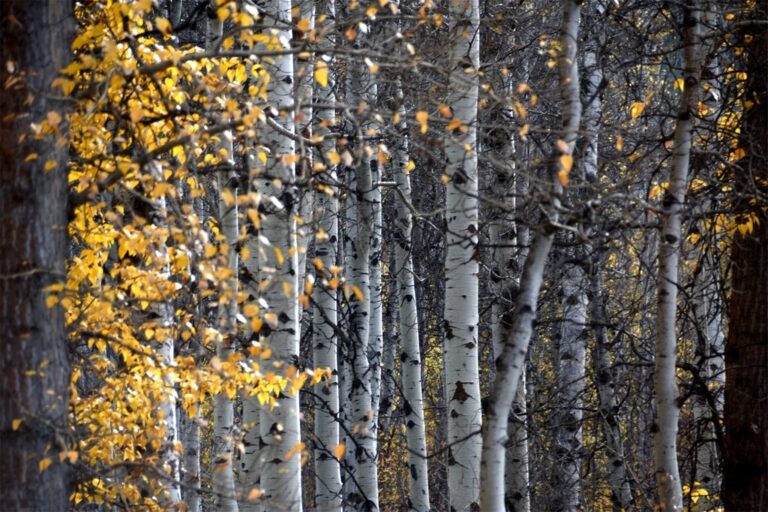
Quaking aspen occupies Arizona’s highest forested elevations, typically above 7,500 feet on mountains like the San Francisco Peaks. Its smooth, white bark and heart-shaped leaves make it one of the most photographed native trees in the state.
The tree gets its name from leaves that flutter and shimmer at the slightest breeze, thanks to flattened leaf stems. In fall, entire aspen groves turn brilliant gold almost simultaneously, drawing visitors from across the Southwest.
Aspen groves often function as a single connected organism, since new trunks sprout from a shared root system. Some aspen colonies are estimated to be thousands of years old, even though individual trunks rarely live past 150 years.
18. Arizona Cypress (Hesperocyparis arizonica)
Arizona cypress grows in the canyons and mountains of central and southeastern Arizona, often reaching 40 to 70 feet tall. Its blue-gray, scale-like foliage gives the tree a distinctive silvery appearance among the surrounding green pines and oaks.
This species is remarkably fire-adapted, with fibrous, shredding bark that helps protect the trunk from moderate burns. Round, woody cones can remain closed on branches for years, releasing seeds only after fire heat triggers them to open.
Arizona cypress has become a popular ornamental and windbreak tree well beyond its native range, prized for its drought tolerance and attractive form. In the wild, though, it remains restricted to specific canyon and mountain habitats.
19. Douglas Fir (Pseudotsuga menziesii)
Douglas fir grows in Arizona’s cooler, moister mountain canyons and north-facing slopes, typically above 7,000 feet. While more commonly associated with the Pacific Northwest, Arizona’s populations represent a hardy, drought-adapted variety of the species.
This towering conifer can exceed 100 feet in height within suitable canyon habitat, with soft, flat needles and distinctive drooping cones featuring three-pronged bracts. Those bracts make Douglas fir cones instantly recognizable compared to other regional conifers.
Douglas fir provides critical shade and moisture retention in Arizona’s Sky Island canyons, supporting cooler microclimates than surrounding slopes. These pockets often shelter species more typical of forests hundreds of miles to the north.
20. White Fir (Abies concolor)
White fir grows at Arizona’s highest, coolest elevations, often mixed with Douglas fir and Engelmann spruce above 8,000 feet. Its soft, blue-green needles and smooth, silvery-gray bark distinguish it from the state’s pine species.
This tree can live for 300 years or more, growing into a tall, symmetrical form that’s often harvested regionally as a Christmas tree. Its needles release a pleasant citrus-like scent when crushed.
White fir requires more moisture than most Arizona natives, restricting it to sheltered, high-elevation forests on mountains like the San Francisco Peaks and the White Mountains. These cooler forest pockets are increasingly vulnerable to drought stress.
21. Engelmann Spruce (Picea engelmannii)
Engelmann spruce marks the upper limit of Arizona’s forested elevations, growing in sub-alpine zones above 9,000 feet on the state’s tallest peaks. This is about as close to true alpine habitat as Arizona gets.
Its short, sharp needles and thin, scaly bark help it endure harsh winter conditions rarely associated with the Southwest. Dense stands of Engelmann spruce create a cool, shaded understory very different from the sunbaked desert far below.
Engelmann spruce grows slowly, sometimes taking over a century to reach full maturity. These high-elevation forests remain among the least visited and most fragile ecosystems anywhere in Arizona.
22. Netleaf Oak (Quercus rugosa)
Netleaf oak, sometimes called net-leaf live oak, grows in the Sky Island ranges of southeastern Arizona, occupying similar elevation bands to Emory oak. Its thick, leathery leaves have distinctly wavy, net-veined margins that give the species its name.
This evergreen oak holds its foliage year-round, providing consistent cover for wildlife even during Arizona’s driest winter months. Its acorns mature within a single season, feeding birds and small mammals throughout the fall.
Netleaf oak often grows as a large shrub or small multi-trunked tree, rarely exceeding 30 feet. It thrives on rocky slopes and canyon edges where competition from larger trees is limited.
23. Arizona Rosewood (Vauquelinia californica)
Arizona rosewood is a slow-growing, evergreen native found on rocky desert slopes and canyon walls across central and southern Arizona. Clusters of small white flowers bloom in late spring, followed by woody seed capsules that persist through winter.
This species tolerates extreme heat and drought exceptionally well, making it a popular choice for xeriscape landscaping throughout Phoenix and Tucson. Its narrow, leathery leaves reduce water loss during the hottest months of the year.
Arizona rosewood rarely exceeds 20 feet in height, often growing as a dense, rounded shrub rather than a true tree. Its wood is notably hard and heavy, a trait reflected clearly in its common name.
24. Soaptree Yucca (Yucca elata)
Soaptree yucca isn’t a tree in the strict botanical sense, but its tall, woody trunk and tree-like form earn it a spot on most native Arizona tree lists, including guides from state nurseries. It’s also New Mexico’s state flower, though it grows widely across Arizona’s grasslands and deserts.
This species can grow a distinctive trunk over time, eventually reaching heights of 15 feet or more with a crown of narrow, spiky leaves. Tall flower stalks shoot up each summer, topped with clusters of creamy white blooms.
Soaptree yucca gets its name from the saponin compounds in its roots, historically used by Indigenous communities as a natural soap and shampoo. Its slow growth and striking silhouette make it a defining feature of Arizona’s high desert grasslands.
25. Joshua Tree (Yucca brevifolia)
Joshua tree, another yucca species that reaches genuinely tree-like proportions, grows in the far northwestern corner of Arizona within the Mojave Desert. It’s one of the most recognizable silhouettes in the American Southwest.
This species can live for over 150 years, growing slowly into a twisted, branching form topped with spiky rosettes of leaves. Its white-green flowers bloom in spring, pollinated exclusively by the yucca moth in a relationship found nowhere else in nature.
Joshua trees depend entirely on specific climate conditions found only in limited pockets of Arizona, making the state’s populations ecologically significant despite their small footprint. Conservation groups increasingly monitor these stands as climate patterns shift across the Mojave region.
Final Thoughts
Arizona’s 25 native trees span an extraordinary range, from ground-hugging desert specialists like desert willow to towering ponderosa pines exceeding 100 feet. Pinyon-juniper woodlands alone cover more than 20% of the entire state, making that combination Arizona’s single most dominant native forest type.
Once you start recognizing these 25 trees, Arizona stops looking like a barren desert and starts looking like layered, living country. Every elevation band tells its own story, from palo verde blooming in the low desert to aspen groves shimmering near the peaks.
Start with whatever grows closest to home, then work your way up in elevation as your curiosity grows. Before long, you’ll spot the difference between a blue palo verde and a foothill palo verde without even breaking your stride.
References
- Arizona Department of Forestry and Fire Management, Community Forestry — https://dffm.az.gov/forestry-community-forestry/urban-community-forestry
- Arizona Department of Forestry and Fire Management, Tree Care — https://dffm.az.gov/forestry-community-forestry/tree-care
- USDA Forest Service, Arizona’s Forest Resources, 2001–2014 — https://research.fs.usda.gov/treesearch/56264
- USDA Forest Service, Forests of Arizona, 2021: FIA Annual Snapshot — https://research.fs.usda.gov/treesearch/80254
- USDA Forest Service, 2022 Arizona Forest Health Highlights — https://fs.usda.gov/foresthealth/docs/fhh/AZ_FHH_2022.pdf
- University of Arizona Cooperative Extension, Verde Valley Plant List — https://extension.arizona.edu/sites/extension.arizona.edu/files/attachment/VerdeValleyPlantListApril2021.pdf
- Arizona Department of Forestry and Fire Management, State and Private Forestry Fact Sheet 2026 — https://apps.fs.usda.gov/nicportal/temppdf/sfs/naweb/az_std.pdf

Tim M Dave is a gardening expert with a passion for houseplants, particularly cacti and succulents. With a degree in plant biology from the University of California, Berkeley, he has vast experience in gardening. Over the years, he has cultivated a vast collection of desert plants and learned a great deal about how to grow and care for these unique companions.