20 Popular Types of Dragon Fruit: Every Variety Worth Knowing, With Photos
I still remember the first time I cut open a dragon fruit and found stark white flesh speckled with tiny black seeds. I expected something closer to the deep magenta I had seen in photos. That small surprise is exactly why this guide exists.
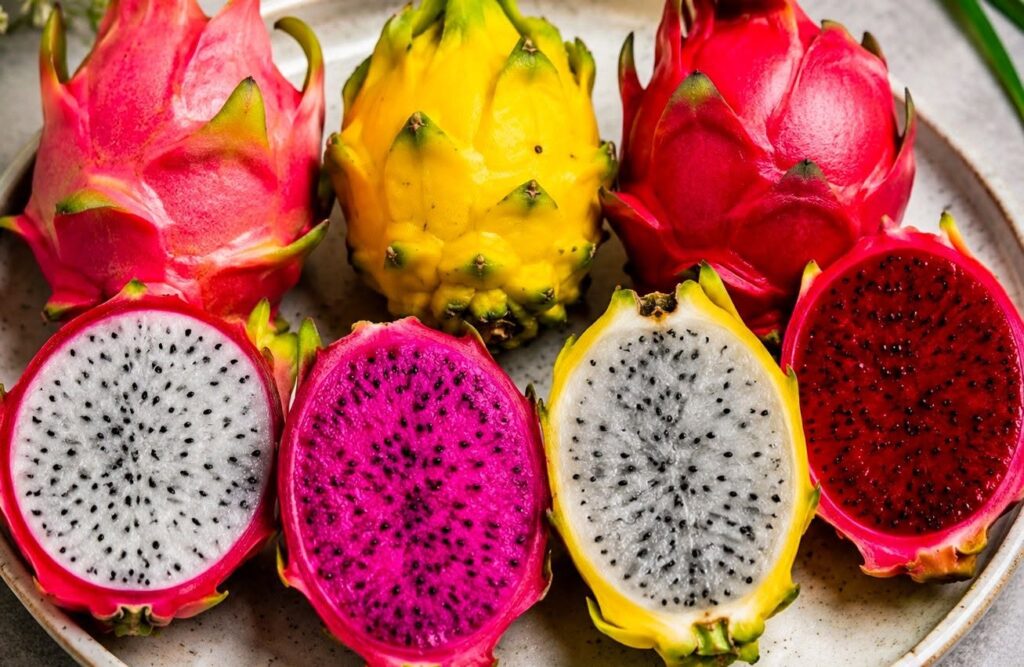
Dragon fruit is not one single thing. The color of the skin rarely predicts the color of the flesh inside, and the flavor can range from barely sweet to genuinely rich.
Below, I have grouped 20 popular types of dragon fruit into five practical categories, with detailed notes on growing zones, plant characteristics, and care, so you can shop, grow, or cook with real confidence.
The Main Dragon Fruit Categories
Before the full list, here is the short version. Dragon fruit, also called pitaya or pitahaya, comes from climbing cacti in the family Cactaceae, most now classified under the genus Selenicereus (formerly grouped separately as Hylocereus), according to the University of Hawaii College of Tropical Agriculture and Human Resources (CTAHR).
From that shared cactus family, growers and breeders have produced dozens of named cultivars, generally split into:
- White-fleshed dragon fruit — mild, subtly sweet, the most widely available type
- Red and pink-fleshed dragon fruit — sweeter, juicier, rich in natural pigments
- Purple and magenta hybrid dragon fruit — deep color, bold flavor, often named after classic rock songs
- Yellow-skinned dragon fruit — smaller fruit, widely considered the sweetest
- Specialty and rare dragon fruit — unusual traits like spineless stems or oversized fruit
A Short History Worth Knowing
Dragon fruit is native to tropical America, including southern Mexico, the Pacific side of Guatemala, Costa Rica, and El Salvador, according to University of Florida IFAS Extension. It later spread through Colombia, Ecuador, Venezuela, and other South American countries long before it became a global commercial crop.
The plant reached Southeast Asia centuries later, where French colonists are believed to have introduced it to Vietnam. That single introduction transformed the crop entirely.
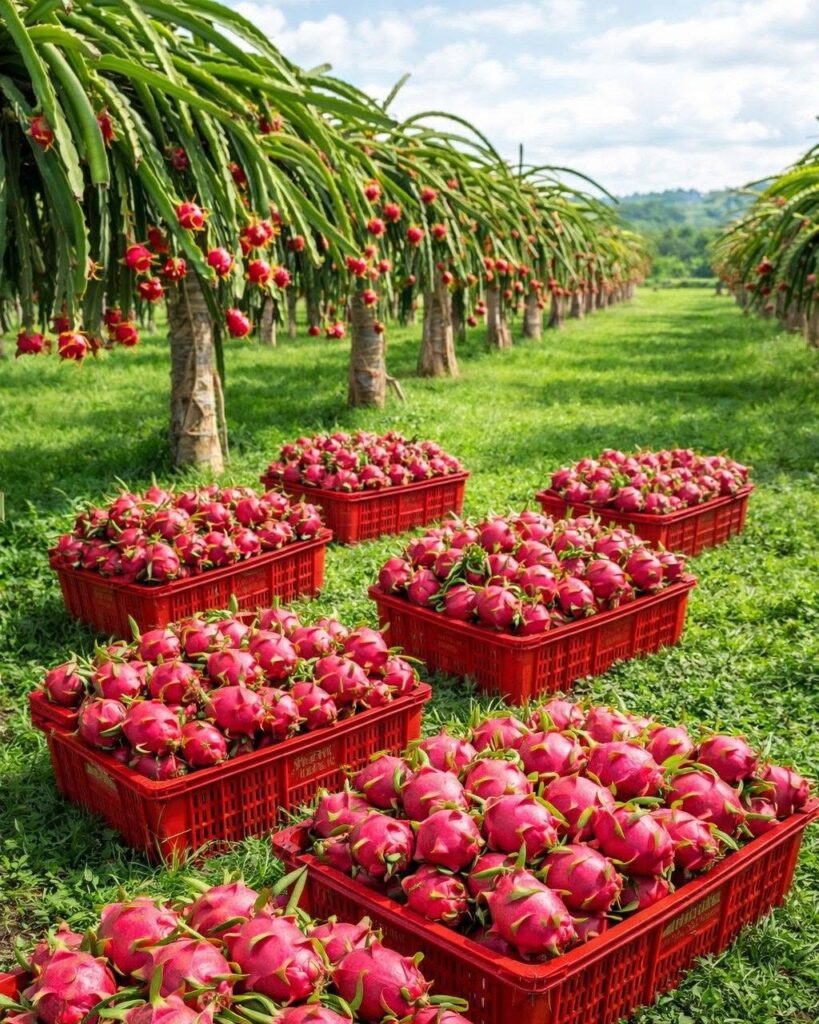
Vietnam has since become the world’s dominant dragon fruit grower. According to a 2024 export analysis, Vietnam cultivates nearly 55,000 hectares of dragon fruit and produces over one million tons annually, with roughly 80 to 85 percent of that harvest destined for export markets, chiefly China, the United States, and India.
Growing Zones and Climate: Where Dragon Fruit Actually Thrives
Dragon fruit is a tropical and subtropical crop, and its cold tolerance is far more limited than its cactus appearance suggests. UF/IFAS Extension notes that plants tolerate cool or warm climates as long as temperatures stay below 100°F, with optimal growth occurring between 65°F and 77°F.
Freezing temperatures are the real threat. Extended exposure to temperatures below 31°F can seriously damage or kill a pitaya plant, though UF/IFAS notes that vines often recover quickly from brief, light freezing injury.
In the continental United States, that narrows outdoor cultivation mostly to USDA Hardiness Zones 10 and 11 — South Florida, South Texas, Hawaii, and parts of coastal Southern California. Elsewhere, growers rely on greenhouses, containers that can be moved indoors, or heavily protected microclimates.
A few zone-specific notes worth knowing:
- Zone 9b–10 (South Florida, South Texas): Outdoor trellised growing works well year-round with occasional frost protection during rare cold snaps.
- Zone 9a and cooler: Container growing is strongly recommended, since plants can be moved indoors or under cover before frost.
- Coastal Southern California (Zone 10a–10b): Marine influence keeps winters mild enough for many growers, though summer heat and fog patterns vary by microclimate.
- Everywhere else: Greenhouse or indoor container cultivation is the realistic path, with supplemental lighting to trigger flowering.
Regardless of zone, dragon fruit demands strong, direct sunlight and a sturdy trellis, since a mature plant’s fleshy stems can stretch up to 20 feet and weigh several hundred pounds once established.
Understanding Dragon Fruit Species and Flesh Color
Before diving into named cultivars, it helps to understand the underlying species.
According to a scientific naming reference published by the USDA Animal and Plant Health Inspection Service (APHIS), at least six species have contributed to today’s commercial dragon fruit varieties, including Selenicereus undatus, S. costaricensis, S. monacanthus, S. megalanthus, S. guatemalensis, and S. ocamponis.
Flesh color depends on species and cross-breeding, not on skin color alone. A pink-skinned fruit might contain white, red, or deep magenta flesh, which is exactly why the categories below matter more than skin color when shopping or choosing a cultivar to grow.
White-Fleshed Dragon Fruit (Best for Mild, Everyday Eating)
White-fleshed types are the most widely distributed dragon fruit in grocery stores worldwide. They are mildly sweet, refreshing, and often compared to a kiwi crossed with a pear.
1. Vietnamese White (Thanh Long)
As the backbone of Vietnam’s entire dragon fruit export industry, this self-fertile cultivar produces pink-skinned, medium-to-large fruit averaging around 14 ounces, with white flesh and a total soluble solids reading of roughly 13 to 19 percent, a strong measure of sweetness for a white-fleshed type. Vines are exceptionally vigorous and productive.
Growing zones and conditions: Well suited to Zones 10 and 11 outdoors, and the standard commercial choice throughout tropical and subtropical Asia. It tolerates high humidity and heat better than many hybrid cultivars.
Care tips: As a strong self-pollinator, it doubles as a reliable pollen donor for less fertile cultivars planted nearby. Trellis heavily, since its vigor quickly produces dense stem growth that needs regular pruning.
Best use: Fresh eating and the default choice for commercial export production worldwide.
2. David Bowie
David Bowie is among the most popular white-fleshed cultivars, producing some of the largest fruit in its category, often reaching a full pound. Vibrant red skin with green-tipped fins gives it strong visual appeal, and the flavor carries a subtle lemony finish reminiscent of kiwi crossed with pear.
Growing zones and conditions: Performs well in Zones 9b through 11, and is a favorite among home growers in California and Florida for its self-pollinating reliability.
Care tips: Because it is self-pollinating, it requires no partner cultivar to set fruit, making it an excellent single-plant choice for smaller yards or patios.
Best use: Fresh eating, juicing, fruit salads, and garnishes, thanks to its large size and mild flavor.
3. Alice
Named for a California rare-fruit grower, Alice produces semi-sweet, medium-sized fruit typically between half a pound and one pound, with a smooth, refreshing flavor profile on moderately vigorous vines.
Growing zones and conditions: Well-adapted to Zones 9b through 11, with particularly consistent performance in mild coastal California climates.
Care tips: Provide full sun and a sturdy trellis; this variety benefits from occasional cross-pollination with a different cultivar to improve fruit set even though it can self-pollinate.
Best use: Fresh eating for home growers wanting dependable, moderate-sized fruit.
4. Delight
Delight is a reliable white-fleshed cultivar known for balanced sweetness and reliable self-pollination, producing medium fruit on vigorous, easy-to-manage vines. It is well suited to Zones 9b through 11, including greenhouse production in cooler regions.
Care tips: Because it self-pollinates reliably, it is a practical choice for isolated single-plant setups where no other cultivar is available nearby.
Best use: Everyday fresh eating for growers who want low-maintenance, consistent yields.
5. Seoul Kitchen
Seoul Kitchen is a white-fleshed selection appreciated for its clean, refreshing flavor and productive vines, producing medium fruit with good visual presentation. It performs well in Zones 9b through 11, and is frequently recommended alongside David Bowie in mixed home orchard plantings.
Care tips: Pairing it with David Bowie or another compatible cultivar nearby can improve cross-pollination and overall fruit set.
Best use: Fresh eating and diversified home orchard plantings.
Red and Pink-Fleshed Dragon Fruit (Best for Bold Flavor and Antioxidants)
Red-fleshed types are sweeter, juicier, and more intensely flavored than their white-fleshed relatives. Their deep color comes from betalains, natural pigments also found in beets, which research has linked to antioxidant activity.
6. American Beauty
American Beauty is one of the most requested red-fleshed cultivars, producing purple-red flesh that is tart when picked early and notably sweet at full ripeness, on vigorous, highly productive vines.
This popular variety of dragon fruit grows well in Zones 9b through 11, and is considered one of the more heat-tolerant red-fleshed selections available to home growers.
Care tips: It self-pollinates but produces even better yields when cross-pollinated with Lisa or Sugar Dragon planted nearby, so consider a second cultivar if maximizing harvest is the goal.
Best use: Fresh eating and desserts where bold color and rich flavor matter most.
7. Vietnamese Jaina (Red Jaina)
Vietnamese Jaina is among the heaviest-producing cultivars available, with fruit averaging half a pound to three-quarters of a pound and especially dark red flesh on vigorous, heavy-bearing vines. It is well-suited to Zones 9b through 11, and a common choice among commercial growers focused on juice production.
Care tips: Its heavy fruit set means extra trellis support is worthwhile, since the vines can become overloaded during peak production periods.
Best use: Its juice potential makes it a favorite for smoothies and tropical drinks, alongside fresh eating.
8. Bloody Mary
This is a striking, deep-red-fleshed cultivar named for its vivid color, producing medium-to-large fruit prized among home growers for rich juice and dessert applications. Bloody Mary is adaptable across Zones 9b through 11, performing comparably to other red-fleshed hybrids in warm, humid climates.
Care tips: Regular pruning after the vine reaches the top of its trellis encourages the lateral branching needed for consistent flowering.
Best use: Desserts, juices, and any dish where deep red color is the visual highlight.
9. Halley’s Comet
Halley’s Comet is a red-to-purple-fleshed hybrid cultivar known for strong vigor and heavy fruit set, producing medium-to-large fruit on vines that branch prolifically. It performs well in Zones 9b through 11, and is commonly grown alongside other named hybrids in mixed home orchards for diversified pollination.
Care tips: Its vigorous branching habit benefits from an especially sturdy trellis structure capable of supporting significant stem weight over time.
Best use: Fresh eating and mixed-orchard cross-pollination support for other hybrid cultivars.
10. Robles Red
Recognized for bold color and consistent growth, Robles Red produces medium fruit with reliably deep red flesh on moderately vigorous vines. It is well-suited to Zones 9b through 11, and frequently recommended for home gardeners seeking dependable red-fleshed production.
Care tips: Requires standard trellising and consistent watering; it is considered relatively low-maintenance among red-fleshed hybrids.
Best use: Dependable home-garden fresh eating without excessive care requirements.
11. Eureka Red
Eureka Red is a red-fleshed selection valued for juicier texture and a more intense flavor profile than standard white-fleshed types, on productive, moderately vigorous vines. It is adaptable across Zones 9b through 11, with solid performance in both humid and drier warm climates.
Care tips: Consistent moisture during fruit development improves juiciness; allow the soil to dry slightly between waterings to avoid root rot.
Best use: Fresh eating and juice production, thanks to its notably juicy texture.
Purple and Magenta Hybrid Dragon Fruit (Best for Unique Flavor and Garden Novelty)
This category covers hybrids between red-fleshed and white-fleshed parent varieties, producing fruit with deep purple or magenta interiors. Many of these cultivars carry playful names borrowed from classic rock songs and musicians.
12. Physical Graffiti
This is a hybrid of red-fleshed and white-fleshed parent lines, producing large fruit often weighing up to 1.5 pounds with a balanced sweet-and-sour flavor and light purple, showy flesh, on highly vigorous, prolific vines.
Physical Graffiti Performs exceptionally well in Zones 9b through 11, and is specifically noted as growing well in both California and Florida soils.
Care tips: It is self-pollinating and high-yielding, sometimes producing so heavily that growers need to thin excess fruit to maintain quality and vine health.
Best use: Considered one of the best all-around performers for fresh eating, widely regarded as one of the tastiest cultivars available to home growers.
13. Purple Haze
Purple Haze is a large, sweet, low-seed cultivar that can weigh up to two pounds, with a flavor often described as grape crossed with kiwi, on vigorous, highly productive vines. It is well-adapted to Zones 9b through 11, performing reliably across warm coastal and inland climates alike.
Care tips: Like most magenta-fleshed types, it is self-pollinating and does not require a separate pollinator variety, simplifying care for single-plant growers.
Best use: Fresh eating, juicing, and garnishing, given its genuine commercial value and low seed count.
14. Natural Mystic
This is a red-fleshed hybrid producing large, semi-sweet fruit with red skin, on self-fertile vines named after the well-known Bob Marley track. Natural Mystic is suited to Zones 9b through 11, with reliable production reported by specialty growers across warm-climate regions.
Care tips: Because it is self-fertile, it needs no pollinator partner, though cross-pollination with a compatible cultivar can still improve overall yield.
Best use: Fresh eating for growers who want reliable production from a single self-fertile plant.
15. Cosmic Charlie
Cosmic Charlie is a magenta-fleshed hybrid appreciated for deep color and balanced sweetness, producing medium-to-large fruit on moderately vigorous vines. It performs well in Zones 9b through 11, frequently grown alongside Physical Graffiti and Voodoo Child in specialty orchards.
Care tips: Benefits from being planted near other hybrid cultivars to diversify pollen sources, even though it can produce fruit on its own.
Best use: Fresh eating and visual variety in a mixed dragon fruit planting.
16. Voodoo Child
This is a deeply colored hybrid cultivar valued for its striking presentation and moderately sweet, tangy flavor, on vigorous, well-branching vines. Voodoo Child is adaptable across Zones 9b through 11, commonly grown in mixed collections alongside other named hybrid cultivars.
Care tips: Commonly used to diversify pollination in mixed dragon fruit plantings, making it a useful addition to an orchard already growing other hybrids.
Best use: Fresh eating and collector-style plantings valued for variety and visual appeal.
Yellow-Skinned Dragon Fruit (Best for Maximum Sweetness)
Yellow dragon fruit comes from a genetically distinct species, Selenicereus megalanthus, and is widely regarded as the sweetest category of all. The fruit tends to be smaller than red or white types, with thinner, spinier skin that sheds its thorns as it ripens.
17. Ecuador Palora
This is a well-known yellow-skinned cultivar producing oval, thorned fruit that loses its spines at full ripeness. Fruit averages around 0.8 pounds, with intensely sweet, crisp white flesh on slender, green, thorn-covered stems.
Because S. megalanthus tolerates slightly cooler nights better than red or white hybrids, it can perform in the cooler portions of Zone 9b in addition to Zones 10 and 11, though it still requires a frost-free climate.
Care tips: Allow the fruit to fully ripen and drop its spines naturally before harvest; picking too early results in noticeably less sweetness.
Best use: Many growers consider it the benchmark for yellow dragon fruit flavor, ideal for fresh eating where maximum sweetness is the priority.
18. Yellow Thai
Yellow Thai is a smaller-fruited yellow variety popular in Southeast Asian markets, prized for its tangy-sweet balance and crisp texture, on slender, moderately vigorous vines. It is suited to Zones 10 and 11, with strong performance in Southeast Asia’s tropical lowland climate replicated in similar U.S. growing regions.
Care tips: Provide full sun and well-draining soil; like other yellow types, it is more sensitive to overwatering than red or white-fleshed hybrids.
Best use: Fresh eating for those who enjoy a tangier balance alongside the category’s signature sweetness.
19. Giant Colombian Yellow
This is a larger-fruited yellow selection, grown primarily in Colombia, which remains the world’s leading producer of Selenicereus megalanthus. This type offers more flesh per fruit while retaining the category’s signature sweetness.
Giant Colombian Yellow is best suited to Zones 10 and 11, mirroring the warm, high-altitude tropical conditions of its native Colombian growing regions.
Care tips: Because yellow types generally take longer to ripen, often around 90 days from flowering, patience during the final ripening stage rewards growers with noticeably better flavor.
Best use: Fresh eating where larger portions of the category’s signature sweet flesh are desired.
Specialty and Rare Dragon Fruit (Best for Collectors and Unique Growing Conditions)
20. Sin Espinas (Spineless Dragon Fruit)
This is a genuinely unusual cultivar notable for having little to no thorns along its stems, making it far easier and safer to prune and harvest. The fruit itself carries thick pink skin, green-tipped fins, and deep red flesh weighing around one pound, on self-fertile vines.
Spineless Dragon Fruit is adaptable across Zones 9b through 11, performing comparably to other red-fleshed hybrids in warm, humid climates.
Care tips: Its lack of thorns makes hand-pollination and pruning significantly safer and faster, a genuine practical advantage for home growers who dislike handling spiny cactus stems.
Best use: Fresh eating, and an excellent choice for collectors or families who want an easier, less prickly dragon fruit plant to maintain.
ALSO READ: Dragon Fruit Cactus Care and Propagation Guide
Pollination: Why Some Dragon Fruit Varieties Need a Partner
Dragon fruit flowers are hermaphroditic, meaning each bloom carries both male and female parts. Despite that, many cultivars are self-incompatible and will not set fruit reliably using their own pollen, according to UF/IFAS Extension.
To improve yields, growers are advised to plant two or three genetically different cultivars together rather than multiples of the same clone. Cross-pollination between different types consistently improves both fruit set and final fruit size.
Flowers open only at night, when bees are inactive. Moths and bats are the natural pollinators in native habitats, though this has rarely been observed in commercial settings, so many growers hand-pollinate at night or in the early morning hours instead.
Important Statistics Worth Knowing
Numbers help put the global dragon fruit trade into perspective, and I think a few of these are genuinely striking.
- Vietnam cultivates approximately 55,000 hectares of dragon fruit and produces over one million tons annually, according to a 2024 export industry analysis.
- Roughly 80 to 85 percent of Vietnam’s dragon fruit harvest is grown specifically for export.
- In 2023, Vietnam’s dragon fruit export volume reached nearly 600,000 tons, valued at approximately $600 million.
- A mature, 3- to 4-year-old pitaya plant can produce approximately 220 pounds (100 kg) of fruit per year, according to UF/IFAS Extension.
- A single pitaya planting can remain productive for roughly 20 years, based on the same UF/IFAS research.
- As of a 2013 University of California assessment, Florida grew more than 400 acres of dragon fruit, while California grew an estimated 100 to 200 acres and Hawaii around 200 acres.
- Fruit can be harvested roughly 30 to 50 days after flowering, with fruit weight increasing by about 50 percent between the earliest and latest recommended harvest windows, according to University of Hawaii CTAHR research.
These figures show a crop that has moved from a regional curiosity to a genuine global commodity within a single generation.
How to Choose the Right Dragon Fruit Type
I always tell first-time growers and shoppers to start with their actual goal, not the prettiest photo online. Ask yourself three questions:
- Do I want mild flavor or bold sweetness? White-fleshed types are gentle and versatile; red, purple, and yellow types deliver noticeably more intensity.
- Am I growing this or just eating it? If growing, plan for cross-pollination by choosing at least two different cultivars rather than one self-fertile clone alone.
- What is my climate really like? Below Zone 9b, container growing with winter protection is far more realistic than in-ground planting.
Color on the outside tells you almost nothing about the flesh inside. I learned this myself the hard way, expecting a rich red center from a pink-skinned fruit and finding plain white flesh instead. Checking the specific cultivar name, not just the skin color, is the only reliable way to know what you are getting.
Disease pressure is also worth understanding before planting. UF/IFAS Extension notes that pitaya plants can be affected by stem and fruit canker, fruit and stem rot, and bacterial infections, all of which are made worse by poor airflow and excess soil moisture.
I have found that spacing plants generously along the trellis and pruning back dense growth each season solves most of these problems before they start. A little airflow does more good than any fungicide applied after the fact.
Storage and Handling Tips That Extend Shelf Life
Even a perfectly ripe dragon fruit can go soft or lose flavor fast if stored carelessly. A few simple habits make a real difference.
Fresh dragon fruit keeps for about 4 to 5 days at room temperature, but University of Hawaii CTAHR research shows that storage in perforated plastic bags at around 40°F can extend shelf life to 25 to 30 days.
Harvest only fully colored, mature fruit, since dragon fruit does not continue ripening properly once removed from the plant. Handle it gently, since the thin, scaled skin bruises more easily than its tough appearance suggests.
Once cut, refrigerate any unused flesh in a sealed container and use it within two to three days for the best texture and flavor.
Nutrition Snapshot
Dragon fruit is prized for being both refreshing and nutritionally interesting. Fresh pitaya pulp is roughly 83 to 89 percent water, depending on species, according to nutrient composition data compiled by UF/IFAS Extension.
Vitamin C content varies meaningfully by species, with white-fleshed types (Hylocereus undatus) providing around 25 mg per 100 grams, notably higher than some red-fleshed relatives in the same comparison. The fruit also contributes modest amounts of calcium, phosphorus, iron, and dietary fiber.
Red-fleshed varieties additionally contain betalain pigments, the same antioxidant compounds found in beets, which several nutrition studies have linked to anti-inflammatory and heart-health benefits.
Frequently Asked Questions
What is the sweetest type of dragon fruit? Yellow-skinned dragon fruit (Selenicereus megalanthus), including cultivars like Ecuador Palora, is widely regarded as the sweetest category, followed by red-fleshed hybrids like American Beauty and Physical Graffiti.
Does dragon fruit need a pollinator plant? Many cultivars do. Because numerous dragon fruit varieties are self-incompatible, planting two or three genetically distinct types together significantly improves fruit set and size.
How many types of dragon fruit exist in total? Beyond these 20 popular cultivars, growers and nurseries maintain dozens of additional named selections. Nearly all of them, however, fall within the four color-based categories covered in this guide.
Can dragon fruit grow outside the tropics? Yes, but only with real limitations. Outdoor in-ground growing works reliably in USDA Zones 10 and 11; everywhere else, container growing with winter protection or a greenhouse is the practical path.
Why does my dragon fruit have white flesh even though the skin is pink? Skin color and flesh color come from different genetic traits. Pink or red skin can surround white, red, or magenta flesh depending on the specific species and cultivar, not the outer color alone.
Is dragon fruit a cactus or a regular fruit tree? It is a climbing, vine-like cactus in the family Cactaceae. Despite its cactus origins, it has a fairly high water requirement and cannot tolerate hard freezes the way many desert cacti can.
Which dragon fruit cultivar is best for a first-time home grower? Self-pollinating types such as David Bowie, Physical Graffiti, or Purple Haze are excellent starting points, since they set fruit reliably without needing a second cultivar planted nearby.
Final Thoughts
Twenty types is a lot to take in in one sitting, and I don’t expect anyone to memorize every cultivar name. What matters is understanding the four real categories — white for mild everyday eating, red or purple for bold flavor and color, and yellow for maximum sweetness.
Once you understand that framework, choosing a specific cultivar becomes a matter of personal taste, available growing space, and a genuine appreciation for one of the most visually spectacular fruits in the world.
References
- University of Florida IFAS Extension. Pitaya (Dragonfruit) Growing in the Florida Home Landscape. https://ask.ifas.ufl.edu/publication/HS303
- University of Florida IFAS Extension. Pitaya (Dragon Fruit) (Hylocereus undatus) Pests and Beneficial Insects. https://ask.ifas.ufl.edu/publication/IN1292
- University of Hawaii College of Tropical Agriculture and Human Resources (CTAHR). Pitaya (Dragon Fruit, Strawberry Pear), Fruits and Nuts FN-9. https://www.ctahr.hawaii.edu/oc/freepubs/pdf/F_N-9.pdf
- USDA Animal and Plant Health Inspection Service (APHIS). Scientific Names of Dragon Fruit Species. https://www.aphis.usda.gov/sites/default/files/scientificnames_dragon_fruit_species.pdf
- Agricultural Marketing Resource Center, Iowa State University. Dragon Fruit. https://www.agmrc.org/commodities-products/fruits/dragon-fruit
- National Center for Biotechnology Information (NCBI), National Institutes of Health. Pitaya Nutrition, Biology, and Biotechnology: A Review. https://pmc.ncbi.nlm.nih.gov/articles/PMC10530492/
- National Center for Biotechnology Information (NCBI), National Institutes of Health. Distinguishing Three Dragon Fruit (Hylocereus spp.) Species Grown in Andaman and Nicobar Islands of India Using Morphological, Biochemical and Molecular Traits. https://pmc.ncbi.nlm.nih.gov/articles/PMC7859243/

Tim M Dave is a gardening expert with a passion for houseplants, particularly cacti and succulents. With a degree in plant biology from the University of California, Berkeley, he has vast experience in gardening. Over the years, he has cultivated a vast collection of desert plants and learned a great deal about how to grow and care for these unique companions.