20 Kentucky Native Shrubs (With Growing Details)
I have walked a lot of Kentucky fence rows, creek banks, and forest edges over the years. Every single time, the same lesson shows up: native shrubs do more work than any imported ornamental ever will. They feed birds. They hold soil. They ask for almost nothing once established.
This guide covers 20 shrubs native to Kentucky, what the shrub looks like, where it grows best in Kentucky, and why it earns a spot in your yard.
Remember to pick shrubs based on your soil moisture, not just your climate zone. Kentucky ranges from wet Bluegrass floodplains to dry Appalachian ridgetops, and the wrong native shrub in the wrong spot still struggles.
The 20 Native Shrubs of Kentucky
1. American Hazelnut (Corylus americana)
American hazelnut grows across every region of Kentucky, usually reaching 10 to 16 feet tall and wide. Its toothed leaves turn a warm yellow-orange in fall, and the edible nuts ripen by late summer.
I like recommending this one to new gardeners because it is nearly foolproof. It tolerates clay, part shade, and neglect equally well.
Squirrels, deer, and several bird species rely on the nuts for fall and winter food. Plant it as an informal hedge or screen along a property line for the best results.
2. New Jersey Tea (Ceanothus americanus)
This low, rounded shrub tops out around 3 feet and produces clusters of small white flowers in early summer. Colonists once dried its leaves as a caffeine-free tea substitute during the Revolutionary War, which is where the common name comes from.
New Jersey Tea handles dry, rocky soil that would kill most ornamentals. Its deep taproot makes it drought tolerant once established, though that same root makes transplanting difficult after year one.
Bees and butterflies swarm the blooms, and the plant also fixes nitrogen in the soil through root nodules. It is an excellent choice for a sunny, dry front-yard bed.
3. Northern Spicebush (Lindera benzoin)
Spicebush is one of the first native shrubs to bloom each spring, with small yellow flowers appearing before the leaves. Crush a leaf or twig and you get an immediate spicy, citrusy scent.
It grows 6 to 12 feet tall in the understory of moist Kentucky woodlands and tolerates fairly deep shade, which makes it valuable for shady lots where few flowering shrubs perform well.
Spicebush is the sole host plant for the spicebush swallowtail butterfly caterpillar. Female plants also produce red berries that migrating thrushes eat heavily in fall.
4. Common Buttonbush (Cephalanthus occidentalis)
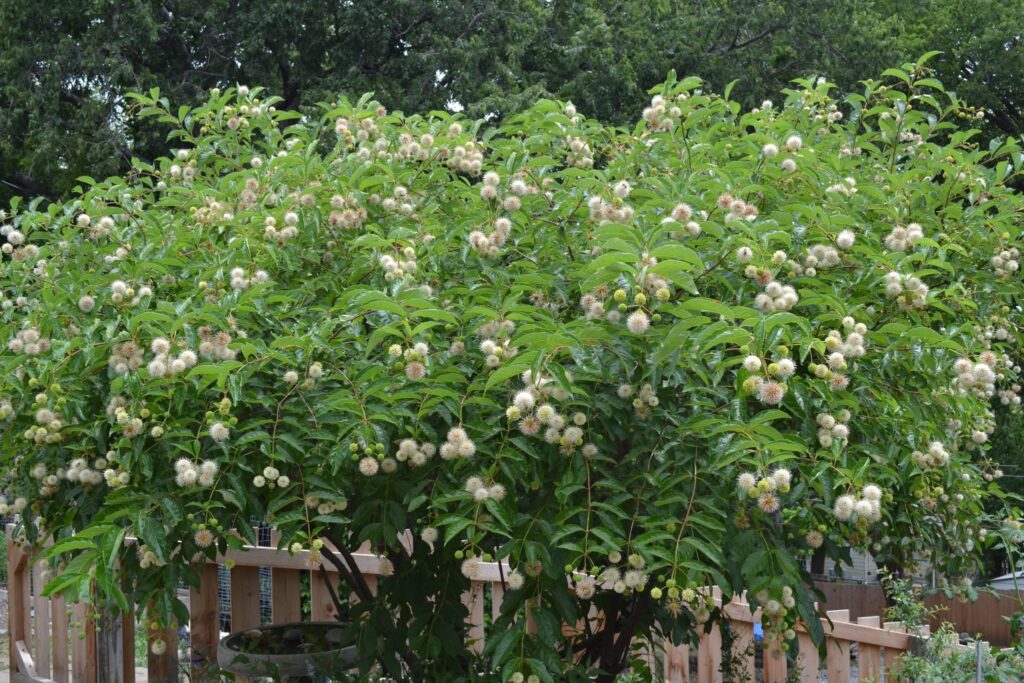
Buttonbush produces round, pincushion-like white flower clusters in mid to late summer, unlike almost any other native shrub in the state. It grows 6 to 12 feet tall and genuinely thrives with wet feet.
This is the shrub to plant at the edge of a pond, rain garden, or low spot that stays soggy after storms. Most ornamental shrubs rot in those conditions; buttonbush does not.
The flowers draw an impressive number of butterflies, bees, and hummingbirds. Ducks and other waterfowl also eat the seeds, which is why wildlife managers plant it around wetland restoration sites.
5. Winterberry Holly (Ilex verticillata)
Winterberry is a deciduous holly, meaning it drops its leaves in fall and reveals bright red berries that persist through winter. Female plants need a nearby male pollinator to set fruit, so buy at least one of each.
It grows 6 to 10 feet tall and prefers consistently moist, slightly acidic soil, though it adapts to average garden conditions reasonably well.
Kentucky’s own extension nurseries recommend winterberry as the direct replacement for inkberry holly, which suffers badly from root rot across the state. The winter berry display also feeds cedar waxwings and robins when food is scarce.
6. American Witch Hazel (Hamamelis virginiana)
Witch hazel is the last native shrub to bloom in Kentucky each year, producing thin, ribbon-like yellow flowers in October and November after the leaves have already fallen. It reaches 15 to 20 feet, more small tree than shrub.
The strange late bloom time means it feeds any remaining late-season moths and flies when almost nothing else is flowering.
Witch hazel tolerates full shade better than most flowering shrubs, making it a strong pick for the north side of a house or a mature woodland edge.
7. Fragrant Sumac (Rhus aromatica)
Fragrant sumac stays low and spreading, usually 2 to 6 feet tall, with three-lobed leaves that resemble poison ivy but lack the toxic oils. Crushed leaves release a strong citrus scent.
This shrub is built for tough spots: dry banks, rocky slopes, and erosion-prone areas where grass will not establish. Its spreading root system holds soil in place effectively.
Fall color runs deep red to orange, and the small red berry clusters that follow the spring flowers feed a range of songbirds through winter.
8. Smooth Sumac (Rhus glabra)
Smooth sumac grows taller and more upright than its fragrant cousin, often reaching 9 to 15 feet, and it spreads by suckering roots to form colonies over time. That spreading habit means it is best used along a fence line rather than a small foundation bed.
The tall, cone-shaped red seed clusters remain on the plant well into winter, providing an emergency food source for birds when other options run out.
Fall foliage color is genuinely spectacular, often shifting through orange, red, and purple on the same plant.
9. Silky Dogwood (Cornus amomum)
Silky dogwood grows 6 to 10 feet tall along streambanks and wet meadow edges throughout Kentucky. Its reddish-purple stems add winter interest once the leaves drop, and clusters of blue-tinted fruit follow the white spring flowers.
This shrub handles occasional flooding without complaint, which makes it one of the better choices for a rain garden or a low spot near a downspout.
More than 40 bird species are documented using dogwood fruits as a food source across the eastern United States, and silky dogwood is a reliable contributor to that total in Kentucky.
10. Gray Dogwood (Cornus racemosa)
Gray dogwood prefers drier ground than its silky cousin and tolerates full sun to partial shade equally well. It reaches 8 to 12 feet and spreads by suckers, eventually forming a dense thicket.
White berries on bright red stalks appear in late summer, creating a striking two-tone display that photographs beautifully and disappears quickly once birds arrive.
Because it thickets so readily, gray dogwood works well as an informal privacy screen or a mass planting along a difficult slope.
11. Black Chokeberry (Aronia melanocarpa)
Black chokeberry produces white spring flowers followed by dark purple-black berries packed with antioxidants. The shrub grows 3 to 6 feet tall and adapts to wet or average soil without much fuss.
Fall color turns a deep, glossy red that rivals burning bush, the invasive shrub it is often recommended to replace in Kentucky landscape plans.
The berries are edible for humans, though tart, and they persist on the plant into winter as an important food source for grouse, robins, and cedar waxwings.
12. American Elderberry (Sambucus canadensis)
Elderberry grows fast, often 5 to 12 feet in a single season, with large flat-topped clusters of white flowers in early summer followed by dark purple berry clusters in August.
It prefers consistently moist soil and full sun, making it a natural fit for the edge of a pond, ditch, or rain garden bed.
Elderberries are widely used in jams, syrups, and immune-support supplements, and more than 40 species of birds are known to eat the fruit before humans get the chance.
13. Mapleleaf Viburnum (Viburnum acerifolium)
This is the shade-tolerant viburnum of Kentucky’s forest understory, growing 4 to 6 feet tall with leaves shaped almost exactly like a maple leaf. Flat white flower clusters appear in late spring.
Mapleleaf viburnum handles dry shade better than almost any other flowering native shrub on this list, which solves a common and frustrating landscaping problem.
Blue-black berries follow the flowers and disappear quickly once migrating birds find them in fall.
14. Arrowwood Viburnum (Viburnum dentatum)
Arrowwood viburnum grows larger and more sun-tolerant than mapleleaf, typically reaching 6 to 10 feet with a rounded, dense form. White flower clusters bloom in late spring, followed by blue fruit in fall.
Native Americans reportedly used the straight young stems for arrow shafts, which explains the common name.
This shrub tolerates clay soil, drought, and occasional wet spells, making it one of the most adaptable choices for a Kentucky foundation planting or hedge.
15. Mountain Laurel (Kalmia latifolia)
Mountain laurel is an evergreen shrub found mainly in eastern Kentucky’s Appalachian forests, especially on acidic, well-drained slopes. It grows 4 to 10 feet tall and produces striking pink to white cup-shaped flowers in late spring.
This is a shrub that demands the right site. Alkaline soil, standing water, or heavy clay will kill it within a season or two.
Every part of mountain laurel is toxic if eaten, so keep that in mind around grazing livestock or curious pets, even though the flower display is genuinely one of the finest in the eastern forest.
16. Catawba Rhododendron (Rhododendron catawbiense)
Catawba rhododendron is another Appalachian specialty, forming dense evergreen thickets on mountain slopes in eastern Kentucky counties. It can reach 6 to 15 feet and produces large purple-pink flower trusses in May and June.
Like mountain laurel, it needs acidic, well-drained soil and does poorly in Kentucky’s alkaline Bluegrass clay without significant soil amendment.
The evergreen foliage provides year-round cover for wildlife, and the spring bloom draws bumblebees in large numbers.
17. Flame Azalea (Rhododendron calendulaceum)
Flame azalea is a deciduous native azalea found on Appalachian slopes and ridges in eastern Kentucky, producing flowers in shades of yellow, orange, and red that genuinely look like small flames against green forest.
It grows 4 to 8 feet tall and blooms in May, slightly ahead of most rhododendrons, which extends the flowering season if you plant several native ericaceous shrubs together.
This azalea prefers dappled shade and acidic, humus-rich soil similar to its rhododendron and laurel neighbors on the same slopes.
18. Farkleberry (Vaccinium arboreum)
Farkleberry is the largest native blueberry relative in Kentucky, sometimes growing tree-like to 20 feet, though it is more often seen as a large multi-stemmed shrub. Federal fire-ecology records classify it as rare and local within the state.
Small white, bell-shaped flowers appear in late spring, followed by black berries that are edible but quite dry and mealy compared to cultivated blueberries.
Its twisted, gnarled bark gives farkleberry strong winter interest, and the berries feed a range of birds and small mammals well into the colder months.
19. Eastern Redcedar (Juniperus virginiana)
Eastern redcedar is technically a small tree, but it is frequently grown and pruned as a large evergreen shrub or screen. Federal forestry data describes it as the most widely distributed native conifer in the eastern United States.
It tolerates poor, rocky, and alkaline soil better than almost any other evergreen on this list, including the thin limestone soils common across central Kentucky.
Cedar waxwings and other birds rely heavily on the blue, berry-like cones for winter food, and dense stands provide critical cover during ice storms.
20. Strawberry Bush (Euonymus americanus)
Strawberry bush, also called hearts-a-bustin, grows 4 to 6 feet with green, angled stems that stay photosynthetic even in winter. The real show comes in fall, when warty pink-red seed capsules split open to reveal bright orange seeds.
It grows naturally in shaded woodland understory across most of Kentucky and tolerates deep shade better than most flowering shrubs.
White-tailed deer browse this shrub heavily, which unfortunately means it can be difficult to establish in areas with high deer pressure without some protective fencing at first.
How to Choose the Right Shrub for Your Site
Match soil moisture first, sunlight second, and mature size third. A shrub planted in the wrong moisture zone will struggle no matter how much sun or shade it gets.
For wet spots: buttonbush, silky dogwood, and elderberry are reliable choices. For dry, rocky slopes: fragrant sumac, New Jersey Tea, and eastern redcedar perform well. For deep shade: mapleleaf viburnum, spicebush, and strawberry bush are strong options.
If you are gardening in eastern Kentucky’s mountain counties with acidic soil, mountain laurel, Catawba rhododendron, and flame azalea are worth the extra care they require. Everywhere else in the state, stick to the more adaptable species on this list first.
A Note on Buying and Planting Season
Fall planting generally works best for Kentucky native shrubs, since cooler air temperatures reduce transplant stress while the soil is still warm enough for root growth. Spring planting is the second-best option, particularly for species that struggle with winter heaving in heavy clay.
Avoid planting native shrubs during the peak heat of a Kentucky summer whenever possible. New root systems have a harder time keeping up with water demand when daytime temperatures push into the 90s, and even drought-tolerant species like New Jersey Tea benefit from a full season to establish before facing that stress.
Buy the smallest reasonable container size your budget allows. Smaller native shrubs often establish faster and catch up in size to larger, more expensive specimens within just a few years, since they spend less energy recovering from transplant shock.
Final Thoughts
I have replanted parts of my own yard with several shrubs on this list, and the difference in bird activity alone was noticeable within two seasons. Native shrubs are not a trend. They are simply the plants that already know how to survive here.
Start with two or three species that match your soil and light conditions, and expand from there. Kentucky’s native shrub palette is large enough that almost any yard, wet or dry, shaded or sunny, has a genuine option.
References
- University of Kentucky, Martin-Gatton College of Agriculture, Food and Environment, Nursery Crop Extension Research – Native Plants: https://nursery-crop-extension.mgcafe.uky.edu/ukrec-nursery-crops/native-plants
- University of Kentucky, Department of Horticulture – Home Gardens Resources: https://horticulture.mgcafe.uky.edu/homegardens
- Kentucky Office of Nature Preserves, Kentucky Energy and Environment Cabinet – Kentucky Plant and Natural Communities Database: http://eppcapp.ky.gov/nprareplants/
- U.S. Department of Agriculture, Forest Service, Fire Effects Information System – Vaccinium arboreum (Farkleberry): https://www.fs.usda.gov/database/feis/plants/shrub/vacarb/all.html
- U.S. Department of Agriculture, Forest Service, Fire Effects Information System – Juniperus virginiana (Eastern Redcedar): https://research.fs.usda.gov/feis/species-reviews/junvir
- U.S. Fish and Wildlife Service – Species Profile: Eastern Red-cedar (Juniperus virginiana): https://www.fws.gov/species/eastern-red-cedar-juniperus-virginiana
- National Park Service, Abraham Lincoln Birthplace National Historical Park – Plants of the Park: https://www.nps.gov/abli/learn/nature/plants.htm

Tim M Dave is a gardening expert with a passion for houseplants, particularly cacti and succulents. With a degree in plant biology from the University of California, Berkeley, he has vast experience in gardening. Over the years, he has cultivated a vast collection of desert plants and learned a great deal about how to grow and care for these unique companions.