The Mimosa Tree (Albizia julibrissin): Size, Growth Rate, Problems, and Cultivation
The mimosa tree (Albizia julibrissin) is a fast-growing, flowering deciduous tree best known for its feathery, fern-like leaves and stunning powder-puff pink blossoms.
I have encountered the mimosa tree in parks, roadsides, and home gardens across the southeastern United States. Once you see it in bloom — especially on a warm summer evening when the flowers seem to glow — it is hard to forget.
The name “mimosa” is widely used in common speech, though botanists place this species in the genus Albizia.
True mimosas belong to a different genus entirely. Still, the name has stuck, and for most gardeners and homeowners, it is simply the mimosa tree.
| Common Name | Mimosa Tree, Silk Tree, Persian Silk Tree |
| Scientific Name | Albizia julibrissin |
| Family | Fabaceae (Legume family) |
| Native Range | Southwest Asia to Central China |
| Introduced to U.S. | 1745 |
| USDA Hardiness Zones | 6–9 |
| Mature Height | 20–40 feet (6–12 meters) |
| Mature Spread | 20–50 feet (6–15 meters) |
| Growth Rate | Fast — up to 5 feet per year |
| Lifespan | 10–20 years (relatively short-lived) |
| Bloom Season | June to August |
| Flower Color | Pink, white, or bicolored (pink and white) |
| Leaf Type | Bipinnately compound, feather-like |
| Sun Requirements | Full sun to partial shade |
| Soil Preference | Well-drained; tolerates poor soils |
| Water Needs | Moderate; drought-tolerant once established |
| Invasive Status | Invasive in many southeastern U.S. states |
| Toxicity | Seeds and bark are toxic to dogs and cats |
Origin and History of the Mimosa Tree
The mimosa tree has a long and interesting history. It was first formally described by the Italian botanist Antonio Durazzini in the 18th century, though it had been cultivated in China and Persia for centuries before that.
In China, the tree is called héhuāshù (合欢树), which loosely translates to “collective happiness tree.” The Chinese have used it in traditional medicine and herbal practice for thousands of years. The bark, in particular, has been used as a calming remedy in Chinese herbalism.
In the United States, the tree was introduced in 1745 by the French botanist André Michaux, who planted it in his South Carolina garden. From there, it spread rapidly. By the 20th century, it had naturalized across the eastern United States, from New York to Florida and westward into Texas.
Today, it is both admired and debated. In many U.S. states, it is listed as an invasive species. But in its native lands — and in the hearts of those who grew up with it — it remains a deeply beloved tree.
Physical Description: What Does a Mimosa Tree Look Like?
The mimosa tree has a very distinctive appearance. Even without its flowers, it is recognizable from a distance.
Leaves
The leaves are bipinnately compound — meaning each large leaf is made up of many smaller leaflets arranged in a feather-like pattern. A single leaf can span 20 inches or more.
The leaflets fold together at night and during rain, a behavior known as nyctinasty. This “sleeping” movement is one of the tree’s most fascinating traits.
Flowers
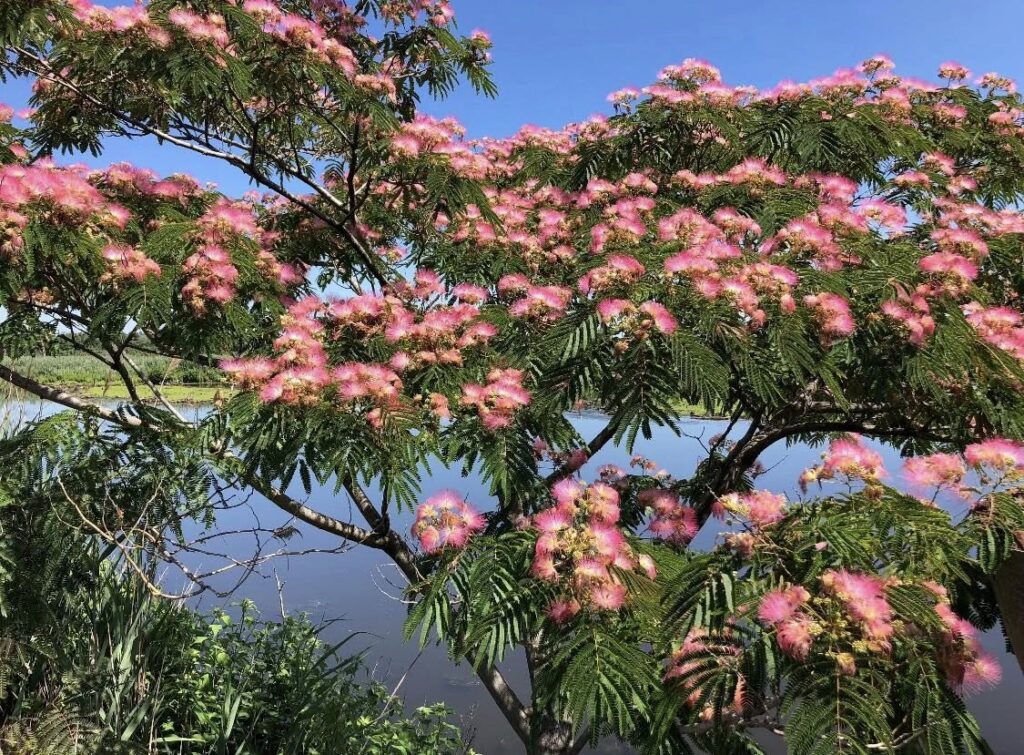
The flowers are the tree’s defining feature. Each bloom looks like a delicate, silky pom-pom — a cluster of thin, long stamens that range from pale pink to deep rose.
Some varieties produce white flowers. The blooms are fragrant, especially in the evening, and they attract hummingbirds, butterflies, and bees in large numbers.
Flowering typically begins in June and continues through August, making it a valuable nectar source in late summer when many other flowers have faded.
Bark and Trunk
The bark is gray-brown and somewhat smooth when young, becoming slightly rougher with age.
The trunk is often low-branching with a wide, spreading canopy that creates a flat-topped or vase-shaped silhouette. This spreading form is one reason the tree provides excellent light shade.
Seed Pods
After flowering, the tree produces flat, brownish seed pods that look similar to those of other legumes. Each pod can be 6 inches long and contains several hard seeds.
The pods persist through winter and are a major reason why the tree spreads so readily — one mature tree can produce thousands of seeds per year.
Mimosa Tree Growth Rate and Size
One of the most notable features of the mimosa tree is its speed of growth. Under favorable conditions, a young mimosa can add 4 to 5 feet of height per year. This rapid growth makes it attractive for those who want quick shade or visual impact in the landscape.
At maturity, the tree typically reaches 20 to 40 feet in height, with a canopy spread that can equal or exceed its height. The wide, arching branches create a distinctive umbrella-like canopy that provides dappled shade.
However, this fast growth comes with a trade-off. Mimosa trees are relatively short-lived, with a typical lifespan of only 10 to 20 years. The wood is weak and brittle, making the tree susceptible to storm damage and breakage.
Where Does the Mimosa Tree Grow? Climate and Range
The mimosa tree thrives in USDA Plant Hardiness Zones 6 through 9. This range covers much of the southern and central United States, including states like Georgia, North Carolina, Tennessee, Virginia, Alabama, Texas, and California.
In colder climates (zones 5 and below), the tree may die back in harsh winters but can sometimes survive if planted in a sheltered location with winter protection.
Globally, the mimosa tree is found across southern Europe, the Middle East, South Asia, East Asia, and much of the southeastern United States. It grows along roadsides, forest margins, disturbed land, and river banks.
How to Grow and Care for a Mimosa Tree
Growing a mimosa tree is generally straightforward, especially in warmer climates. Here is what you need to know.
Sunlight
The mimosa tree prefers full sun. It needs at least 6 hours of direct sunlight daily to grow well and produce abundant flowers. While it tolerates partial shade, flowering will be reduced.
Soil Requirements
One of the tree’s strongest points is its tolerance for poor soils. It grows in clay, sandy, loamy, or rocky soils. It handles slightly acidic to slightly alkaline conditions (pH 4.6 to 8.0). The main requirement is good drainage — mimosa trees do not tolerate waterlogged roots.
Watering
Young trees need regular watering to establish. Once established, the mimosa tree is moderately drought-tolerant. In most climates, rainfall is sufficient. In very dry summers, occasional deep watering will help maintain vigor.
Fertilization
The mimosa tree typically does not need fertilization. As a legume, it fixes atmospheric nitrogen through root bacteria, enriching the soil around it. Adding heavy nitrogen fertilizer can actually reduce flowering.
Pruning
Prune mimosa trees in late winter or early spring, before new growth begins. Remove dead, damaged, or crossing branches. The goal is to maintain an open canopy for air circulation.
Avoid heavy pruning in summer, as it can increase the tree’s susceptibility to mimosa wilt disease.
Propagation
Mimosa trees propagate easily from seed. The hard seed coat requires scarification (light scratching or soaking in hot water) before planting to improve germination. Seeds can also be planted directly in fall and allowed to stratify naturally over winter.
Common Mimosa Tree Varieties and Cultivars
Several cultivars have been developed to enhance ornamental appeal or improve disease resistance.
- ‘Summer Chocolate’ — Perhaps the most popular cultivar. It features dark burgundy-purple foliage throughout the growing season, which contrasts beautifully with the pink flowers. It is slightly slower-growing than the species.
- ‘Rosea’ — Produces deeper pink flowers compared to the typical species. A classic ornamental choice.
- ‘Alba’ — A white-flowered variety. Less commonly found, but striking in the right garden setting.
- ‘Ishii Weeping’ — A weeping form with arching, cascading branches. Excellent as a specimen tree in formal gardens.
- ‘Pendula’ — Another weeping variety with a graceful, drooping form.
Mimosa Tree Flowers: Attracting Pollinators
The mimosa tree is an exceptional pollinator plant. The long, silky stamens of the flowers produce abundant nectar that attracts a wide range of wildlife.
Hummingbirds are among the most enthusiastic visitors. The tubular shape of the flower cluster and the nectar-rich blooms make the mimosa a reliable food source during summer.
Butterflies, including swallowtails and skippers, are regularly seen feeding on mimosa flowers. The tree’s long bloom period — spanning two to three months — makes it especially valuable in gardens designed for pollinators.
Bees also visit frequently. Honey produced near mimosa trees often has a light, floral quality.
If you are designing a wildlife-friendly garden, the mimosa tree deserves serious consideration — as long as its invasive potential is managed carefully.
Mimosa Tree Problems: Pests and Diseases
The mimosa tree, while generally tough, is not without its vulnerabilities.
Mimosa Wilt (Fusarium Wilt)
This is the most serious disease affecting mimosa trees in the United States. Caused by the fungus Fusarium oxysporum f. sp. perniciosum, mimosa wilt causes wilting of branches, yellowing of leaves, and eventual death of the tree.
There is no effective chemical cure once a tree is infected. Removing and destroying affected trees is the only reliable control.
Prevention is the best strategy: plant resistant varieties, avoid wounding the tree unnecessarily, and maintain good soil drainage.
Webworm (Homadaula anisocentra)
The mimosa webworm is a caterpillar that binds leaves together with silk webbing and feeds within. Severe infestations can defoliate the tree. Treatments with Bacillus thuringiensis (Bt) or chemical insecticides are effective when applied early.
Scale Insects
Several species of scale insects can infest mimosa trees, feeding on sap and causing leaf yellowing and branch dieback. Horticultural oil sprays in early spring are an effective control.
Root Rot
In poorly drained soils, the roots can develop rot caused by Phytophthora or other water molds. Planting in well-drained soil is the most effective prevention.
Is the Mimosa Tree Invasive?
This is one of the most important questions about the mimosa tree — and the answer, in many parts of the United States, is yes.
The mimosa tree was introduced to the U.S. in the 18th century as an ornamental plant. Over decades, it naturalized aggressively, particularly in the Southeast.
Today, it is listed as an invasive species in multiple states, including Virginia, North Carolina, Tennessee, Georgia, and Maryland.
The tree’s aggressive spread is driven by several factors:
- Prolific seed production — a single tree can produce up to 30,000 seeds per year.
- Seed viability — seeds can remain viable in the soil for several years.
- Adaptability — the tree colonizes disturbed areas, roadsides, forest edges, and stream banks rapidly.
- Allelopathic properties — mimosa roots may release chemicals that inhibit the growth of nearby native plants.
When it invades natural areas, it competes with native species for sunlight and resources, altering the character of ecosystems that native wildlife depend on.
I want to be honest here: if you live in the southeastern United States, planting a mimosa tree requires careful thought.
There are beautiful native alternatives — like the eastern redbud (Cercis canadensis) or fringe tree (Chionanthus virginicus) — that provide ornamental value without the invasive risk.
Mimosa Tree Uses: Ornamental, Cultural, and Medicinal
Despite its invasive concerns, the mimosa tree has legitimate uses across several domains.
Ornamental Value
As a landscape tree, the mimosa is hard to match for visual drama. The combination of ferny foliage, brilliant pink summer flowers, and fast growth makes it popular for large gardens, parks, and streetscapes.
Traditional Medicine
In Traditional Chinese Medicine (TCM), both the bark (Albizia bark or Hehuanpi) and flowers (Hehuanhua) of the mimosa tree are used. The bark is considered calming and is used to relieve anxiety, irritability, insomnia, and depression.
Modern research has begun investigating the chemical basis of these effects, with some studies identifying bioactive compounds with genuine anxiolytic properties.
In Ayurvedic medicine in India, the tree has also been used in various formulations.
Timber
The wood of the mimosa tree is lightweight and not particularly durable. However, it has been used locally for small woodworking projects, tool handles, and occasionally in light construction.
Soil Improvement
As a legume, the mimosa tree fixes nitrogen in the soil. This makes it potentially useful in land rehabilitation and agroforestry projects in degraded lands — particularly in its native Asian range.
Food (Ethnobotanical Uses)
In parts of Asia, the flowers and young leaves of Albizia julibrissin are used in cooking. Dried flowers are sometimes added to teas or soups.
Mimosa Tree Toxicity: Is It Safe for Pets and Humans?
This is a critical point for anyone with pets or young children.
The mimosa tree is toxic to dogs and cats. The seeds and seed pods are the most dangerous parts. Ingestion can cause vomiting, weakness, and tremors, in pets. In severe cases, toxicity can be life-threatening.
The exact toxic compounds are not fully characterized, but the effects are well-documented in veterinary literature. If your pet has ingested any part of a mimosa tree, contact a veterinarian or the ASPCA Animal Poison Control Center immediately.
For humans, the tree is generally considered low-toxicity in incidental contact. However, the seeds should not be consumed, and some individuals experience skin irritation from contact with the sap or leaves. Children should not be allowed to chew on pods or seeds.
Mimosa Tree vs. Other Similar Trees
Gardeners sometimes confuse the mimosa tree with other feathery-leafed trees. Here are the key distinctions.
Mimosa (Albizia julibrissin) vs. Honey Locust (Gleditsia triacanthos): Both have compound leaves, but the honey locust has longer, narrower leaflets and often has prominent thorns. It does not produce pink powder-puff flowers.
Mimosa vs. Jacaranda (Jacaranda mimosifolia): Both have feathery leaves and are planted ornamentally. The jacaranda produces spectacular purple-blue flowers (not pink) and is hardy only in USDA zones 9–11.
Mimosa vs. Royal Poinciana (Delonix regia): Often called the “flamboyant tree,” the royal poinciana also has bipinnate leaves but bears vivid red-orange flowers and is tropical in its requirements.
Environmental Considerations and Responsible Planting
If you are determined to plant a mimosa tree — and many people are, for very good reasons — there are ways to do so more responsibly.
- Choose sterile or low-fertility cultivars. Some cultivars produce fewer viable seeds. While no fully sterile variety is currently commercially available, breeding efforts are ongoing.
- Plant in contained settings. Urban environments with minimal adjacent natural areas reduce the risk of invasive spread.
- Deadhead spent flowers. Removing seed pods before they mature and disperse significantly reduces the tree’s reproductive output.
- Monitor and remove seedlings. Regularly remove volunteer seedlings around your property to prevent spreading.
In states where it is listed as invasive, consider the legal and ecological implications before planting. Always check with your local Cooperative Extension office for guidance specific to your region.
Frequently Asked Questions About Mimosa Trees
How fast does a mimosa tree grow? Very fast. Expect 3 to 5 feet of growth per year under good conditions.
How long do mimosa trees live? Typically 10 to 20 years. Some survive longer in ideal conditions, but the species is inherently short-lived.
When do mimosa trees bloom? Usually from June through August, with peak bloom in midsummer.
Can I grow a mimosa tree in a pot? Yes, for a time. A young mimosa can be grown in a large container. However, it will eventually need to be planted in the ground to reach full size.
Is the mimosa tree the same as the mimosa plant (Mimosa pudica)? No. Mimosa pudica — the “sensitive plant” that folds its leaves when touched — is a low-growing herbaceous plant in a different genus. The two are not the same, though they share a family.
Do mimosa trees smell good? Yes. The flowers have a sweet, honey-like fragrance, especially noticeable in the evening.
Conclusion
The mimosa tree is a plant of contradictions. It is beautiful yet brittle. Fast-growing yet short-lived. Ecologically valuable in its native range, yet invasive in parts of the United States.
What I find most compelling about this tree is how it sparks conversation. Botanists debate its ecology. Gardeners debate its beauty. Herbalists debate its medicine.
Understanding the mimosa tree fully — its biology, its benefits, and its risks — is the only responsible way to engage with it.
References and Further Reading
- NC State Extension — Albizia julibrissin (Mimosa, Silk Tree) https://plants.ces.ncsu.edu/plants/albizia-julibrissin/
- USDA Forest Service — Fire Effects Information System (FEIS): Albizia julibrissin https://www.fs.usda.gov/database/feis/plants/tree/albjul/all.html

Tim M Dave is a gardening expert with a passion for houseplants, particularly cacti and succulents. With a degree in plant biology from the University of California, Berkeley, he has vast experience in gardening. Over the years, he has cultivated a vast collection of desert plants and learned a great deal about how to grow and care for these unique companions.