25 Common Lawn Pests: How to Identify, Treat, and Prevent Every One of Them
A lawn under attack rarely announces the culprit. It just fades — a yellow patch here, a spongy spot there, a section that pulls up like loose carpet.
I have knelt down in more than one dying lawn only to realize the real damage was happening two inches underground, completely out of sight. The pest is almost never what you assume it is on first glance.
Most lawn pest damage comes down to a handful of insects — grubs, chinch bugs, armyworms, and billbugs — plus the burrowing animals that feed on them. Correct identification through soil or damage inspection, targeted treatment, and consistent lawn care resolve the vast majority of infestations.
This guide walks through 25 of the most common lawn pests found across the United States, from soil-dwelling grubs to the moles that hunt them. For each one, you will learn how to identify it, how to treat it, and how to keep it from returning.
1. White Grubs
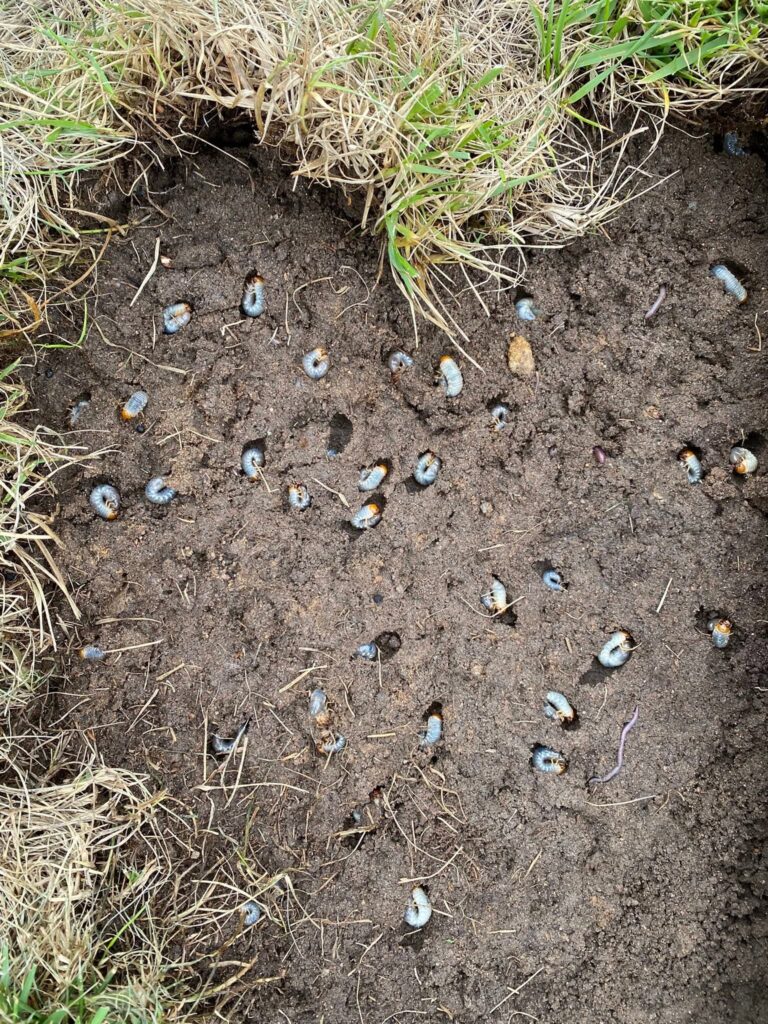
White grubs are the larvae of scarab beetles, including Japanese beetles, June beetles, and masked chafers. They are creamy white, C-shaped, and roughly ½ to 1½ inches long, with a distinct brown head and three pairs of legs clustered near the front.
Damage shows up as irregular, spongy patches of dead or dying turf that pull up easily, almost like a loose rug, because the roots have simply been chewed away underneath. Peel back a damaged section and you’ll usually find several grubs curled in the top few inches of soil.
Treat: Curative insecticides containing trichlorfon or carbaryl work best when grubs are small and actively feeding, typically in late summer. Beneficial nematodes, specifically Heterorhabditis bacteriophora, offer an effective biological alternative when soil moisture and timing are right.
Always confirm an actual grub population before treating. Digging up a one-square-foot section in a few different spots and counting grubs gives a far more reliable answer than guessing from surface symptoms alone.
Prevent: Water deeply but infrequently, since egg-laying females are drawn to moist soil in midsummer. Keeping the lawn healthy and appropriately fertilized also helps turf tolerate light grub feeding without visible damage.
2. Japanese Beetles
The adult stage of the most notorious white grub species, Japanese beetles are about ⅜ inch long with a shiny, metallic green body and coppery-bronze wing covers. They emerge from the soil in early July and remain active through September.
While the grub stage damages roots underground, adult beetles feed on foliage and flowers above ground, skeletonizing leaves on more than 200 plant species in the surrounding landscape.
Treat: Handpicking beetles into a bucket of soapy water works surprisingly well for light infestations, especially early in the morning when they are sluggish. For heavier populations, insecticides labeled for adult beetles provide short-term relief, though repeat applications are often needed through the emergence window.
Prevent: Avoid beetle traps near the lawn you are trying to protect — they tend to attract more beetles into the area than they actually catch. Treating the grub stage in the soil is a far more effective long-term strategy than chasing adults around the yard.
READ MORE: How to Control Japanese Beetles in Your Lawn (Prevent Grubs)
3. Chinch Bugs
Chinch bugs are small, true bugs with black bodies and white, overlapping wings marked by a distinctive black triangle. Adults reach about a fifth of an inch long, while nymphs start reddish-orange and darken as they mature.
They feed by sucking plant juices while injecting a toxin that turns grass yellow, then brown, in irregular patches — damage that is often mistaken for drought stress since it worsens fastest in sunny, dry areas near sidewalks and driveways.
Treat: Spot-treat affected areas rather than the whole lawn, since chinch bugs cluster in localized zones. A population of roughly 20 to 25 chinch bugs per square foot is generally the threshold that warrants insecticide treatment.
Prevent: Overseed with endophyte-enhanced ryegrass or fine fescue, since these varieties are naturally more resistant to chinch bug feeding. Keeping thatch under half an inch also removes one of their favorite hiding and egg-laying spots.
4. Sod Webworms
Sod webworms are the larvae of small, tan lawn moths, growing to about ¾ to 1 inch long with a fleshy, cream-to-brown body. You will often see the adult moths fluttering low over the grass at dusk, which is usually the first clue something is off.
Larvae feed at night, chewing grass blades down to bare patches and leaving behind silky webbing and small green fecal pellets scattered through the thatch.
Treat: Apply insecticide in the early evening, right before the larvae become active, for the best results. Bacillus thuringiensis, a naturally occurring soil bacterium, offers an effective and low-toxicity option for lighter infestations.
Prevent: Reduce thatch buildup regularly, since it provides both shelter and food for developing larvae. Maintaining consistent mowing and irrigation also keeps turf vigorous enough to recover quickly from light feeding.
ALSO READ: Small Holes in Lawn Overnight – Identification and What to Do
5. Fall Armyworms
Fall armyworms earn their name by moving through a lawn in large, destructive groups, capable of stripping an entire yard within days. Larvae range from 1 to 2 inches long and vary from gray to yellowish-green, with a distinctive inverted “Y” marking on the head.
Damage looks like scalped, ragged patches of turf that can spread rapidly across an entire property in a matter of days once a population takes hold.
Treat: Insecticides containing chlorantraniliprole or spinosad give strong control when applied while larvae are still small. Because armyworms feed mainly at night, treating in the late afternoon or evening improves how much active ingredient actually reaches them.
Prevent: Watch closely in late summer and early fall, when outbreaks are most common, especially after storms that can carry moths in from other regions. A count of more than three to four larvae per square foot is generally the signal to act quickly.
6. Black Cutworms
Black cutworms are dark gray to black caterpillars, roughly 1 to 2 inches long, that curl into a tight “C” shape when disturbed. They feed at night and hide in the thatch or soil surface during the day, which makes them one of the trickier pests to spot directly.
Damage appears as small, circular dead spots or notched, ragged grass blades, often most visible on closely mowed turf like putting greens or low-cut home lawns.
Treat: Because these caterpillars are nocturnal, applying insecticide or biological controls like Steinernema carpocapsae nematodes in the late afternoon improves contact with actively feeding larvae. Watering the treatment lightly into the thatch afterward helps it reach where the worms are hiding.
Prevent: Reduce excess thatch, since it gives cutworms daytime cover close to their food source. Regular mowing also disrupts the moths’ preferred egg-laying sites in taller grass.
7. Billbugs
Adult billbugs are small, dark brown to black weevils with a long, curved snout, growing to about ½ inch long. It is actually the larval stage — small, legless, white grubs — that does the real damage by tunneling through grass stems and chewing on roots.
A simple tug test helps confirm billbugs: damaged grass often snaps off cleanly at the crown, and you may notice sawdust-like frass left behind inside the hollowed stems.
Treat: For severe infestations, insecticides containing bifenthrin or carbaryl provide effective control. Beneficial nematodes and predatory beetles offer a solid natural option when infestations are caught early.
Prevent: Rotate insecticide types from year to year to avoid resistance building up in local billbug populations. Keeping the lawn properly fertilized and irrigated also helps turf recover faster from light feeding damage.
8. Mole Crickets
Mole crickets are large, brown insects, roughly 1 to 1½ inches long, with distinctive shovel-like front legs built for burrowing through soil. They are most common in the southern and coastal United States, particularly in sandy soils.
Their tunneling near the surface leaves raised, spongy ridges across the lawn, and heavy feeding on roots and stems can cause large sections of turf to wilt or die.
Treat: Baits applied in spring and fall tend to work best, since that is when mole crickets are most active near the surface. Insecticides containing imidacloprid or bifenthrin are commonly recommended for heavier infestations.
Prevent: Since mole crickets favor light, sandy soil, improving soil structure with organic matter can make conditions less hospitable. A simple soapy-water drench test in suspect areas confirms their presence before you commit to treatment.
9. Fire Ants
Fire ants are small, reddish-brown ants that build distinctive dome-shaped mounds, sometimes over a foot wide, without any visible entrance hole on top. Disturb a mound and you will know almost instantly — they swarm fast and deliver a painful, burning sting that can trigger serious allergic reactions in sensitive individuals.
Treat: The two-step approach works well for most yards: broadcast a bait insecticide across the entire lawn first, then follow up by treating individual mounds directly with a drench, granule, or dust product for faster knockdown.
Prevent: Avoid disturbing new mounds before treating them, since agitated colonies often relocate and rebuild elsewhere. Regular lawn monitoring in warm months catches new colonies while they are still small and easier to manage.
10. European Chafers
European chafer grubs closely resemble Japanese beetle grubs but tend to grow slightly larger, reaching up to an inch long. Adults are tan to light brown beetles that emerge in late June, roughly two weeks earlier than Japanese beetles.
Damage patterns mirror standard white grub symptoms — thinning, wilting turf that pulls up in loose sections, often accompanied by digging from birds or mammals hunting the grubs underneath.
Treat: The same curative insecticides and beneficial nematode treatments used for other white grubs are effective against European chafers, provided they’re applied while grubs are still small.
Prevent: Because European chafers emerge slightly earlier than other grub species, adjusting preventive treatment timing forward by a week or two can improve control in regions where this pest is common.
11. Asiatic Garden Beetles
Adult Asiatic garden beetles are small, cinnamon-brown beetles about ⅜ inch long that feed on foliage at night and burrow into soil during the day, which makes them easy to miss. Their grub stage looks similar to other white grubs but tends to be slightly smaller.
Damage to turf shows the same root-pruning symptoms typical of other grub species, with thinning and patchy dieback most visible in late summer.
Treat: Standard grub-targeted insecticides and beneficial nematodes provide effective control when applied during the active larval feeding period in late summer.
Prevent: Reducing outdoor lighting near lawns can help, since adult beetles are strongly attracted to light at night and tend to concentrate egg-laying in well-lit areas.
12. Two-Lined Spittlebugs
These small, dark brown insects are named for the two orange or reddish lines running across their back. Nymphs surround themselves in a frothy, spit-like mass on grass blades, which is often the first thing homeowners notice.
Feeding damage causes yellowing and weakening of the grass, particularly in damp, shaded areas with heavy thatch buildup.
Treat: Insecticidal soap or a targeted contact insecticide applied directly to the foam masses gives effective control without heavy chemical use across the whole lawn.
Prevent: Reducing thatch and improving drainage in consistently damp areas removes the moist environment these insects depend on to thrive.
13. Leafhoppers
Leafhoppers are small, wedge-shaped insects, usually green, brown, or yellow, that hop or fly away quickly when disturbed. They feed on plant sap using piercing mouthparts, leaving behind a stippled, whitish discoloration across the grass blades.
Treat: Most home lawns tolerate light leafhopper feeding without any treatment at all. For heavier populations, an insecticidal soap or pyrethrin-based product applied directly to active areas usually resolves the issue quickly.
Prevent: Keeping the lawn healthy and adequately watered reduces stress that would otherwise make grass more attractive to feeding leafhoppers.
14. Crane Fly Larvae (Leatherjackets)
Crane fly larvae, nicknamed “leatherjackets” for their tough, grayish-brown skin, are legless and grow up to 1½ inches long. They live just below the soil surface and feed on grass roots and crowns, mostly in cool, wet regions of the Pacific Northwest and Northeast.
Damage appears as thinning, brownish patches that are especially noticeable in early spring as populations peak after overwintering.
Treat: Insecticides labeled specifically for crane fly larvae, applied in early spring or fall, offer the most reliable control window. Beneficial nematodes can also provide meaningful suppression in moist soil conditions.
Prevent: Improving drainage in low, soggy areas of the lawn makes the environment less favorable for egg-laying adult crane flies in late summer and fall.
15. Ground Pearls
Ground pearls are tiny, pearl-like scale insects that attach to grass roots and cover themselves in a hard, waxy, golden-colored shell. They are most damaging to bermudagrass and centipedegrass in warm southern climates.
Damage shows up as slow, irregular decline of turf in roughly circular patches that steadily expand year after year, often mistaken for a fungal disease at first glance.
Treat: Unfortunately, there is no reliable chemical control once ground pearls are established, since their waxy coating protects them from most insecticides.
Prevent: Because there is no effective cure, prevention centers on avoiding the introduction of infested sod or soil, and maintaining strong turf vigor to tolerate light infestations.
16. Ticks
Ticks are small, flat, eight-legged arachnids that wait in tall grass, brush, or leaf litter for a host to brush past. They range from pinhead-sized nymphs to the more visible, swollen adult stage after feeding.
Unlike most pests on this list, ticks don’t damage the grass itself — the real concern is the disease risk they pose to people and pets moving through the lawn.
Treat: Perimeter insecticide treatments focused on the lawn edge, brush lines, and shaded transition zones are typically far more effective than treating the entire open lawn.
Prevent: Keep grass mowed short, clear leaf litter and brush piles, and create a buffer of wood chips or gravel between wooded areas and the lawn to discourage tick movement into high-traffic zones.
17. Fleas
Fleas are tiny, dark, wingless insects that move by jumping rather than flying, and they are almost always brought into a lawn by pets or wild animals passing through. Shaded, humid areas near pet resting spots are their preferred breeding grounds.
Treat: Insect growth regulators combined with an adulticide insecticide, applied to shaded and pet-frequented areas specifically, give the most effective control.
Prevent: Regular pet flea prevention paired with routine mowing and reducing shaded, humid pockets in the yard keeps flea populations from establishing in the first place.
18. Earwigs
Earwigs are dark brown insects with distinctive pincers at the rear of their body, typically around ¾ inch long. They hide in damp, dark spots during the day and feed at night on decaying organic matter, though large populations can also nibble on tender grass and seedlings.
Treat: In most home lawns, earwig populations remain low enough that no treatment is necessary. For heavier infestations, a perimeter insecticide application around mulch beds and foundation lines usually resolves the issue.
Prevent: Reducing excess mulch, damp debris, and standing moisture near the lawn’s edge removes the shelter earwigs depend on during daylight hours.
19. Millipedes
Millipedes are slow-moving, cylindrical arthropods with many pairs of legs, usually dark brown to black, that curl into a tight spiral when disturbed. They feed primarily on decaying organic matter and rarely cause any real harm to living grass.
Treat: Because millipedes are mostly harmless to turf, treatment is rarely necessary beyond simply sweeping or removing them from patios and walkways where they wander in large numbers.
Prevent: Reducing excess moisture, leaf litter, and mulch buildup near the lawn’s border discourages millipedes from congregating close to the house.
20. Sowbugs and Pillbugs
Sowbugs and pillbugs are small, gray, segmented crustaceans, often called “roly-polies” for the way pillbugs curl into a tight ball when touched. Both feed on decaying plant material and are more of a nuisance than a genuine threat to healthy turf.
Treat: Large populations near foundations or garden beds can be managed with a perimeter insecticide, though most lawns never need treatment for this pest at all.
Prevent: Removing damp mulch, leaf piles, and other organic debris near the home reduces the moist habitat these creatures need to thrive.
21. Moles
Moles are small, burrowing mammals with soft gray-brown fur, oversized front paws, and no visible eyes or ears. Rather than eating grass, they tunnel through lawns hunting earthworms and soil-dwelling insects, leaving raised ridges and volcano-shaped mounds across the yard.
A heavily tunneled lawn often signals an abundant insect food source underground, which is precisely why moles showed up there in the first place.
Treat: Trapping remains the most consistently effective method, since most repellents and vibrating stakes offer only temporary results at best. Position traps directly across active tunnels, which you can confirm by flattening a section and checking if it’s pushed back up within a day.
Prevent: Reducing grub and earthworm populations through balanced lawn care can make a yard less attractive to moles, though it will not guarantee they stay away entirely, since earthworms alone can sustain them.
22. Voles
Voles are small, mouse-like rodents with short tails and rounded faces, distinct from moles in that they actually feed on grass, roots, and bulbs rather than insects. Look for narrow, visible surface trails winding through the lawn, especially noticeable after snow melts in spring.
Treat: Snap traps placed along active runways offer effective, targeted control. Where populations are large, rodenticide bait stations can help, though they should be placed carefully to avoid exposure to pets and wildlife.
Prevent: Keeping grass mowed and reducing dense ground cover near the lawn’s edge removes the concealment voles rely on to move around safely.
23. Pocket Gophers
Pocket gophers are burrowing rodents recognized by the distinctive fan-shaped mounds of loose soil they push up at the entrance to their tunnels, usually with the opening plugged from the inside. Unlike mole mounds, gopher mounds tend to be more crescent-shaped and noticeably larger.
Treat: Trapping at the main tunnel system remains the most reliable control method, though it requires locating the active burrow rather than a temporary side tunnel.
Prevent: Underground wire mesh barriers installed around garden beds and high-value lawn areas can help redirect gopher activity away from the most visible parts of a property.
24. Armadillos
Armadillos are armored, nocturnal mammals found mainly in southern states, easily identified by the small, cone-shaped holes they dig while rooting through soil in search of grubs and insects. Unlike neat mole tunnels, armadillo damage tends to look more like scattered, shallow digging across the surface.
Treat: Live trapping with bait positioned along a fence line or barrier funnel tends to work best, since armadillos generally follow set paths through a yard.
Prevent: Reducing grub populations removes a major food incentive, and installing a low barrier fence angled outward at the base can discourage them from digging underneath.
25. Skunks and Raccoons
Skunks and raccoons are not technically lawn pests in the traditional sense, but both will tear up patches of turf overnight while digging for grubs, leaving small, irregular holes or rolled-back sections of sod scattered across the yard.
This kind of digging is usually a strong, unmistakable sign that a grub population underneath has already reached a damaging level.
Treat: Addressing the underlying grub infestation is the most effective long-term solution, since these animals are simply following a reliable food source.
Prevent: Securing trash cans and pet food outdoors removes secondary attractants, while treating grub populations proactively removes the main reason these animals visit in the first place.
ALSO READ: Lawn Spiders Identification + How to Get Rid of Them
Why Lawn Pests Deserve Serious Attention
Lawn pest damage is not a cosmetic footnote. It is a measurable, recurring cost across American lawns, golf courses, and sports fields.
The U.S. Department of Agriculture has estimated that Japanese beetle grubs alone cause around $235 million in turf damage annually — roughly $78 million spent on control and another $156 million spent replacing ruined turf.
Here’s a detail that genuinely surprised me: research at Cornell University found that more than 70 percent of grub control treatments were applied needlessly, because there were no grubs actually present in the lawn. Misdiagnosis is expensive in both directions.
That is exactly why identification has to come before treatment. Spraying blindly wastes money, harms beneficial insects, and sometimes fails to touch the real problem.
Common Threads Across Nearly Every Lawn Pest
Looking back across all 25, a pattern becomes clear. Moisture, thatch, and an unmonitored grub population sit behind a surprising share of these problems, either directly or indirectly.
That is genuinely useful news, because it means a homeowner does not need 25 separate strategies — just a handful of consistent habits done well.
- Inspect before you treat: Dig a one-square-foot section, or run a simple soapy-water drench test, before reaching for any insecticide.
- Manage thatch: Keep the thatch layer under half an inch, since it shelters webworms, cutworms, chinch bugs, and billbugs alike.
- Water wisely: Deep, infrequent watering discourages egg-laying insects that prefer consistently moist soil near the surface.
- Mow correctly: Regular mowing at the right height reduces hiding spots for caterpillars and disrupts adult moths looking for places to lay eggs.
- Treat the source, not the symptom: Chasing moles, skunks, or armadillos without addressing the grub population underneath is a losing, repetitive battle.
Pest Risk by Season
Timing narrows the list of suspects fast, since most lawn pests follow a fairly predictable calendar.
Spring: Billbugs, black cutworms, crane fly larvae, and overwintered grubs become active as soil warms and turf resumes growth.
Summer: Chinch bugs, sod webworms, Japanese beetles, mole crickets, and fire ants peak during the hottest, most humid stretches of the year.
Fall: Fall armyworms surge, especially after tropical storms, while grub damage from summer feeding often becomes most visible in September.
Winter: Vole activity is often easiest to spot right as snow melts, revealing the surface trails that were hidden all season.
Keeping a simple record of when damage first appears each year makes the following year’s diagnosis significantly faster. A repeating pattern is more useful than a single photo.
Region and Grass Type Matter Too
Not every pest threatens every lawn equally. Warm-season grasses like bermudagrass, St. Augustine, zoysia, and centipedegrass in the South face heavier pressure from chinch bugs, mole crickets, fire ants, and ground pearls.
Cool-season lawns of Kentucky bluegrass, tall fescue, and perennial ryegrass across the North and Midwest deal more often with white grubs, sod webworms, billbugs, and crane fly larvae.
Knowing your region and grass species before inspecting damage narrows the likely culprit list considerably. It’s one of the fastest shortcuts toward an accurate diagnosis.
When Should You Call a Professional?
If cultural fixes and targeted treatments aren’t resolving repeat damage in the same spots year after year, it’s worth bringing in a licensed pest control operator or contacting your local extension office.
Cooperative extension services, like those cited below, often provide free or low-cost help identifying pests from a physical sample. A confirmed identification saves money and prevents unnecessary pesticide use, which matters both for your wallet and for the beneficial insects living in your soil.
Frequently Asked Questions
Can I get rid of lawn pests without chemicals? Yes, in many cases. Beneficial nematodes, proper watering, correct mowing height, and thatch management resolve a large share of infestations without synthetic insecticides.
How do I know if it’s grubs or drought stress? Try the tug test. Grub-damaged turf pulls up easily like loose carpet, while drought-stressed grass generally stays rooted even when it looks brown and wilted.
Are moles and grubs the same problem? Not exactly, but they’re often connected. Moles feed on grubs and earthworms, so persistent mole activity is frequently a sign of an underlying insect population worth investigating.
What is the single biggest mistake homeowners make? Treating before confirming the pest. Broad, preventive insecticide applications without an actual inspection waste money and can harm the beneficial insects that keep pest populations in check naturally.
Final Thoughts
A pest-damaged lawn is frustrating, but it is almost always fixable once you know exactly what you’re dealing with. Most of the 25 pests above respond well to the same core approach: confirm the culprit, treat it at the right time, and adjust the conditions that invited it in the first place.
Take the extra ten minutes to dig, inspect, or run a soapy drench test before spraying anything. In my experience, that single step saves more lawns — and more money — than any insecticide ever could on its own.
References
- University of Maryland Extension — Insects and Mites in Home Lawns: https://extension.umd.edu/resource/insects-and-mites-home-lawns
- University of New Hampshire Extension — Insect Pests of Home Lawns: https://extension.unh.edu/resource/insect-pests-home-lawns-fact-sheet
- University of California Statewide IPM Program (UC ANR) — Lawn Insects: https://ipm.ucanr.edu/home-and-landscape/lawn-insects/
- Mississippi State University Extension — Control of Insect Pests In and Around the Home Lawn: https://extension.msstate.edu/publications/control-insect-pests-and-around-the-home-lawn
- Rutgers New Jersey Agricultural Experiment Station — An Integrated Approach to Insect Management in Turfgrass: White Grubs: https://njaes.rutgers.edu/fs1009/
- University of Minnesota Extension — Japanese Beetles in Yards and Gardens: https://extension.umn.edu/yard-and-garden-insects/japanese-beetles
- Iowa State University Extension and Outreach — White Grub Control in Turfgrass: https://yardandgarden.extension.iastate.edu/encyclopedia/white-grub-control-turfgrass

Tim M Dave is a gardening expert with a passion for houseplants, particularly cacti and succulents. With a degree in plant biology from the University of California, Berkeley, he has vast experience in gardening. Over the years, he has cultivated a vast collection of desert plants and learned a great deal about how to grow and care for these unique companions.