10 Types of Crabgrass in Your Lawn (Identification With Pictures)
I once spent an entire Saturday hand-pulling what I thought was one stubborn weed patch, only to learn later that I’d actually been fighting two different crabgrass species at once. That mix-up cost me weeks, since each one responds a little differently to timing and treatment.
Crabgrass isn’t a single plant. It’s a whole genus, Digitaria, with roughly 220 species worldwide. Most lawns only ever deal with a handful of them, but knowing which one you’re looking at changes how you fight it.
This guide breaks down 10 types of crabgrass, from the two everyone recognizes to a few regional species most homeowners have never heard named.
What Makes a Grass “Crabgrass” in the First Place
All Digitaria species share a few traits. Their seed heads branch out in finger-like spikes, which is exactly where the genus name comes from, since digitus is Latin for “finger.”
They’re mostly warm-season summer annuals. Seeds germinate once soil temperatures climb into the 50s and 60s Fahrenheit, plants grow through summer, and frost kills them off in fall.
That annual cycle matters. A single crabgrass plant can produce roughly 150,000 seeds in one season, and those seeds sit in the soil waiting for next spring’s bare patches.
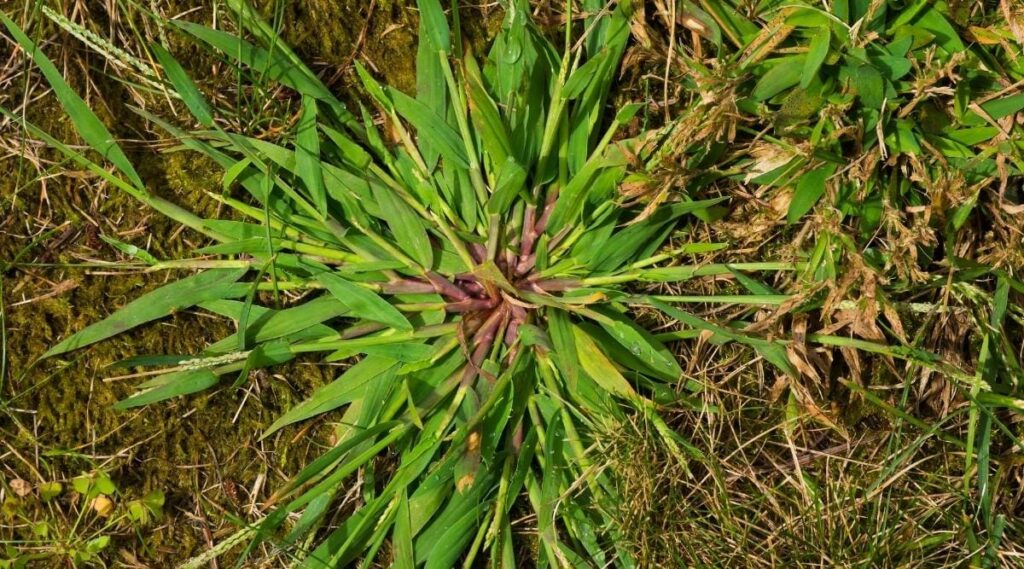
Crabgrass also spreads outward from a central point, sometimes reaching 12 inches in diameter by late summer, choking out whatever turf sat underneath it.
That circular spreading pattern is often the first clue homeowners notice. A healthy lawn shows an odd, lighter-green rosette in June, and by August it has widened into a bald patch once frost eventually kills the plant.
Not every Digitaria species behaves identically, though. Some clump upright, some hug the ground in tight mats, and a few even root at every leaf node they touch, which is exactly why lumping them all together as “just crabgrass” misses useful detail.
1. Large Crabgrass (Digitaria sanguinalis)
Large crabgrass, also called hairy crabgrass, is the species most homeowners picture when they hear the word “crabgrass.” It’s the most widespread type across lawns in the United States.
It can reach up to two feet tall, though in mowed lawns it usually sprawls flat and low instead. Its leaf blades and sheaths are covered in noticeably long, sparse hairs, which is the easiest way to separate it from its smooth-leaved cousin.
Interestingly, large crabgrass is native to Europe and was originally brought to North America as a forage crop. It escaped cultivation and became one of the most common turf weeds on the continent.
Its stems root wherever they touch soil, forming dense mats that are genuinely hard to pull out by hand without leaving root fragments behind.
2. Smooth Crabgrass (Digitaria ischaemum)
Smooth crabgrass is the other half of the “big two” that dominate lawn conversations. It’s smaller than large crabgrass and, true to its name, lacks the noticeable hairs on its stems and sheaths.
Its leaves are more slender, and the whole plant tends to stay lower and more compact. It’s genuinely easy to overlook until seed heads appear in mid-summer.
Research on this species has even found it carries specific bacteria on its seeds that appear to suppress competing plants nearby, part of why it holds ground so effectively once established.
Smooth crabgrass thrives in thin, underfed, poorly watered turf, which is really the underlying condition that lets any crabgrass species take hold in the first place.
3. Southern Crabgrass (Digitaria ciliaris)
Southern crabgrass, sometimes labeled “summer grass,” is exactly what its name suggests: a species most common across the southern and coastal United States.
It resembles large crabgrass in having hairy leaf sheaths, but its leaf blades themselves are typically hairless, which is the main identification clue that separates the two.
It favors warm, humid coastal plain conditions and often appears in lawns, roadsides, and disturbed soil throughout the Gulf Coast and Southeast.
Because it thrives in heat that would slow other crabgrass species, southern crabgrass can stay actively growing later into the fall than its northern relatives.
ALSO READ: 15 Weeds That Look Like Grass: How to Identify and Deal With Each One
4. Asian Crabgrass (Digitaria bicornis)
Asian crabgrass is native to tropical Asia, Madagascar, and Australia, but it has become an established lawn and garden weed in parts of the southern U.S. and beyond.
It has a ground-hugging, clumping habit and can root at its leaf nodes as it spreads, which makes it notably difficult to pull once it has settled in.
This species is easily confused with southern crabgrass, since the two share overlapping ranges and similar hairy features on stems and sheaths.
Hand-weeding works best while plants are still small, before secondary roots have anchored them firmly into the soil.
5. India Crabgrass (Digitaria longiflora)
India crabgrass, sometimes called Indian crabgrass, is a low-growing, mat-forming species that behaves more like a creeping ground cover than an upright weed.
It’s less prominent in northern lawn discussions but shows up as a documented turf and garden weed in warmer regions, including parts of the southeastern U.S.
Its creeping habit means it can spread laterally across bare or thin turf areas even faster than some upright crabgrass species.
Because it hugs the ground so tightly, mowing alone rarely slows it down. Improving turf density is usually the more effective long-term fix.
6. Violet Crabgrass (Digitaria violascens)
Violet crabgrass earns its name from a subtle violet or purple tinge that can appear on its seed heads and stems as the plant matures.
It’s considered a rare find in some regions. In New England, for example, it has only been documented in isolated locations, unlike the widespread large and smooth crabgrass species.
It shares the genus’s typical finger-like seed head structure, but its individual spikelets are notably shorter than those of several related species.
Its rarity in cooler climates means most homeowners dealing with a crabgrass problem are unlikely to encounter this particular species at all.
7. Carolina Crabgrass / Fall Witchgrass (Digitaria cognata)
Fall witchgrass, also known as Carolina crabgrass or mountain hairgrass, is a bit of an outlier on this list. It behaves more like a native prairie and roadside grass than a classic lawn invader.
It’s found across much of North America, often in sandy soils, open fields, and disturbed ground rather than dense home lawns.
Its wiry, branching seed heads give it a wispy, almost tumbleweed-like appearance late in the season, which is where the “witchgrass” name comes from.
It’s rarely the primary target of lawn herbicide programs, but it’s worth recognizing since it belongs to the same genus as the more troublesome turf species.
8. Jamaican Crabgrass (Digitaria horizontalis)
Jamaican crabgrass is a tropical and subtropical species most often encountered in warm, humid climates across the Caribbean, Central America, and the southernmost U.S.
It has a low, spreading growth habit similar to other warm-climate Digitaria species, thriving in disturbed soil, garden beds, and thin turf.
It’s less documented in cooler-climate turf literature simply because it doesn’t survive hard frost, which limits its northern range significantly.
Where it does occur, its management follows the same basic principles as other crabgrass species: dense, healthy turf is the best long-term defense.
9. Shaggy Crabgrass (Digitaria villosa)
Shaggy crabgrass takes its common name from its noticeably hairy, almost shaggy-looking foliage, even more pronounced than what’s seen on large crabgrass.
It’s a less commonly discussed species in mainstream lawn care guides, appearing more often in botanical inventories than in typical homeowner weed-control articles.
Its dense hair coverage on leaves and stems is the clearest way to distinguish it from the smoother-leaved crabgrass species on this list.
Like its relatives, it’s a warm-season annual that dies back with the first hard frost of the year.
10. Dwarf Crabgrass (Digitaria serotina)
Dwarf crabgrass lives up to its name, staying noticeably shorter and more compact than large or smooth crabgrass, even in unmowed conditions.
It tends to favor sandy soils and is documented in parts of the southeastern United States, often turning up in lawns with poor, low-fertility ground.
Its smaller stature can actually make it easier to overlook in a mowed lawn, since it doesn’t tower over surrounding turf the way taller crabgrass species can.
Despite its size, it reproduces by seed just like the rest of the genus, and a thin lawn gives it just as much opportunity to spread.
ALSO READ: 5 Safe Ways to Get Rid of Crabgrass in Summer (Without Use of Chemicals)
Why Crabgrass Keeps Coming Back Every Year
Crabgrass is a summer annual, which means the entire plant dies with the first hard frost. That fact alone explains most of the frustration homeowners feel.
Every dead crabgrass plant leaves behind bare soil and thousands of dormant seeds, creating the exact conditions the next generation needs to germinate the following spring.
Mowing too short is one of the biggest triggers. Cutting turf below the recommended height for its species exposes soil to sunlight, which crabgrass seeds need to sprout.
Thin, underfed lawns are the second major cause. A dense, healthy stand of turf physically shades the soil surface, denying crabgrass seeds the light and warmth they need.
This is really the core lesson every extension publication repeats: crabgrass is a symptom, not the root problem. It shows up where turf is already struggling.
Practical Ways to Manage Any Crabgrass Species
Raise your mowing height. Most turfgrass species perform better, and shade out crabgrass more effectively, at a taller cutting height than many homeowners use by habit.
Apply pre-emergent herbicide at the right soil temperature. Most guidance points to soil temperatures reaching 50°F to 55°F, often timed to coincide with forsythia bloom in many regions.
Water deeply but infrequently. Frequent, shallow watering favors shallow-rooted crabgrass seedlings over deeper-rooted, established turfgrass.
Fertilize on a proper schedule. A well-fed lawn recovers faster from wear and crowds out weed seedlings before they can establish.
Hand-pull small infestations early. Once nodes touch soil and root in, especially with species like Asian or India crabgrass, pulling becomes far harder and less effective.
A Few Numbers Worth Knowing
Crabgrass problems tend to be worse in the southern U.S. than in cooler regions, largely because warmer spring soil temperatures give it an earlier competitive head start over turfgrass.
A single crabgrass plant’s seed output, that 150,000-seed figure, is one reason a single missed season of control can create a multi-year seed bank in the soil.
Crabgrass seed spikes are frequently mistaken for bermudagrass seed heads, since both produce finger-like branches, though crabgrass branches originate at slightly separated points along the stem rather than from one central junction.
Two species, large and smooth crabgrass, account for the vast majority of documented lawn infestations across the continental United States, even though the genus itself includes over 200 species globally.
Frequently Asked Questions
Are all 10 of these types found in typical home lawns? No. Large and smooth crabgrass dominate most residential lawn problems across the U.S. Species like violet crabgrass, fall witchgrass, and shaggy crabgrass are documented but far less commonly encountered by the average homeowner.
Can I use the same herbicide on every crabgrass species? Most pre-emergent and post-emergent products labeled for “crabgrass” target the common species effectively, but always check the product label, since timing and rates can vary by region and grass type.
Why does crabgrass seem to appear in the same spots every year? Because seeds accumulate in the soil at that exact location. If the underlying issue, thin turf or excess sunlight reaching bare soil, isn’t fixed, new seeds germinate there season after season.
Does pulling crabgrass by hand actually work? It can, especially for small infestations caught early. The challenge is that mature plants root at stem nodes, so any root fragment left behind can potentially regrow.
Is crabgrass dangerous to pets or children? No. Crabgrass itself isn’t toxic. The main concern is usually aesthetic and structural, since it crowds out desirable turf and leaves bare patches once it dies each fall.
Does one crabgrass plant really produce that many seeds? Yes, estimates put large and smooth crabgrass at up to roughly 150,000 seeds per plant in a single season, which is why even a small, unmanaged patch can seed an entire lawn within a couple of years.
Why do some crabgrass species root at the nodes while others don’t? Species like large crabgrass and Asian crabgrass send out stems that touch the ground and root wherever they make contact, forming a spreading mat. This habit makes hand-pulling far less effective once the plant matures, since broken root fragments can potentially resprout.
Will killing crabgrass in fall stop it from coming back next spring? Not entirely. Frost already kills the visible plant every year regardless of what you do. The real target is the seed bank sitting in the soil, which is why spring pre-emergent timing matters more than fall cleanup.
Can crabgrass grow in shaded lawns? Rarely to a serious degree. Nearly all Digitaria species need substantial direct sunlight to germinate and thrive, which is exactly why crabgrass problems concentrate in thin, sun-exposed turf rather than shaded areas under trees.
ALSO READ: 10 Best Weed Killers That Won’t Kill Grass: Safe Selective Herbicides for Lawn
Crabgrass vs. Look-Alike Grasses
Crabgrass gets blamed for a lot of lawn trouble that isn’t actually crabgrass. A few common look-alikes are worth knowing before you start treatment.
Bermudagrass produces similar finger-like seed heads, but its branches all originate from a single point at the top of the stem. Crabgrass branches emerge at slightly separated intervals along the stem instead.
Goosegrass has a distinctive flattened, silvery-white base and forms a stiffer clump than the sprawling mat habit typical of crabgrass. It also tends to germinate later in the season.
Dallisgrass spreads through short, thick underground rhizomes, giving it a perennial habit crabgrass simply doesn’t have. Crabgrass reproduces entirely by seed each year and has no rhizomes or stolons at all.
Quackgrass grows upright with a more rigid posture, while crabgrass hugs the ground in a horizontal, sprawling pattern, especially under regular mowing.
Getting this distinction right matters because perennial grassy weeds like dallisgrass and quackgrass need entirely different control strategies than an annual species like crabgrass.
Quick Identification Reference
| Species | Common Name | Key Identifying Trait |
| Digitaria sanguinalis | Large / Hairy Crabgrass | Long hairs on both leaf surfaces and sheath |
| Digitaria ischaemum | Smooth Crabgrass | Hairless leaves and sheath, smaller stature |
| Digitaria ciliaris | Southern Crabgrass | Hairy sheath, hairless leaf blades |
| Digitaria bicornis | Asian Crabgrass | Clumping habit, roots at leaf nodes |
| Digitaria longiflora | India Crabgrass | Low, tight, mat-forming ground cover |
| Digitaria violascens | Violet Crabgrass | Faint violet tinge on seed heads |
| Digitaria cognata | Fall Witchgrass / Carolina Crabgrass | Wispy, tumbleweed-like seed heads |
| Digitaria horizontalis | Jamaican Crabgrass | Tropical range, frost-intolerant |
| Digitaria villosa | Shaggy Crabgrass | Dense, shaggy hair on foliage |
| Digitaria serotina | Dwarf Crabgrass | Compact, short stature, sandy soils |
Regional Timing for Pre-Emergent Control
Crabgrass germination timing shifts noticeably by region, which is why a single national calendar date never works well for pre-emergent applications.
In the Cornbelt and Northeast, germination typically begins once soil temperatures hold steady in the 50°F to 55°F range, often in mid-to-late spring.
Across Southern California’s inland valleys, germination can start as early as mid-February, with growth continuing well into early April before tapering off.
In Central and Coastal California, sprouting can begin slightly later, from early February to mid-March, with new seed germination continuing through summer into fall.
Northern and coastal regions with cooler soil tend to see the latest start dates and the shortest overall growing season for crabgrass, since early frost cuts the cycle short.
Because of this regional spread, checking local soil temperature, rather than relying on a fixed calendar date, remains the most reliable way to time a pre-emergent application correctly.
Final Thought
Crabgrass identification isn’t just a botany exercise. Knowing whether you’re dealing with large crabgrass, southern crabgrass, or one of the less common species actually changes your timing window and your treatment choice.
If you’re unsure which species has taken over your lawn, a photo sent to your local cooperative extension office is usually the fastest, most reliable way to get a confirmed answer.
References
- Iowa State University Extension and Outreach. Large Crabgrass — Crop and Pest Management Encyclopedia. https://crops.extension.iastate.edu/encyclopedia/large-crabgrass
- Penn State Extension. Lawn and Turfgrass Weeds: Smooth Crabgrass and Large Crabgrass. https://extension.psu.edu/lawn-and-turfgrass-weeds-smooth-crabgrass-and-large-crabgrass
- University of California Statewide IPM Program. Crabgrass — Pest Notes. https://ipm.ucanr.edu/PMG/PESTNOTES/pn7456.html
- NC State Extension Gardener Plant Toolbox. Digitaria sanguinalis (Large Crabgrass). https://plants.ces.ncsu.edu/plants/digitaria-sanguinalis/
- NC State Extension Gardener Plant Toolbox. Digitaria bicornis (Asian Crabgrass). https://plants.ces.ncsu.edu/plants/digitaria-bicornis/
- Cornell University Weed Identification Blog. Smooth and Large Crabgrass. https://blogs.cornell.edu/weedid/crabgrasses/
- Washington State University Extension, Hortsense. Weeds: Crabgrass — Digitaria spp. https://hortsense.cahnrs.wsu.edu/fact-sheet/weeds-crabgrass-digitaria-spp/

Tim M Dave is a gardening expert with a passion for houseplants, particularly cacti and succulents. With a degree in plant biology from the University of California, Berkeley, he has vast experience in gardening. Over the years, he has cultivated a vast collection of desert plants and learned a great deal about how to grow and care for these unique companions.