25 Types of Lawn Diseases (Identification, With Pictures)
A lawn rarely dies overnight. It fades in patches, thins in circles, or turns a strange rust color — and by the time most homeowners notice, the disease has already spread.
Most lawn diseases are caused by fungi that thrive in excess moisture, poor airflow, or unbalanced fertilizer. Correct identification, proper watering, and targeted fungicide use (only when needed) solve the vast majority of cases.
I have spent enough time crawling around brown patches with a magnifying glass to know one thing for certain: guessing is the most expensive mistake in lawn care. The wrong fix can make the problem worse.
This guide breaks down 25 of the most common turfgrass diseases in the United States. For each one, you will learn how to spot it, how to treat it, and how to keep it from returning.
Let’s dive into the list of common lawn diseases.
1. Brown Patch
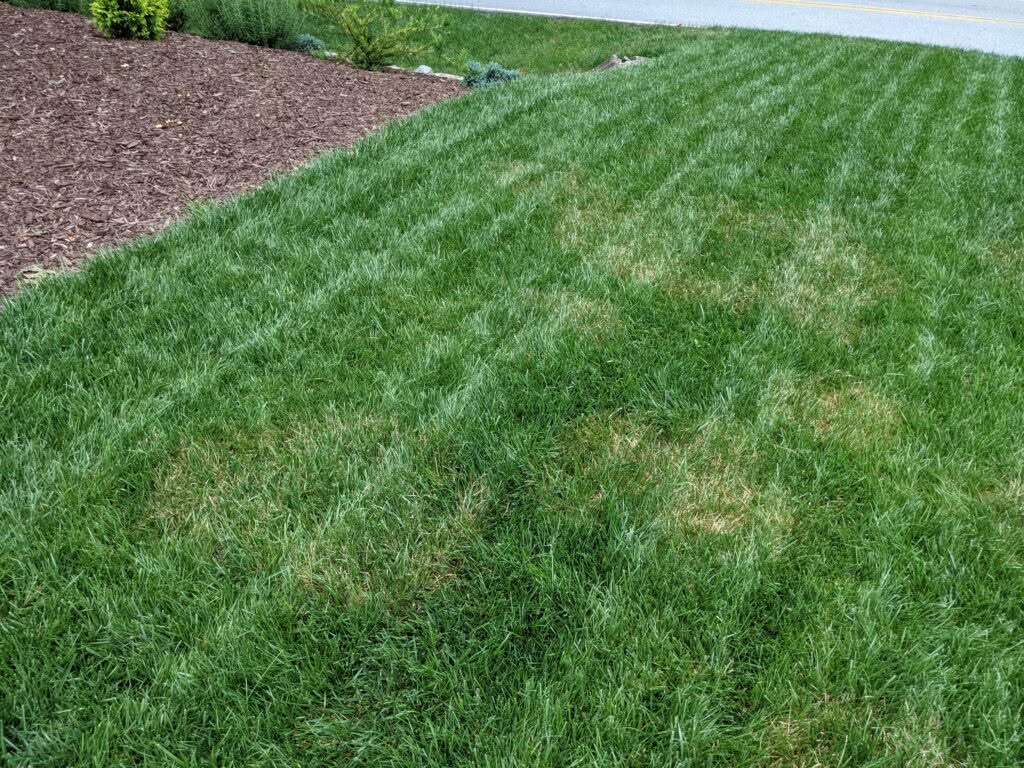
Brown patch is caused by several species of the fungus Rhizoctonia, and it shows up as circular, yellow-to-brown patches that can stretch up to three feet wide. Look closely at individual blades and you will notice tan lesions rimmed by a darker chocolate-brown border, which is the clearest fingerprint of this disease.
In lawns, the patches often don’t look as neat as the textbook circle. They tend to blur into thinning, irregular areas, especially on tall fescue and perennial ryegrass during muggy summer nights.
Treat: Start by cutting back on nitrogen, since lush, over-fed grass is exactly what this fungus prefers to attack. If the outbreak is already spreading fast, a fungicide containing azoxystrobin or propiconazole gives the most reliable knockdown.
Apply fungicide in the evening or early morning, and expect to repeat treatment every two to four weeks during a hot, humid stretch. One application rarely finishes the job on its own.
Prevent: Water only in the early morning so the grass has all day to dry, and avoid fast-release nitrogen during the hottest months. Mowing at the correct height for your grass species also matters more than most homeowners realize, since scalped turf recovers far more slowly once infected.
ALSO READ: 7 Main Reasons New Grass is Turning Yellow (And How to Fix)
2. Large Patch
Large patch is essentially the warm-season cousin of brown patch, caused by a different strain of Rhizoctonia solani. It appears as circular, orange-to-yellow rings that expand outward over time, often finished off with a smoky brown edge where the fungus is actively working.
Zoysiagrass, St. Augustine, centipedegrass, and bermudagrass are the usual targets, and symptoms are most visible in spring as the lawn tries to green up unevenly.
Treat: Curative sprays are far less effective than preventive ones for this disease. The best results come from applying fungicide in fall, once soil temperatures cool to around 70°F, since that is when the fungus is actually infecting the turf even though damage won’t show until spring.
Prevent: Cut off nitrogen applications after mid-to-late summer, since late-season feeding pushes lush growth right into the fungus’s favorite window. Reducing irrigation frequency and improving drainage in low spots also goes a long way toward keeping the root zone from staying saturated.
3. Dollar Spot
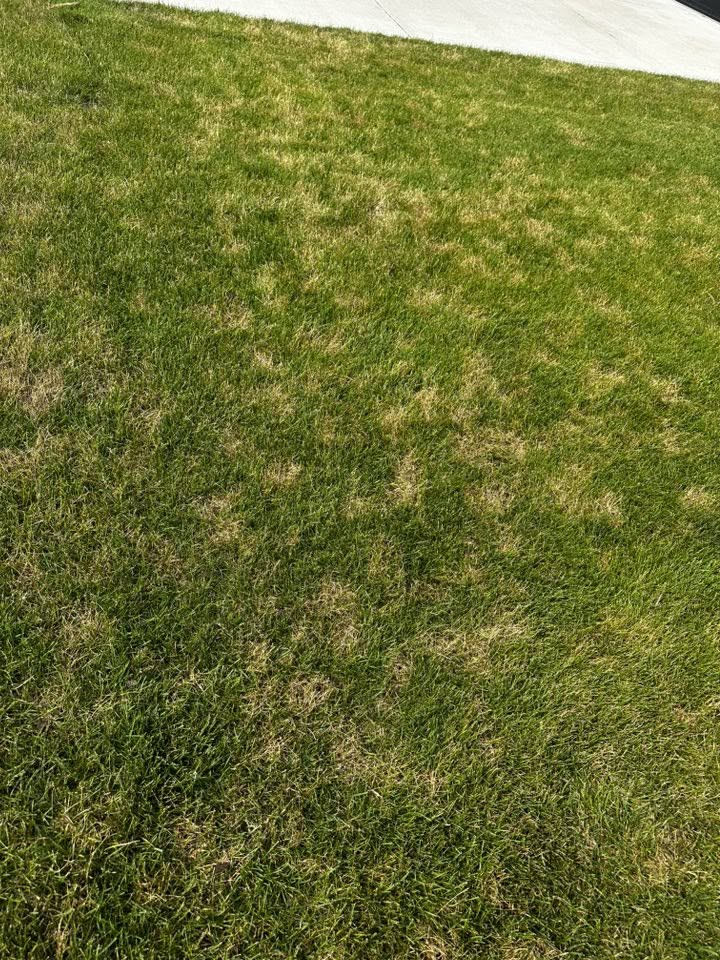
Dollar spot gets its name from the small, straw-colored, silver-dollar-sized spots it leaves scattered across a lawn. Left unchecked, those spots merge together into larger, irregular patches that can cover significant ground.
The fungus behind it, Clarireedia species, thrives between 60°F and 85°F with high humidity and prolonged leaf wetness, which is why it often flares up during dewy summer mornings.
Treat: Fungicides containing propiconazole or azoxystrobin give solid control, particularly when applied at the earliest sign of spotting rather than after the lawn already looks patchy. Waiting even a week can mean the difference between a light spray and repeated treatments.
Prevent: Here is the twist that catches people off guard: dollar spot usually shows up in lawns that are under-fertilized, not over-fed. Keeping nitrogen at an adequate, consistent level is often enough to stop it before it starts.
4. Pythium Blight
Pythium blight is one of the fastest-moving lawn diseases out there, and I mean that literally — it can wipe out a healthy-looking lawn within 24 hours under the right conditions. Look for water-soaked, greasy lesions on the leaves and stems, which quickly progress into large, blighted patches.
Creeping bentgrass, perennial ryegrass, and annual bluegrass are especially vulnerable, and warm, humid nights are this fungus’s ideal breeding ground.
Treat: Because it moves so quickly, fungicide needs to go down at the very first sign of greasy streaking, not after the damage has already spread across the yard. Chemical control alone is rarely enough; biological controls can help, but they typically aren’t sufficient without cultural support.
Prevent: Improve drainage, aerate compacted soil, and never mow when the grass is wet, since mower wheels can physically drag the pathogen from one section of the lawn to another.
ALSO READ: 6 Ways to Revive Grass That is Dying (Make it Green Again)
5. Gray Leaf Spot
Gray leaf spot, caused by the fungus Pyricularia grisea, starts as small brown spots that expand into tan or gray oval lesions with a purple or brown border. It hits St. Augustine grass hardest, though tall fescue, bermudagrass, and ryegrass can be affected too.
During humid weather, the lesions take on a grayish, almost fuzzy appearance from the spores developing on dying tissue, and severely infected turf can look scorched, similar to drought stress.
Treat: Fungicide programs do work, but this disease has developed documented resistance to certain chemical classes, so rotating products is not optional — it’s essential for keeping control effective season after season.
Prevent: Avoid pushing excess nitrogen during summer, and mow frequently enough to remove infected leaf tissue before spores have time to build up and spread across the lawn.
6. Rust
Rust starts as tiny orange to reddish-brown flecks on leaf blades that swell into raised, powdery pustules. It’s one of the easier diseases to confirm yourself — walk across an infected lawn in white shoes, and you will likely see orange dust on your soles afterward.
Bluegrass, tall fescue, ryegrass, and zoysiagrass are the most common hosts, and rust favors turf that is already stressed by drought, low nitrogen, or heavy shade.
Treat: When infection is heavy, fungicides containing azoxystrobin or thiophanate-methyl provide effective control. For light cases, simply mowing more frequently to remove infected tissue often does the trick.
Prevent: Since rust is largely a symptom of a weak, slow-growing lawn, consistent fertilizing and adequate irrigation solve the underlying problem rather than just the surface symptom.
7. Powdery Mildew
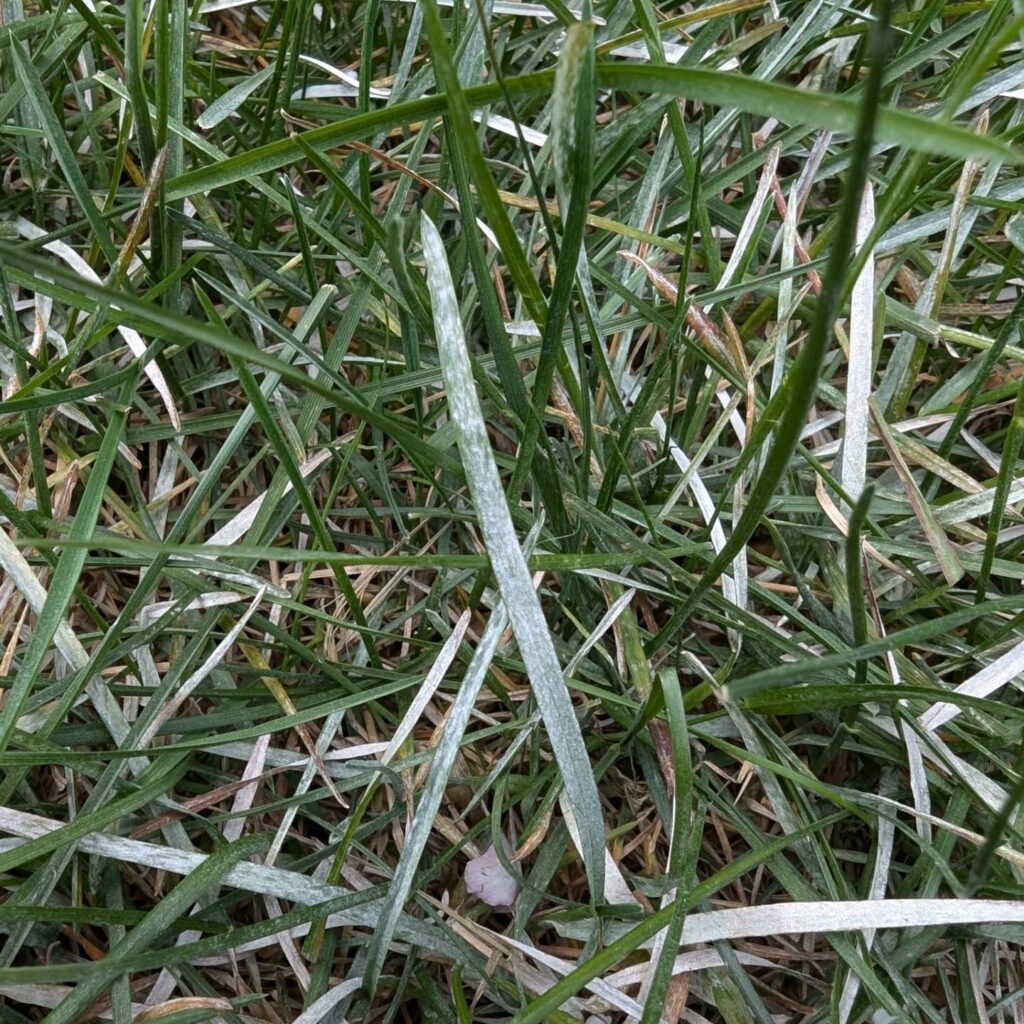
Powdery mildew, caused by the fungus Blumeria graminis, coats grass blades in a grayish-white, dusty film that looks almost like flour was sprinkled across the lawn. It is one of the most visually obvious turf diseases, and thankfully one of the least damaging.
This disease is almost always tied to shade — you will rarely see it in a lawn area that gets full, direct sun for most of the day.
Treat: Fungicide can help knock down an active outbreak, but honestly, it rarely matters as much as fixing the shade problem sitting underneath it. Treating the symptom without touching the cause just invites the mildew right back.
Prevent: Prune back overhanging branches and thin out dense shrubs to let more sunlight and airflow reach the affected patch of lawn.
8. Red Thread
Red thread announces itself with pink to red, thread-like fungal strands that literally bind grass blades together. From a distance, an infected lawn can take on a distinct reddish or pink tint that’s hard to mistake for anything else.
It shows up most often during cool, humid stretches in spring and fall, and it can affect nearly any cool-season turf species.
Treat: In many mild cases, a simple application of nitrogen resolves the problem without any fungicide involved at all, since the fungus struggles to spread on vigorously growing grass.
Prevent: Red thread is a textbook sign of low soil fertility, so keeping a consistent, appropriately timed feeding schedule for your specific grass type is the most dependable long-term fix.
9. Fairy Ring
Fairy ring shows up as a ring or arc of unusually dark green grass, sometimes accompanied by mushrooms sprouting along the band, with a dead or thinned strip running through the middle. It’s caused by soil fungi breaking down buried organic matter underground.
Rings can grow slowly over many years, sometimes expanding by a foot or more annually as the fungus works its way outward through the soil.
Core aeration combined with deep watering can help push moisture past the water-repellent fungal mat that often forms underground. In severe or stubborn cases, physically removing and replacing the soil in the ring is sometimes the only lasting fix.
Prevent: Clear out buried wood, tree stumps, and other organic debris before establishing a new lawn, since decomposing material is exactly what feeds this fungus below the surface.
10. Gray Snow Mold
Gray snow mold appears as circular, grayish-white patches with a crusty, matted texture, usually right as snow melts away in early spring. The grass often looks flattened and stuck together, almost like it was pressed under a heavy weight all winter — which, in a sense, it was.
Treat: Once the ground is exposed, gently raking the matted areas helps the grass dry out faster and encourages new growth to push through. Most lawns recover on their own without needing fungicide once temperatures rise.
Prevent: Avoid mowing too tall heading into winter, since long grass blades are more prone to matting under snow cover. If possible, avoid consistently piling snow in the same spot year after year, as that concentrates moisture and cold in one vulnerable area.
11. Pink Snow Mold (Microdochium Patch)
Pink snow mold looks similar to its gray cousin but carries a distinct pinkish tinge along the patch edges. Unlike gray snow mold, this one doesn’t need snow cover at all — it can appear during any cool, wet stretch of fall or early spring weather.
Treat: In regions with a history of this disease, a fungicide application in late fall, before the ground freezes, offers the best protection heading into winter.
Prevent: Improve surface drainage wherever water tends to pool, and hold off on heavy nitrogen applications as the lawn heads into its dormant season.
12. Anthracnose
Anthracnose, caused by the fungus Colletotrichum graminicola, starts with yellow to bronze patches that darken into a deeper brown as the disease progresses. Look closely during humid weather and you may spot tiny black fruiting structures on the dying leaf tissue — a telltale sign confirming the diagnosis.
This disease often targets turf that is already under some form of stress rather than healthy, vigorously growing grass.
Treat: Fungicides alone rarely solve an anthracnose problem, because the underlying stress needs to be addressed first. Treating the symptom while ignoring drought stress or compaction just delays the next outbreak.
Prevent: Avoid cutting the grass too short, and don’t let the lawn sit under prolonged drought stress, since both conditions are the biggest triggers pathologists point to for this disease.
13. Summer Patch
Summer patch produces circular patches of wilted, reddish-brown turf that seem to appear out of nowhere during long, hot summer stretches. It’s most commonly seen in Kentucky bluegrass lawns, where the fungus quietly attacks the root system long before symptoms show above ground.
Treat: By the time patches are visible, the infection has usually been active for weeks already. Preventive fungicide applications made in late spring, before symptoms appear, are far more effective than trying to treat visible damage in July or August.
Prevent: Overseeding with a more resistant species like tall fescue reduces long-term risk, and relieving soil compaction through regular aeration helps roots grow deep enough to tolerate summer heat stress.
14. Necrotic Ring Spot
Necrotic ring spot creates rings of dead, straw-colored grass with a tuft of surviving healthy green grass sitting in the very center — a pattern pathologists sometimes nickname “frog-eye” because of how distinct it looks from above.
Kentucky bluegrass lawns on compacted or poorly draining soil are the most frequent victims of this disease.
Treat: Fungicide applications timed for fall or spring, paired with core aeration to relieve compaction, tend to produce the best long-term results. This is a slow-healing disease, so patience matters as much as the treatment itself.
Prevent: Keep thatch buildup under control and avoid mowing too short, since both conditions make it easier for the fungus to establish itself in the root zone.
15. Spring Dead Spot
Spring dead spot shows up as circular dead patches in bermudagrass lawns just as the turf tries to green up after winter. Left alone, these patches often expand into rings over the following several years rather than healing on their own.
Treat: Recovery is genuinely slow with this disease, and it can take more than one growing season to fully bounce back. Fungicide applications must go down in the fall, months before any visible symptoms appear in spring, which makes timing the hardest part of managing it.
Prevent: Avoid applying nitrogen late in summer, and dethatch the lawn regularly, since a thick thatch layer gives the fungus a comfortable place to overwinter and build up strength.
ALSO READ: 5 Things To Do With Grass Clippings (After Mowing Your Lawn)
16. Take-All Root Rot
Take-all root rot produces yellow, thinning patches where the roots underneath have turned weak and blackened, often pulling up from the soil with almost no resistance. St. Augustine grass is the most commonly affected species, though other warm-season turf can be hit too.
Treat: Lowering soil pH slightly with sulfur-based products can help make conditions less favorable for the pathogen. Fungicide should be applied while the turf is actively growing rather than dormant, since the chemical needs living tissue to be absorbed effectively.
Prevent: Avoid over-watering, which keeps roots perpetually wet and weak, and try to reduce herbicide-related stress on the lawn, since stressed roots are far more vulnerable to this particular pathogen.
17. Melting Out (Leaf Spot)
Melting out, caused by Helminthosporium and related fungi, begins as small purplish-brown spots on individual leaf blades. As the infection advances, the whole plant seems to “melt” into thinning, rotted-looking patches across the lawn.
Treat: In advanced cases, fungicide provides real relief, but in many lighter infections, simply raising the mowing height solves the problem without any chemical intervention at all.
Prevent: Avoid scalping the lawn, and be careful not to spike nitrogen applications heavily in spring, since both practices push tender new growth that this fungus finds easy to infect.
18. Slime Mold
Slime mold coats grass blades in a gray, black, or bluish crust after a rainy spell, giving the lawn the odd appearance of having ash dumped across it. It usually shows up in circular patterns and is most common from late spring through fall.
Despite how alarming it looks, slime mold does not actually feed on the living grass plant underneath it.
Treat: This one is almost entirely cosmetic. A quick pass with a hose, a rake, or even the lawn mower is usually all it takes to clear it away.
Prevent: Keep the thatch layer under control, since slime molds are feeding on decaying organic matter in the thatch rather than the grass itself, and less thatch simply means less food for them.
19. Yellow Patch
Yellow patch, caused by a cool-weather strain of Rhizoctonia, shows up as rings or patches of light green to yellow turf during cool, wet conditions. Unlike many other patch diseases, it rarely causes serious dieback of the actual grass plants.
Treat: In most residential lawns, the discoloration fades on its own once the weather warms and the ground dries out, so heavy chemical treatment usually isn’t necessary.
Prevent: Improving surface drainage in low, soggy areas and reducing excess thatch buildup both lower the odds of a recurring outbreak.
20. Pink Patch
Pink patch resembles red thread in many ways but produces a more distinctly pink, almost gelatinous coating on infected grass blades during cool, humid conditions. The two diseases are close cousins and often get confused for each other in the field.
Treat: A balanced, consistent fertility program typically clears pink patch without needing any chemical fungicide at all.
Prevent: Since low nitrogen is the most common underlying trigger, correcting fertility levels is usually the simplest and most permanent solution.
21. Fusarium Patch
Fusarium patch starts as small, water-soaked spots that expand into orange-brown patches, most active during cool, damp stretches in fall and early spring. It shares some visual overlap with pink snow mold, since both are caused by related Microdochium species.
Treat: Fungicide applications timed before the season’s first hard frost tend to reduce the severity of outbreaks the following spring.
Prevent: Cut back on nitrogen late in the growing season, and improve air circulation across the lawn to help leaf surfaces dry faster after rain or dew.
22. Stripe Smut
Stripe smut produces long, dark gray to black stripes running the full length of individual leaf blades, which eventually curl, split, and shred as the disease progresses. It’s a systemic infection, meaning it lives inside the plant itself rather than just on the surface.
Treat: Unfortunately, there is no reliable cure once a lawn is infected. At that point, the most practical path forward is reseeding the affected areas with resistant grass cultivars.
Prevent: Choosing resistant grass varieties from the very beginning is the single most effective defense, since prevention genuinely outperforms any treatment option available for this disease.
23. Copper Spot
Copper spot produces small, copper-orange to salmon-colored spots, most often seen on bentgrass lawns kept at very low mowing heights, such as putting greens or high-maintenance residential turf.
Treat: Fungicides containing thiram or chlorothalonil have shown effective control against this disease when applied at the first sign of discoloration.
Prevent: Maintaining proper potassium levels through regular soil testing, along with avoiding overly acidic soil conditions, both help keep this disease from taking hold.
24. Turfgrass Nematode Damage
Nematode damage looks deceptively like ordinary drought stress — general thinning, yellowing, and wilting — even when the lawn is being watered adequately. It shows up most often in sandy soils, where these microscopic roundworms move and feed most easily.
Treat: There genuinely aren’t many effective home remedies for nematode damage. The right first step is sending a soil sample to your state’s agriculture or extension lab to confirm both the presence and species of nematode involved.
Prevent: Building a deep, healthy root system through proper irrigation and consistent organic matter in the soil makes turf noticeably more tolerant of nematode pressure, even if it doesn’t eliminate the pests entirely.
25. St. Augustine Decline (Mosaic Virus)
This disease produces a distinct mottled, mosaic-like yellowing pattern across the leaf blades, without the circular patch shapes typical of fungal turf diseases. It is one of the few common lawn problems caused by a virus rather than a fungus.
Treat: Fungicides simply do not work here, since there is no fungus to target. Once a lawn is infected, there is no chemical cure, and management shifts almost entirely toward prevention and replacement.
Prevent: Plant virus-resistant St. Augustine cultivars from the start, and always disinfect mower blades between different lawn sections to avoid spreading the virus mechanically from an infected area to a healthy one.
Why Lawn Diseases Deserve Serious Attention
Turfgrass is not a minor hobby crop. It is one of the largest managed landscapes in the country.
The U.S. turfgrass and lawn care industry generates an estimated $40 to $60 billion a year in economic activity, according to the Economic Research Service and the National Turfgrass Research Initiative.
That scale matters because disease pressure on turf is not rare or minor. Extension pathologists at land-grant universities note that millions of dollars are spent annually on fungicides just to prevent or treat disease outbreaks on golf courses, athletic fields, and home lawns.
Most infections share three ingredients: a susceptible grass species, an active fungal pathogen, and favorable weather. This is called the disease triangle, and it explains why the same lawn can look perfect one month and ruined the next.
Common Threads Across Nearly Every Lawn Disease
After going through all 25, a pattern becomes obvious. Excess moisture, low airflow, and unbalanced nitrogen sit behind most of these problems.
That is genuinely reassuring news. It means a homeowner does not need 25 separate strategies — just a handful of consistent habits.
- Watering: Irrigate early in the morning, deeply but infrequently, so grass blades are not wet overnight.
- Mowing: Cut at the correct height for your grass species, and never remove more than one-third of the blade length at once.
- Fertilizing: Match nitrogen timing to your grass type — cool-season lawns benefit from fall feeding, while warm-season lawns need it in late spring and summer.
- Airflow: Prune back shrubs and trees that shade or block wind movement across the lawn.
- Thatch and compaction: Aerate compacted soil and dethatch when the layer exceeds half an inch, since both trap moisture near the crown of the plant.
Disease Risk by Season
Timing tells you a lot before you even look closely at the grass. Most turf pathogens have a preferred season, and matching symptoms to the calendar narrows your list fast.
Spring: Large patch, spring dead spot, fusarium patch, and gray or pink snow mold show up as the ground thaws and stays cool and damp.
Summer: Brown patch, dollar spot, pythium blight, gray leaf spot, rust, and summer patch dominate once daytime heat and humidity climb.
Fall: Necrotic ring spot, take-all root rot, and fusarium patch often begin quietly in fall, even though symptoms may not appear until the following spring.
Winter: Snow molds and slime molds are the main concern, and both tend to look far worse than the actual long-term damage they cause.
Keeping a simple log of when symptoms first appear each year is one of the most underrated diagnostic tools a homeowner has. A pattern across two or three seasons is more reliable than a single photo.
Grass Type and Disease Susceptibility
Not every lawn faces the same risks. Cool-season grasses like tall fescue, Kentucky bluegrass, and perennial ryegrass are more prone to brown patch, dollar spot, red thread, and necrotic ring spot.
Warm-season grasses such as bermudagrass, zoysiagrass, centipedegrass, and St. Augustine grass deal more often with large patch, take-all root rot, gray leaf spot, and spring dead spot.
Knowing your grass species before you diagnose a problem cuts the list of likely suspects roughly in half. It is one of the fastest shortcuts to an accurate diagnosis.
When Should You Call a Professional?
If you have tried cultural fixes and the disease keeps returning in the same spot each year, it’s worth getting a proper diagnosis.
Cooperative extension offices at land-grant universities, such as those cited below, typically offer sample testing for a modest fee. A confirmed diagnosis prevents wasted money on the wrong fungicide, which is a mistake I have seen far too often.
Frequently Asked Questions
Can lawn disease spread to other plants in my yard? Most turfgrass fungi are host-specific and do not infect trees, shrubs, or garden beds in a meaningful way.
Is fungicide always necessary? No. Extension pathologists note that most residential lawn diseases can be managed through cultural practices alone, without any fungicide use.
Why does my lawn get the same disease every year? Recurring disease usually points to an unresolved condition — poor drainage, compacted soil, or incorrect fertilizer timing — rather than bad luck.
What is the single biggest mistake homeowners make? Watering in the evening. It leaves grass blades wet overnight, which is exactly the condition most fungal pathogens need to infect the plant.
Final Thoughts
A diseased lawn is frustrating, but it is rarely a lost cause. Most of the 25 diseases above respond well to the same core habits: smart watering, correct mowing, and balanced fertility.
Take the time to identify the problem correctly before reaching for a chemical solution. In my experience, that one step saves more lawns than any fungicide ever could.
References
- University of Maryland Extension — Lawn Diseases: https://extension.umd.edu/resources/yard-garden/lawns/lawn-diseases
- Penn State Extension — Lawn and Turfgrass Diseases: https://extension.psu.edu/trees-lawns-and-landscaping/turfgrass-and-lawn-care/pests-and-diseases
- University of Florida IFAS Gardening Solutions — Lawn Diseases: https://gardeningsolutions.ifas.ufl.edu/lawns/problems-and-solutions/lawn-diseases/
- University of Delaware Cooperative Extension — Diseases of Turfgrass: Identification and Management: https://www.udel.edu/academics/colleges/canr/cooperative-extension/fact-sheets/turfgrass-disease-identification/
- Clemson University Home & Garden Information Center — Brown Patch & Large Patch Diseases of Lawns: https://hgic.clemson.edu/factsheet/brown-patch-large-patch-diseases-of-lawns/
- University of Missouri Extension — Turfgrass Disease Control: https://extension.missouri.edu/publications/g6756
- NC State Extension Publications — Diseases of Cool-Season Turfgrasses: https://content.ces.ncsu.edu/diseases-of-cool-season-grasses

Tim M Dave is a gardening expert with a passion for houseplants, particularly cacti and succulents. With a degree in plant biology from the University of California, Berkeley, he has vast experience in gardening. Over the years, he has cultivated a vast collection of desert plants and learned a great deal about how to grow and care for these unique companions.