25 Best Aquarium Plants for a Fish Tank: Low light, no CO2, Floating, and More
I have kept planted tanks long enough to know one thing for certain: the right plants make or break an aquarium. They are not just decoration. They are the lungs, the filter, and the nursery of your tank, all rolled into one living system.
In this guide, I am walking you through 25 aquarium plants that actually work — for beginners, for busy people, and for aquascapers who want a showpiece tank.
Every plant here is grouped by where it grows, so you know exactly what to buy for the front, middle, back, or surface of your aquarium.
Why Live Plants Matter in a Fish Tank
Live aquatic plants absorb ammonia, nitrite, and nitrate directly from the water column. This is not a marketing claim — it is basic plant physiology. Plants use nitrogen compounds as food, which means every leaf you grow is pulling waste out of your fish’s water.
They also release oxygen during daylight hours through photosynthesis, which helps stabilize pH and supports fish respiration.
According to Oklahoma State University Extension research on recirculating aquatic systems, plants recover dissolved waste nutrients from fish water, which reduces the need for water exchange and improves the overall stability of the system.
I have watched cloudy, algae-prone tanks turn clear within two to three weeks of adding a dense plant load. That is not luck. That is biology doing its job.
Beyond water quality, plants give your fish cover, shade, and breeding grounds. Skittish species like bettas and tetras behave more naturally when they have somewhere to hide. A bare tank is a stressed tank.
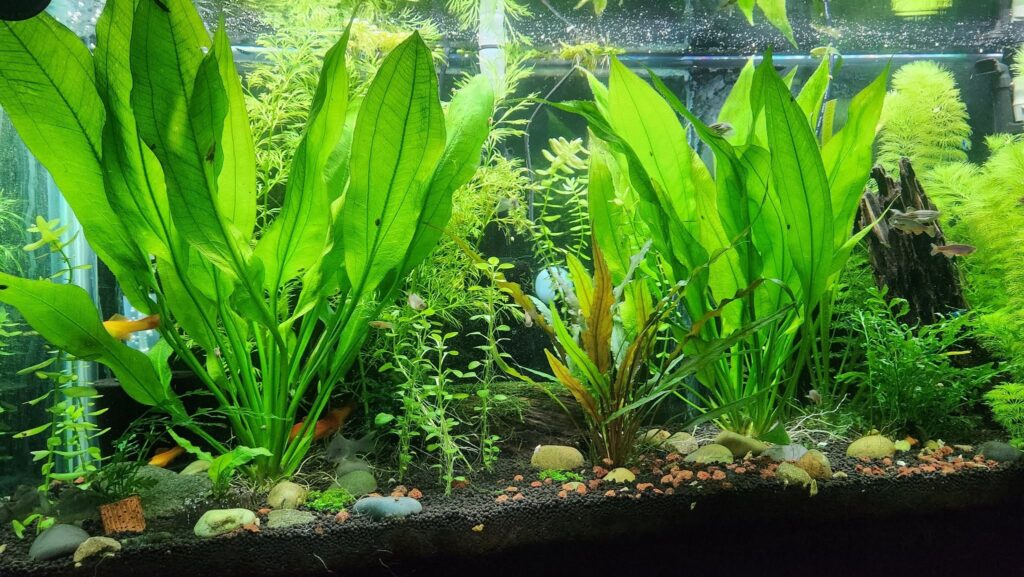
Best Aquarium Plants in a Nutshell
- Total beginner: Java Fern, Anubias, Java Moss, Amazon Sword, Vallisneria
- Low light, no CO2: Anubias, Cryptocoryne, Water Wisteria, Hornwort
- Fast growers for new tank cycling: Hornwort, Water Sprite, Anacharis, Duckweed
- Carpet plants (advanced): Dwarf Baby Tears, Monte Carlo, Dwarf Sagittaria
- Floating plants for betta tanks: Amazon Frogbit, Red Root Floater, Water Lettuce
Now let’s go through all 25, one at a time.
Foreground and Carpet Plants
These stay short and are planted at the front of the tank.
1. Dwarf Baby Tears (Hemianthus callitrichoides ‘Cuba’)
This is the plant behind every jaw-dropping “carpet” aquascape you have seen on social media. It needs strong lighting and injected CO2 to spread properly across the substrate.
Without CO2, it grows slowly and often melts back. I only recommend this one once you are past the beginner stage.
2. Monte Carlo (Micranthemum tweediei)
Monte Carlo is often marketed as the “easy” alternative to Dwarf Baby Tears. Its round leaves are larger, and it tolerates moderate light better than most true carpet plants.
It still prefers CO2 for a dense, dense mat, but I have grown patchy carpets of it under high-output LED alone.
3. Dwarf Sagittaria (Sagittaria subulata)
This grass-like plant spreads by runners and forms a low, lawn-like carpet over time. It tolerates low light and no CO2, which makes it far more forgiving than the two plants above.
Give it a nutrient-rich substrate and it will slowly fill in open space on its own.
4. Marimo Moss Ball (Aegagropila linnaei)
Technically an alga, not a vascular plant, but I am including it because nearly every aquarium plant list mentions it — and for good reason. It is nearly indestructible.
Marimo balls need no substrate, no CO2, and only weekly rotation to keep their round shape. They are a favorite for shrimp and betta tanks.
Rhizome and Epiphyte Plants (Attach to Wood or Rock)
These plants should never be buried in substrate — their rhizome will rot.
5. Java Fern (Microsorum pteropus)
Java Fern is, in my opinion, the single most beginner-proof aquarium plant available. It grows attached to driftwood or rocks, tolerates a wide light range, and needs no substrate and no fertilizer to survive.
Aquatic plant databases describe it as one of the easiest plants in cultivation, thriving under both strong and weak lighting alike. I have never killed one, and I have killed plenty of plants.
6. Anubias barteri
Anubias is the other pillar of low-tech aquascaping. Its thick, dark green leaves resist most fish species that like to nibble plants, including goldfish and larger cichlids.
Never bury the rhizome — tie or glue it to hardscape instead. It grows slowly, which means less maintenance for you.
7. Bucephalandra
Often called “Buce” by hobbyists, this plant looks similar to Anubias but with more color variety — blue, green, and even metallic sheens on the leaves. It also attaches to wood and rock.
It is slightly fussier about water flow and mineral content than Anubias, but the visual payoff is worth the extra attention.
Midground Plants
These fill the space between your foreground and background.
8. Cryptocoryne wendtii
Crypts are the workhorse of the midground. They come in green, bronze, and red varieties, and they root well in gravel or sand substrate.
One quirk worth knowing: crypts can experience “crypt melt,” where leaves dissolve after being moved or after a water change disturbance. Don’t panic — they almost always regrow within a few weeks.
9. Water Wisteria (Hygrophila difformis)
This is one of the fastest-growing midground plants I have ever kept. Its lacy, feathery leaves create a soft, natural texture that fish love swimming through.
It can be planted in substrate or left floating, and it tolerates a wide range of lighting conditions.
10. Bacopa caroliniana
Bacopa has small, rounded, slightly succulent-looking leaves on an upright stem. Crush a leaf between your fingers and you will notice a faint lemon scent — a small detail I always enjoy pointing out to guests.
It roots easily from cuttings, making it simple to propagate once established.
11. Amazon Sword (Echinodorus amazonicus / bleheri)
The Amazon Sword is a classic centerpiece plant with broad, sword-shaped leaves that can reach over a foot tall. It is a heavy root feeder, so nutrient-rich substrate matters more than water column fertilizer here.
I have used a single sword plant as the sole focal point of a 20-gallon tank, and it filled the space beautifully within two months.
12. Pogostemon stellatus (Star Grass)
Star Grass forms whorls of narrow leaves along a tall stem, creating a starburst pattern that catches the eye in a planted display. It responds strongly to good lighting with reddish tints on new growth.
It grows fast enough to need regular trimming, which also means it pulls excess nutrients quickly.
Background and Stem Plants
Tall, fast-growing plants for the back of the tank.
13. Rotala rotundifolia
Rotala is a stem plant famous for turning shades of pink and red under strong lighting. It is one of the more rewarding plants to watch change color week by week.
Trim the tops and replant the cuttings to create a fuller, bushier background wall.
14. Ludwigia repens
Ludwigia is another color-changing stem plant, shifting from green to a rich reddish-brown depending on light intensity and nutrient availability. It is forgiving of moderate light, unlike many red-leaved plants.
I find it pairs beautifully next to green background plants for visual contrast.
15. Cabomba caroliniana
Cabomba has delicate, fan-like underwater foliage that moves gracefully with current. It is a favorite among egg-scattering fish species because they can hide their eggs in the fine leaf structure.
It is a fast grower but can be brittle, so handle it gently during water changes.
16. Hornwort (Ceratophyllum demersum)
Hornwort is one of the toughest, fastest-growing plants in the aquarium trade. It can be planted or simply left floating, and it grows in almost any light condition.
I recommend this plant specifically during new tank cycling — its rapid nutrient uptake helps control ammonia spikes while your biological filter establishes itself.
17. Vallisneria (Vallisneria americana / spiralis)
Vallisneria, or “Val,” is a tall, ribbon-leafed plant that spreads through runners to form dense background clusters. The USDA PLANTS Database lists Vallisneria americana as a widespread native aquatic species found throughout much of North America.
According to the Lady Bird Johnson Wildflower Center, this species can be cultivated in aquariums given a rich substrate layer, full light, and stable water temperature. It spreads aggressively once established, so plan your spacing in advance.
18. Anacharis / Elodea (Egeria densa)
Anacharis is sold in nearly every pet store, and for good reason — it is cheap, fast-growing, and highly effective at absorbing excess nutrients. Extension research on Mid-Atlantic water gardens notes that this submerged plant is widely used in aquariums for its oxygen-generating capabilities.
It can be rooted or left completely free-floating, giving you flexibility in how you use it.
19. Guppy Grass (Najas guadalupensis)
Guppy Grass is a thin, bushy stem plant that grows extremely fast, often more than an inch per day under good conditions. It is a favorite for shrimp colonies and fry, since baby fish can hide safely among the dense strands.
It has no true roots and can simply be tossed into the tank to establish itself.
Floating Plants
These grow at the water’s surface, with roots dangling below.
20. Water Sprite (Ceratopteris thalictroides)
Water Sprite is incredibly versatile — it can be planted in substrate or allowed to float freely, and it thrives either way. Its lacy leaves provide excellent cover for fry and shrimp.
I like using it in breeding tanks specifically because baby fish instinctively hide among the roots.
21. Amazon Frogbit (Limnobium laevigatum)
Frogbit has round, lily-pad-like leaves and long trailing roots that betta fish love to rest against. It also blocks excess light, which helps control algae growth in overlit tanks.
Be careful not to let it cover the entire surface, or gas exchange at the water line will suffer.
22. Red Root Floater (Phyllanthus fluitans)
This small floating plant has striking reddish roots and rounded green leaves that turn a coppery-red under bright light. Research from the University of Florida’s Center for Aquatic and Invasive Plants notes that this species has spread partly through the aquarium plant trade after escaping cultivation.
Because of that, never release it into local waterways — dispose of excess plant material in the trash, not the drain.
23. Water Lettuce (Pistia stratiotes)
Water Lettuce forms rosettes of soft, velvety, pale-green leaves that float on the surface like tiny cabbages. It grows quickly and shades the tank, which some fish species genuinely appreciate.
It also has a reputation as an invasive species in warm climates outdoors, so it should be kept strictly to indoor aquariums.
24. Duckweed (Lemna minor)
Duckweed is tiny, fast-spreading, and controversial among hobbyists — some love it, some consider it a pest. It is genuinely one of the most efficient nutrient absorbers in the aquarium plant world.
Penn State Extension research identifies duckweed as a free-floating aquatic plant that thrives especially in nutrient-rich water. That same trait makes it excellent at pulling excess nitrate from a heavily stocked tank — just be ready to remove handfuls weekly, or it will take over the surface completely.
Moss
25. Java Moss (Taxiphyllum barbieri)
Java Moss might be the single most useful plant on this entire list. It attaches to any hardscape, tolerates almost any water condition, and creates a soft green carpet texture within weeks.
Breeders use it constantly, since it holds fish eggs and shrimp fry safely out of reach of hungry adult fish. I always keep a small clump running in my quarantine tanks for exactly this reason.
How I Choose Plants for a New Tank
I always start with light. Match your plant choices to your actual light output, not the plant you wish you could grow. Low-light setups should stick to Anubias, Java Fern, Java Moss, and Cryptocoryne.
Second, I check root type. Rhizome plants (Anubias, Java Fern, Bucephalandra) get tied to wood or rock. Root-feeders (Amazon Sword, Vallisneria, Cryptocoryne) go into nutrient-rich substrate.
Third, I plan for growth speed. Fast growers like Hornwort, Anacharis, and Water Sprite are ideal for a brand-new tank because they absorb ammonia quickly during the nitrogen cycle.
Common Mistakes I See Beginners Make
Burying a rhizome plant completely in substrate. This suffocates Anubias and Java Fern and eventually causes rot. Only the roots should be buried, never the thick rhizome stem.
Skipping root tabs for heavy feeders. Plants like Amazon Sword and Vallisneria draw nutrients through their roots. Without fertilized substrate or root tabs, growth stalls and leaves turn pale.
Overcrowding fast growers. Duckweed and Guppy Grass multiply so quickly that an unmanaged tank can lose surface light within a month. Thin them out weekly.
Ignoring water parameters. Most aquarium plants thrive in a pH range between roughly 6.5 and 7.8, with stable temperatures and moderate hardness. Wild temperature or pH swings stress plants just as much as they stress fish.
How to Spot a Healthy Plant Before You Buy
I inspect three things before any plant goes into my cart: leaf color, roots, and stem firmness. Yellowing, translucent, or mushy leaves are a red flag, even on an otherwise attractive bunch.
Roots should look white or pale, not black or slimy. Black, rotting roots usually mean the plant has been sitting in poor water for too long at the store.
Gently tug the stem. A firm, springy stem snaps back into place. A limp or slimy stem often means the plant is already dying and will melt within days of introduction.
I also always quarantine new plants for about a week in a separate container. This single habit has saved me from introducing snail eggs and algae spores into an established tank more times than I can count.
Lighting and Layout: Getting the Basics Right
Aquarium lighting is usually measured by color temperature, expressed in Kelvin. Most planted tanks perform best under full-spectrum lighting between roughly 6,500K and 8,000K, which mimics natural daylight and supports steady photosynthesis.
Duration matters as much as intensity. I run my lights for eight to ten hours a day, no more. Longer photoperiods usually feed algae faster than they feed your plants.
When it comes to layout, think in three horizontal bands. Foreground plants like Dwarf Sagittaria and Monte Carlo stay under four inches tall. Midground plants like Cryptocoryne and Bacopa fill the six-to-ten-inch range. Background stems like Rotala and Vallisneria climb toward the surface.
I also leave sightlines open on one side of the tank. A wall of tall plants across the entire back looks crowded fast — a slight diagonal taper toward one corner gives the eye somewhere to rest.
Fertilizing Without Overdoing It
Root-feeding plants such as Amazon Sword, Vallisneria, and Cryptocoryne benefit from fertilizer tabs pushed into the substrate near their roots, replaced roughly every four to six weeks.
Stem plants and floaters, on the other hand, absorb most of their nutrients directly through the water column. A liquid all-in-one fertilizer dosed weekly usually covers their needs.
Watch your fish, not just your plants, after dosing. Over-fertilizing is one of the fastest ways to trigger an algae bloom, and it rarely helps the plants grow any faster once their basic needs are already met.
Frequently Asked Questions
What is the easiest aquarium plant for beginners? Java Fern and Anubias are widely considered the two most forgiving species. Both survive low light, require no CO2, and do not need to be planted in substrate.
Do aquarium plants really improve water quality? Yes. Plants absorb nitrogen compounds such as ammonia and nitrate directly from the water, which is why heavily planted tanks often need less frequent water changes.
Can I mix floating plants with rooted plants? Absolutely, though floating plants can block light from reaching plants below. Keep floating coverage under roughly 30 to 40 percent of the surface if you also want carpet or midground plants to thrive.
Which plants are safe with goldfish and cichlids? Tough, thick-leaved plants like Anubias, Java Fern, and Vallisneria tend to survive fish that like to dig or nibble. Delicate stem plants usually get destroyed quickly by these species.
Do I need CO2 injection for a planted tank? No, not for most plants on this list. Carpet plants like Dwarf Baby Tears and Monte Carlo benefit most from CO2, while low-tech species like Anubias, Java Fern, and Cryptocoryne grow fine without it.
Final Thoughts
I have tried nearly every plant on this list at some point in my own tanks, and I keep coming back to the same conclusion: start simple, then expand. Java Fern, Anubias, and Java Moss will teach you the basics without punishing small mistakes.
Once your confidence grows, stem plants and carpet species open the door to genuinely stunning aquascapes. Take it one plant at a time, watch how your fish respond, and let the tank guide your next move.
References
- Pennsylvania State University Extension. Mid-Atlantic Pocket Guide to Water Garden Species. https://extension.psu.edu/mid-atlantic-pocket-guide-to-water-garden-species
- Purdue University, Department of Botany and Plant Pathology. Identifying and Managing Aquatic Vegetation. https://ag.purdue.edu/btny/purdueweedscience/wp-content/uploads/2021/03/Identifying-and-Managing-Aquatic-Vegetation.pdf
- Oklahoma State University Extension. Recirculating Aquaculture Tank Production Systems: Aquaponics — Integrating Fish and Plant Culture. https://extension.okstate.edu/fact-sheets/recirculating-aquaculture-tank-production-systems-aquaponics-integrating-fish-and-plant-culture.html
- United States Department of Agriculture, Natural Resources Conservation Service. PLANTS Database: Vallisneria americana Profile. https://plants.usda.gov/home/plantProfile?symbol=vaam3
- Lady Bird Johnson Wildflower Center, The University of Texas at Austin. Native Plant Database: Vallisneria americana. https://www.wildflower.org/plants/result.php?id_plant=vaam3
- University of Missouri Libraries. Aquatic Plants: Plant Identification and Foraging. https://libraryguides.missouri.edu/plant-identification-and-foraging/aquatic
- University of Florida, Institute of Food and Agricultural Sciences (UF/IFAS). Center for Aquatic and Invasive Plants. https://plants.ifas.ufl.edu/

Tim M Dave is a gardening expert with a passion for houseplants, particularly cacti and succulents. With a degree in plant biology from the University of California, Berkeley, he has vast experience in gardening. Over the years, he has cultivated a vast collection of desert plants and learned a great deal about how to grow and care for these unique companions.