25 Stunning Trees With Pink Flowers (Identification With Pictures)
I have spent considerable time researching and observing many of these trees firsthand, and I can say with confidence: few things in nature rival the sight of a mature cherry tree in full bloom or a Silk Tree draping its feathery pink plumes over a summer garden.
According to the United States Forest Service, trees provide ecosystem services valued at over $18.3 billion annually in the United States alone — and flowering trees contribute meaningfully to pollinator support, biodiversity, and human well-being.
Pink-flowering trees, in particular, offer:
- Strong visual impact across all garden sizes
- Excellent pollinator value for bees and butterflies
- Seasonal interest from early spring through late summer
- Increased property value — studies show mature trees can raise property value by up to 15% (University of Washington, Urban Forestry Research)
Let us explore 25 of the most stunning trees with pink flowers — complete with care tips.
Early Spring Bloomers
1. Japanese Cherry Blossom (Prunus serrulata)
Perhaps the most iconic pink-flowering tree in the world, the Japanese Cherry Blossom — called Sakura in Japanese — has been cultivated for over 1,000 years.
It typically blooms between late March and early May, producing clouds of soft pink to deep rose flowers before the leaves emerge. The Yoshino and Kwanzan varieties are particularly popular in temperate gardens.
Mature trees reach 15–25 feet in height. They prefer well-drained, slightly acidic soil and full sun exposure. The National Cherry Blossom Festival in Washington D.C. draws over 1.5 million visitors annually, underscoring the tree’s global cultural significance.
2. Eastern Redbud (Cercis canadensis)
The Eastern Redbud is a North American native that never fails to impress. What makes it distinctive is that its small, magenta-pink flowers emerge directly from the bark of branches and trunk — a phenomenon botanists call cauliflory.
It is a small to medium tree, typically 20–30 feet tall, and thrives across USDA Hardiness Zones 4–9. The Missouri Botanical Garden notes it as one of the most ornamentally valuable native trees in eastern North America.
Beyond beauty, Redbud flowers are edible and were historically consumed by Native American communities.
3. Saucer Magnolia (Magnolia × soulangeana)
The Saucer Magnolia is a hybrid species that produces large, chalice-shaped blooms in shades of white, pale pink, and deep rose-purple. It blooms in early spring, often before the leaves emerge, making the display truly spectacular.
Trees grow to 20–25 feet. They are best planted in a sheltered position, as late frosts can damage the early blooms. Saucer Magnolias are widely cultivated across Europe, North America, and East Asia.
4. Star Magnolia (Magnolia stellata)
The Star Magnolia is a compact tree or large shrub, rarely exceeding 15–20 feet, which makes it ideal for smaller gardens. Its flowers are star-shaped with narrow, strap-like petals in white to pale pink.
Blooming is remarkably early — sometimes as soon as late February in mild climates. The Royal Horticultural Society (RHS) has awarded this species its prestigious Award of Garden Merit, recognising its outstanding value for garden cultivation.
5. Pink Dogwood (Cornus florida f. rubra)
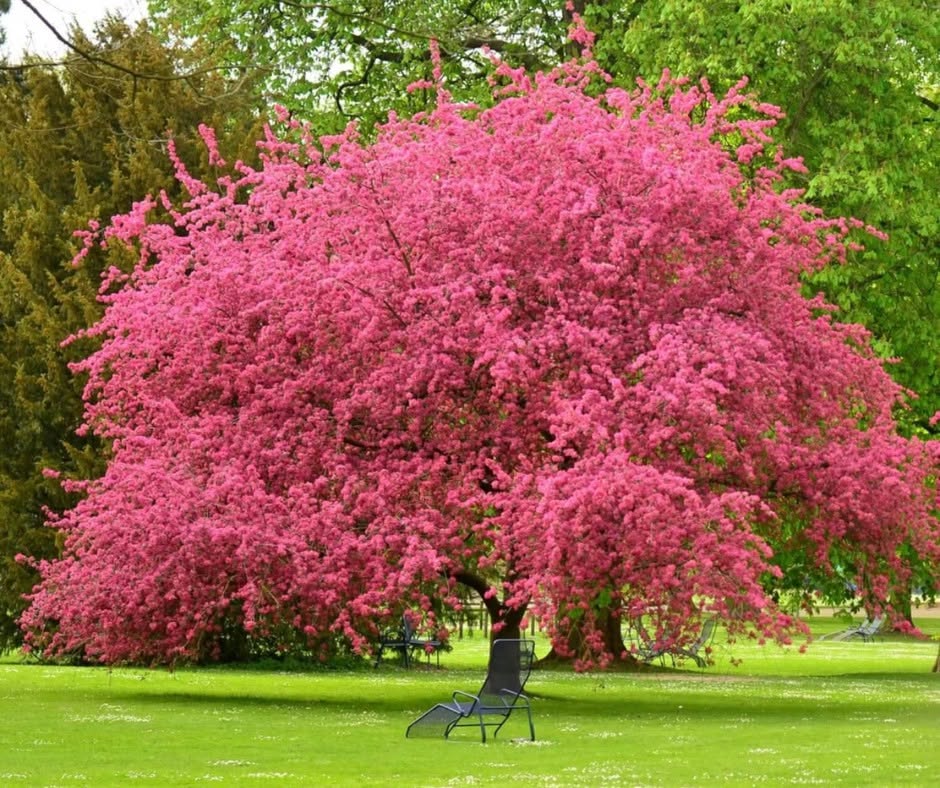
A beloved American native, the Pink Dogwood produces showy pink bracts — not true petals — that surround a cluster of small true flowers. It blooms in mid-spring and is a stunning companion to azaleas and rhododendrons.
Pink Dogwood grows 15–30 feet tall and performs best in partial shade with moist, well-drained, acidic soil. It is the official state tree of Missouri and Virginia. The Dogwood is also an important food source for over 40 species of birds.
6. Flowering Almond (Prunus triloba)
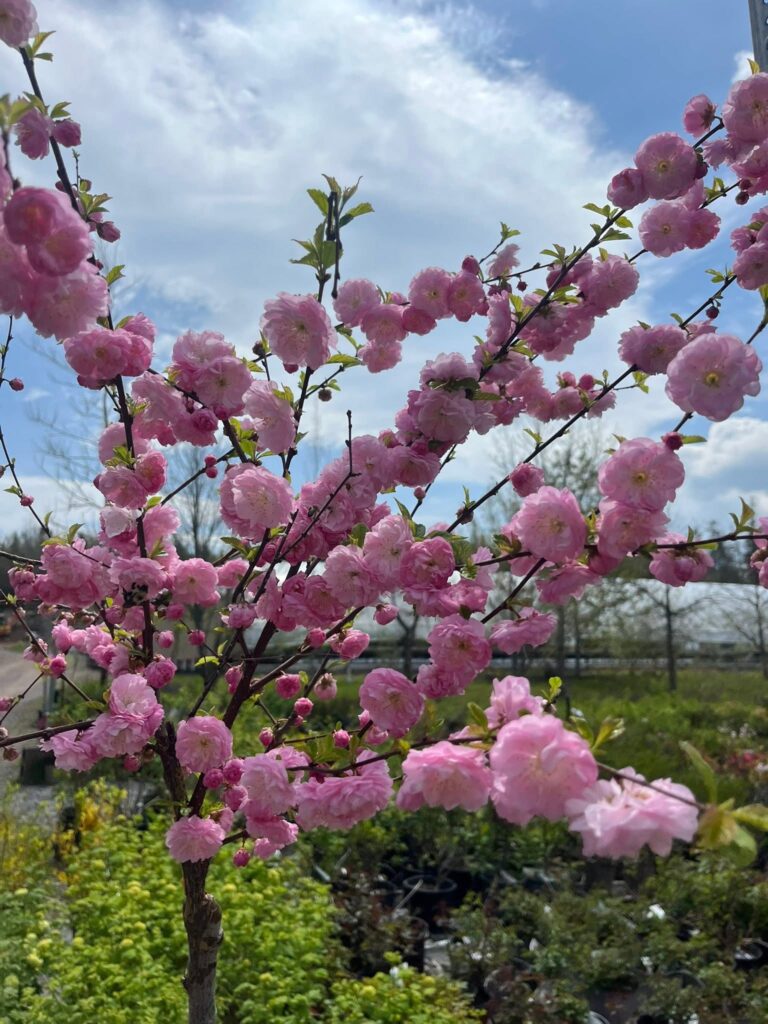
Often grown as a multi-stemmed large shrub or small tree, the Flowering Almond produces an abundance of double, rose-pink flowers in early spring. The effect is dramatic — almost frothy in appearance.
It reaches 10–15 feet and is suited to USDA Zones 3–6, making it one of the hardiest pink-flowering trees available. Prune immediately after flowering to encourage the next year’s bloom.
7. Taiwan Cherry (Prunus campanulata)
Unlike many cherry trees, the Taiwan Cherry blooms in late winter to very early spring, sometimes as early as January in warm climates. Its deep rose-red to hot-pink pendulous flowers are among the most vivid of any Prunus species.
It is a fast-growing tree reaching 20–30 feet. Particularly popular in Southern California and the Gulf Coast region, where winters are mild.
Mid-Spring Bloomers
8. Crabapple (Malus spp.)
Pink-flowering crabapple varieties are among the most versatile ornamental trees available. Cultivars such as Malus ‘Prairifire’, ‘Pink Spires’, and ‘Adams’ produce masses of rich pink to magenta flowers in mid-spring.
Crabapples are remarkably adaptable, growing in USDA Zones 3–8 and tolerating a wide range of soil conditions. Most grow 15–25 feet tall. As an added bonus, they produce small ornamental fruits that provide winter food for birds.
According to the Arnold Arboretum at Harvard University, there are over 700 named crabapple cultivars — a testament to their horticultural importance.
9. Kwanzan Cherry (Prunus serrulata ‘Kwanzan’)
A cultivar of the Japanese Cherry, the Kwanzan is particularly known for its large, double, deep-pink flowers that appear in hanging clusters. Each bloom can contain up to 30 petals, giving them a lush, peony-like appearance.
It grows 15–25 feet tall and prefers full sun. This is one of the most widely planted street trees across the eastern United States and is a highlight of Washington D.C.’s Tidal Basin.
10. Persian Silk Tree (Albizia julibrissin)
The Persian Silk Tree is unlike any other on this list. Rather than conventional petals, it produces feathery, powder-puff flowers in shades of vivid pink and cream from late spring through summer.
It is a fast-growing, wide-spreading tree that can reach 20–40 feet. While beautiful, it is considered invasive in parts of the southeastern United States — always check local regulations before planting.
11. Red Horsechestnut (Aesculus × carnea)
A hybrid between the Common Horsechestnut and the Red Buckeye, the Red Horsechestnut produces upright spires of deep rose-pink flowers (called panicles) in mid to late spring. Each spike can reach 8–12 inches in length.
Trees grow 30–40 feet tall and are long-lived, with some specimens exceeding 100 years. They are widely planted as street trees across Europe and North America.
12. Paulownia (Paulownia tomentosa)
Also called the Princess Tree or Empress Tree, Paulownia produces large, fragrant, lilac-pink, trumpet-shaped flowers in mid-spring before the leaves emerge. The flower clusters are bold and showy.
It is one of the fastest-growing trees in the world — capable of growing up to 15 feet in a single year under ideal conditions. It is native to China but widely naturalised elsewhere.
13. Pink Trumpet Tree (Tabebuia heterophylla)
Native to the Caribbean, the Pink Trumpet Tree is a tropical gem that produces masses of bright pink, funnel-shaped flowers on bare branches before spring leaf-out. The display lasts 7–10 days but is unforgettable.
It grows 20–30 feet tall and is suited to USDA Zones 10–12. Popular in South Florida, Hawaii, and similar warm climates.
14. Weeping Cherry (Prunus pendula)
The Weeping Cherry combines graceful, cascading branch form with an abundance of pale pink to deep rose flowers. It is one of the most photographed ornamental trees in the world.
Trees typically grow 20–30 feet tall with an equal spread. The weeping form creates an almost waterfall-like effect of pink blossoms in early spring. Best planted as a specimen tree with ample space to display its arching branches.
Late Spring and Summer Bloomers
15. Mountain Laurel (Kalmia latifolia)
While often classified as a large shrub, mature Mountain Laurel can reach tree-like proportions of 15–20 feet in ideal conditions. Its buds are particularly striking — star-shaped and deep pink — opening to pale pink or white flowers in late spring.
It is the state flower of both Connecticut and Pennsylvania. Mountain Laurel thrives in acidic, well-drained soils in partial shade, much like rhododendrons.
16. Pink Locust (Robinia × ambigua ‘Decaisneana’)
A hybrid locust variety, the Pink Locust produces hanging clusters of soft rose-pink, pea-like flowers reminiscent of wisteria in early summer. Trees grow 40–50 feet tall and are moderately fast-growing.
Unusually for a pink-flowering tree, the Pink Locust is also highly fragrant — the blooms carry a sweet, vanilla-like scent. It is tolerant of poor, dry soils.
17. Crepe Myrtle (Lagerstroemia indica)
Crepe Myrtle is arguably the most popular pink-flowering tree in the American South. It blooms prolifically from midsummer to early autumn, producing large clusters of crinkled flowers in shades ranging from pale blush to deep hot pink.
Trees vary from dwarf varieties (3–4 feet) to standard trees reaching 25–30 feet. They thrive in full sun and heat, making them ideal for USDA Zones 7–10. Their attractive exfoliating bark adds winter interest.
18. Oleander (Nerium oleander)
Although frequently grown as a large shrub, Oleander can be trained into a small, single-stemmed tree reaching 15–20 feet. It produces showy pink flowers from late spring through autumn — one of the longest bloom seasons of any plant on this list.
It is highly drought-tolerant and thrives in coastal environments. However, all parts of the Oleander are toxic if ingested — an important consideration for households with children or pets.
19. Strawberry Tree (Arbutus unedo)
The Strawberry Tree earns its place here for its delicate, urn-shaped pink and white flowers that appear in autumn and early winter — rare timing for a flowering tree. Simultaneously, it bears red, strawberry-like fruits from the previous year’s flowers.
It grows 15–30 feet tall and is native to the Mediterranean and western Ireland. Remarkably, it is the only Mediterranean plant native to Ireland, where it grows in County Kerry.
Tropical and Subtropical Pink Trees
20. Bauhinia (Bauhinia variegata)
Known as the Orchid Tree, Bauhinia is widely planted across tropical and subtropical regions for its exotic, orchid-like pink to magenta flowers. Each flower has five petals with a distinctive shape that has made it a symbol of Hong Kong.
It grows 20–35 feet tall and blooms in late winter to spring in tropical climates. It is the floral emblem of Hong Kong.
21. Pink Shower Tree (Cassia grandis)
The Pink Shower Tree is a spectacular tropical species producing large clusters of salmon-pink flowers along its branches. Native to Central and South America, it is widely planted as a street tree across tropical Asia and the Caribbean.
It can reach 60 feet in its native habitat. In full bloom, the canopy appears completely smothered in pink — a truly breathtaking sight.
22. Tibouchina (Tibouchina granulosa)
While more commonly known for its purple flowers, certain Tibouchina varieties produce striking rose-pink blooms from summer through winter. Native to Brazil, it is an increasingly popular ornamental in subtropical gardens worldwide.
It grows 15–30 feet tall. The large, velvety leaves have prominent veining, giving the tree a lush, tropical appearance even when not in flower.
23. Crape Myrtle ‘Natchez Pink’ (Lagerstroemia ‘Natchez’)
A cultivar worth singling out, ‘Natchez’ is one of the most disease-resistant Crape Myrtles available. It produces profuse clusters of pale blush-pink flowers from midsummer onwards and has spectacular cinnamon-coloured exfoliating bark.
It grows 20–30 feet and performs best in USDA Zones 7–9. The combination of summer flowers, autumn colour, and winter bark makes it a four-season ornamental.
Unusual and Rare Pink-Flowering Trees
24. Dove Tree (Davidia involucrata)
The Dove Tree is one of the most unusual flowering trees in the world. Each flower head is surrounded by two large, unequal white bracts tinged with pink that flutter in the breeze, resembling handkerchiefs or doves in flight.
Native to China, it grows 30–50 feet tall. It is slow to bloom, often taking 10+ years from seed to first flower, but the wait is invariably worth it. The Arnold Arboretum describes it as one of the most spectacular ornamental trees in cultivation.
25. Pink Frangipani (Plumeria rubra)
No list of pink-flowering trees would be complete without Frangipani. This iconic tropical tree produces intensely fragrant, five-petalled flowers in shades from soft blush to deep rose. Its perfume is one of the most recognisable floral scents in the world.
Native to Central America and the Caribbean, it grows 15–25 feet. The flowers are used in garlands, perfumery, and traditional ceremonies across South and Southeast Asia.
How to Choose the Right Pink-Flowering Tree for Your Garden
The right tree depends on four factors:
1. Climate Zone. Match the tree to your USDA Hardiness Zone. A Pink Frangipani will thrive in Miami but perish in Chicago.
2. Garden Size. A Paulownia reaching 60 feet is unsuitable for a small urban garden, whereas a Flowering Almond at 10–15 feet fits perfectly.
3. Bloom Season. For continuous colour, combine an early-spring cherry with a mid-spring crabapple and a summer-blooming Crepe Myrtle.
4. Soil and Water. Most pink-flowering trees prefer well-drained, slightly acidic soil. Always amend heavy clay before planting.
General Care Tips for Pink-Flowering Trees
- Watering: Most newly planted trees need deep watering once or twice per week for the first two years. After establishment, many tolerate drought well.
- Fertilising: Apply a balanced, slow-release fertiliser in early spring. Avoid excess nitrogen, which encourages foliage at the expense of flowers.
- Pruning: Prune spring-blooming trees immediately after flowering. Prune summer bloomers in late winter or early spring.
- Pest and Disease Management: Monitor for aphids, scale insects, and fungal diseases such as powdery mildew. Good air circulation reduces disease pressure significantly.
Final Thoughts
Pink-flowering trees are far more than ornamental luxuries. They support pollinators, provide shade, improve air quality, and bring genuine emotional joy — something I think anyone who has stood beneath a cherry tree in full bloom will understand instinctively.
Whether you have a large rural property or a small urban courtyard, there is a pink-flowering tree suited to your space. The 25 species and cultivars detailed above represent a range of climates, sizes, and bloom seasons, ensuring that every gardener can find a worthy candidate.
Start with what thrives in your climate zone, give it the right soil and light conditions, and you will be rewarded with one of nature’s most spectacular seasonal displays — year after year.
References
- Missouri Botanical Garden — Plant Finder Database (Eastern Redbud, Magnolias, Cercis canadensis): https://www.missouribotanicalgarden.org/plantfinder/plantfinderdetails.aspx?taxonid=276970
- Royal Horticultural Society (RHS) — Award of Garden Merit Plant Search (Star Magnolia, Prunus species): https://www.rhs.org.uk/plants/search-results?query=magnolia+stellata
- Arnold Arboretum, Harvard University — Living Collections (Crabapples, Dove Tree): https://arboretum.harvard.edu/plants/
- USDA Forest Service — Urban and Community Forestry Programme: https://www.fs.usda.gov/managing-land/urban-forests
- University of Florida IFAS Extension — Crape Myrtle (Lagerstroemia indica) Environmental Horticulture: https://edis.ifas.ufl.edu/publication/ST371
- North Carolina State University Extension — Gardening Portal (Cornus florida, Prunus serrulata, native tree profiles): https://plants.ces.ncsu.edu
- Smithsonian Institution — National Zoo and Conservation Biology Institute (Bauhinia, Flowering Trees of the Tropics): https://nationalzoo.si.edu/animals/plants

Tim M Dave is a gardening expert with a passion for houseplants, particularly cacti and succulents. With a degree in plant biology from the University of California, Berkeley, he has vast experience in gardening. Over the years, he has cultivated a vast collection of desert plants and learned a great deal about how to grow and care for these unique companions.