15 Trees With Orange Leaves (Fall Foliage, With Pictures)
There is a specific kind of quiet joy that comes from standing under a tree ablaze in orange. I have walked through parks in late October and stopped mid-step, just to look up.
If you are searching for that feeling in your own yard, or simply trying to identify the tree outside your window, this guide covers it all.
Orange fall foliage happens for a chemical reason. As chlorophyll breaks down in autumn, it stops masking other pigments already present in the leaf. Carotenoids, the same compounds that color carrots and pumpkins, take over and reveal shades of amber, copper, and orange.
According to the U.S. Forest Service, over 800 tree species in North America alone display some form of autumn color change, though only a fraction turn a true, vivid orange. This article narrows that list down to 15 reliable, stunning performers.
15 Trees With Orange Leaves
Here are 15 trees that reliably deliver that warm, orange glow every fall.
1. Sugar Maple (Acer saccharum)
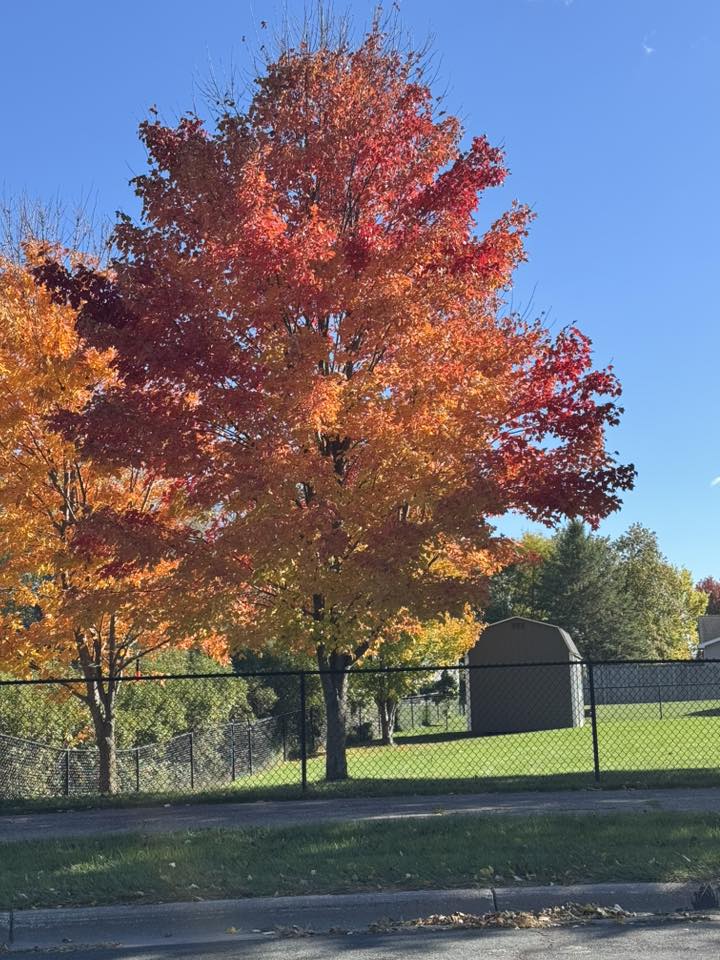
The Sugar Maple is arguably North America’s most famous fall tree, and for good reason. Its leaves shift through a stunning gradient of yellow, orange, and red, often on the same tree at once. This is the maple responsible for much of New England’s tourist-driving fall foliage season.
Sugar Maples grow to 60-75 feet tall and thrive in USDA zones 3 through 8. They prefer well-drained soil and full sun, though they tolerate partial shade reasonably well.
I find that no two Sugar Maples color up quite the same way, which is part of their charm. One tree might lean orange while its neighbor turns nearly scarlet. This species is also the primary source of maple syrup, adding practical value to its beauty.
If you are planting one, give it plenty of room. Its root system spreads wide, and its canopy eventually shades a large area.
2. Sassafras (Sassafras albidum)
Sassafras trees put on one of the most underrated color shows in North America. Their mitten-shaped leaves turn a rich blend of orange, yellow, and scarlet, sometimes all at once on a single branch.
This tree is native to eastern North America and grows well in USDA zones 4 through 9. It reaches a modest 30-60 feet, making it more manageable than many large shade trees.
Sassafras leaves come in three distinct shapes on the same tree: oval, mitten-shaped, and three-lobed. This variation adds visual texture even before autumn color kicks in.
Historically, the root bark was used to flavor root beer, though this practice has declined due to safety concerns around safrole, a natural compound found in the plant.
3. American Persimmon (Diospyros virginiana)
The American Persimmon offers a two-part show: golden-orange foliage in fall, followed by orange fruit that often lingers after the leaves drop. It is a favorite among wildlife gardeners for this reason.
This tree grows 35-60 feet tall and does well in USDA zones 4 through 9. It tolerates poor soil and drought better than most fruiting trees, which makes it a low-maintenance option.
The fruit itself is edible once fully ripe, though unripe persimmons are famously astringent. Deer, raccoons, and birds all compete for the fallen fruit come autumn.
I always recommend this tree to anyone wanting both beauty and function. Few species combine ornamental fall color with a genuine food source this well.
4. Black Tupelo (Nyssa sylvatica)
Black Tupelo, also called Black Gum, produces some of the earliest and most dramatic fall color of any North American tree. Its leaves often turn a deep, glossy orange-red as early as September, well before most other species begin changing.
This tree grows to 30-50 feet and adapts to USDA zones 3 through 9. It handles wet soil exceptionally well, making it a smart choice near ponds or low-lying areas.
Black Tupelo is also a critical food source for pollinators. Its small spring flowers produce nectar that bees use to make a especially prized variety of honey called tupelo honey.
Because it colors so early, this tree is often the first sign that autumn has truly arrived in mixed forests.
5. Bald Cypress (Taxodium distichum)
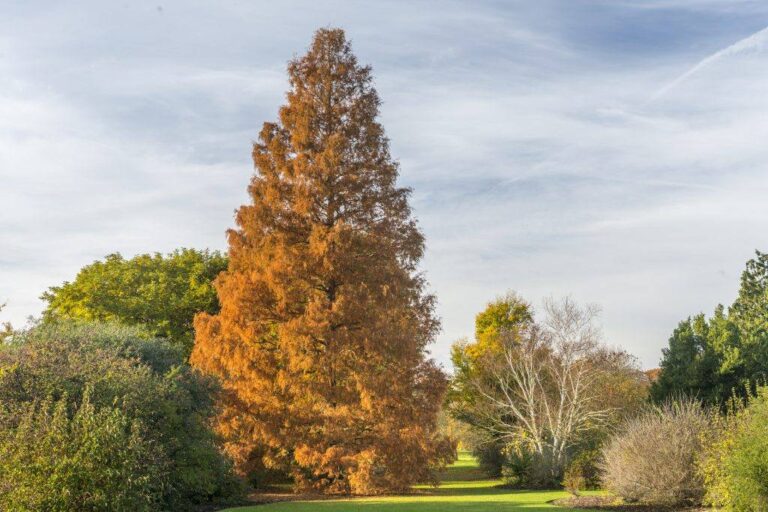
Bald Cypress breaks the rule that conifers stay green year-round. This deciduous conifer turns a warm, rusty orange in fall before dropping its needle-like leaves entirely, an unusual trait among cone-bearing trees.
Native to the southeastern United States, it grows 50-70 feet tall and thrives in USDA zones 4 through 10. It is famously tolerant of standing water and is often seen growing directly in swamps and river edges.
The tree’s distinctive “knees,” woody projections that rise from its roots, add unique visual interest even outside of fall. Louisiana officially recognizes it as the state tree.
Bald Cypress is an excellent choice for wet yards where other trees struggle. Few species combine such resilience with such striking seasonal color.
6. Katsura Tree (Cercidiphyllum japonicum)
The Katsura Tree is a sensory experience, not just a visual one. Its heart-shaped leaves turn apricot-orange in autumn and release a scent often compared to burnt sugar or cotton candy as they fall and decompose.
Native to Japan and China, this tree grows 40-60 feet tall in USDA zones 4 through 8. It prefers moist, well-drained soil and benefits from some afternoon shade in hotter climates.
This species is prized by landscape designers for its symmetrical, elegant shape. The blue-green summer foliage makes the autumn transformation feel even more dramatic by contrast.
I have never met anyone who smelled a Katsura’s fall leaves for the first time without a look of surprise. It genuinely smells like caramel.
7. Chinese Pistache (Pistacia chinensis)
Chinese Pistache is a go-to street tree in warmer climates, largely because it delivers reliable orange-to-red fall color even in regions where extreme cold is rare. It’s a favorite among municipal planners in California and Texas.
This tree reaches 25-35 feet and grows well in USDA zones 6 through 9. It tolerates drought, poor soil, and urban pollution better than most ornamental species.
Its compound leaves turn a fiery combination of orange and scarlet, often described as one of the most consistent color displays among small-to-medium trees. Female trees also produce small red-blue fruit that attracts birds.
For homeowners in the South wanting fall color without a Northern climate, this tree is often the best available option.
8. Sourwood (Oxydendrum arboreum)
Sourwood delivers one of the earliest and longest-lasting color displays in the Southeast. Its leaves shift to a deep orange-red as early as late summer, and the color often persists for weeks longer than other species.
Native to the southeastern United States, it grows 25-30 feet tall in USDA zones 5 through 9. It prefers acidic, well-drained soil and does best with some protection from harsh afternoon sun.
Sourwood also produces drooping clusters of white, bell-shaped flowers in summer, which are a major nectar source for the prized sourwood honey of Appalachia.
Its slow growth rate makes it ideal for smaller residential landscapes where a massive canopy isn’t practical.
9. American Beech (Fagus grandifolia)
American Beech leaves turn a warm golden-orange and, unusually, often stay attached to the branches well into winter, a trait called marcescence. This gives the tree a striking presence even after most others have gone bare.
This species grows 50-70 feet tall in USDA zones 3 through 9. It prefers rich, well-drained soil and can tolerate significant shade, making it a common understory tree in mature forests.
Beech bark is smooth and light gray, which contrasts beautifully against the persistent copper-orange leaves through the colder months. This has made it a popular subject for winter photography.
American Beech is a slow grower, often taking decades to reach full maturity, but the patience pays off in longevity, with some trees living over 300 years.
10. Witch Hazel (Hamamelis virginiana)
Witch Hazel is unusual because it flowers in late fall, right as its leaves turn a soft yellow-orange. This overlap of blooming and color change is rare among temperate trees and makes it a standout in any autumn garden.
This small tree or large shrub reaches 15-20 feet and grows in USDA zones 3 through 8. It tolerates partial shade well, making it useful under the canopy of larger trees.
The plant is also the source of witch hazel extract, a well-known astringent used in skincare products worldwide. This dual-purpose nature adds practical appeal beyond its looks.
Its spidery, ribbon-like yellow-orange flowers appear after the leaves fall, extending seasonal interest into November in many regions.
11. Japanese Maple (Acer palmatum, select cultivars)
Certain Japanese Maple cultivars, such as ‘Sango-kaku’ and ‘Osakazuki’, turn a vivid, almost luminous orange in fall. This species is beloved by gardeners for the sheer control it offers over color, size, and shape.
Most cultivars stay compact, ranging from 6 to 25 feet tall, and grow well in USDA zones 5 through 8. They prefer partial shade and consistent moisture, especially in hotter regions.
Japan’s own tourism data shows that autumn leaf viewing, called “koyo,” draws millions of domestic and international visitors annually, with Japanese Maples central to the tradition.
For smaller yards or container gardening, this tree offers dramatic color without demanding the space that larger species require.
12. Sweetgum (Liquidambar styraciflua)
Sweetgum produces one of the most varied color displays of any tree, often showing purple, red, yellow, and orange leaves simultaneously across its star-shaped foliage. A single tree can look like it’s wearing several different colors at once.
This tree grows 60-75 feet tall in USDA zones 5 through 9. It adapts to a wide range of soil types, though it prefers moist, slightly acidic conditions.
Its spiky seed pods, often called “gumballs,” are a well-known nuisance for some homeowners, but the fall color display is frequently cited as compensation enough.
Sweetgum is widely planted across the southern and eastern United States and remains one of the most recognizable trees during peak autumn season.
13. Shagbark Hickory (Carya ovata)
Shagbark Hickory turns a rich golden-orange each fall, and its distinctive peeling bark makes it identifiable year-round, even in winter when the leaves are gone. It is a staple of eastern hardwood forests.
This tree grows 60-80 feet tall in USDA zones 4 through 8. It prefers deep, well-drained soil and is often found alongside oaks in mature woodland settings.
The nuts produced by this tree are edible and were a significant food source for Indigenous peoples and early settlers, sweeter than most other hickory species.
Because of its slow growth and long taproot, Shagbark Hickory is best planted while young, as it does not transplant well once established.
14. Norway Maple (Acer platanoides)
Norway Maple leaves turn a bright, clear orange-yellow, and the tree’s dense canopy makes for a particularly full, saturated display compared to more open-branched species. It is one of the most widely planted street trees in urban environments.
This tree reaches 40-50 feet tall and grows in USDA zones 3 through 7. It tolerates urban pollution, compacted soil, and road salt better than most maple species.
It should be noted that Norway Maple is considered invasive in parts of the northeastern United States, where it outcompetes native species. Some regions restrict new plantings.
Despite this concern, mature specimens already established in yards and parks remain popular for their reliable, vivid autumn color.
15. Flowering Dogwood (Cornus florida)
Flowering Dogwood rounds out this list with leaves that turn a deep, reddish-orange, paired with clusters of bright red berries that persist after leaf drop. It offers one of the most complete seasonal transformations of any small tree.
This species grows 15-30 feet tall in USDA zones 5 through 9. It thrives as an understory tree, preferring partial shade and moist, well-drained soil.
Beyond fall color, Flowering Dogwood is prized for its showy white or pink spring blooms, giving it two distinct seasons of visual interest each year.
Its berries are an important food source for over 35 species of birds, according to wildlife studies, making it as valuable ecologically as it is ornamentally.
ALSO READ: 15 Stunning Trees with Red Leaves Year-Round
Why Do Some Leaves Turn Orange Instead of Red or Yellow?
The final color depends on a mix of pigments and weather conditions. Yellow comes from xanthophylls, red comes from anthocyanins produced fresh in autumn, and orange appears when both carotenoids and a moderate amount of anthocyanin combine.
Cool nights and sunny days boost anthocyanin production, which is why orange and red tend to intensify after a cold snap. Drought stress, soil pH, and even a tree’s genetics also play a role in how orange the leaves eventually become.
How to Choose the Right Orange-Leaf Tree for Your Yard
Start with your climate zone. Trees like Chinese Pistache and Sourwood tolerate southern heat well, while Sugar Maple and American Beech need cooler winters to perform their best.
Consider your available space. Large shade trees such as Sweetgum and Sugar Maple need 40 feet or more of clearance, while Japanese Maples and Witch Hazel fit comfortably into smaller yards.
Think about soil and moisture conditions. Bald Cypress and Black Tupelo handle wet soil far better than most species, making them ideal for low-lying or poorly drained lots.
Finally, consider what else the tree offers. Persimmon provides fruit, Sourwood provides honey-quality nectar, and Dogwood provides bird-friendly berries, giving added value beyond the seasonal color show.
ALSO READ: 10 Beautiful Trees with Yellow Leaves in Fall
Final Thoughts
Orange fall foliage is one of nature’s most generous, temporary gifts. Each of these 15 trees earns its place through color, resilience, or ecological value, often all three at once.
I always encourage people to plant with the long view in mind. A tree chosen today might not show its full color potential for a decade, but that first proper autumn display makes the wait worthwhile.
Whichever species you choose, one thing is certain: a well-placed orange-leafed tree transforms a yard from ordinary to unforgettable every single fall.

Tim M Dave is a gardening expert with a passion for houseplants, particularly cacti and succulents. With a degree in plant biology from the University of California, Berkeley, he has vast experience in gardening. Over the years, he has cultivated a vast collection of desert plants and learned a great deal about how to grow and care for these unique companions.