45 Types of Kalanchoe (Plant Details, With Pictures)
Kalanchoe is one of the most rewarding groups of succulents. It offers bright flowers, fuzzy leaves, odd shapes and very little fuss. I have always found it a kind plant for beginners.
But the genus is large. Depending on the source, botanists count well over 100 species, and some lists give about 174 accepted names. Many are native to Madagascar, while others come from mainland Africa and parts of Asia.
This guide covers 45 types of kalanchoe, explaining what each plant looks like, how big it grows and what to watch for.
What Is a Kalanchoe?
Kalanchoe belongs to the stonecrop family, Crassulaceae, the same family as the jade plant. These plants store water in thick, fleshy leaves. That is why they handle dry spells so well.
The name is often linked to a Chinese term meaning “that which falls and grows.” It fits well. Many species drop tiny plantlets from their leaves, and each plantlet can root on its own.
The best-known florist type, Kalanchoe blossfeldiana, was found in Madagascar in 1926. It reached Europe around 1930 through German plant breeder Robert Blossfeld, according to the University of Arkansas Division of Agriculture. It soon became a favorite winter pot plant.
Quick Safety Note Before You Buy
Most kalanchoes are toxic if eaten. NC State Extension lists several of them, including the panda plant and florist kalanchoe, as plants with medium poison severity. Keep them away from pets and small children.
Some species are also invasive in warm regions. In Florida, the University of Florida’s IFAS program lists certain kalanchoes as invasive after they escaped from gardens. I will point these out as we go.
45 Types of Kalanchoe
1. Kalanchoe blossfeldiana (Flaming Katy, Florist Kalanchoe)
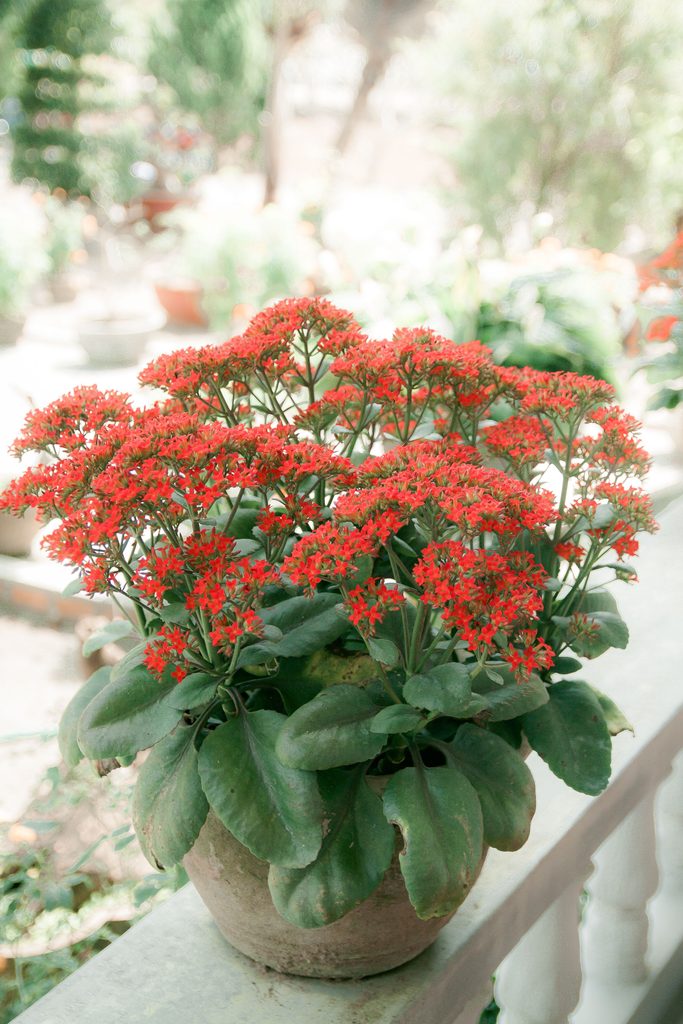
This is the kalanchoe most people know. It grows about 6 to 18 inches tall and carries glossy green leaves. Its flower clusters come in red, pink, orange, yellow and white.
It blooms for weeks, which makes it a popular gift plant. To rebloom, it needs long nights. University extension sources note that flowering takes about 12 weeks after long nights begin.
Give it bright, indirect light and water only when the soil is dry. Overwatering is the main cause of failure. I think it is the best first kalanchoe for any home.
2. Kalanchoe tomentosa (Panda Plant)
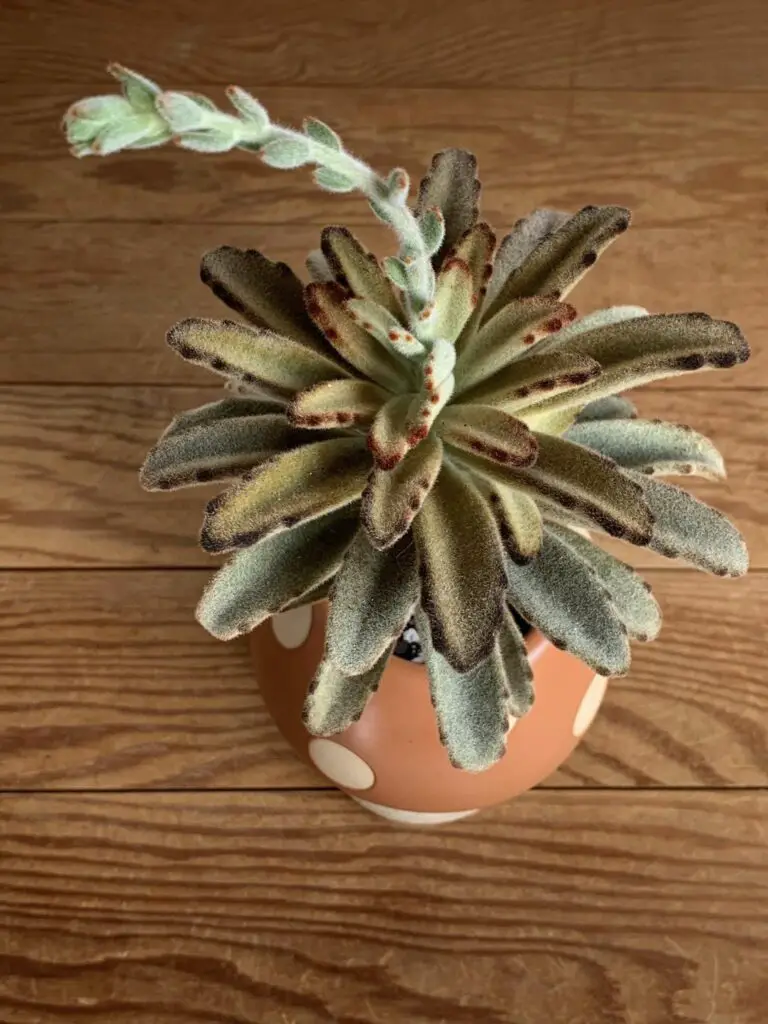
The panda plant is soft to the touch. Its thick leaves are covered in fine silver hairs, and the tips carry brown markings that look like paw prints.
It grows from 1 to 3 feet tall and suits USDA zones 9 to 11. Indoors, it stays smaller and slower. It rarely flowers in a pot.
Give it bright light and a gritty soil mix. Leggy growth usually means it needs more sun. Because it is toxic if eaten, keep it out of reach of pets.
3. Kalanchoe daigremontiana (Mother of Thousands)
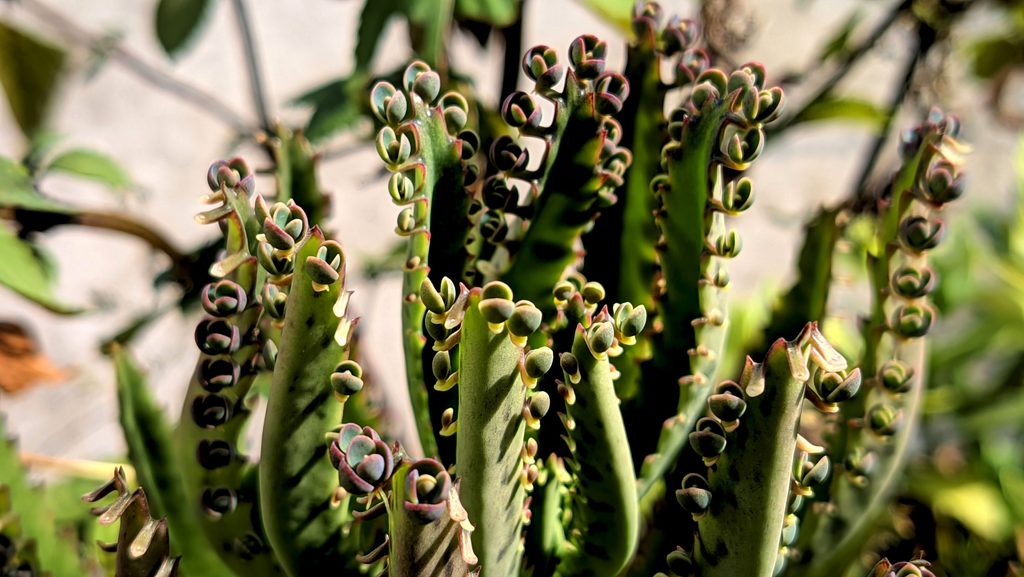
This plant is known for the tiny plantlets along its leaf edges. They drop off and root almost anywhere. The leaves are long, grayish green and marked with reddish-brown spots.
It comes from southwest Madagascar and is monocarpic, so each plant dies after it flowers. Houseplants rarely bloom at all.
In warm climates, it can spread fast. UF/IFAS lists it among kalanchoes that have escaped cultivation in Florida. Please grow it in a pot, and never dump cuttings outdoors.
4. Kalanchoe delagoensis (Chandelier Plant)
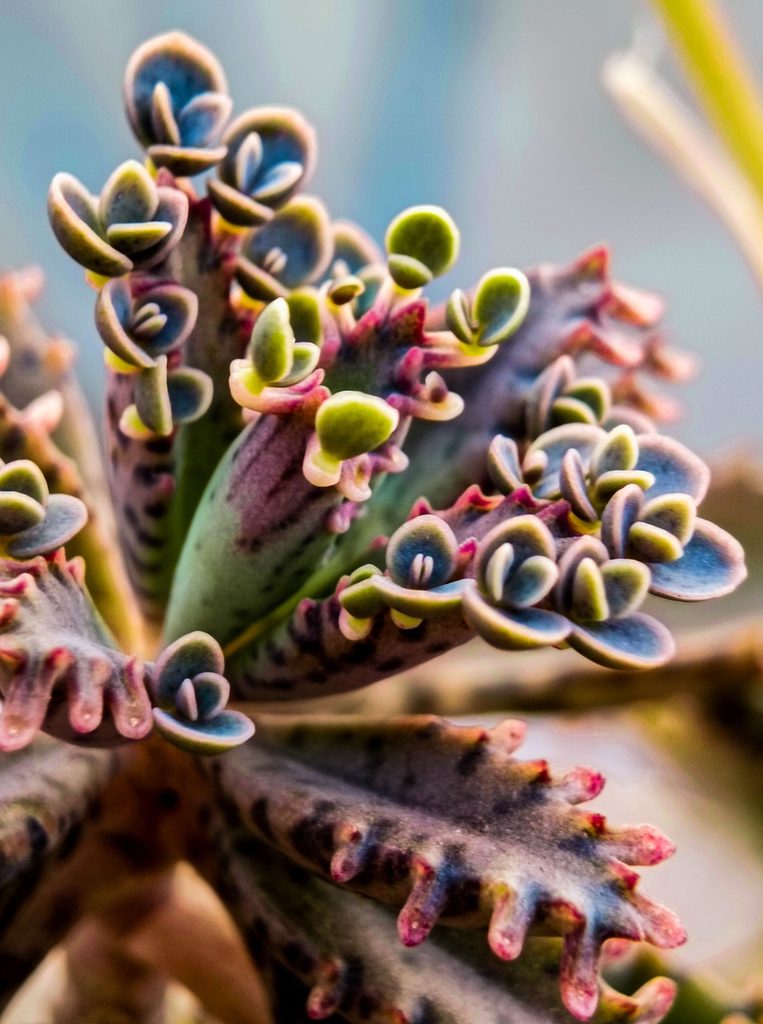
This one grows tall, narrow, tube-like leaves. Small plantlets form at the tips, like tiny crowns. The plant can reach about 3 feet in good conditions.
It is also called mother of millions. In autumn or winter, it may produce orange-red, bell-shaped flowers.
Like its relative above, it is a strong spreader. In Florida it is treated as an invasive concern. If you grow it, keep it contained.
5. Kalanchoe × houghtonii (Mother of Millions Hybrid)
This plant is a hybrid of K. daigremontiana and K. delagoensis. It was created in the 1930s by crossing experiments in California, as research on its spread notes.
Its leaves are narrower than those of mother of thousands, with brownish bands. It makes plantlets in huge numbers.
Florida’s Invasive Species Council lists it as Category II. It has damaged coastal dunes in the state. I would only grow it in a closed pot, if at all.
6. Kalanchoe luciae (Paddle Plant, Flapjack)
The paddle plant forms a neat rosette of round, wide leaves. In strong sun, the edges turn a deep red. In shade, they stay pale green.
It grows 1 to 2 feet tall and stays mostly single-stemmed. It blooms only once, after several years. Then the main plant dies, but it usually leaves offsets.
It needs bright light and well-drained soil. Water deeply, then let it dry fully. It is one of the most photogenic succulents you can buy.
7. Kalanchoe thyrsiflora (Flapjack, White Lady)
Sellers often confuse this plant with K. luciae, and the two look very similar. Both have thick, round paddles. This one is usually coated with a chalky white powder.
The powder protects the leaves from harsh sun. Touching it leaves fingerprints, so handle it gently.
It prefers full sun and dry soil. Yellow flowers appear on a tall spike. After blooming, the rosette dies, as in many monocarpic types.
8. Kalanchoe beharensis (Felt Bush, Velvet Leaf)
This is a large, tree-like kalanchoe. It grows 3 to 5 feet tall indoors and much taller outdoors. The leaves are triangular, rusty brown and covered in felt-like hairs.
It looks bold and sculptural. In my view, it works well as a statement plant in a bright corner.
Avoid overwatering, as the thick stems rot easily. It is slow to flower in pots. Give it good drainage and lots of light.
9. Kalanchoe marmorata (Penwiper Plant, Pen Wiper)
The penwiper plant has flat, rounded, blue-green leaves with purple-brown blotches. The leaf edges are scalloped. It usually grows 1 to 2 feet tall.
It blooms with white, tubular flowers that smell pleasant at night. Some forms are pink-tinged.
It is easy to propagate from leaves. Keep it in bright light and water lightly. This plant forgives small mistakes.
10. Kalanchoe marnieriana (Marnier’s Kalanchoe)
Marnier’s kalanchoe has round, grayish-green leaves with a reddish edge. They sit in pairs along thin, arching stems. The plant can reach about 5 feet in ideal conditions.
The flowers are pink to coral and appear in clusters. It originates in Madagascar.
It wants full sun and fast-draining soil. A little stress turns the leaf margins red. It is a good choice for a hanging pot.
11. Kalanchoe pinnata (Cathedral Bells, Air Plant)
This tall, upright species has fleshy, scalloped leaves. Mature plants carry hanging, bell-shaped flowers in green and red. The plantlets form along the leaf edges.
It is widely used in traditional medicine across the tropics. Scientific reviews exist, but it is not a safe home remedy.
UF/IFAS lists K. pinnata among kalanchoes that have naturalized in Florida. In warm places, I would grow it with care.
12. Kalanchoe laetivirens (Mother of Thousands Lookalike)
Gardeners often mix this plant up with K. daigremontiana. The leaves are wide, light green and have wavy, toothed edges. Plantlets grow along the margins.
It grows fast and fills a pot quickly. Flowers are rare indoors.
Care is simple: bright light, little water and a free-draining mix. Like other plantlet makers, it can spread, so check for fallen babies often.
13. Kalanchoe fedtschenkoi (Lavender Scallops)
This plant has blue-gray leaves edged in pink or lavender. The stems arch and trail. It is sometimes sold as rainbow kalanchoe in its variegated form.
It grows well in hanging baskets and rock gardens. Orange to salmon flowers appear in late winter.
It prefers full sun for the best color. Cuttings root very fast in water or soil. A good plant for sharing with friends.
14. Kalanchoe manginii (Beach Bells)
Beach bells is a trailing type with small, rounded leaves. In spring, it produces bright orange-red bell flowers that hang down in clusters.
It grows well in hanging baskets. It stays compact and rarely exceeds a foot in height.
Give it bright light and moderate water. It dislikes frost. I find it one of the prettiest bloomers among the small species.
15. Kalanchoe orgyalis (Copper Spoons)
Copper spoons has leaves that look like polished metal. The upper side is golden brown with a suede-like texture. The underside is silvery.
It forms a shrubby plant up to about 3 feet tall. It is a slow grower.
Sun brings out the best color. Water sparingly and never leave it wet. Yellow flowers show up in winter on mature plants.
16. Kalanchoe bracteata (Silver Teaspoons)
This shrubby species has thick, spoon-shaped leaves covered in fine silver-white hairs. The look is soft and pale. NC State Extension includes it in its genus overview.
It grows upright and slowly branches. It fits a sunny windowsill well.
Keep the soil on the dry side. The plant tolerates drought but not soggy roots. Small, bell-like flowers may appear in season.
17. Kalanchoe rhombopilosa (Pies from Heaven)
The silver-gray leaves have brown spots and wavy edges. The overall shape is diamond-like. It rarely grows taller than 12 inches.
It blooms with small, yellowish-green flowers on slender stalks. The plant comes from Madagascar.
It does well in small pots. Provide lots of light and keep it fairly dry. In my experience, it is slow, but it rewards patience.
18. Kalanchoe millotii (Millot’s Kalanchoe)
This species has triangular, scalloped leaves covered in soft, pale hairs. They look gray-green and slightly velvety. The plant forms a compact shrub.
It is a Madagascar native and relatively easy to keep. It suits bright windows and rock gardens.
Water only when the soil is dry. It can produce yellowish flowers on tall stems. Cuttings root well in spring.
19. Kalanchoe gastonis-bonnieri (Donkey Ears)
Donkey ears grows a single, tall rosette of long, curved leaves. The leaves are gray-green with reddish-brown blotches, like a lizard’s skin.
It is monocarpic, so the plant flowers once and then dies. Before that, it often makes plantlets at the leaf tips.
It needs bright light and well-drained soil. Avoid water on the center of the rosette. A mature plant is quite striking.
20. Kalanchoe longiflora (Long-Flowered Kalanchoe)
This plant comes from southern Africa. It forms low rosettes of oval, fleshy leaves that often turn red-bronze in strong light.
Its yellow flowers have long tubes and sit on tall stalks. They appear in winter or spring.
It is a good small container plant. Give it full sun and good drainage. It spreads gently through offsets.
21. Kalanchoe pumila (Flower Dust Plant)
The flower dust plant is a low, trailing species. Its leaves are coated with a fine white powder that gives them a frosted look. Stems spread and cascade.
In winter and spring it produces bright pink to purple flowers. The contrast with the pale foliage is lovely.
It is ideal for hanging baskets. Provide bright light and very little water. Do not wipe the leaves, as the powder is part of its charm.
22. Kalanchoe humilis (Desert Surprise)
This small plant forms a rosette of wide, gray-green leaves with purple-brown spots. The markings look hand-painted. It stays low to the ground.
It is a Madagascar native and quite compact. A single plant fits in a tiny pot.
Give it good light and a gritty mix. The tall flower spike has small, greenish-yellow blooms. It enjoys a warm room.
23. Kalanchoe sexangularis (Red-Leaf Kalanchoe)
This tough African species has glossy, wavy leaves that turn deep red in full sun. In shade, they stay green.
It grows as a small shrub, up to about 2 feet. Yellow flowers appear in winter.
It is easy and fast. It also adapts well to poor soil. I recommend it for people who want bold color without much work.
24. Kalanchoe prolifera (Giant Kalanchoe)
This is one of the tallest kalanchoes. A mature plant can grow past 6 feet. The leaves are large, wide and gray-green.
It gets its name from plantlets that appear on the flower stalks, not on the leaf edges. The blooms are small and borne in tall clusters.
It is better suited to large containers or greenhouses. Give it space, light and warmth. It will outgrow most windowsills.
25. Kalanchoe synsepala (Walking Kalanchoe)
The walking kalanchoe forms a rosette of wavy, spoon-shaped leaves. It sends out long runners that produce new plantlets, so the plant seems to “walk.”
Leaves often show pinkish or red edges in good light. It is a Madagascar native.
It works well in wide, shallow pots. Water lightly and give it plenty of sun. Remove runners if you want a tidy plant.
26. Kalanchoe suarezensis (Suarez Kalanchoe)
This Madagascar native forms a shrubby plant with thick, glossy leaves. It is less common in homes, so it appeals to collectors. Stems become woody with age.
The flowers are pinkish and appear in clusters in the cool season.
Give it bright light and a sandy mix. Water sparingly. Like most of its relatives, it dislikes cold, wet soil.
27. Kalanchoe eriophylla (Snowy Kalanchoe)
The snowy kalanchoe is covered in dense, white woolly hairs. The small rosettes look like tiny tufts of cotton. It stays low and compact.
It is a Madagascar species and is best kept in a protected spot. Rain or splashing water can damage the hairs.
Keep it in a bright, dry place. Water at the soil level only. A good plant for a collector’s tray.
28. Kalanchoe peltata (Peltate Kalanchoe)
The word “peltata” refers to the way the leaf stalk joins near the center of the blade. This gives the foliage a shield-like look. The leaves are rounded and fleshy.
It is a Madagascar species and stays modest in size. Flowers are small and borne in loose clusters.
Provide full sun and gritty soil. Allow it to dry between waterings. It is a quiet, charming plant.
29. Kalanchoe rotundifolia (Common Kalanchoe)
This southern African species has round, blue-green leaves and a shrubby habit. Stems can reach 2 to 3 feet. The foliage often takes on a reddish tint in strong light.
It produces bright orange-red flowers in tubular clusters. Birds and bees often visit them.
It copes with drought well. It is a good candidate for dry, sunny gardens in warm zones. Protect it from frost.
30. Kalanchoe crenata (Neverdie)
The common name says a lot. This hardy plant has fleshy, scalloped leaves and tall stems that carry yellow-orange flowers. It grows in tropical Africa.
It thrives in many conditions and recovers quickly from damage. Plantlets can form on old flower stalks and leaf edges.
Provide warmth and light. It tolerates a bit more water than desert succulents, but good drainage is still key.
31. Kalanchoe porphyrocalyx (Bell Flower Kalanchoe)
This small Madagascar species is grown mainly for its flowers. The blooms hang like little lanterns and have a purple-tinged calyx. The leaves are thick and spoon-shaped.
It is an easy plant for hanging pots. It stays neat and does not spread aggressively.
Bright light and light watering are enough. Pinch back leggy stems in spring to keep it full.
32. Kalanchoe hildebrandtii (Silver Crown)
Silver crown has silvery-white leaves and a slender, upright stem. The leaves are oval and slightly wavy. Older plants may reach several feet in height.
The color alone makes it special. In bright light, the silver shade is at its best.
Grow it in a very well-drained mix. Water only after the soil dries out fully. Overwatering will quickly harm its roots.
33. Kalanchoe beauverdii (Beauverd’s Kalanchoe)
This species grows long, thin, twining stems. It may climb through other plants or trail from a pot. The leaves are narrow and often drop in the dry season.
It is unusual among kalanchoes because it behaves more like a vine. Plantlets appear on stem nodes.
Give it bright light and room to climb. Water moderately in the growing season. It is a good talking point for visitors.
34. Kalanchoe bouvetii (Bouvet’s Kalanchoe)
Bouvet’s kalanchoe is a Madagascar shrub with thick, fleshy leaves and a sturdy form. It is a slow grower and takes years to mature.
It suits large pots and mixed succulent displays. The plant has a strong, architectural shape.
Place it in full sun and use a gritty mix. Water lightly. Patience is the main requirement here.
35. Kalanchoe arborescens (Tree Kalanchoe)
As the name suggests, this species grows into a small tree. The stems become woody, and the leaves are thick and bluish-green. It is a Madagascar native.
It is a rare sight in homes, but it does well in large greenhouses and warm gardens. Mature plants can bloom.
Use a deep pot, strong light and a sandy mix. Avoid heavy watering. It is a plant for those who like bold forms.
36. Kalanchoe aliciae (Alicia’s Kalanchoe)
This Madagascar shrub has silvery-gray, fleshy leaves with a smooth, waxy surface. It is upright and branches with age. The overall look is clean and modern.
It is rarely seen in shops, so I count it as a collector’s find.
Place it in full sun and give it fast-draining soil. Water only when the soil is dry. Protect it from cold.
37. Kalanchoe jongmansii (Jongmans’ Kalanchoe)
This rare Madagascar species forms a compact, shrubby plant with thick leaves. It is slow to grow and best suited to patient hobbyists.
It produces small, bell-like flowers on tall stalks. The bloom is modest but charming.
Bright light and a mineral-rich mix keep it healthy. Water sparingly and avoid cold drafts.
38. Kalanchoe streptantha (Twisted-Flower Kalanchoe)
The species name points to its twisted flower shape. It is a small Madagascar plant that suits tiny pots and shallow dishes.
It is not common in the trade. You may need to look through specialist nurseries or plant swaps.
Give it plenty of light and let the soil dry between drinks. It does best in warm, stable conditions.
39. Kalanchoe laciniata (Christmas Tree Plant)
This plant earns its name from its deeply cut, feathery leaves. They look like small evergreen branches. It occurs across parts of Africa and Asia.
It grows upright to about 2 or 3 feet. Pale yellow to greenish flowers form in clusters.
It is tolerant and easy. Offer bright light and moderate water. It also roots easily from leaf and stem cuttings.
40. Kalanchoe viguieri (Viguier’s Kalanchoe)
This is a Madagascar species with a compact, shrubby form. It is uncommon in cultivation. Collectors prize it for its sturdy look and thick leaves.
Its care mirrors that of other Madagascar types. Give it sun, warmth and perfect drainage.
Watering once the soil is fully dry is enough. In cool, damp weather, keep it inside.
41. Kalanchoe ceratophylla (Horned Leaf Kalanchoe)
The leaves of this plant are deeply lobed, almost like antlers. They are fleshy and light green. It is found across parts of Africa and Asia.
Small yellow flowers appear on tall stalks. Plantlets may form along the leaf margins.
It prefers bright light and moderate water. It makes an interesting, textured pot plant.
42. Kalanchoe lanceolata (Lance-Leaf Kalanchoe)
This widespread species has narrow, lance-shaped leaves covered in fine, sticky hairs. It can reach around 3 feet and often grows in dry, open places.
The flowers are yellow to orange and appear in dense heads. It blooms mainly in the cooler months.
The plant is hardy and easy to grow. Give it light, warmth and well-drained soil.
43. Kalanchoe campanulata (Bell-Flowered Kalanchoe)
The name means “bell-shaped,” and the flowers match it. They hang in loose clusters and have a soft pink or coral color. This is a Madagascar species.
It is a slender, graceful plant with thin, fleshy leaves. It suits hanging pots and borders in warm zones.
Provide bright light and moderate water. Remove old flower stalks to encourage new growth.
44. Kalanchoe gracilipes (Slender-Stalk Kalanchoe)
This small Madagascar species has slender stems and a delicate habit. It is a good choice for people who like dainty plants.
It is rare in the nursery trade, so it is mainly found among enthusiasts.
Give it bright light and a well-drained mix. Water only when the soil has dried. Keep it away from cold windows.
45. Kalanchoe uniflora (Coral Bells Kalanchoe)
This trailing plant is one of the loveliest small kalanchoes. It spreads in a mat of tiny leaves, then drapes over the edge of a pot. In season, it is covered in pink to coral bell flowers.
It is a Madagascar native. It does best in hanging baskets or raised containers.
Provide bright light, light water and a free-draining mix. It is delicate, but a happy plant is a showstopper.
How to Choose the Right Kalanchoe
Start with your light. Sun lovers such as the paddle plant, panda plant and copper spoons need a bright window. For lower light, the florist kalanchoe is more forgiving.
Then think about space. Small types like K. humilis and K. uniflora suit shelves. Large ones like K. beharensis and K. prolifera need floor space.
Finally, consider your climate. Plantlet-making species can become invasive in warm regions, so use pots. I always advise checking local invasive plant lists before planting outdoors.
Basic Kalanchoe Care at a Glance
Most kalanchoes follow the same simple rules:
- Light: Bright, indirect light suits most. Fuzzy and powdery types prefer more sun.
- Water: Let the soil dry between waterings. Overwatering causes root and stem rot.
- Soil: Use a cactus or succulent mix with good drainage.
- Air: Good air flow helps prevent powdery mildew.
- Blooming: For florist kalanchoes, give 14 hours of darkness daily for several weeks.
NC State Extension also warns that gloves are wise when handling some species, as the sap can irritate skin.
ALSO READ:
Lighting Up Your Flaming Katy: Light Requirements for Kalanchoe blossfeldiana
Flaming Katy Watering Schedule: Keep Your Christmas Kalanchoe Thriving
6 Reasons Your Kalanchoe Leaves are Falling Off and How to Fix
Frequently Asked Questions
How many types of kalanchoe are there? Counts vary by botanist. Many sources list more than 100 species, and some give about 174 accepted names. Hybrids and cultivars add many more.
Which kalanchoe is best for beginners? The florist kalanchoe (K. blossfeldiana) is the easiest. It is cheap, widely available and flowers for weeks.
Are kalanchoes safe for pets? No. NC State Extension lists several species as poisonous if eaten. Keep them out of reach of pets and children.
Are any kalanchoes invasive? Yes. UF/IFAS reports that several species have escaped gardens and become invasive in Florida. These include mother of thousands and mother of millions.
Final Thoughts
Kalanchoes offer a wide range of shapes, colors and moods. Some give bright flowers. Others offer soft, sculptural leaves. A few are simply fun to watch as they make baby plants.
My advice is to start small. Try a florist kalanchoe or a panda plant, learn how they like to be watered, and then grow your collection. With 45 types to explore, you will not run out of choices.
References
- NC State Extension Gardener Plant Toolbox. Kalanchoe blossfeldiana. https://plants.ces.ncsu.edu/plants/kalanchoe-blossfeldiana/
- NC State Extension Gardener Plant Toolbox. Kalanchoe (genus overview). https://plants.ces.ncsu.edu/plants/kalanchoe
- University of Arkansas System Division of Agriculture. Plant of the Week: Kalanchoe. https://uaex.uada.edu/yard-garden/resource-library/plant-week/kalanchoe-3-7-08.aspx
- UF/IFAS Plant Directory. Kalanchoe species. https://plant-directory.ifas.ufl.edu/plant-directory/kalanchoe-species/
- UF/IFAS Extension, Volusia County. Invasive species: Mother of millions (Kalanchoe). https://blogs.ifas.ufl.edu/volusiaco/2026/02/19/invasive-species-mother-of-millions-kalanchoe/
- National Library of Medicine, PubMed Central. Research on Kalanchoe × houghtonii as an invasive plant. https://pmc.ncbi.nlm.nih.gov/articles/PMC7035272
- Oklahoma State University Extension. Florists’ Kalanchoe. https://extension.okstate.edu/programs/plant-id/plant-profiles/florists-kalanchoe

Tim M Dave is a gardening expert with a passion for houseplants, particularly cacti and succulents. With a degree in plant biology from the University of California, Berkeley, he has vast experience in gardening. Over the years, he has cultivated a vast collection of desert plants and learned a great deal about how to grow and care for these unique companions.