Are Orchids Toxic to Cats? What Every Pet Owner Needs to Read
The moment I noticed my cat chewing on the leaves of my Phalaenopsis orchid, my stomach dropped. Like most cat owners who also love houseplants, I had that immediate, panicked thought: Is this going to hurt her? If you are reading this article, there is a good chance you have had a very similar moment — or you are trying to prevent one.
The good news is that the most common orchids kept as houseplants are not toxic to cats. The ASPCA (American Society for the Prevention of Cruelty to Animals) lists orchids in the Orchidaceae family as non-toxic to both cats and dogs.
But before you close this tab and consider the matter settled, there is significantly more you need to understand. Toxicity is not the only risk orchids present to cats, and not every plant sold under the common name “orchid” belongs to a safe species.
This guide covers everything a responsible cat owner should know: which orchids are safe, which are not, what symptoms to watch for, why cats are drawn to orchids in the first place, and how to keep both your plants and your cat safe in the same home.
Understanding Plant Toxicity: What “Non-Toxic” Actually Means
One of the most common misconceptions about pet-safe plants is that “non-toxic” means “completely harmless in any amount.” That is not accurate, and understanding the distinction can protect your cat from unnecessary discomfort.
Non-toxic, in the context of veterinary plant safety databases, means that a plant does not contain compounds known to cause systemic poisoning, organ damage, or life-threatening reactions in cats. It does not mean a plant is inert.
Even non-toxic plants can cause mild gastrointestinal upset — vomiting, drooling, or loose stools — simply because cats are obligate carnivores whose digestive systems are not designed to process significant quantities of plant material.
Think of it this way: eating a large amount of plain rice would not poison a human, but it might cause a stomach ache. The same principle applies to cats and non-toxic plants. A small nibble of an orchid leaf is unlikely to cause any reaction at all. Consuming a large portion of the plant — roots, leaves, and all — might cause temporary digestive distress even though the plant is technically non-toxic.
With that in mind, the answer to “are orchids toxic to cats?” becomes clearer: true orchids (family Orchidaceae) are not toxic to cats, but ingestion can still cause mild, temporary symptoms that deserve attention and monitoring.
Which Orchids Are Safe for Cats?
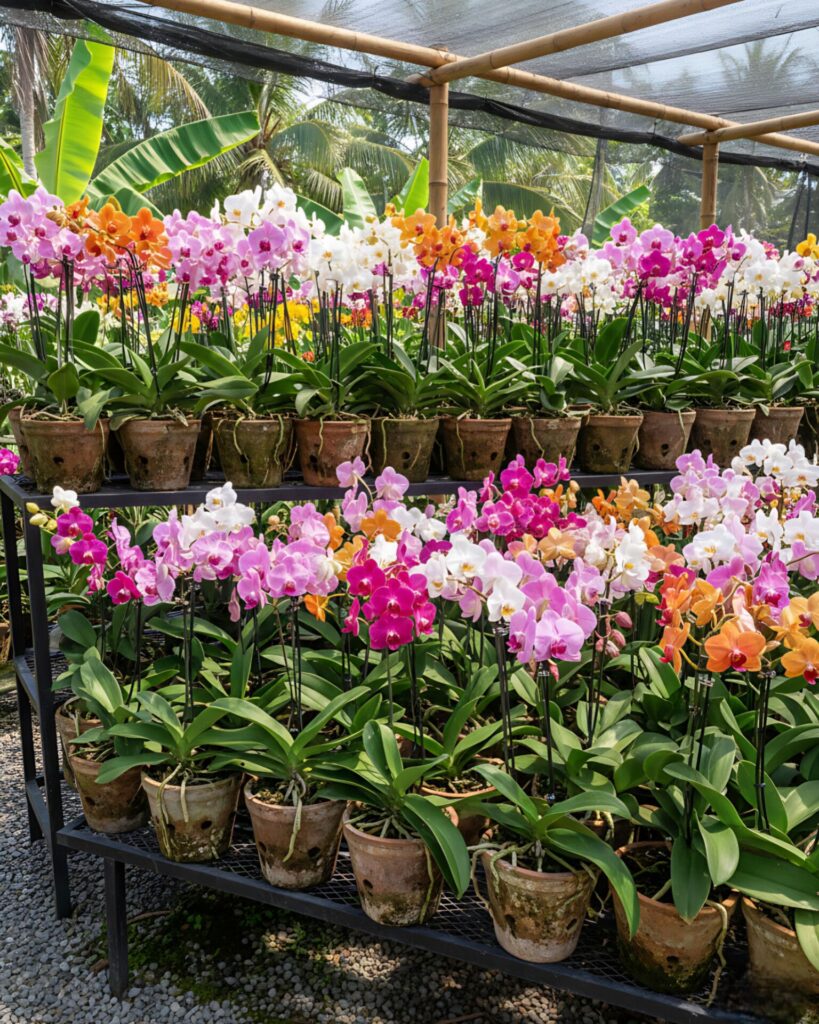
The Orchidaceae family is one of the largest plant families on Earth, with over 28,000 documented species and more than 100,000 registered hybrids. The vast majority of orchids kept as houseplants belong to genera that are considered non-toxic to cats. Here are the most common ones:
Phalaenopsis (Moth Orchid)
The Phalaenopsis is by far the most popular houseplant orchid in the world, available in virtually every grocery store, garden center, and home improvement retailer. Its flat, arching sprays of flowers in white, pink, purple, and yellow make it an enduring favorite. It is confirmed non-toxic to cats by the ASPCA and is considered one of the safest flowering houseplants for homes with pets.
Cattleya
Known as the “queen of orchids” for its large, dramatically ruffled flowers, the Cattleya is a favorite among orchid enthusiasts. It is also non-toxic to cats and dogs, making it a safe choice for pet-friendly households that want a more exotic-looking plant.
Dendrobium
Dendrobium orchids produce long canes covered in smaller flowers and are widely grown as houseplants across North America, Europe, and Australia. Non-toxic to cats, they are available in a remarkable range of colors and bloom reliably when given proper care.
Oncidium (Dancing Lady Orchid)
The Oncidium is recognizable by its branching sprays of small, cheerful flowers — often yellow and brown — that resemble tiny dancing figures. It is non-toxic to cats and an excellent choice for cat owners who want something a little more unusual than a standard Phalaenopsis.
Miltoniopsis (Pansy Orchid)
Named for its large, flat flowers that resemble pansies, the Miltoniopsis is a beautifully fragrant orchid that thrives in cooler indoor conditions. It is non-toxic to cats and appreciated by growers who enjoy fragrant houseplants.
Epidendrum
A large and diverse genus of orchids, Epidendrum species are popular with hobbyist growers for their unusual flower forms. They are non-toxic to cats and relatively easy to cultivate indoors.
The common thread across all of these genera is that they are listed as non-toxic by veterinary and horticultural authorities. If your cat occasionally nibbles on one of these plants, the realistic outcome is mild at worst — and often no reaction at all.
The Plants That Go by “Orchid” But Are Not True Orchids
Here is where things get significantly more important. Several popular plants carry the word “orchid” in their common name but do not belong to the Orchidaceae family — and some of them are genuinely toxic to cats.
This is perhaps the most critical piece of information in this entire article. Many cat owners research “orchids and cats,” learn that orchids are safe, and then assume that any plant called an orchid must therefore be safe. That assumption can be dangerous.
Lily of the Valley Orchid — NOT a True Orchid
The common name “Lily of the Valley Orchid” is sometimes applied to several different plants, including Convallaria majalis — which is severely toxic to cats. True Lily of the Valley contains cardiac glycosides that can cause heart arrhythmias, seizures, and death. If you have a plant sold to you as a “Lily of the Valley Orchid,” it requires immediate identification before assuming it is safe.
Nun’s Orchid / Ground Orchid (Phaius tankervilleae)
The Nun’s Orchid is a true orchid (family Orchidaceae) but is sometimes confused with other species at point of sale. It is generally considered non-toxic, but confirm the genus before making that assumption.
Jewel Orchid (Ludisia discolor)
Jewel Orchids are true orchids grown primarily for their velvety, dark foliage with pink or silver veining rather than their flowers. They are non-toxic to cats and make excellent low-light houseplants for pet-friendly homes.
Boat Orchid (Cymbidium)
Cymbidium orchids are popular in cut flower arrangements and as houseplants in cooler climates. They are non-toxic to cats and widely grown in Australia, the UK, and the Pacific Northwest where cooler temperatures suit them well.
Wild Orchids — Exercise Caution
If you live in a region where wild orchid species grow natively — parts of the US Southeast, the UK countryside, tropical Asia, or Central America — wild orchid identification requires expert verification before assuming any species is safe. While most wild orchids are not toxic, some grow near or alongside genuinely toxic plants, and misidentification is a real risk.
What Happens If a Cat Eats an Orchid?
Even with confirmed non-toxic orchid species, it is helpful to know what a typical reaction looks like if your cat consumes any part of the plant. Being informed means you can act calmly and appropriately rather than panicking.
If a cat nibbles a small amount of a non-toxic orchid: In most cases, nothing happens. Many cats chew on houseplants out of curiosity or boredom and show no reaction whatsoever. A small bite of an orchid leaf or petal is unlikely to cause any symptoms.
If a cat consumes a larger amount: Mild, temporary gastrointestinal symptoms may occur. These can include:
- Brief episodes of vomiting
- Drooling or lip-licking
- Mild lethargy for a few hours
- Loose stools
These symptoms, when caused by a non-toxic plant, are self-limiting — they typically resolve within a few hours without veterinary intervention. The cat’s body is simply responding to unusual plant material in the digestive system.
When to contact a veterinarian immediately:
- Symptoms persist for more than 12–24 hours
- Vomiting is frequent or violent
- The cat shows signs of pain, difficulty breathing, or extreme lethargy
- You are not certain which plant the cat consumed
- The cat consumed a plant you have not been able to positively identify as non-toxic
When in doubt, always call your veterinarian or the ASPCA Animal Poison Control Center at 888-426-4435. It is always better to make a precautionary call than to wait and hope.
The Real Risks Orchids Pose to Cats (That Have Nothing to Do With Toxicity)
Even if orchid toxicity is not a major concern, there are several non-toxic but genuine risks that cat owners with orchids should understand.
Fertilizer and Pesticide Exposure
This is arguably the most significant orchid-related risk for cats. Orchids are commonly treated with chemical fertilizers, systemic pesticides, and fungicides — both by commercial growers before purchase and by home growers throughout the plant’s life. These products can be far more dangerous than the plant itself.
If your cat is eating or rubbing against orchid foliage, and the plant has recently been treated with any chemical product, that chemical exposure can cause genuine toxicity symptoms that have nothing to do with the orchid itself. Always keep treated plants out of reach of pets and follow label instructions regarding re-entry intervals after treatment.
Bark and Potting Media Ingestion
Most orchids — particularly Phalaenopsis — are grown in chunky bark-based potting media rather than traditional soil. If your cat digs in orchid pots or chews on the growing medium, ingesting bark chips, perlite, or moss in quantity can cause gastrointestinal blockages, which are genuinely serious and may require veterinary intervention.
Decorative Top Dressings
Some commercially sold orchids are decorated with dyed moss, colored stones, or synthetic decorative materials on top of the potting medium. These materials can be toxic or mechanically harmful if swallowed. Remove any decorative dressing from orchid pots in a home with cats.
Physical Injuries from Climbing or Chewing
Cats that habitually climb toward high-shelf orchids can knock heavy ceramic pots onto themselves or onto flooring where they — or you — could be injured. This is a practical safety concern that has nothing to do with toxicity but is worth considering in plant placement decisions.
Why Are Cats Attracted to Orchids?
Understanding why cats go after houseplants helps in designing better prevention strategies. Cats interact with houseplants for several distinct reasons:
Texture and movement. Orchid leaves, particularly those of Phalaenopsis, have a firm, smooth texture that some cats find satisfying to chew. The dangling aerial roots of orchids also move when disturbed, triggering predatory play instincts.
Boredom and under-stimulation. A cat with insufficient mental and physical stimulation will find entertainment anywhere it can — and houseplants are a readily available target. Cats that regularly destroy houseplants often benefit significantly from increased interactive play, puzzle feeders, and environmental enrichment.
Nutritional seeking behavior. Some cats seek out grass and plant material when they feel an instinctive need to aid digestion or purge their stomach. Providing a pot of cat grass (wheat grass or oat grass) as an alternative can redirect this behavior away from your orchids.
Scent attraction. Fragrant orchids — like Miltoniopsis or certain Dendrobium species — may attract cats through scent. Some orchids produce subtle vanilla, citrus, or floral compounds that curiosity-driven cats find worth investigating.
How to Keep Orchids and Cats Safely in the Same Home
The good news is that this does not have to be an either/or situation. With thoughtful placement and a few practical strategies, cats and orchids can coexist peacefully. Here is what works:
Elevate plants strategically
Place orchids on high shelves, hanging planters, or dedicated plant stands that your cat genuinely cannot access. Know your cat’s jumping ability — most domestic cats can reach surfaces up to five or six feet high from a standing position.
Use physical deterrents
Placing double-sided tape, aluminum foil, or commercial cat deterrent mats around the base of plant stands makes the area less appealing to explore. Cats strongly dislike the sensation of sticky or crinkly surfaces under their paws.
Provide cat-friendly plant alternatives
Offer your cat cat grass, catnip, or valerian as designated chewing plants. When cats have their own plant to interact with, their interest in your orchids often diminishes significantly.
Avoid strong fertilizers with residual surface contact
If you fertilize orchids, use liquid fertilizers applied to the root zone only, and keep cats away from the plant for at least 24 hours after treatment. Slow-release granular fertilizers left on top of potting media should be removed from any pot accessible to cats.
Train with gentle redirection. When you catch your cat approaching an orchid, a calm, consistent “no” paired with immediate redirection to an appropriate toy or activity reinforces the boundary over time. Punishment is counterproductive — calm, consistent redirection is far more effective.
Outdoor Orchids and Free-Roaming Cats
In warmer US climates — Florida, Southern California, Hawaii, Texas, and parts of the Southeast — as well as in tropical and subtropical regions globally, some orchid species grow outdoors as epiphytes on trees or as garden plants. Cats that roam outdoors in these regions may encounter wild or naturalized orchid species.
The same non-toxic classification applies to most outdoor species, but the risk of pesticide and fertilizer exposure is real in ornamental garden contexts. If you grow orchids outdoors in a region where your cat has garden access, apply the same precautions regarding chemical treatments that apply indoors.
Additionally, outdoor cats in tropical regions may encounter genuinely toxic plants near orchid-growing areas — particularly certain bromeliads, aroids, and lily family species that co-occur in similar growing environments. Always supervise garden access and maintain awareness of what grows alongside your orchids in outdoor settings.
Summary: The Key Facts to Remember
To bring it all together clearly:
- True orchids (family Orchidaceae) are non-toxic to cats according to the ASPCA and major veterinary authorities.
- The most common houseplant orchids — Phalaenopsis, Cattleya, Dendrobium, Oncidium, and Cymbidium — are all confirmed safe for cats.
- “Non-toxic” does not mean “no risk.” Large quantities of any plant material can cause temporary gastrointestinal upset in cats.
- Some plants sold as “orchids” are not true orchids and may carry genuine toxicity. Always verify the full botanical name of any plant in your home.
- Fertilizers, pesticides, and potting media present real risks even when the orchid itself is safe.
- If your cat shows persistent, severe, or worsening symptoms after plant contact, contact your veterinarian or the ASPCA Animal Poison Control Center immediately.
Suggested For You:
Black Spots on Orchid Leaves Are a Warning Sign — Here Is What Your Plant Is Trying to Tell You
Are Snake Plants Toxic to Dogs? What Dog Owners Need to Know
Are Pothos Toxic to Cats? What Every Pet Owner Must Know
Explained: Are Carnations Toxic to Cats?
Is Aloe Vera Plant Toxic to Cats? The Risks and Precautions
Are Christmas Cactus Poisonous to Cats? What to Know
The relationship between houseplants and pets does not have to be stressful. With the right information and a few practical precautions, your orchid collection and your cat can share the same home without either one coming to harm. And for what it is worth — my cat recovered from her Phalaenopsis encounter without so much as a single vomit. I cannot say the same for my nerves that afternoon.
References
- ASPCA Animal Poison Control Center — Toxic and Non-Toxic Plant List: Orchids https://www.aspca.org/pet-care/animal-poison-control/toxic-and-non-toxic-plants
- Cornell University College of Veterinary Medicine — Feline Health Center: Household Hazards https://www.vet.cornell.edu/departments-centers-and-institutes/cornell-feline-health-center/health-information/feline-health-topics
- University of California, Davis — School of Veterinary Medicine: Poisoning in Small Animals https://www.vetmed.ucdavis.edu/hospital/small-animal-clinic
- North Carolina State University Extension — Plants Database: Toxic Plant Profiles https://plants.ces.ncsu.edu/
- University of Illinois College of Veterinary Medicine — Toxicology Resources for Pet Owners https://vetmed.illinois.edu/pet_column/

Tim M Dave is a gardening expert with a passion for houseplants, particularly cacti and succulents. With a degree in plant biology from the University of California, Berkeley, he has vast experience in gardening. Over the years, he has cultivated a vast collection of desert plants and learned a great deal about how to grow and care for these unique companions.