10 Common River Birch Tree Problems: Identification and How to Fix
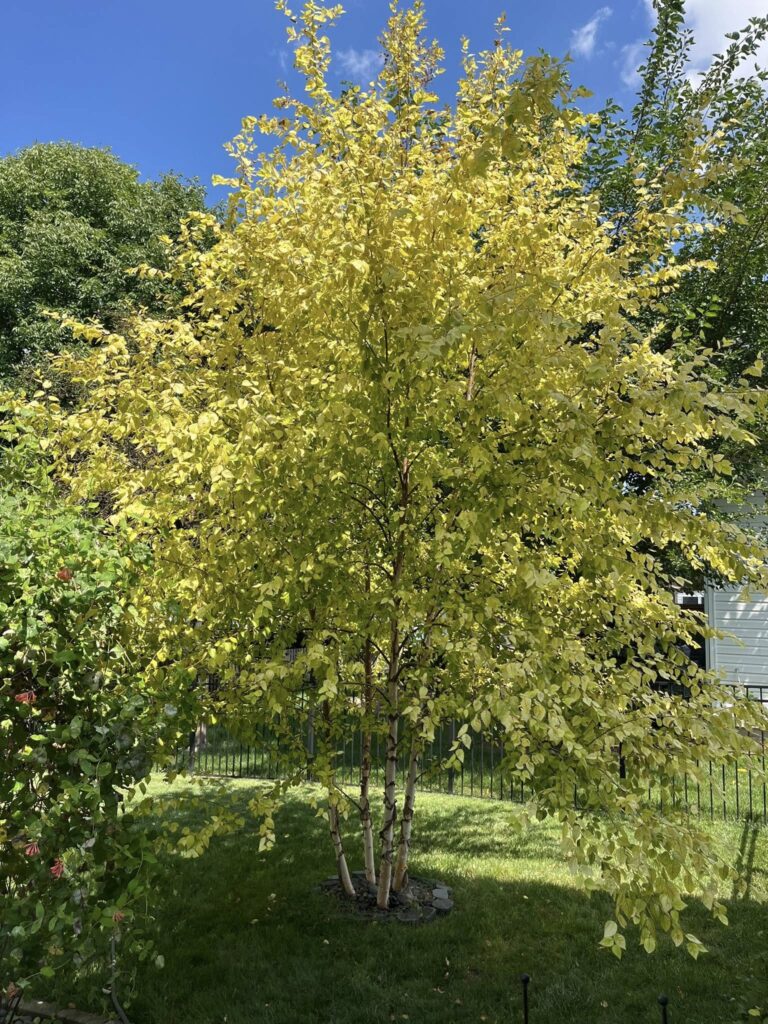
River birch trees are among the most graceful trees you can grow in a home landscape. Their peeling, cinnamon-colored bark is unlike anything else in the garden. Their canopy moves with even the lightest breeze, and in autumn, their leaves turn a warm, butter yellow before they fall.
But river birch trees are not without their challenges.
If you have been growing one — or planning to — you need to understand what can go wrong and why. Some problems are minor and pass on their own. Others will weaken the tree steadily over years. A few can kill it entirely if not addressed with care.
This guide covers the most common river birch tree problems in detail: what causes them, how to identify them, and what you should do. At the end, it also covers the growing conditions these trees need to stay strong and relatively trouble-free.
Understanding River Birch First
The river birch (Betula nigra) is native to the eastern United States, where it grows naturally along riverbanks, floodplains, and wetland edges. It is one of the most heat-tolerant birch species — which is why it has become so widely planted across a range of climates.
It is also, for all its beauty, a tree that responds visibly and quickly to stress. River birch shows its problems early. That is both a challenge and an advantage. Pay attention to the signals, and you can often act before serious damage sets in.
The Most Common River Birch Tree Problems
1. Leaf Scorch — The Summer Struggle
If the edges of your river birch leaves are turning brown and crispy in midsummer, you are most likely looking at leaf scorch. It is one of the most common complaints from river birch owners, and it causes real alarm the first time you see it.
The cause is almost always water stress. River birch is a moisture-loving tree by nature — it evolved along rivers and in wet lowlands. When the soil dries out during hot summers, the tree cannot move water fast enough from roots to leaves. The leaf edges dry out and die.
Hot, dry winds make it worse. So does reflected heat from pavement, buildings, or walls near the tree.
Leaf scorch is not a disease. The leaves look damaged, but the tree is not infected. However, if water stress continues year after year, the tree gradually declines.
What to do:
- Water deeply and consistently during dry spells, particularly in summer. River birch needs more water than most landscape trees.
- Apply a 3–4 inch layer of organic mulch around the base of the tree — extending to the drip line if possible — to retain soil moisture and moderate soil temperature.
- Avoid planting river birch in hot, dry, or reflected-heat locations.
- If scorch is severe and recurring, consider whether the planting site is simply wrong for this species.
2. Chlorosis — Yellow Leaves That Should Be Green
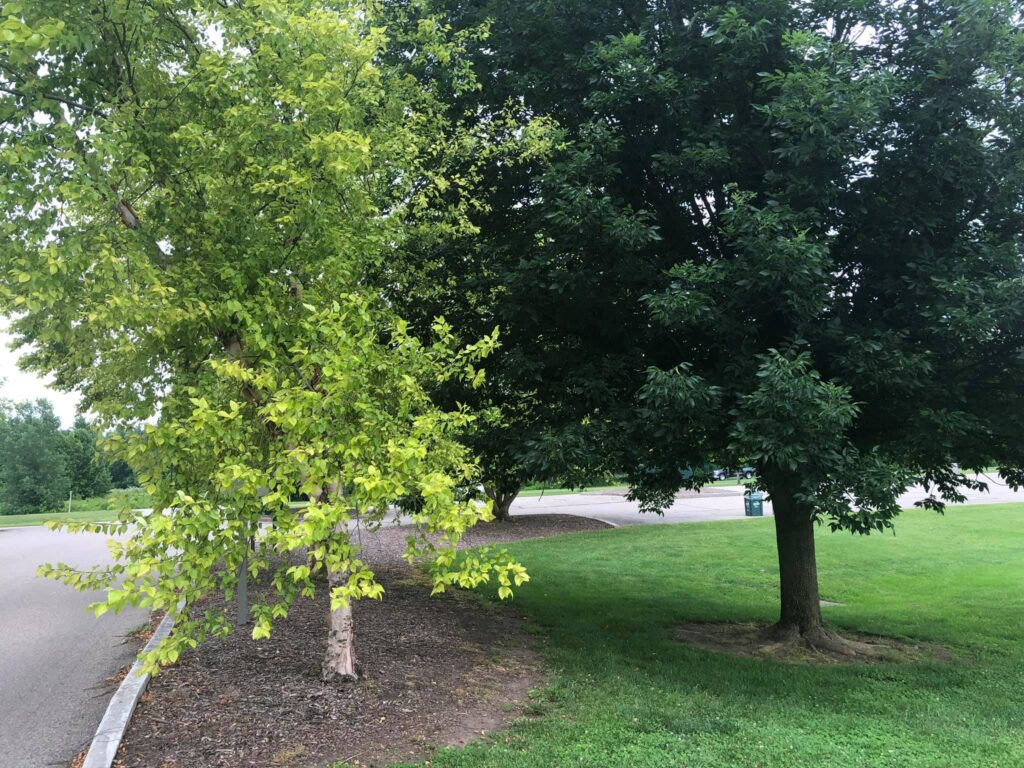
Chlorosis is a condition where the leaves lose their green color and turn yellow — sometimes a pale, washed-out yellow, other times bright yellow with the veins remaining green. This pattern, called interveinal chlorosis, is a strong indicator of iron or manganese deficiency.
River birch is particularly sensitive to high soil pH. When the pH rises above 6.5, iron and manganese become less available to the roots — even when these minerals are physically present in the soil. The tree simply cannot absorb them efficiently.
This is a widespread problem in areas where tap water is alkaline, soils are naturally high in lime, or where concrete foundations and paths leach calcium carbonate into the surrounding soil over time.
Chlorosis weakens the tree progressively. Affected leaves photosynthesize less efficiently, reducing the energy available for growth and disease resistance.
What to do:
- Test your soil pH before doing anything else. A soil test is inexpensive and removes all guesswork.
- If the pH is above 6.5, apply elemental sulfur to gradually lower it. Follow recommended rates carefully — lowering pH is a slow process.
- Apply chelated iron as a soil drench or foliar spray for faster correction of visible symptoms.
- Acidifying fertilizers, such as those formulated for azaleas and rhododendrons, can help maintain lower pH over time.
- Avoid using wood ash or lime near river birch, as both raise soil pH.
3. Bronze Birch Borer — The Invisible Killer
This is the problem that river birch growers fear most — and rightly so.
The bronze birch borer (Agrilus anxius) is a metallic wood-boring beetle whose larvae feed inside the wood of birch trees, tunneling through the cambium layer — the vital tissue just beneath the bark that carries water and nutrients from roots to canopy.
The damage is largely invisible until it is severe. You may not notice anything wrong until you see the top of the tree dying back — a process called dieback or flagging. By then, the infestation is often well advanced.
Characteristic signs of bronze birch borer include:
- D-shaped exit holes in the bark (roughly 3–4mm wide), left when adult beetles emerge in late spring
- Serpentine tunnels visible beneath loose or peeling bark
- Swollen or ridged areas on the trunk and branches
- Progressive dieback starting from the top of the canopy and moving downward
The borer targets stressed trees far more aggressively than healthy ones. Trees suffering from drought, transplant shock, poor drainage, or nutrient deficiency are at dramatically higher risk.
The good news is that river birch (Betula nigra) is more resistant to bronze birch borer than other birch species — particularly white birch (Betula papyrifera) and European birch (Betula pendula). But it is not immune, especially when stressed.
What to do:
- Keep the tree as healthy and stress-free as possible. This is the single most effective prevention.
- Water consistently. A drought-stressed river birch is a borer target.
- If an infestation is confirmed, apply systemic insecticides containing imidacloprid as a soil drench in early spring, before adult beetles emerge.
- Prune and destroy heavily infested branches.
- In severe cases where the main trunk is compromised, removal may be the only option to prevent the tree from becoming a hazard.
4. Birch Leafminer — Cosmetic but Concerning
Birch leafminers are the larvae of small sawflies (Fenusa pusilla and related species). They feed between the upper and lower surfaces of birch leaves, creating irregular, blotchy, brown patches that give the tree a scorched or diseased appearance.
The damage is largely cosmetic on healthy trees. A single defoliation will not kill a river birch. But repeated infestations over multiple seasons weaken the tree, reduce its vigor, and — critically — make it more vulnerable to bronze birch borer.
Leafminer damage is most visible from late spring through summer. Infested leaves eventually brown entirely and drop early.
What to do:
- Systemic insecticides applied in spring, before adults lay eggs, are the most effective control. Imidacloprid applied as a soil drench works well because it is taken up by the tree and affects larvae feeding on the leaves.
- Remove and destroy infested leaves where practical.
- On small or young trees, physical removal of affected leaves limits the spread.
- Encourage natural predators — parasitic wasps attack leafminer larvae and provide meaningful biological control when not disrupted by broad-spectrum pesticide use.
5. Aphids — Soft Pests With Hard Consequences
Several aphid species attack river birch. The spiny witch hazel gall aphid (Hamamelistes spinosus) is among the most notable; it causes distinctive, pineapple-shaped galls on birch catkins and creates colonies on the undersides of leaves.
More commonly, birch aphids (Euceraphis species) cluster on young shoots and leaf undersides, extracting sap and excreting sticky honeydew. This honeydew drips onto surfaces below the tree and encourages sooty mold — a black fungal growth that reduces the leaf’s ability to absorb light.
Heavy infestations cause leaf curl, yellowing, and premature leaf drop.
What to do:
- In most cases, natural predators — ladybugs, lacewings, and parasitic wasps — keep aphid populations in check without any intervention required.
- A strong jet of water dislodges aphid colonies from shoots and leaves effectively.
- Insecticidal soap or neem oil can be applied when populations are high and natural control is insufficient.
- Avoid excess nitrogen fertilization, which promotes the soft, lush growth that aphids prefer.
6. Dieback — When Branches Die for No Obvious Reason
Dieback in river birch — the progressive death of branches from the tips inward — can result from several causes: borer infestation, canker disease, severe drought stress, winter injury, or root problems.
Canker diseases are a common and often underestimated cause. Fungi such as Botryosphaeria and Nectria species infect wounded or stressed wood and cause localized areas of dead bark — cankers — that girdle branches and interrupt the flow of water and nutrients.
The affected branch wilts and dies beyond the canker. If you cut into the wood at the canker site, the tissue beneath is often discolored — brown or dark rather than the pale cream of healthy wood.
What to do:
- Prune back dead or dying branches to healthy wood. Make cuts at least several inches below the visible damage, into wood that is clearly healthy.
- Sterilize pruning tools between cuts to avoid spreading fungal spores to clean wood.
- Maintain tree health — canker fungi are opportunists that exploit weakness. A vigorous, well-watered tree is far less susceptible.
- Avoid wounding the tree unnecessarily, and protect it from mechanical damage by lawn equipment.
7. Root Problems — Too Wet, Too Dry, Too Compacted
River birch has a reputation for tolerating wet soils, and it does — better than most trees. But “tolerating wet conditions” is not the same as thriving in permanently waterlogged soil.
Standing water around the roots for extended periods limits oxygen availability to root cells. This leads to root suffocation, root rot caused by Phytophthora and similar pathogens, and eventual tree decline.
On the opposite end, compacted urban soils restrict root expansion, reduce water infiltration, and create chronic drought stress even in areas with adequate rainfall. River birch planted in compacted urban environments — surrounded by pavement or heavily trafficked ground — often decline years before their time.
What to do:
- Plant river birch where water drains reasonably within 24–48 hours after heavy rain.
- In urban settings, use structural soil mixes or tree pit designs that reduce compaction and allow roots to expand.
- Core aerate compacted soil around the root zone annually.
- Mulch heavily — organic mulch moderates soil moisture, temperature, and improves soil structure over time.
8. Caterpillar Defoliation
Several caterpillar species feed on birch foliage, including fall webworm (Hyphantria cunea) and various tent caterpillar species. Fall webworm builds silken nests at the ends of branches and feeds within them during late summer.
While the nests are unsightly and defoliation looks alarming, healthy river birch trees generally recover well from a single season of caterpillar feeding. Repeated defoliation over consecutive years, however, weakens the tree noticeably.
What to do:
- Remove webworm nests physically when accessible. Pruning out affected branch tips in summer is effective and causes no lasting harm to the tree.
- Bacillus thuringiensis (Bt), a naturally occurring soil bacterium, is a highly effective and environmentally safe biological insecticide for caterpillar control.
- Encourage birds — many species feed heavily on caterpillars and their eggs.
9. Premature Leaf Drop in Late Summer
Many river birch owners are startled when their tree drops significant quantities of leaves in late July or August — well before autumn. This is often not a disease or pest problem at all. It is a normal stress response to summer heat and drought.
River birch sheds leaves when water demand exceeds supply. This is a survival mechanism — by reducing its leaf area, the tree reduces the water it needs to maintain.
While it looks alarming, this seasonal leaf drop rarely causes lasting harm if the tree is otherwise healthy and is watered adequately. The tree will often hold its remaining leaves until normal autumn leaf fall.
What to do:
- Water deeply during dry summer periods. This is the most effective response.
- Mulch to retain soil moisture around the root zone.
- If leaf drop is severe every summer despite adequate watering, reassess the planting site.
10. Armillaria Root Rot — A Serious Fungal Threat
Armillaria root rot, caused by Armillaria species (commonly called honey fungus), is a serious soil-borne disease that attacks the roots and root collar of river birch and many other trees.
Signs include: yellowing and wilting foliage, dieback of the canopy, white mycelial fans beneath the bark at the base of the tree, and the appearance of honey-colored mushrooms at the base in autumn.
Armillaria is difficult to eradicate from the soil — the fungus can persist for decades. Once a tree is significantly infected, recovery is unlikely. Removal and replacement with a resistant species is often the only realistic option.
What to do:
- Remove infected trees promptly, including as much of the root system as possible.
- Improve soil drainage in the area before replanting.
- Choose a different tree species — one known to be less susceptible to Armillaria — for replanting in the same spot.
Growing River Birch Right: The Foundation of a Healthy Tree
Understanding the problems is only half the answer. The other half is giving the tree what it genuinely needs from the start. A healthy river birch is dramatically more resilient than a stressed one.
Sunlight
River birch performs best in full sun to partial shade. It tolerates light shade but grows more vigorously and is more disease-resistant in locations with at least six hours of direct sunlight per day.
Soil
The tree prefers moist, slightly acidic soil with a pH between 5.0 and 6.5. It performs well in loamy, sandy, or clay soils provided drainage is adequate. Avoiding alkaline soils is critical — high pH is a direct cause of chlorosis, one of the most persistent river birch problems.
If your soil is heavy clay or compacted, amend it with organic matter before planting.
Watering
Consistent moisture is essential — especially during the first two to three years after planting. River birch does not tolerate prolonged drought. During dry summers, deep watering once or twice per week is often necessary.
Once established, the tree is more resilient, but it still benefits from supplemental watering during extended dry periods. Never allow the soil to become bone dry around the root zone.
Mulching
Mulch is one of the most valuable things you can do for a river birch. A 3–4 inch layer of shredded wood chips or bark mulch, spread from the base of the trunk to the drip line (but kept a few inches away from the trunk itself), retains moisture, moderates soil temperature, suppresses weeds, and gradually improves soil structure as it breaks down.
Fertilization
River birch generally does not need heavy fertilization. An annual application of a slow-release, acidifying fertilizer in early spring is sufficient for most landscape trees. Avoid high-nitrogen fertilizers, which push rapid, weak growth.
If chlorosis is present, targeted iron or manganese supplementation is more appropriate than general fertilization.
Pruning
Prune river birch in late summer or early autumn — not in spring. Birch trees bleed heavily when pruned in late winter or spring as sap rises, which can weaken the tree and attract borers. Late-season pruning, after the tree has leafed out fully, results in less sap flow and faster wound closure.
Remove dead, damaged, or crossing branches. Maintain an open canopy structure for good air circulation.
Variety and Site Selection
Before planting, consider the cultivar carefully. ‘Heritage’ (Betula nigra ‘Heritage’) is the most widely planted and most broadly recommended cultivar — it has superior resistance to bronze birch borer compared to the straight species, excellent heat tolerance, and striking, light-colored peeling bark.
Choose your site thoughtfully. River birch planted in the right location — with adequate moisture, acidic soil, and good sunlight — is a largely self-sustaining tree. Planted in the wrong spot, it becomes a constant source of problems.
Suggested For You:
Understanding Money Tree: History, Care Details and Common Problems
Understanding The Weeping Cherry Tree: History, Care Details, and Common Problems
10 Common Crabapple Tree Problems and How to Fix Them
The Japanese Black Pine Bonsai (Pinus thunbergii): History, Styling, and Growth Requirements
The Japanese White Pine (Pinus parviflora): History, Features and Growth Requirements
Final Thoughts
River birch is a genuinely beautiful tree with real strengths: heat tolerance, wet-soil adaptability, striking bark, and year-round visual interest. But it is also a tree that wears its stress openly.
Most of the problems covered in this guide are preventable — or at least manageable — when you understand what the tree needs and what threatens it. The keys are consistent moisture, acidic well-drained soil, and a watchful eye for the early signs of borers, chlorosis, and canker.
Inspect your tree regularly. Learn its normal appearance so that changes are easy to spot. And if something looks wrong, act early — the sooner a problem is identified and addressed, the more options you have.
Given the right care and a site suited to its nature, a river birch will reward you for decades with one of the most distinctive silhouettes in the landscape.
References
- University of Florida IFAS Extension — River Birch (Betula nigra) https://edis.ifas.ufl.edu/publication/ST101
- Penn State Extension — Bronze Birch Borer https://extension.psu.edu/bronze-birch-borer
- University of Minnesota Extension — Birch Trees: Problems and Care https://extension.umn.edu/trees-and-shrubs/birch-trees
- Cornell University — Plant Disease Diagnostic Clinic: Armillaria Root Rot https://plantclinic.cornell.edu/factsheets/armillaria.pdf
- Purdue University Extension — Chlorosis of Trees and Shrubs https://www.extension.purdue.edu/extmedia/HO/HO-4.pdf

Tim M Dave is a gardening expert with a passion for houseplants, particularly cacti and succulents. With a degree in plant biology from the University of California, Berkeley, he has vast experience in gardening. Over the years, he has cultivated a vast collection of desert plants and learned a great deal about how to grow and care for these unique companions.