20 Invasive Vines That Can Kill Your Trees (And What to Do About Them)
There is a particular kind of damage that happens quietly. No storm, no drought, no visible wound — just a vine, working its way up a trunk, year after year, until the tree it once merely touched is struggling to survive. I have watched this happen to mature oaks, healthy maples, and decades-old dogwoods in otherwise well-maintained landscapes. By the time most people notice, the damage is already significant.
Invasive vines are one of the most underestimated threats to trees in North America. They compete for light, add crushing structural weight, girdle trunks, introduce moisture that rots bark, and create conditions where disease and pests thrive.
Some work slowly over several seasons. Others can blanket a canopy within a single growing year. In either case, the tree rarely wins without intervention.
This article covers 20 invasive vines that pose a documented threat to trees, with details on how each causes harm, where it is most prevalent, and what makes it difficult to control.
Why Invasive Vines Are So Dangerous to Trees
Before the plant-by-plant breakdown, it is worth understanding the mechanisms of vine damage. Not all invasive vines harm trees in the same way, and recognizing the type of damage helps in both prevention and removal.
The four primary ways invasive vines damage trees are:
- Smothering and shading. Dense vine canopies block sunlight from reaching tree leaves. Without adequate photosynthesis, trees weaken gradually and become vulnerable to secondary stressors.
- Girdling. Twining vines wrap tightly around trunks and branches. As the tree grows outward and the vine tightens, it cuts off the flow of water and nutrients through the cambium layer — essentially strangling the tree from the outside.
- Weight and wind sail. A vine-covered tree becomes a far heavier, wind-catching structure. During storms, the added weight and drag dramatically increases the risk of branch failure and whole-tree uprooting.
- Bark damage and moisture retention. Vines that cling to bark trap moisture against the trunk, accelerating rot, fungal infection, and insect colonization. Some vines penetrate bark tissue directly as they anchor themselves.
Here are the 20 invasive vines most commonly documented as threats to trees across the United States.
1. Kudzu (Pueraria montana var. lobata)
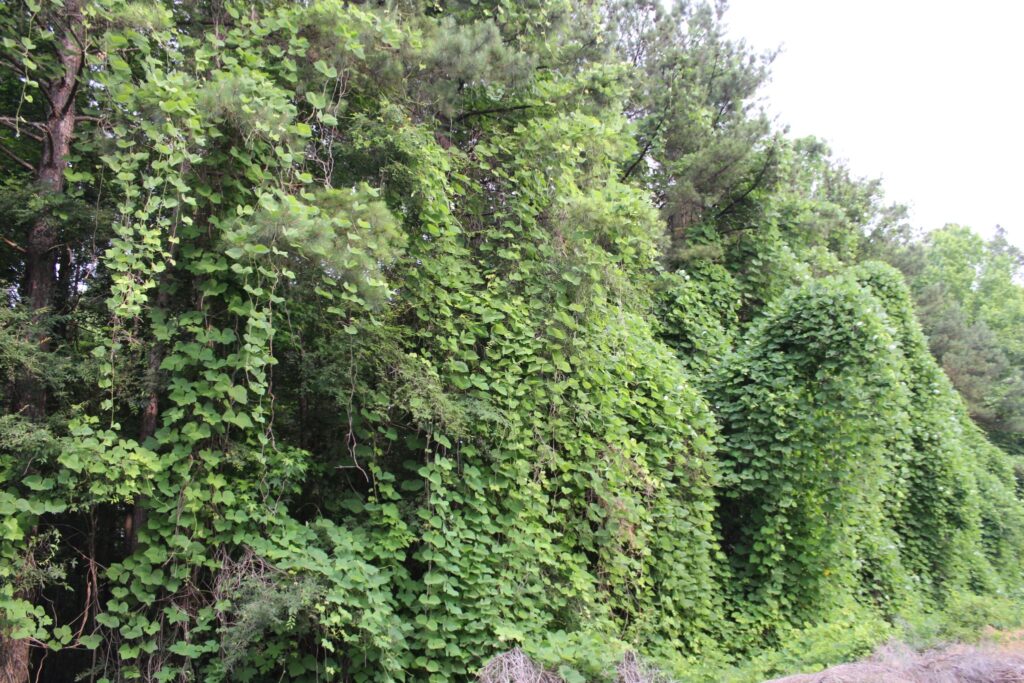
Kudzu is the most infamous invasive vine in North America — and for good reason. Originally introduced from Japan and China for erosion control and livestock fodder, it now blankets millions of acres across the American Southeast. Its growth rate in warm weather is extraordinary — up to one foot per day under ideal conditions.
Kudzu kills trees by completely smothering them, blocking all sunlight from reaching leaves. It can cover an entire mature tree canopy within a single growing season. The vines are also extremely heavy, causing physical branch breakage and, in severe infestations, complete crown collapse.
- Most affected regions: Southeastern US (Alabama, Georgia, Mississippi, Tennessee, South Carolina)
- Damage type: Smothering, weight stress, girdling
- Control difficulty: Very high — roots can extend 12 feet deep and persist for years
2. Japanese Honeysuckle (Lonicera japonica)
Japanese Honeysuckle may smell wonderful, but it is a serious ecological threat. Introduced as an ornamental plant in the early 1800s, it has since spread across nearly every US state. Its fragrant white and yellow flowers attract birds that spread its seeds widely.
It climbs by twining tightly around young tree stems and saplings, causing severe girdling damage that is often fatal to small trees. On larger trees, it shades lower branches and creates a dense, competing canopy layer. It is also semi-evergreen, meaning it continues to suppress native vegetation through the winter months in milder climates.
- Most affected regions: Eastern and Central US, Pacific Northwest
- Damage type: Girdling of young trees, shading, suppression of native understory
- Control difficulty: High — spreads aggressively by both seed and vegetative runners
3. Oriental Bittersweet (Celastrus orbiculatus)
Few invasive vines cause the level of structural tree damage that Oriental Bittersweet inflicts. It is a vigorous twining vine that spirals around trunks and branches with tremendous force. As it grows, it literally twists and deforms tree trunks, creating constrictions that disrupt vascular tissue.
Its berries are brightly colored — orange and red — and are unfortunately used in holiday wreaths and dried floral arrangements, which inadvertently spreads the seeds to new areas. It was introduced from Asia in the 1860s and is now considered one of the most damaging invasives in the Northeast.
- Most affected regions: Eastern US, New England, Mid-Atlantic states
- Damage type: Severe girdling, trunk deformation, canopy smothering
- Control difficulty: Very high — resprouts vigorously from roots after cutting
4. English Ivy (Hedera helix)
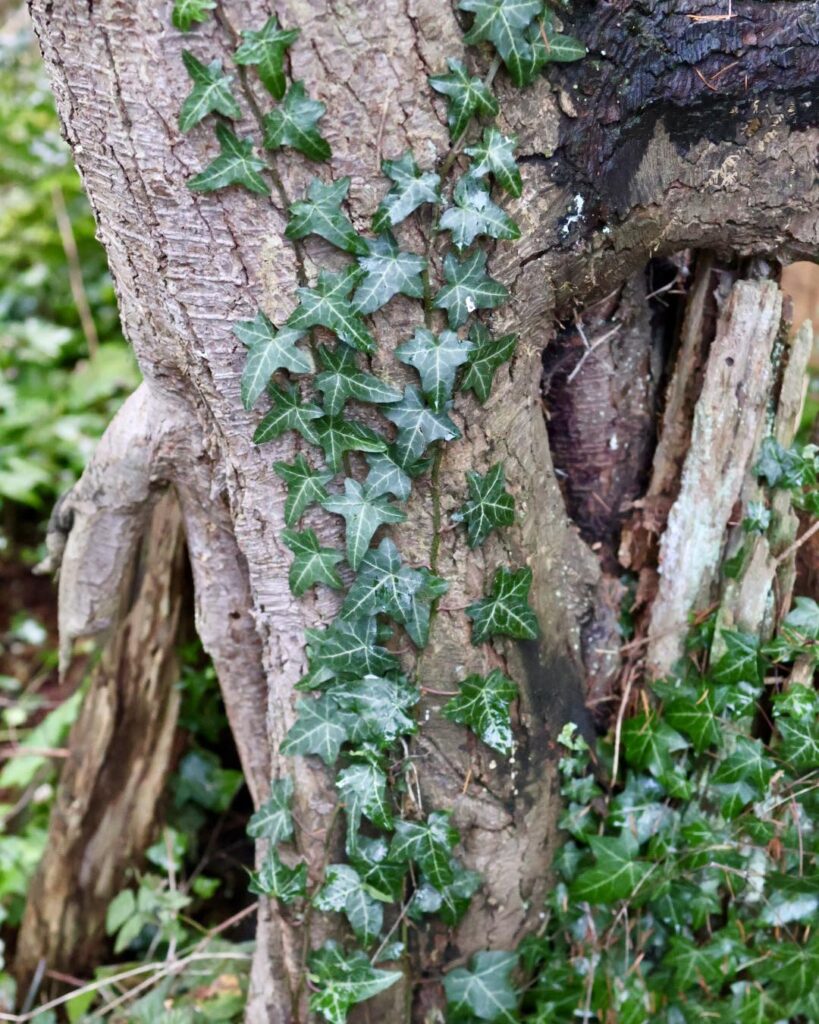
English Ivy is deceptively charming. For generations, it has been planted as a tidy ground cover and wall climber in gardens across North America. The problem is that once it reaches a tree trunk, it begins climbing — and it does not stop. As it ascends, it creates what ecologists call an “ivy desert” around the base of the tree, outcompeting all other plants for nutrients and moisture.
The real damage comes in two forms: the weight of dense ivy growth can topple branches and entire trees during ice storms or high winds, and the moisture trapped against the bark by ivy’s adhesive rootlets creates a favorable environment for wood-rotting fungi and bacterial canker diseases.
- Most affected regions: Pacific Northwest, Mid-Atlantic, Southeast, Southern California
- Damage type: Weight stress, bark moisture retention, disease facilitation, root competition
- Control difficulty: Moderate to high — requires cutting at the base and allowing the climbing portion to die in place before removal
5. Porcelain Berry (Ampelopsis brevipedunculata)
Often mistaken for a native grape vine, Porcelain Berry is a highly invasive Asian species whose remarkable metallic berries in shades of turquoise, purple, and lavender make it visually distinctive — and unfortunately popular in some ornamental settings. Birds consume the berries enthusiastically, spreading seeds across wide areas.
It climbs by tendrils and grows rapidly, competing directly with native trees for light and canopy space. In forested edges and riparian areas, it can displace entire native shrub and tree layers. Young trees are particularly vulnerable to being completely engulfed.
- Most affected regions: Eastern US, especially New England and Mid-Atlantic states
- Damage type: Canopy competition, light deprivation, native tree seedling suppression
- Control difficulty: Moderate — seedlings pull easily but mature vines require systemic herbicide treatment
6. Mile-a-Minute Weed (Persicaria perfoliata)
The name says it all. Mile-a-Minute Weed is one of the fastest-growing invasive vines in North America, capable of extending six inches in a single day under warm, humid conditions. Native to Eastern Asia, it was introduced through contaminated nursery stock and has spread rapidly across the Eastern US since the 1930s.
Its sharp, recurved barbs allow it to scramble over and through other vegetation, including shrubs and young trees. It forms dense mats that completely smother saplings and suppress forest regeneration. Although primarily an annual, it produces prodigious quantities of seed that persist in soil.
- Most affected regions: Mid-Atlantic states, New England, Appalachian region
- Damage type: Physical smothering, suppression of tree seedlings and saplings
- Control difficulty: Moderate for small infestations; challenging at landscape scale due to seed bank
7. Chinese Wisteria (Wisteria sinensis) and Japanese Wisteria (Wisteria floribunda)
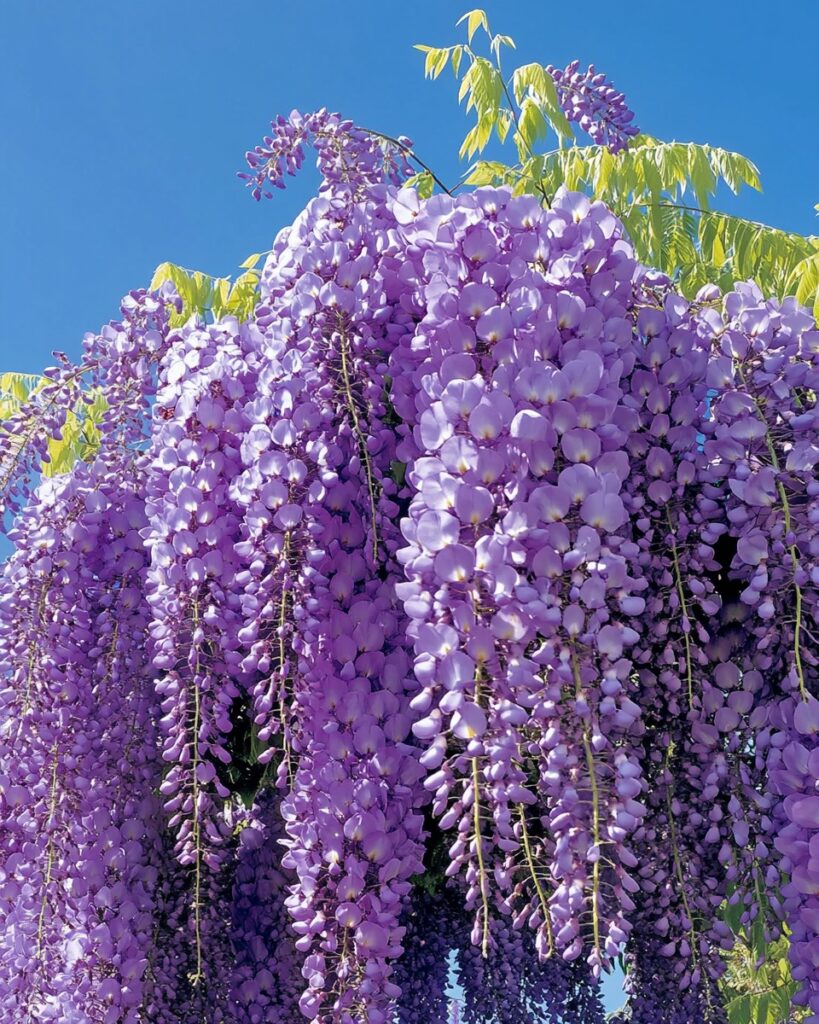
Wisteria’s cascading purple flowers are iconic — and that beauty is precisely why this plant has been so widely planted and so widely misunderstood. Both Chinese and Japanese Wisteria are classified as invasive in many US states. Unlike the native American Wisteria (Wisteria frutescens), these Asian species are aggressive twiners capable of girdling and toppling mature trees.
Wisteria vines can grow to enormous dimensions over time — woody stems thick as a person’s arm are not uncommon in old infestations. The twining action is powerfully constricting, and the combined weight of a large wisteria canopy can structurally compromise entire trees.
- Most affected regions: Southeast, Mid-Atlantic, portions of the Midwest
- Damage type: Severe girdling, catastrophic weight loading, canopy smothering
- Control difficulty: Very high — established plants resprout vigorously; complete root removal is rarely practical
8. Japanese Climbing Fern (Lygodium japonicum)
Japanese Climbing Fern is a particularly insidious invasive because it does not look threatening. Its delicate, lacy fronds twine gracefully around anything in their path — shrubs, young trees, fence posts. But where it establishes, it forms dense, layered mats that smother native vegetation and carry fire in ways that native plants do not.
In the Southeast, this fern’s ability to carry fire up into tree canopies — called a “fire ladder” effect — poses a serious additional risk. Forests with heavy Japanese Climbing Fern infestations suffer more severe crown fire damage than those without it.
- Most affected regions: Southeast US (Florida, Georgia, Louisiana, Texas)
- Damage type: Smothering, fire ladder facilitation, competition with native species
- Control difficulty: High — spreads by spores and is difficult to control at landscape scale
9. Air Potato (Dioscorea bulbifera)
Air Potato is a tropical vine native to Asia and Africa that has become a major invasive threat in Florida and the Gulf Coast states. It climbs by twining and can reach heights of 60–70 feet — easily engulfing the canopy of a mature tree in a single season. Its common name comes from the aerial tubers (bulbils) that form along the stems and drop to the ground, each capable of sprouting a new plant.
The combination of rapid vertical growth and prolific bulbil production makes Air Potato exceptionally difficult to control. A single vine can produce dozens of new plants from dropped bulbils each year, overwhelming any manual removal effort that is not sustained over multiple seasons.
- Most affected regions: Florida, Gulf Coast states
- Damage type: Canopy smothering, extreme weight loading
- Control difficulty: Very high — requires multi-year, systematic management
10. Multiflora Rose (Rosa multiflora)
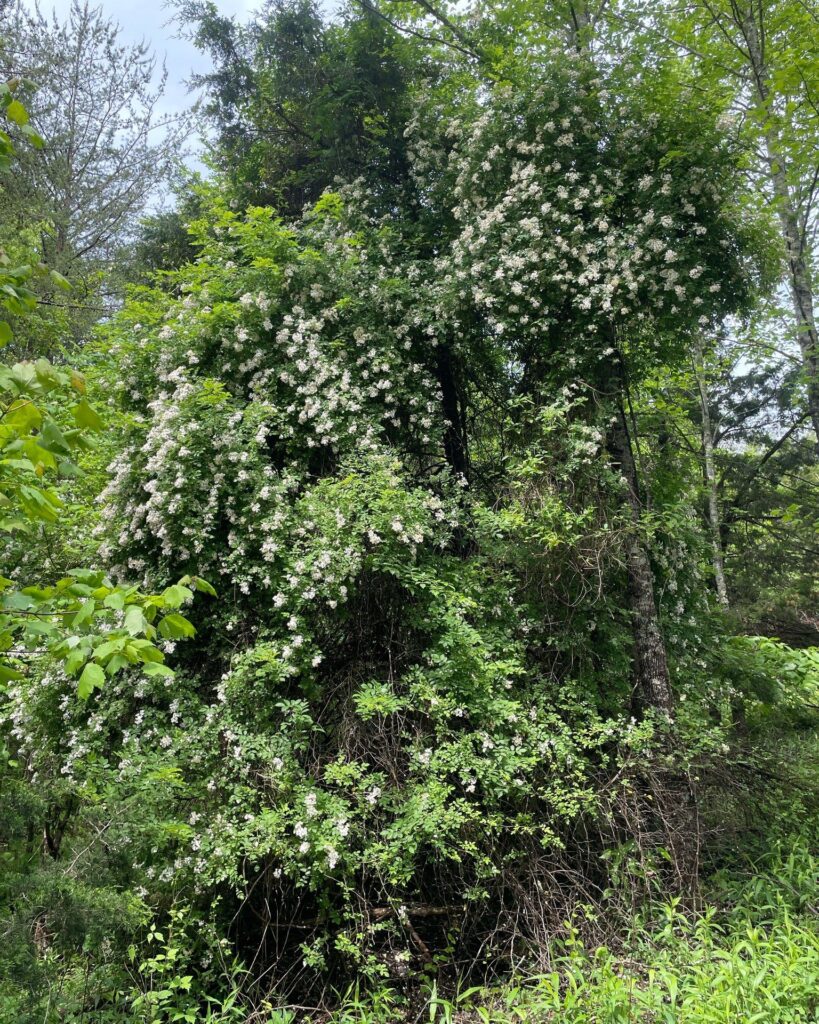
While technically a shrub with arching, scrambling canes rather than a true climbing vine, Multiflora Rose climbs into tree canopies in a way that causes vine-like damage. Its long, thorny canes arch over and through shrubs and small trees, using thorns to hook onto bark and branches while it grows upward.
Dense infestations can completely engulf the lower canopy of trees, blocking light and adding enormous physical weight. It was widely promoted in the mid-20th century as a “living fence” and for erosion control before its invasive nature became understood. It is now classified as a noxious weed in numerous US states.
- Most affected regions: Eastern and Central US
- Damage type: Physical hooking and mechanical damage, canopy competition, light suppression
- Control difficulty: High — roots deeply and resprouts aggressively; thorns make manual removal challenging
11. Cat’s Claw Vine (Macfadyena unguis-cati)
Cat’s Claw Vine earns its name from the hook-shaped tendrils that latch onto bark, masonry, and any available surface with remarkable tenacity. Native to Central and South America, it has naturalized across the southern US and is considered invasive in parts of California, Florida, and Texas.
It climbs trees aggressively, forms dense evergreen canopies that block light, and produces underground tubers that make eradication particularly frustrating. Even after cutting to the ground, tubers can regenerate the plant for years.
- Most affected regions: California, Florida, Texas, Gulf Coast
- Damage type: Bark damage from tendrils, canopy smothering, light competition
- Control difficulty: Very high — underground tuber system extremely persistent
12. Trumpet Creeper (Campsis radicans)
Native to the Eastern US but frequently invasive outside its natural range, Trumpet Creeper is a vigorous climbing vine with attractive orange-red trumpet flowers. While it supports hummingbirds and native pollinators within its natural range, it becomes a serious invasive problem in the Western US and in European and Australian contexts.
Even within its native range, it can cause bark damage through its aerial rootlets and becomes overwhelming on young trees. Its underground root system spreads extensively, allowing it to recolonize quickly after removal. The sap also causes dermatitis in some people, making removal an unpleasant task.
- Most affected regions: Western US when planted outside native range; also invasive in Europe and Australia
- Damage type: Bark adhesion damage, moisture retention, root system competition
- Control difficulty: Moderate to high — resprouts persistently from roots
13. Bitter Lemon / Balsam Pear (Momordica charantia)
Balsam Pear is a fast-growing tropical vine that has established invasive populations in Florida, Hawaii, and other warm US regions. It scrambles over shrubs and climbs into trees using tendrils, forming a dense leafy mat that blocks photosynthesis in host trees.
Its bright orange-red fruits split open to reveal scarlet seeds that birds and small mammals distribute widely. In Hawaii and South Florida, it has become a particularly serious problem in native forest edges and disturbed areas where it can outcompete tree seedlings entirely.
- Most affected regions: Florida, Hawaii, Gulf Coast
- Damage type: Canopy smothering, competition with native tree seedlings
- Control difficulty: Moderate — manageable with persistent removal, but seed bank prolongs reinfestation
14. Old World Climbing Fern (Lygodium microphyllum)
Old World Climbing Fern is considered one of Florida’s most serious invasive plant threats. Unlike its relative Japanese Climbing Fern, it is capable of climbing to extraordinary heights — wrapping trees, smothering canopies, and forming what biologists describe as a continuous fern “blanket” over entire forest patches.
The fire ladder risk it creates is even more acute than Japanese Climbing Fern. In the Florida Everglades, it has altered fire regimes significantly, carrying ground fires into tree canopies that historically would not have burned. It spreads by wind-dispersed spores and can colonize new areas rapidly.
- Most affected regions: Southern Florida, especially the Everglades
- Damage type: Extreme canopy smothering, fire ladder, native ecosystem disruption
- Control difficulty: Very high — biological control research is ongoing
15. Five-Leaf Akebia (Akebia quinata)
Five-Leaf Akebia, also called Chocolate Vine, is a semi-evergreen Asian vine that was introduced as an ornamental due to its fragrant, chocolate-scented flowers and interesting lobed leaves. It has naturalized across much of the Eastern US and is classified as invasive in several states including Tennessee, North Carolina, and Virginia.
It twines aggressively around young trees and shrubs, causing girdling damage similar to Oriental Bittersweet. It is semi-evergreen, meaning it can suppress vegetation year-round in warmer parts of its invasive range. It is also highly drought-tolerant once established, making it persistent in a variety of conditions.
- Most affected regions: Eastern US, Mid-Atlantic, Southeast
- Damage type: Girdling of young trees, canopy competition, year-round shading
- Control difficulty: Moderate to high — resprouts from root crown after cutting
16. Silk Vine (Periploca graeca)
Silk Vine is a fast-growing deciduous twiner from Southeastern Europe and Asia that has escaped cultivation in parts of the Eastern US. It climbs by twining tightly around young trees and shrubs, causing girdling damage. Its milky sap is toxic to mammals, including pets and humans.
While not yet as widespread as some vines on this list, it is well established in natural areas of Pennsylvania and New Jersey and is considered an emerging invasive threat in the Mid-Atlantic region. Early identification and removal are strongly recommended.
- Most affected regions: Mid-Atlantic states (Pennsylvania, New Jersey)
- Damage type: Girdling, toxic sap creates handling hazards during removal
- Control difficulty: Moderate — manageable if caught early before extensive spread
17. Climbing Euonymus (Euonymus fortunei)
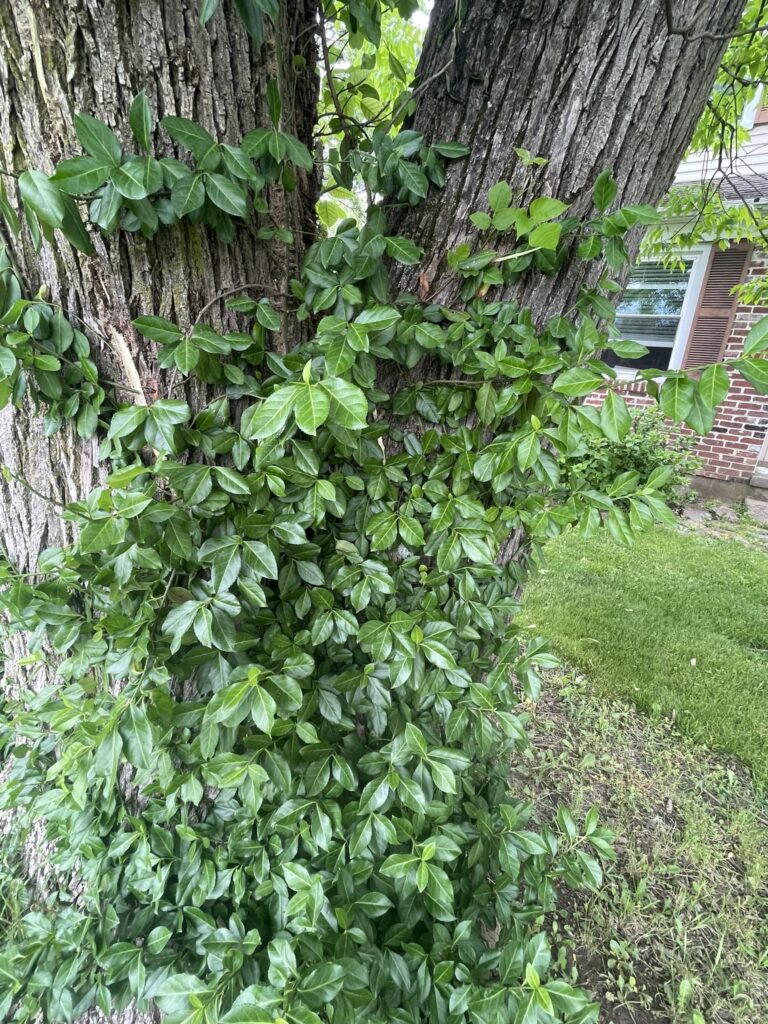
Wintercreeper, as it is commonly known, is a popular landscaping plant that has become invasive across a wide area of the Eastern and Central US. Like English Ivy, it begins as a ground cover, then transitions to a climbing form when it reaches a vertical surface — including tree trunks.
In its climbing form, it produces a different leaf type and begins fruiting heavily, with seeds spread by birds. It smothers tree bark, retains moisture, and competes directly with tree roots for soil resources. The USDA and multiple state agencies have identified it as a significant invasive threat in forest understory environments.
- Most affected regions: Eastern and Central US, Great Plains
- Damage type: Bark moisture retention, root competition, canopy smothering
- Control difficulty: Moderate — cut-stump herbicide treatment most effective
18. Wild Grape Relatives — Invasive Species (Vitis spp. — non-native)
While native wild grapes (Vitis spp.) are an important part of eastern North American ecosystems, several non-native grape relatives and hybrid populations have become invasive in specific regions. Riverbank Grape and certain escaped cultivated varieties can grow to enormous sizes, placing heavy vine loads on host trees.
The weight of large grape vines during leafed-out summer and especially during ice storms is a primary cause of branch failure in forested areas throughout the Eastern US. Their high-canopy growth habit means damage often occurs in the upper crown, which is difficult to detect and address before structural failure occurs.
- Most affected regions: Eastern US, riparian corridors
- Damage type: Severe weight loading, branch failure risk, canopy competition
- Control difficulty: Moderate — effective if vines are cut at the base and roots treated
19. Bindweed (Calystegia spp. and Convolvulus arvensis)
Field Bindweed and Hedge Bindweed are twining vines that spiral around young tree stems and saplings with a relentless persistence that frustrates gardeners and land managers alike. While they rarely threaten mature, large-diameter trees, they can be fatal to newly planted trees and saplings by girdling and shading in the first one to three years of establishment.
Field Bindweed in particular has an extraordinarily deep root system — sometimes extending fifteen to twenty feet into the soil — making complete eradication nearly impossible without sustained, multi-year management. It is listed as a noxious weed in more US states than almost any other invasive plant.
- Most affected regions: Throughout the continental US — one of the most widespread invasive vines nationally
- Damage type: Girdling of young trees, shading, root competition
- Control difficulty: Extremely high — deep root system resists most control methods
20. Virginia Creeper Lookalikes — Invasive Parthenocissus Species
A word of careful clarification here. Native Virginia Creeper (Parthenocissus quinquefolia) is NOT invasive — it is a beneficial native vine with significant wildlife value. However, its close Asian relative, Japanese Creeper or Boston Ivy (Parthenocissus tricuspidata), is considered invasive in parts of the US, particularly in the Northeast and Pacific Northwest.
Japanese Creeper adheres to bark using adhesive-tipped tendrils that can penetrate and damage bark tissue, create moisture pockets, and facilitate fungal infections in trees. It also grows rapidly and covers large surface areas of trunk and canopy, blocking light from reaching the tree’s lower branches.
- Most affected regions: Northeast US, Pacific Northwest, portions of the Midwest
- Damage type: Bark penetration, moisture retention, light competition
- Control difficulty: Moderate — requires physical removal and follow-up treatment to prevent reattachment
How to Safely Remove Invasive Vines From Trees
If you have identified any of these vines on your property, removal should be done carefully to avoid damaging the tree in the process. Here are the core principles:
Cut — don’t pull. For vines already climbing a tree, cutting the vine at the base (ground level) and at approximately shoulder height is the standard approach. This kills the climbing portion without requiring you to pull it from the canopy — which can cause significant branch damage on its own.
Let it die in place. Once cut, allow the severed climbing portion to die and decay before attempting to remove it from the tree. Dead vines detach far more easily and with less physical force than living ones.
Treat the cut stump. Many invasive vines resprout vigorously from the root crown after cutting. Applying an appropriate systemic herbicide (such as glyphosate or triclopyr) to the freshly cut stump immediately after cutting dramatically improves control results.
Repeat monitoring is essential. Most invasive vines require follow-up treatment over multiple seasons. A single removal effort is rarely sufficient. Mark the location and return to check for regrowth at least twice per year.
Suggested For You:
10 Flowering Vines for Zone 7: Pet Friendly Choices
15 Best Climbing Vines for Pergolas: Picks That Will Transform Your Outdoor Space
15 Best Climbing Vines for a Trellis: Turn Your Plain Yard Into a Living Masterpiece
25 Best Rain Garden Plants: Native Perennials, Shrubs, and Grasses
15 Stunning Climbing Vines with Purple Flowers: Purple Power That Will Transform Any Garden
Final Thoughts
The trees in your landscape and in natural areas around you are long-term investments — ecological, aesthetic, and financial. A 50-year-old oak or a mature maple provides a value to the surrounding environment that no replacement planting can replicate for generations. Protecting those trees from invasive vines is one of the most impactful things a property owner or land steward can do.
The 20 vines covered in this article represent a genuine threat — not a theoretical one. They are actively damaging trees in forests, parks, and private landscapes across the United States right now. Early identification is always easier than late-stage removal. The sooner you recognize an invasive vine on your property, the better your chances of managing it successfully.
If you are ever uncertain about identification or the best management approach for your region, contact your state’s cooperative extension service or a certified arborist. Both are excellent, accessible resources — and both can save you considerable effort and cost by pointing you toward proven local strategies.
Your trees are worth protecting. Start by knowing their enemies.
References
- USDA National Invasive Species Information Center (NISIC) https://www.invasivespeciesinfo.gov/plants/vines-and-groundcovers
- University of Georgia Center for Invasive Species and Ecosystem Health (Bugwood) https://www.invasive.org/
- Penn State Extension — Invasive Plants of the Eastern United States https://extension.psu.edu/invasive-plants
- University of Florida IFAS Extension — Invasive Plants in Florida https://edis.ifas.ufl.edu/topic_invasive_plants
- North Carolina State University Extension — Invasive Plant Species Profiles https://plants.ces.ncsu.edu/

Tim M Dave is a gardening expert with a passion for houseplants, particularly cacti and succulents. With a degree in plant biology from the University of California, Berkeley, he has vast experience in gardening. Over the years, he has cultivated a vast collection of desert plants and learned a great deal about how to grow and care for these unique companions.