Understanding American Hornbeam (Carpinus caroliniana): Identification, History, Cultivation Details, Problems and More
If you have ever walked through a shaded forest near a stream and noticed a small, heavily built tree with smooth, gray bark that ripples like flexed muscle, you have likely met the American Hornbeam (Carpinus caroliniana).
The American Hornbeam is one of the most ecologically valuable and visually distinctive trees in eastern North America. It thrives where other trees struggle, supports wildlife generously, and brings remarkable four-season interest to landscapes.
Whether you are a homeowner, a forester, a naturalist, or simply a curious reader, this guide covers everything worth knowing about this exceptional tree.
What Is the American Hornbeam?
The American Hornbeam belongs to the family Betulaceae — the birch family. Its scientific name, Carpinus caroliniana, reflects its early documentation in the Carolinas. It carries several common names, each telling a story about its character:
- Musclewood — for its striking, sinewy bark
- Ironwood — for its remarkably dense, hard wood
- Blue Beech — for bark that superficially resembles the American Beech
- Water Beech — for its preference for moist, streamside habitats
These names are not mere botanical trivia. They reveal the tree’s toughness, its unique texture, and the habitats where it feels most at home.
Here is a quick understanding of this American native species.
| Scientific Name | Carpinus caroliniana |
| Family | Betulaceae |
| Common Names | American Hornbeam, Musclewood, Ironwood, Blue Beech |
| Native Range | Eastern North America (Zones 3–9) |
| Mature Height | 20–35 feet |
| Light | Full shade to full sun |
| Soil | Moist, well-drained, slightly acidic |
| Growth Rate | Slow (6–12 inches/year) |
| Wildlife Value | Very high |
| Landscape Use | Understory, rain garden, naturalized areas |
Native Range and Natural Habitat
The American Hornbeam is native to eastern North America, with a range stretching from Nova Scotia and southern Quebec in the north, south through Florida, and west to eastern Kansas, Nebraska, and Texas. It also extends into parts of Mexico and Central America.
Within forests, it occupies the understory — the shaded layer beneath taller canopy trees like oaks, maples, and beeches. It is especially common along streambanks, floodplains, and moist ravines. The tree is well adapted to periodic flooding, and you will rarely find it far from water in its native habitat.
I have personally encountered American Hornbeam growing right at the edge of creek beds, its roots gripping the bank while taller trees towered overhead. There is something quietly impressive about how it holds its ground in such difficult conditions.
Physical Characteristics
Size and Form
The American Hornbeam is a small to medium-sized tree, typically reaching 20 to 35 feet (6–10 meters) in height, though it occasionally grows taller. It tends to have a broad, irregular crown with slender, often drooping branches.
In open settings, the tree grows more rounded. In dense shade, it becomes more open and wide-spreading.
Its multi-stemmed growth habit gives it a shrubby, layered appearance that blends naturally into woodland settings.
The Bark — A Defining Feature
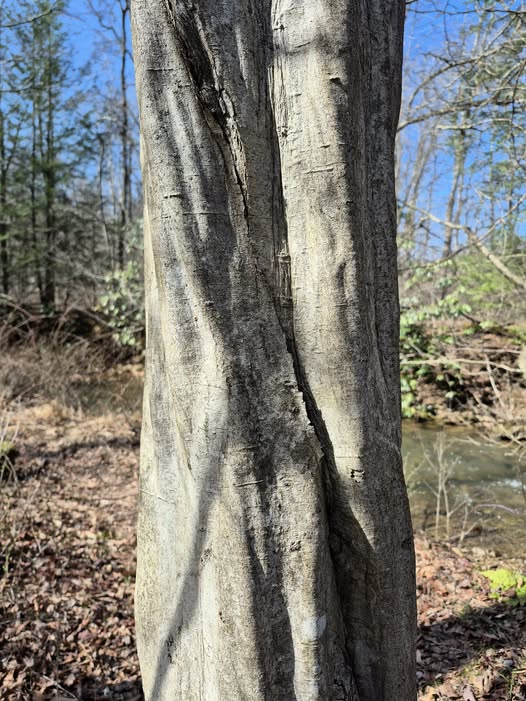
If there is one feature that makes the American Hornbeam instantly recognizable, it is the bark. The smooth, blue-gray bark twists and bulges like the muscles of an athlete’s arm. This is not a disease or deformity — it is normal, healthy growth, caused by sinuously interlocking wood fibers beneath the thin bark surface.
This characteristic is so distinctive that, once you see it, you will never misidentify this tree again.
Leaves
The leaves are simple, alternate, and ovate, measuring 2 to 4 inches (5–10 cm) in length. They have sharply double-toothed margins and prominent parallel veins — a classic feature of the birch family.
In spring, leaves emerge bright green and slightly glossy. In autumn, they turn yellow, orange, and red, providing a reliable and beautiful fall color display, even in deep shade where many trees fail to color well.
Flowers
The American Hornbeam is monoecious — meaning it bears separate male and female flowers on the same tree. Both appear in spring alongside the emerging leaves.
- Male (staminate) catkins are yellowish-green and hang in drooping clusters.
- Female (pistillate) catkins are smaller and upright initially.
The flowers are wind-pollinated and, while not showy, they are ecologically important.
Fruit
The fruit is one of the tree’s most charming features. Small, ribbed nutlets develop attached to leafy, three-lobed bracts (modified leaves), forming loose, hop-like clusters called strobiles. These clusters hang from the branches in late summer through autumn, swaying gently in the breeze.
Each nutlet is small — roughly ¼ inch — and hard. The leafy bracts act as wings, helping seeds disperse on the wind.
Growth Rate and Lifespan
The American Hornbeam is a slow-growing tree. Under natural conditions, it may add only 6 to 12 inches (15–30 cm) of height per year. This slow pace is part of why it is so dense and hard-wooded.
Its lifespan typically ranges from 60 to over 100 years. In undisturbed forest conditions, individual specimens can persist for well over a century, slowly expanding their canopy in the dappled understory light.
Ecological Value and Wildlife Benefits
Few trees punch above their weight ecologically the way the American Hornbeam does. It is a keystone species for understory wildlife.
Birds
More than 20 species of birds are known to feed on American Hornbeam seeds and fruit. These include:
- Wild turkey
- Ruffed grouse
- Ring-necked pheasant
- Purple finch
- Bobwhite quail
- Various woodpeckers
The dense branching also provides excellent nesting cover for songbirds.
Mammals
White-tailed deer, beaver, and rabbits browse on the twigs, bark, and leaves. Squirrels and small rodents collect the nutlets. Beaver, in particular, are known to heavily utilize streamside Hornbeam stands for both food and dam-building material.
Insects and Pollinators
The American Hornbeam supports over 100 species of Lepidoptera (moths and butterflies) as a larval host plant, according to entomologist Doug Tallamy’s research on native plant value. This makes it an important species for insect-dependent food webs.
It is a host plant for the Eastern Tiger Swallowtail butterfly, one of the most recognizable butterflies in eastern North America.
Streambank Stabilization
Because it grows naturally along streams and in floodplains, its root system helps stabilize streambanks and reduce soil erosion. This ecological function becomes especially valuable in riparian restoration projects.
Soil, Light, and Growing Conditions
Light Requirements
The American Hornbeam is one of the most shade-tolerant trees in North America. It can survive and even thrive under a dense forest canopy with as little as 3–5% of full sunlight. However, it also grows well in partial shade and will do reasonably well in full sun if moisture is adequate.
Soil Preferences
It prefers moist, well-drained to occasionally wet soils that are rich in organic matter and slightly acidic (pH 4.5–7.0). It tolerates periodic flooding well. Sandy, dry, or compacted soils are less suitable.
In landscaping, it adapts to a wider range of conditions than its native habitat suggests. With supplemental irrigation and mulching, it can grow in drier, suburban settings.
Hardiness Zones
The American Hornbeam is hardy in USDA Plant Hardiness Zones 3 through 9, making it suitable across most of the eastern United States and southern Canada.
Landscape and Garden Uses
The American Hornbeam is gaining well-deserved recognition among landscape architects and native plant gardeners. Here is why:
Understory Planting
It is one of the best trees for shaded garden spaces — under mature oaks, near the north side of buildings, or in woodland garden settings. Its ability to thrive in deep shade fills a gap that few ornamental trees can.
Rain Gardens and Wet Areas
Its tolerance for moist conditions makes it ideal for rain gardens, bioswales, and areas with poor drainage. It is increasingly specified in stormwater management landscaping.
Naturalized Landscapes
Planted along stream corridors or in naturalized areas, it blends seamlessly into native plant communities while providing year-round ecological value. It is not an aggressive spreader, so it is easy to manage.
Four-Season Interest
Few small trees offer as much seasonal variation:
- Spring — fresh green leaves and catkins
- Summer — dense green canopy and hanging fruit clusters
- Autumn — golden to orange-red fall color
- Winter — striking muscular bark and persistent fruit clusters visible against bare sky
Bonsai and Specimen Planting
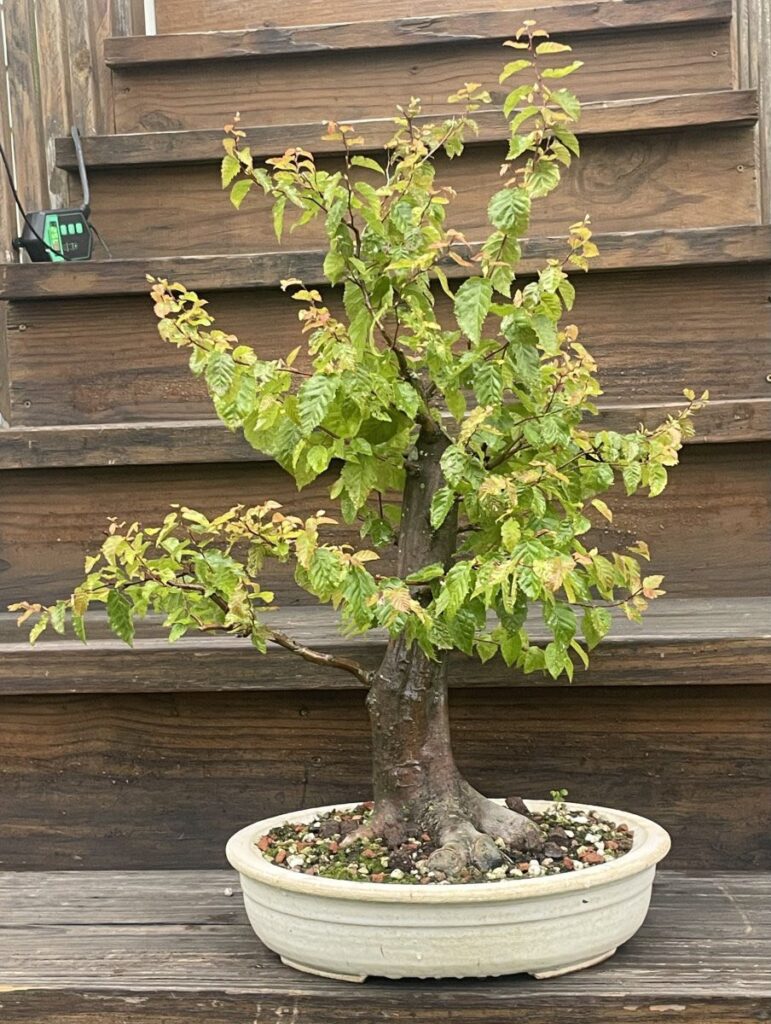
The American Hornbeam’s slow growth, interesting bark, and tolerance of pruning make it a popular choice for bonsai cultivation. As a specimen tree in smaller yards, it provides character without overpowering the space.
Wood Properties and Historical Uses
The common name “Ironwood” is no exaggeration. American Hornbeam produces some of the hardest, densest wood of any native North American tree. The wood is heavy, strong, and resistant to splitting, with a Janka hardness rating well above most commercially used timber species.
Historically, Indigenous peoples and early settlers valued the wood for making tool handles, mallets, wedges, and other items requiring durability. Its small size, however, limits large-scale timber use.
Today, the wood is used in small specialty items — tool handles, walking sticks, and turned objects. It is rarely marketed commercially because of the tree’s small size and scattered distribution.
American Hornbeam vs. Hop Hornbeam
A common point of confusion exists between the American Hornbeam (Carpinus caroliniana) and the Hop Hornbeam (Ostrya virginiana). While both are small native trees in the birch family, they differ in key ways:
| Feature | American Hornbeam | Hop Hornbeam |
| Bark | Smooth, muscular, gray | Shaggy, flaky, brownish |
| Fruit | Three-lobed leafy bracts | Inflated, hop-like sacs |
| Leaf texture | Smooth to slightly hairy | Rough, sandpaper-like |
| Habitat | Wetter, streamside | Drier upland slopes |
| Alternate names | Musclewood | Eastern Ironwood |
Both are excellent native trees worthy of wider planting, but the American Hornbeam generally favors wetter sites while Hop Hornbeam tolerates drier ground.
Pests, Diseases, and Challenges
The American Hornbeam is a relatively pest- and disease-resistant tree, which makes it a low-maintenance choice in appropriate landscapes.
Occasional issues include:
- Leaf spot fungi — minor cosmetic issues that rarely threaten overall health
- Twig blight — can occur in humid conditions but is rarely severe
- Borers — stressed trees may be susceptible, but healthy specimens typically resist infestation
- Deer browsing — significant in areas with high deer populations, especially on young transplants
The biggest challenge with American Hornbeam in landscapes is transplanting. Like many native trees, it develops a wide, fibrous root system and does not transplant easily as a large specimen. Planting small, nursery-grown trees or container-grown stock dramatically improves survival rates.
Conservation Status and Threats
Currently, the American Hornbeam is listed as a species of least concern globally. It remains widespread and locally common across its native range.
However, several threats deserve attention:
- Habitat loss from urban development and floodplain modification
- Invasive plants such as Japanese honeysuckle, multiflora rose, and garlic mustard, which compete in the same understory habitats
- Deer overpopulation, which heavily suppresses natural regeneration in many eastern forest understories
- Climate change, which may alter hydrology and increase drought stress in some parts of its range
Supporting the American Hornbeam in native plant restorations and urban green spaces is a meaningful conservation action, even at the individual level.
How to Plant and Grow American Hornbeam
Sourcing Plants
Always purchase from reputable native plant nurseries that propagate locally sourced stock. Avoid wild-collected plants, which are difficult to transplant and contribute to ecosystem disruption.
Planting Tips
- Plant in spring or early fall for best establishment.
- Choose a site with moist, organic-rich soil and partial to full shade.
- Dig the planting hole two to three times wider than the root ball, but no deeper.
- Mulch generously (3–4 inches) around the base to retain moisture and moderate soil temperature.
- Water regularly during the first two growing seasons.
- Avoid fertilizing heavily — this is a forest tree accustomed to low-nutrient conditions.
Pruning
American Hornbeam requires minimal pruning. Remove dead or crossing branches in late winter to maintain good structure. Avoid heavy pruning, which can stress the tree.
Why You Should Plant the American Hornbeam
In an era when native plant gardening has moved from niche interest to mainstream ecological practice, the American Hornbeam deserves a central role. It is a living ecosystem in a single tree — providing food, shelter, insect habitat, and watershed protection simultaneously.
It fits small urban yards, shaded woodland gardens, streamside restorations, and public green spaces alike. It asks for little in return: some moisture, some shade, and the patience to let it grow on its own quiet schedule.
As landscapes are reimagined with ecological function in mind, trees like the American Hornbeam represent exactly the kind of investment worth making.
References
- University of Florida IFAS Extension — Carpinus caroliniana: American Hornbeam https://hort.ifas.ufl.edu/database/documents/pdf/tree_fact_sheets/carcarb.pdf
- Virginia Tech Department of Forest Resources and Environmental Conservation — Dendrology Fact Sheet: Carpinus caroliniana https://dendro.cnre.vt.edu/dendrology/syllabus/factsheet.cfm?ID=78
- USDA Forest Service — Fire Effects Information System (FEIS) — Carpinus caroliniana https://www.fs.usda.gov/database/feis/plants/tree/carcar/all.html
- North Carolina State University Cooperative Extension — Carpinus caroliniana Plant Profile https://plants.ces.ncsu.edu/plants/carpinus-caroliniana/
- University of Maryland Extension — American Hornbeam (Carpinus caroliniana) https://extension.umd.edu/resource/american-hornbeam

Tim M Dave is a gardening expert with a passion for houseplants, particularly cacti and succulents. With a degree in plant biology from the University of California, Berkeley, he has vast experience in gardening. Over the years, he has cultivated a vast collection of desert plants and learned a great deal about how to grow and care for these unique companions.