25 Different Types of Coconut Trees: Dwarf, Tall Varieties, and More
Coconut trees are among the most versatile and widely distributed trees on Earth. Known scientifically as Cocos nucifera, they thrive across tropical coastlines, island nations, and humid inland regions. But here’s what most people don’t realize — not all coconut trees are the same.
From the towering palms you see swaying above Pacific beaches to the compact garden varieties prized in South Asian homesteads, the coconut tree comes in dozens of distinct varieties. Each one differs in height, yield, fruit color, taste, oil content, and climate tolerance.
I’ve spent considerable time researching these varieties, and what struck me most is how much regional identity is tied to specific coconut types. A coconut farmer in Kerala, India, will speak about their local variety with the same pride a winemaker reserves for a prized grape.
This guide covers 25 different types of coconut trees, organized clearly so you can understand what makes each one unique. Whether you are a farmer, researcher, student, or simply curious — this article has something for you.
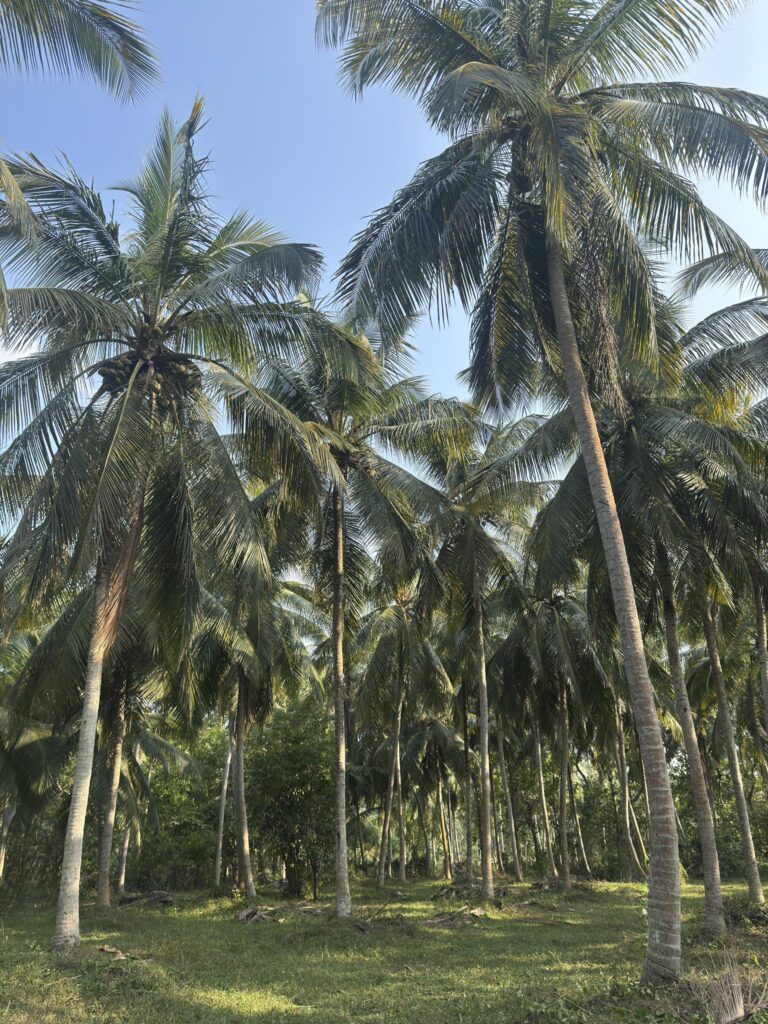
What Are the Two Main Categories of Coconut Trees?
Before diving into specific varieties, it helps to understand the two broad classifications:
- Tall coconut varieties (Typica) — These grow slowly, live longer (up to 100 years), and are generally more resilient. They start bearing fruit at 6–10 years.
- Dwarf coconut varieties (Nana) — These are shorter, faster-bearing (2–4 years), and often preferred for commercial orchards and home gardens.
Most modern commercial hybrids are crosses between tall and dwarf varieties, combining early production with reasonable height and disease resistance.
Now, let’s explore all 25 types.
1. Jamaican Tall
The Jamaican Tall is one of the most recognized coconut varieties in the Caribbean. It grows between 20 and 30 metres and produces large, round coconuts with a high water and copra content. This variety adapts well to sandy coastal soils and humid tropical climates.
Jamaican Tall trees are known for their strong wind resistance, making them a practical choice for hurricane-prone regions. The fruit matures in about 12 months.
2. Malayan Dwarf
Originally from Malaysia, the Malayan Dwarf is one of the most cultivated dwarf varieties worldwide. It comes in three distinct color forms: yellow, green, and red — often referred to as Malayan Yellow Dwarf (MYD), Malayan Green Dwarf (MGD), and Malayan Red Dwarf (MRD).
It begins bearing fruit in as little as 3 years — a major reason it is so commercially popular. Its shorter height also makes harvesting easier and safer. However, it is less resistant to Lethal Yellowing disease compared to some tall varieties.
3. Panama Tall
The Panama Tall is a robust, large-fruited variety grown extensively in Central America. It is highly valued for both fresh coconut consumption and oil production. This variety produces consistently heavy yields and adapts well to a range of tropical soil types.
Panama Tall trees are also used as rootstock in hybrid breeding programs because of their genetic stability.
4. West African Tall
As the name suggests, the West African Tall is the dominant coconut variety across countries like Ghana, Nigeria, Cameroon, and Côte d’Ivoire. It is a hardy, slow-maturing variety that lives for several decades.
This tree is particularly valued for copra production — the dried coconut meat used to extract coconut oil. The nuts are medium to large in size, with thick husks that protect well during transport.
5. East African Tall
The East African Tall thrives in coastal Kenya, Tanzania, and Mozambique. It shares many traits with its West African cousin but has adapted to the slightly different soil profiles and rainfall patterns of East Africa.
Farmers in this region use it primarily for domestic food consumption and oil extraction. It is a resilient variety that withstands periods of drought better than many dwarf types.
6. King Coconut (Sri Lanka)
The King Coconut, known locally as Thambili, is perhaps the most distinct coconut variety on this list. Native to Sri Lanka, it produces striking orange-colored fruits that are smaller than typical coconuts.
What makes it special is the taste. The water inside is exceptionally sweet and rich in electrolytes — far more flavorful than standard green coconuts. In Sri Lanka, King Coconut is consumed primarily as a health drink rather than for its meat or oil. It is rarely found outside Sri Lanka and is considered a national treasure.
7. Fiji Dwarf
The Fiji Dwarf is a compact, slow-growing variety from the Fiji Islands. Despite being classified as a dwarf, it grows taller than many other dwarf types — sometimes reaching 10–12 metres.
It is notable for its natural resistance to Lethal Yellowing disease, which devastated many tall coconut populations in the Caribbean during the 1970s. This resistance made Fiji Dwarf a critical resource in hybrid breeding programs.
8. Maypan Coconut
The Maypan is a hybrid variety developed in Jamaica during the 1960s. It was specifically bred to combat the Lethal Yellowing disease outbreak that destroyed millions of coconut palms in Florida and the Caribbean.
Maypan is a cross between the Malayan Dwarf and Panama Tall. It inherits disease resistance from the dwarf parent and vigor from the tall parent. Today, it is the most widely planted variety in Jamaica and is also grown in Florida, USA.
9. Chowghat Orange Dwarf
Developed at the Central Plantation Crops Research Institute (CPCRI) in Kerala, India, the Chowghat Orange Dwarf is a prized Indian variety known for its bright orange nuts.
It is a fast-bearing, high-yielding dwarf that produces about 70–80 nuts per tree annually. The coconut water is sweet and aromatic, making it popular in local markets as a tender coconut drink. It performs best in the humid tropical climate of South India.
10. Chowghat Green Dwarf
A close relative of the orange variant, the Chowghat Green Dwarf produces green-husked nuts. It is similarly high-yielding and early-bearing.
This variety is especially valued for tender coconut production (young green coconuts sold for their water). Its compact size makes it suitable for small farms and kitchen gardens across Kerala.
11. Tiptur Tall
Named after the town of Tiptur in Karnataka, India, the Tiptur Tall is a popular tall variety in South India. It is known for its high copra content — one of the best among Indian varieties — making it ideal for oil production.
The nuts are large and round, with a thick meat layer. Tiptur Tall trees are moderately resistant to pests and can live productively for 60–80 years with proper care.
12. Laccadive Ordinary
The Laccadive Ordinary is native to the Lakshadweep Islands (formerly Laccadive Islands) off the southwestern coast of India. It is a tall variety adapted to the sandy coral soils and high salinity of island environments.
This variety is particularly important for the local economy of Lakshadweep, where coconut cultivation is the backbone of island life. The nuts have good copra quality and are also used for traditional fiber (coir) production.
13. Andaman Ordinary
From the Andaman and Nicobar Islands in the Bay of Bengal, the Andaman Ordinary is a tall variety well-suited to tropical island conditions. It shares characteristics with other Indian tall types but has adapted to the unique forest-edge microclimates of the Andaman archipelago.
It is primarily used for domestic consumption and coir production in the islands.
14. Philippine Tall (San Ramon)
The Philippine Tall, also known as San Ramon after the location in Zamboanga del Sur where it was developed, is one of the most productive tall varieties in the Philippines. It is widely grown across Mindanao and other southern Philippine islands.
The San Ramon variety is known for its large nut size and excellent copra yield. The Philippines is one of the world’s top coconut producers, and this variety has been a significant contributor to that output for decades.
15. Macapuno Coconut
The Macapuno is one of the most unusual coconut varieties in the world. It is a mutant variety native to the Philippines in which the coconut meat is soft, jelly-like, and almost completely fills the cavity where liquid would normally be.
The flesh is sweet and prized as a luxury dessert ingredient. Macapuno is used extensively in Filipino sweets, ice cream, and pastries. Because the mutant trait is recessive, Macapuno palms must be propagated through embryo culture in laboratory conditions — making them relatively rare and expensive.
16. VHC 1 (Veppankulam Hybrid Coconut)
Developed by Tamil Nadu Agricultural University in India, VHC 1 is a hybrid between East Coast Tall and Malayan Yellow Dwarf. It is one of the highest-yielding coconut varieties available to Indian farmers.
VHC 1 produces up to 150 nuts per tree per year under ideal conditions — significantly above the national average. It begins bearing in about 4 years and is well-suited to the dry-humid climate of Tamil Nadu.
17. Kalpa Raksha
Kalpa Raksha is another hybrid developed at CPCRI, Kerala. It is a cross between Laccadive Micro and West Coast Tall. The variety was specifically developed for salt tolerance and tolerance to waterlogging — important traits for farms in coastal lowlands or flood-prone zones.
The name itself is meaningful: in Sanskrit, Kalpa refers to the coconut tree (the “wish-fulfilling tree”), and Raksha means “protection.” It is a medium-yielding hybrid valued more for its resilience than sheer output.
18. Kalpa Sree
Another CPCRI hybrid, Kalpa Sree is a cross between Laccadive Micro and Chowghat Orange Dwarf. It is compact in stature and begins bearing fruit within 3.5 to 4 years.
The variety is prized for its sweet-tasting tender coconut water and is promoted as an ideal variety for homesteads and small farms in Kerala and coastal Karnataka.
19. Green Dwarf (Nias Green Dwarf)
Originally from Nias Island in Indonesia, the Nias Green Dwarf is a compact, fast-bearing variety producing bright green nuts. It is widely used in breeding programs across Southeast Asia because of its early bearing nature and good nut water quality.
Unlike many dwarf varieties, the Nias Green Dwarf performs reasonably well in slightly less fertile soils, giving it an edge in certain tropical terrains.
20. Red Dwarf
The Red Dwarf is a visually striking variety known for its deep red-husked nuts. While it shares the general characteristics of dwarf varieties — early bearing, manageable height — the red pigmentation sets it apart aesthetically.
Red Dwarf is grown in parts of Southeast Asia, India, and West Africa. It is often planted in ornamental landscapes and research stations, though it also produces quality tender coconut water. Some farmers prize it simply for the visual contrast it adds to their farms.
21. Yellow Dwarf (Malayan Yellow Dwarf)
Already mentioned briefly under Malayan Dwarf, the Yellow Dwarf deserves its own entry because of its extensive use in global coconut improvement programs. Its bright yellow-husked nuts and high disease susceptibility are well-documented, but its genetic contribution to commercial hybrids like Maypan and VHC 1 is enormous.
Yellow Dwarf trees are compact, produce intensely sweet coconut water, and are widely planted as ornamental trees in resorts and hotels across tropical destinations.
22. Tall Coconut of Cochin China (Vietnam Tall)
The Vietnam Tall, sometimes called the Cochin China Tall, is native to the Mekong Delta region of southern Vietnam. It is a robust, salt-tolerant variety that thrives in the brackish waterways and alluvial soils of the delta.
Vietnam is among the top coconut-producing nations in Southeast Asia, and this local tall variety forms the backbone of coconut cultivation in the Mekong provinces. The nuts are medium-sized with good water and copra content.
23. Tagnanan Tall (Philippines)
The Tagnanan Tall is a local Philippine variety named after Tagnanan, Mindanao. It is valued for its large nut size and thick copra layer. While less globally recognized than the San Ramon variety, Tagnanan Tall is important to local communities in Mindanao for both domestic use and commercial copra production.
24. PB-121 (Hybrid — Côte d’Ivoire)
Developed by Marc Delorme Research Station in Côte d’Ivoire, PB-121 is a landmark hybrid in African and international coconut breeding. It is a cross between Malayan Yellow Dwarf and West African Tall.
PB-121 is one of the most studied and documented coconut hybrids in the world. It offers exceptional nut yield, early bearing, and adaptability to various tropical conditions. It has been introduced to coconut-growing nations across Africa, Latin America, and Asia as a model commercial variety.
25. Kopyor Coconut (Indonesia)
Kopyor is Indonesia’s equivalent of the Philippine Macapuno — a naturally mutated variety where the endosperm (coconut meat) does not form properly. Instead of firm white flesh, Kopyor produces a soft, fluffy, sweetish mass inside the nut.
Kopyor coconuts are highly prized in Indonesian cuisine and command significantly higher market prices than ordinary coconuts. They are used in desserts, specialty drinks, and ice cream.
Like Macapuno, Kopyor trees cannot be reliably propagated through conventional seed planting — they are reproduced through embryo rescue technology in agricultural laboratories.
Key Factors That Differentiate Coconut Varieties
Understanding the differences between coconut varieties goes beyond just physical appearance. Here is a quick summary of the main factors breeders and farmers consider:
- Height and lifespan — Tall varieties live longer (60–100 years); dwarfs are more compact.
- Bearing age — Dwarfs start producing in 3–4 years; talls take 6–10 years.
- Nut yield — Hybrid varieties generally outperform pure talls or dwarfs.
- Copra content — Relevant for oil production; varieties like Tiptur Tall and West African Tall excel here.
- Water quality — Varieties like King Coconut, Chowghat Orange Dwarf, and Malayan Yellow Dwarf are prized for sweet water.
- Disease resistance — Fiji Dwarf and Maypan lead in Lethal Yellowing resistance.
- Special traits — Macapuno and Kopyor are genetically mutant types valued as specialty foods.
Why Does Coconut Variety Selection Matter?
Choosing the right coconut variety is a decision with 60-year consequences.
Because coconut trees are a long-term investment, the wrong variety can mean decades of underperformance. A farmer in coastal Kenya planting a Malayan Dwarf without accounting for local disease pressure may face serious losses.
Conversely, a Sri Lankan home gardener who plants a King Coconut variety benefits from a highly marketable, locally beloved product.
For commercial growers, high-yielding hybrids like PB-121, VHC 1, and Maypan offer the best return on investment. For smallholders and home farms, compact dwarf varieties like Kalpa Sree or Chowghat Green Dwarf often provide faster returns and easier management.
For those interested in specialty markets, Macapuno, Kopyor, and King Coconut command premium prices that far exceed ordinary coconut varieties.
Suggested For You:
20 Different Types of Palm Trees: Identification, Features, and Care
20 Stunning Types of Cypress Trees: Visual Identification and Growing Guide
8 Popular Types of Maple Trees: Identification, Features, and Growth Rate
15 Trees That Grow Well in Pots in a Garden: A Complete Guide
15 Privacy Trees for a Garden Fence Line: A Complete Planting Guide
Final Thoughts
The coconut tree is genuinely one of nature’s great gifts. Across cultures and centuries, it has served as food, medicine, shelter material, and economic lifeline. What this guide makes clear is that the term “coconut tree” actually refers to a rich and diverse family of varieties, each shaped by geography, human selection, and sometimes pure biological chance.
Whether you are selecting a variety for a plantation, a research paper, a farm project, or plain curiosity — I hope this guide gave you both the facts and the appreciation this remarkable tree deserves.
References
- Food and Agriculture Organization of the United Nations (FAO) — Coconut Production and Varieties https://www.fao.org/3/i3533e/i3533e.pdf
- Central Plantation Crops Research Institute (CPCRI), India — Coconut Varieties and Hybrids https://www.cpcri.gov.in/index.php/technologies/coconut-varieties-hybrids
- University of Florida IFAS Extension — Coconut Palm (Cocos nucifera) https://edis.ifas.ufl.edu/publication/ST155
- Philippine Coconut Authority (PCA) — Coconut Varieties in the Philippines https://www.pca.da.gov.ph/index.php/programs-projects/r-d/varieties
- Tamil Nadu Agricultural University (TNAU) Agritech Portal — Coconut: Varieties https://agritech.tnau.ac.in/horticulture/horti_plantation_coconut.html

Tim M Dave is a gardening expert with a passion for houseplants, particularly cacti and succulents. With a degree in plant biology from the University of California, Berkeley, he has vast experience in gardening. Over the years, he has cultivated a vast collection of desert plants and learned a great deal about how to grow and care for these unique companions.