15 Trees with Year Round Interest: A Complete Guide
A tree that looks beautiful for three weeks in spring and unremarkable for the remaining forty-nine is still a good tree — but it is not a great one. The truly great garden trees are those that earn their space every single month. They offer something in January as reliably as they do in July. Their winter silhouette is as considered as their summer canopy. They move through the seasons not as a single-act performance but as something altogether more layered, more generous, and more enduring.
For gardeners who think carefully about how their garden looks and functions throughout the entire year, trees with year-round interest are not just desirable — they are essential. A well-chosen specimen can anchor a planting scheme in all four seasons, providing flowers in spring, cooling shade in summer, colour in autumn, and structure, bark, or persistent berries through the depths of winter.
This guide covers 15 of the finest trees for year-round interest. Each one has been chosen because it delivers genuine, distinct ornamental value across multiple seasons — not because it is merely attractive at peak bloom. Together, they represent some of the most rewarding and versatile choices available to gardeners in temperate climates worldwide.
Why Year-Round Interest Matters in Garden Design
Gardens are lived in throughout the year. Not just on warm May afternoons when everything is in flower, but on grey November mornings, on crisp January days when frost sits on the branches, and on overcast August evenings when the garden is more background than spectacle.
A garden composed entirely of spring-flowering plants looks stunning for a month and flat for eleven. One that incorporates trees with sustained, multi-seasonal interest creates a living landscape that shifts and evolves constantly — always offering something to notice, something to appreciate, something that rewards the glance out of a winter window.
Year-round interest in a tree can come from several sources: flowers, foliage, fruit or berries, bark, stem colour, seed heads, catkins, or architectural silhouette. The finest trees combine three or four of these qualities across the full calendar year. The 15 trees in this guide all do exactly that.
Understanding the Four Seasons of a Tree
Before exploring individual species, it helps to understand what each season demands from a tree that aims to hold the garden’s attention throughout the year.
Spring is when most trees make their strongest statement — blossom, fresh new foliage, catkins, and fragrance. Competing here is relatively easy.
Summer is the season of foliage. Trees that offer rich, unusual, or textured leaf colour — purple, silver, gold, or deeply cut forms — continue to draw the eye long after blossom has fallen.
Autumn brings fruit, berries, seed structures, and leaf colour. Trees that deliver all three in combination provide weeks of changing interest as the season progresses.
Winter is where most trees fail to hold attention — and where the finest year-round trees distinguish themselves most clearly. Exceptional bark, persistent berries, architectural branching structure, and winter flowers separate the truly remarkable from the merely attractive.
With that framework in mind, here are 15 trees that perform consistently well across all four.
15 Trees with Year Round Interest
1. Tibetan Cherry (Prunus serrula)
Mature height: 6–8 metres
Hardiness zones: 5–8
Key seasons: Winter (bark), Spring (flowers), Autumn (foliage colour)
The Tibetan cherry may well be the single finest tree for year-round interest in a temperate garden. Most trees are at their weakest in winter. This one is arguably at its most beautiful.
Its mahogany-red bark peels in horizontal strips throughout the year, revealing a new, highly polished surface beneath — warm, burnished, and luminous in low winter sunlight. On a cold, clear January morning, it genuinely glows. In April, small white flowers appear delicately among the developing leaves. Come autumn, the foliage turns a warm buttery yellow before dropping to reveal the bark in full glory once again.
It requires well-drained soil, a sunny or lightly shaded position, and very little pruning. Plant it where the bark can be seen close up — beside a path, near a bench, or at the corner of a terrace. Every month of the year, it gives you a reason to look at it.
2. Amelanchier (Amelanchier lamarckii)
Mature height: 5–10 metres
Hardiness zones: 4–8
Key seasons: Spring (flowers and new foliage), Summer (berries), Autumn (leaf colour)
Amelanchier is the textbook definition of a four-season tree. In April, white star-shaped flowers and coppery-bronze young leaves emerge simultaneously — a combination so refined that it seems almost designed. The two tones play off each other beautifully, and the tree is covered in blossom for two to three weeks.
In early summer, small purple-black berries ripen on the branches. They are sweet, edible, and consumed eagerly by blackbirds, thrushes, and starlings — making the tree a hub of wildlife activity. By late summer the berries have usually gone, but the tree continues to hold its own through a clean, untroubled summer silhouette. Then, in October, the foliage transforms into blazing shades of orange, red, and amber — a display that rivals the finest ornamental maples.
It is fully hardy, tolerates most soils, and requires virtually no maintenance. It is, for many experienced gardeners, the most complete small tree in cultivation.
3. Crab Apple (Malus ‘Evereste’)
Mature height: 5–7 metres
Hardiness zones: 4–8
Key seasons: Spring (blossom), Summer (foliage and developing fruit), Autumn/Winter (fruit)
‘Evereste’ is the crab apple by which others are judged. In April and May, it smothers itself in white flowers opening from red-pink buds — a bicolour blossom effect that is both elegant and generous. The flowers are followed by masses of small, orange-red fruits that colour up in late summer and persist on the tree well into winter, long after the leaves have fallen.
In winter, those bright fruits on bare branches create one of the most attractive natural displays the garden can offer — particularly when frost-touched on a December morning or visited by fieldfares stripping the branches in January. The tree maintains a naturally neat, conical form throughout, requiring almost no pruning to stay tidy.
It supports enormous biodiversity. Its flowers are rich in nectar for early pollinators. Its fruits feed thrushes, waxwings, and fieldfares through the hardest months of winter. And it does all of this without asking much from the gardener.
4. Rowan (Sorbus aucuparia)
Mature height: 5–15 metres
Hardiness zones: 3–7
Key seasons: Spring (flowers), Summer (foliage), Autumn (berries and leaf colour), Winter (bare structure and persistent fruit)
Few native trees compete with the rowan across all four seasons. In May, flat heads of creamy-white flowers carry a gentle, slightly musky fragrance. Through summer, the pinnate foliage — composed of pairs of small, toothed leaflets — creates a light, feathery canopy that moves gracefully in the breeze. In late summer, heavy clusters of orange-red berries colour up brilliantly, drawing attention from the garden boundary or lawn.
As autumn deepens, the foliage turns orange, red, and yellow around the persisting berries. Then, in winter, the bare framework of the tree holds remaining fruits that attract waxwings, fieldfares, and redwings — sometimes in spectacular numbers during cold snaps when northern populations move south in search of food.
Selected cultivars extend the palette further. Sorbus ‘Joseph Rock’ offers amber-yellow berries. Sorbus vilmorinii produces small, rose-pink fruits that fade to white. For ecological value combined with year-round ornamental interest, rowan is exceptionally difficult to surpass.
5. Witch Hazel (Hamamelis × intermedia ‘Jelena’)
Mature height: 3–5 metres
Hardiness zones: 5–9
Key seasons: Winter (flowers and fragrance), Autumn (foliage colour)
The witch hazel makes its most extraordinary contribution precisely when the rest of the garden has withdrawn. In January and February, on bare, arching branches, ‘Jelena’ produces masses of spidery, copper-orange flowers with ribbon-like petals that withstand frost without damage. They release a warm, sweet, distinctly spicy fragrance on mild days — utterly disarming in midwinter.
To step into a garden on a quiet February morning and encounter that scent is something that stays with you. It connects the senses to the garden in a way that few other plants manage at any time of year, let alone in the coldest months.
In autumn, the contribution shifts. The large, ovate leaves colour in extraordinary shades of orange, crimson, and gold — some of the richest and most sustained autumn colour produced by any temperate garden plant. The tree earns its place every day from October through February — the very months most trees have least to offer.
6. Silver Birch (Betula pendula)
Mature height: 15–20 metres
Hardiness zones: 2–7
Key seasons: Winter (bark and silhouette), Spring (catkins and new foliage), Autumn (yellow leaf colour)
The silver birch is a year-round presence in any garden large enough to accommodate it. Its white bark — stark, bright, and immediately distinctive — commands attention throughout the entire year, but particularly in winter when it gleams against a low grey sky or is caught in raking winter sunlight.
In early spring, long golden catkins dangle from the branches before the small, triangular leaves unfold in a fresh, vivid green. The foliage is light and airy, creating a dappled canopy rather than dense shade — one that allows light to reach the ground and supports underplanting with spring bulbs, ferns, and shade-tolerant perennials.
In autumn, the leaves turn clear, clean butter-yellow before falling to reveal the white branches and the delicate tracery of the upper canopy. Even the smallest twigs are elegant in winter silhouette. The silver birch is a tree that can be photographed at any time of year and always yields something worth the image.
7. Japanese Maple (Acer palmatum)
Mature height: 2–8 metres (depending on cultivar)
Hardiness zones: 5–8
Key seasons: Spring (emerging foliage), Summer (sustained leaf colour), Autumn (fiery colour display), Winter (architectural form)
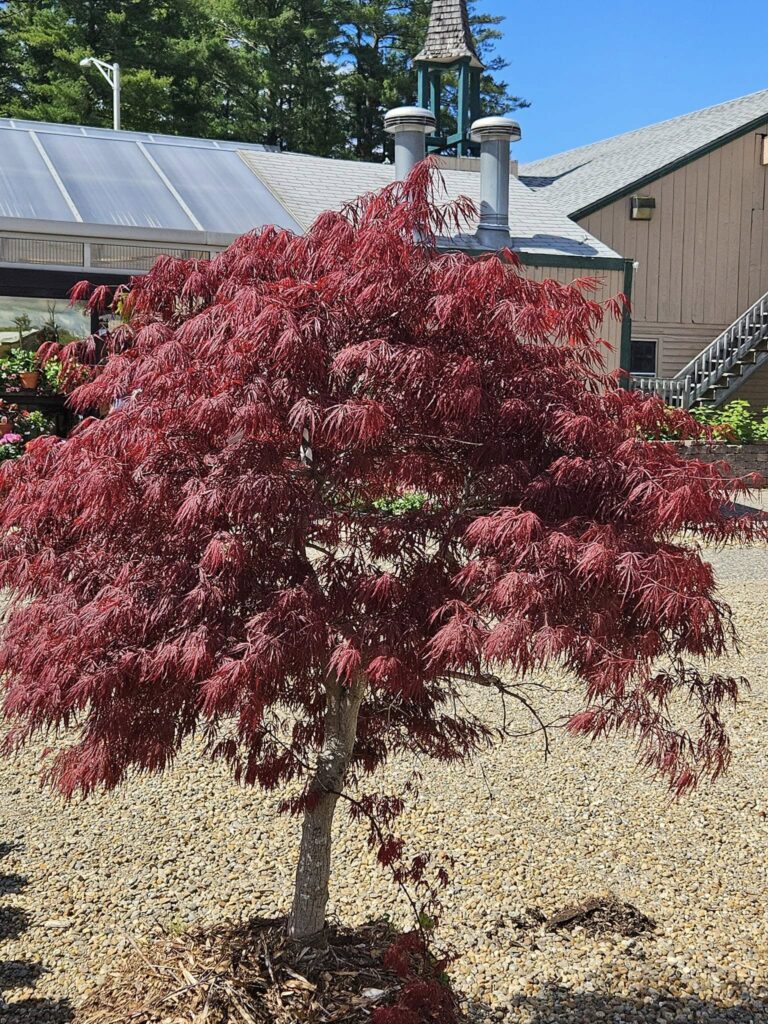
The Japanese maple is among the most widely admired garden trees in the world, and its sustained ornamental value across the full year explains a great deal of that admiration. Cultivars range from small, mounded shrub-trees to upright specimens of 6 metres or more, with foliage ranging from deep burgundy-red (‘Bloodgood’) to vivid fresh green (‘Sango-kaku’) to deeply dissected, feathery forms.
Spring emergence is often as beautiful as autumn colour — the fresh, unfolding leaves in copper, red, or lime green catching light in a way that feels almost translucent. Through summer, the foliage holds its colour reliably, providing months of strong ornamental presence. Then autumn brings the transformation: oranges, reds, and crimsons so intense they can stop a garden visitor in their path.
In winter, the bare architecture of the tree — its fine branching structure and graceful overall form — provides genuine visual interest. The coral bark maple (Acer palmatum ‘Sango-kaku’) adds luminous pink-red young stems to the winter picture, making it perhaps the most complete four-season maple in cultivation.
8. Holly (Ilex aquifolium)
Mature height: 3–15 metres
Hardiness zones: 6–9
Key seasons: All year (evergreen foliage), Autumn/Winter (berries)
Holly is the quintessential year-round tree. As one of relatively few evergreen natives in the temperate garden, it provides structure, colour, and density through every month of the year. Its glossy, spiny leaves — dark green, sometimes variegated with silver or gold — catch light in summer and glisten in winter rain.
In early summer, small, fragrant white flowers attract bees and other pollinators. On female plants, these develop into the bright red berries that have defined the winter garden — and the winter table — for centuries. Berries are produced from October onwards and may persist well into February if not stripped by visiting thrushes and blackbirds, whose own winter survival often depends upon them.
Variegated cultivars such as ‘Argentea Marginata’ (silver-edged leaves) or ‘Golden Milkboy’ (gold-splashed leaves) bring additional colour to the winter garden. Holly withstands hard clipping to maintain a formal or managed shape, giving it considerable flexibility in different garden styles.
9. Ginkgo (Ginkgo biloba)
Mature height: 20–30 metres (stays compact for many years)
Hardiness zones: 3–8
Key seasons: Summer (unique foliage), Autumn (spectacular yellow colour), Winter (silhouette)
The ginkgo is a tree unlike any other on this list — or, indeed, any other tree in cultivation. Its fan-shaped, almost perfectly two-lobed leaves have no close relatives anywhere in the plant kingdom. The species has survived virtually unchanged for over 200 million years, which makes planting one a quietly extraordinary act of connection with geological deep time.
Through spring and summer, the unusual foliage is a soft, fresh blue-green — handsome in a restrained way that complements bolder plants around it. Then, in autumn, it performs one of nature’s most precise colour transformations: the entire tree turns a clear, luminous, almost glowing yellow — sometimes virtually overnight — and holds that colour for a week or two before the leaves fall in a golden carpet beneath the tree.
In winter, the open, somewhat angular branching framework creates a distinctive silhouette. It is a slow-growing tree that resists most pests and diseases almost completely, making it a genuinely carefree investment in year-round presence.
10. Strawberry Tree (Arbutus unedo)
Mature height: 4–8 metres
Hardiness zones: 7–9
Key seasons: All year (evergreen foliage and bark), Autumn/Winter (simultaneous flowers and fruit)
The strawberry tree has a remarkable quality unique among hardy flowering trees: it carries its white, urn-shaped flowers and its strawberry-like red fruits on the tree at the same time — in October and November. The fruit takes a full year to ripen from the previous year’s flowering, which means mature trees always display both simultaneously. It is an extraordinary sight.
Its dark, shredding, red-brown bark provides winter interest and genuine character throughout the year. The evergreen, glossy, dark green leaves maintain their appearance in all seasons. It flowers in autumn when most other trees have finished entirely, providing nectar for late-flying bumblebees and other pollinators.
It tolerates coastal conditions, acidic free-draining soil, and is resistant to honey fungus — a serious pathogen that kills many garden trees. It grows slowly, needs no regular pruning, and in a sheltered, sunny position, provides some of the most distinctive year-round interest of any evergreen tree in cultivation.
11. Whitebeam (Sorbus aria ‘Lutescens’)
Mature height: 8–12 metres
Hardiness zones: 5–7
Key seasons: Spring (silver emerging foliage), Summer (silver-green leaves), Autumn (berries and leaf colour), Winter (silhouette)
The whitebeam opens each spring with a display that is easily mistaken — at a glance — for a tree in flower. The emerging leaves are covered in a thick, white, silver felt on both surfaces, which as they unfurl creates an impression of something between blossom and foliage. As the season advances, the upper surface greens up while the white underside persists, shimmering silver-white whenever the wind turns the leaves.
In May, clusters of white flowers appear above this silver canopy. In autumn, bold red berries ripen among warm golden foliage. In winter, the clean, rounded form of the tree and the soft grey of its winter bark provide a calm, elegant presence in the garden.
It is one of the most chalk-tolerant ornamental trees available, thriving in thin, alkaline soils over limestone and chalk. It tolerates wind and urban pollution. It is genuinely one of the most complete and underappreciated trees for multi-season garden interest.
12. Scots Pine (Pinus sylvestris)
Mature height: 20–35 metres
Hardiness zones: 2–8
Key seasons: All year (evergreen form and bark), Winter (bark colour in low light)
The Scots pine is a tree that reveals its finest quality in winter. As the tree matures, the upper bark transforms from grey-brown at the base to a warm, vivid orange-red in the upper crown — a colour that seems almost to intensify in the flat, low light of December and January. On a clear winter afternoon, a mature Scots pine against a blue sky is one of the most satisfying sights that any temperate garden can offer.
Through the rest of the year, its blue-green needles and naturally sculptural branching form create a year-round architectural presence. It supports a remarkable community of insects — over 170 species of invertebrates are associated with it in the UK alone — making it one of the ecologically richest garden trees available.
It requires no pruning, no specialist soil, and no ongoing maintenance beyond its establishment period. For larger gardens, it is one of the most magnificent long-term investments available.
13. Dawn Redwood (Metasequoia glyptostroboides)
Mature height: 25–40 metres
Hardiness zones: 4–8
Key seasons: Spring (feathery new foliage), Summer (graceful canopy), Autumn (russet-orange colour), Winter (cinnamon bark and silhouette)
The dawn redwood is a deciduous conifer — one of a very small number in the world — which gives it an unusual quality among conifers: it changes dramatically with the seasons. Its feathery, soft needles emerge in vivid spring green, mature into a fresh blue-green canopy through summer, then turn warm russet-orange and amber in autumn before falling to reveal the outstanding winter architecture beneath.
That architecture is worth the entire planting decision on its own. The cinnamon-red, furrowed bark of a maturing dawn redwood is deeply attractive. The pyramidal, buttressed trunk base develops character with age. And the delicate tracery of the upper canopy, revealed in winter, has a lightness and elegance surprising in so large a tree.
It was known only from fossils until a living population was discovered in China in 1944 — one of the great botanical discoveries of the twentieth century. To grow one is to tend a piece of living natural history that will outlast almost everything else in the garden.
14. Dogwood (Cornus kousa)
Mature height: 5–8 metres
Hardiness zones: 5–8
Key seasons: Summer (flowers), Autumn (fruit and leaf colour), Winter (bark and silhouette)
While many ornamental trees peak in spring, Cornus kousa waits. Its large, pointed white flower bracts — technically modified leaves surrounding small central flowers — appear in May and June, long after the main spring flowering season has passed, and persist for several weeks on the horizontal branches. They are among the most refined and beautiful of any late-spring flowering tree display.
In late summer, curious, strawberry-like red composite fruits ripen on the branches. The foliage turns deep red and purple in autumn. And through winter, the layered, horizontal branching structure and the attractive, mottled, flaking bark in shades of grey, brown, and cream provide genuine architectural interest.
It prefers slightly acidic, humus-rich soil in sun or partial shade. It establishes slowly in its first few years, which tests the patience of some gardeners. But those who stay with it are rewarded with one of the most multi-seasonal trees in cultivation — one that is always doing something worth watching.
15. Elder (Sambucus nigra ‘Black Lace’)
Mature height: 3–4 metres
Hardiness zones: 4–7
Key seasons: Spring/Summer (purple foliage and pink flowers), Autumn (black berries and foliage colour), Winter (bare architectural stem framework)
‘Black Lace’ elder earns its place on this list not through any single spectacular season but through consistent, characterful performance across all of them. Its finely cut, almost black-purple foliage — deep and dramatic from the moment it emerges — provides months of bold colour contrast in the garden from spring to late autumn. Against silver or grey foliage, it is particularly striking.
In June and July, flat-headed clusters of tiny pale pink flowers appear above the dark foliage — a combination that is both surprising and sophisticated. These are followed by glossy black berries in early autumn, eagerly taken by garden birds. In winter, the bare, pale-barked stems create a delicate branching structure that holds the garden’s attention in a quiet, understated way.
It responds extremely well to hard annual pruning in early spring, which keeps it compact and stimulates the largest, most intensely coloured new leaves. It tolerates most soils and grows vigorously. As a year-round contributor to garden colour and structure, few shrub-trees of its size match it.
Designing with Year-Round Interest in Mind
Getting the full benefit from trees with multi-seasonal interest requires a little thought about how they are placed in the garden.
Consider what surrounds the tree in each season. A tree with brilliant autumn colour makes the greatest impact when placed against a neutral background — a dark hedge, a pale wall, or an expanse of lawn — rather than surrounded by other plants competing for attention at the same time.
Think about winter visibility. Trees with outstanding bark or persistent berries should be positioned where they are visible from inside the house during the months when you are less likely to be outdoors. A Tibetan cherry or a witch hazel planted just outside a kitchen or living room window earns its place every single day of winter.
Layer complementary seasons. A combination of trees that peak in different seasons — an early spring witch hazel underplanted beside a summer-peaking Cornus kousa, with an amelanchier providing the autumn colour — creates a garden that is constantly moving through phases of interest rather than having a single explosive peak and a long, flat off-season.
Allow adequate space for mature scale. Year-round trees are long-term investments. Plant with the tree’s mature dimensions in mind, not its current size. A tree that is cramped in ten years will never show its full character — and removing a mature tree you have come to love is one of the more dispiriting experiences a gardener can face.
Final Thoughts
The best garden trees are the ones you notice every time you look out of the window — not just in spring, not just in the golden weeks of October, but on a damp Tuesday in November and a bright cold morning in February. They are the trees that make you pause, even when you have passed them a hundred times before.
The 15 trees in this guide are capable of doing exactly that. They have been chosen not for a single moment of glory but for the sustained, shifting, season-by-season presence that elevates a garden from a collection of plants into something that feels genuinely alive throughout the entire year.
Choose one or several. Plant them with care. And then watch what they become.
References
- Royal Horticultural Society (RHS) — Trees for Year-Round Interest
The RHS plant database and advisory pages provide authoritative guidance on selecting garden trees that offer multi-seasonal ornamental value, including species profiles, cultivation notes, and RHS Award of Garden Merit listings.
https://www.rhs.org.uk/plants/types/trees - University of Wisconsin-Madison Extension — Four-Season Landscape Plants
The University of Wisconsin’s extension programme provides research-based guidance on selecting woody landscape plants — including trees — that provide ornamental interest throughout all four seasons in temperate climates.
https://hort.extension.wisc.edu/articles/four-season-landscapes/ - Penn State Extension — Ornamental Trees for the Home Landscape
Pennsylvania State University Extension offers detailed, research-backed profiles of ornamental trees for residential landscapes, with an emphasis on multi-season interest and performance under temperate climatic conditions.
https://extension.psu.edu/ornamental-trees-for-the-home-landscape - Kew Royal Botanic Gardens — Plant Profiles and Seasonal Characteristics
The Kew Gardens plant database provides authoritative botanical data on tree species featured in this article, including seasonal performance data, cultivation requirements, and provenance information.
https://www.kew.org/plants - USDA Forest Service — Ornamental Value and Ecosystem Services of Landscape Trees
The United States Department of Agriculture Forest Service provides scientific literature on the ecological and ornamental contributions of landscape trees across seasonal cycles, supporting evidence-based species selection for home gardens.
https://www.fs.usda.gov/managing-land/urban-forests/utc

Tim M Dave is a gardening expert with a passion for houseplants, particularly cacti and succulents. With a degree in plant biology from the University of California, Berkeley, he has vast experience in gardening. Over the years, he has cultivated a vast collection of desert plants and learned a great deal about how to grow and care for these unique companions.