20 Small Ornamental Grasses for Borders: The Complete Planting Guide
Border planting is one of the most rewarding — and most challenging — aspects of garden design. A well-planted border holds interest across multiple seasons, balances texture and color without becoming chaotic, and maintains a sense of proportion that makes the entire garden feel considered and intentional. Achieving all of that consistently is harder than it looks.
Small ornamental grasses are among the most effective tools available for solving that challenge. They bring a quality to borders that flowering perennials alone cannot provide: movement, fine texture, seasonal continuity, and a natural, relaxed character that softens the rigidity that can creep into heavily planted schemes. They fill the middle and front layers of a border with purpose and grace, and they look good — genuinely good — for far longer than most flowering plants.
This guide covers 20 of the best small ornamental grasses for borders. Each plant has been selected for its compact size, strong ornamental qualities, and suitability for border use across a range of styles, from formal cottage plantings to contemporary naturalistic designs. Whether you are planting a new border from scratch or refreshing an established one, these grasses deserve a prominent place in your plans.
Why Small Grasses Belong in Every Border
The case for including ornamental grasses in border planting has been made convincingly by landscape designers for decades. But it bears repeating — particularly the case for small grasses, which are sometimes overlooked in favor of the dramatic, large-scale species that tend to dominate catalog photographs.
Small grasses — those that stay under two to three feet in height — serve specific and irreplaceable roles in border design. They are the plants that knit a border together, filling the foreground and middle ground with texture and movement that connects the bolder elements — shrubs, tall perennials, structural plants — into a coherent whole. Without them, a border can feel like a collection of individual plants rather than an integrated planting.
They also provide something that few other border plants offer: sustained interest without constant intervention. A well-chosen small grass looks good from spring through winter. It does not need deadheading, does not collapse after flowering, and does not leave a gap in the border when it finishes blooming. It simply grows, moves in the wind, and remains quietly, reliably attractive across every season.
There is something deeply satisfying about that reliability. In a border where other plants demand attention, a small ornamental grass simply gets on with it.
Choosing Small Grasses for Your Border: Key Considerations
Before selecting specific varieties, it helps to think through the conditions of your border and the design goals you are working toward.
Border style. Formal borders with structured, geometric layouts suit small grasses with precise, architectural forms — blue fescue in matching clumps, tightly mounded sedges used as edging, or upright grasses planted in rhythmic repetition. Informal, cottage, or naturalistic borders benefit from grasses with a looser, more flowing habit — fountain-like clumps, arching sedges, and fine-textured feathery grasses that move freely in the breeze.
Light conditions. Most small ornamental grasses prefer full sun, but a meaningful selection performs well in partial shade. Understanding how much direct sun your border receives throughout the day is fundamental to selecting plants that will thrive rather than struggle.
Soil type. The majority of small border grasses prefer well-drained soil and are tolerant of lean, moderately fertile conditions. A few — notably the sedges and tufted hair grass — prefer consistently moist soil. Clay soils benefit from the addition of grit or organic matter before planting to improve drainage and prevent waterlogging around the roots.
Mature size. “Small” is a relative term in horticulture. The grasses in this guide range from a few inches tall to approximately three feet. Position taller small grasses in the middle of the border, compact varieties at the front edge, and the finest, most delicate species where they can be observed closely without being lost in a crowd of larger plants.
Companion planting. Small grasses are rarely used in isolation. Think about the plants they will share the border with — their colors, textures, bloom times, and seasonal behaviors — and choose grasses that complement, contrast, and extend the border’s overall performance across the year.
20 Small Ornamental Grasses for Borders
1. Blue Fescue (Festuca glauca ‘Elijah Blue’)
Blue fescue is the quintessential small border grass. Its intensely silver-blue, spiky, hedgehog-like tussocks have become a modern classic in border design — used as edging, as repeating accent plants, and as color contrast elements in mixed plantings of every conceivable style. ‘Elijah Blue’ is the most reliably colored and most widely available cultivar, and it earns its popularity through consistent, dependable performance across a wide range of conditions.
Its compact, rounded mound — typically under a foot tall — holds its shape throughout the season without staking or intervention. In early summer, slender flower spikes rise gracefully above the foliage before aging to a straw-gold. The blue foliage color is retained year-round, making it one of the most effective small evergreen border plants available.
It performs best in full sun with excellent drainage. It benefits from division every two to three years when the center of the clump begins to die out — a simple task that keeps the plants looking consistently fresh and youthful. It pairs particularly beautifully with warm-colored sedums, burgundy heucheras, and golden-leaved grasses.
Hardiness: USDA Zones 4–8 | Height: 8–12 inches | Light: Full sun | Soil: Well-drained, dry to moderately moist | Type: Evergreen
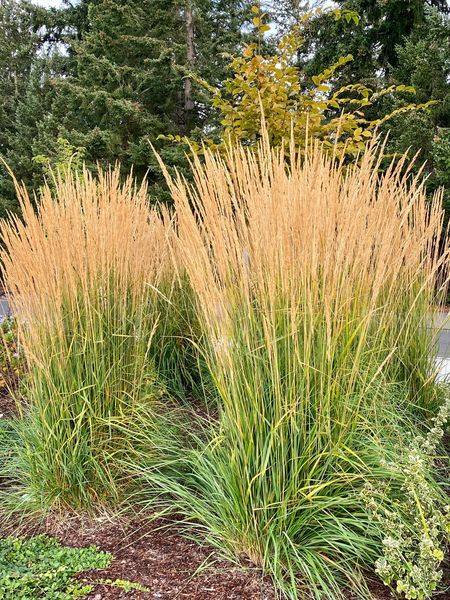
2. Karl Foerster Feather Reed Grass (Calamagrostis x acutiflora ‘Karl Foerster’)
While Karl Foerster grows to five or six feet in flower — technically making it a medium rather than small grass — its narrow, strictly upright habit and relatively modest spread earn it a place in this list for borders where vertical accents are needed without significant width. In a border context, its pencil-thin profile allows it to serve as a tall punctuation mark that takes up very little horizontal space.
Its feathery, pink-tinged flower spikes emerge in late spring — earlier than almost any other ornamental grass — and age to warm, golden wheat tones through summer and autumn. The dried seed heads persist attractively through winter, giving the border structure even in the quietest months of the year.
It is adaptable, tolerating clay soil and a range of moisture conditions. It is clump-forming, completely non-invasive, and requires only the annual spring cutback. For creating vertical rhythm in a mixed border without sacrificing planting space, it is difficult to surpass.
Hardiness: USDA Zones 4–9 | Height: 5–6 feet in flower | Light: Full sun to partial shade | Soil: Adaptable; tolerates clay | Type: Deciduous
3. ‘Evergold’ Sedge (Carex oshimensis ‘Evergold’)
‘Evergold’ sedge is one of the finest front-of-border plants available, regardless of the category of plants being considered. Its arching, narrow leaves with a broad creamy-yellow central stripe and rich dark green margins create a vivid, warm focal point that holds its color and form through every month of the year. In a winter border, when most other plants have disappeared, a clump of ‘Evergold’ glows with a warmth that the entire planting benefits from.
It thrives in partial shade — a quality that makes it especially valuable in the shadier sections of a mixed border where full-sun grasses struggle to maintain their appeal. It is compact and evergreen, spreading gently to form a neat, mounding clump that requires almost no maintenance to remain attractive.
As a companion plant, ‘Evergold’ is extraordinarily versatile. Its golden tone pairs beautifully with deep blue muscari in spring, with purple-leaved heucheras and dark-stemmed actaeas in summer, and with the bronze seed heads of other grasses in autumn.
Hardiness: USDA Zones 5–9 | Height: 12–18 inches | Light: Partial shade to full shade | Soil: Moist, well-drained | Type: Evergreen
4. Dwarf Fountain Grass (Pennisetum alopecuroides ‘Hameln’)
‘Hameln’ dwarf fountain grass is a perfectly proportioned small border grass that delivers a complete ornamental package in a manageable, compact form. Its fine-textured, dark green, arching foliage forms a graceful, rounded mound through the growing season. From midsummer, creamy-white, bottlebrush-like flower spikes emerge and persist through autumn, aging to warm buff tones as the season progresses.
In autumn, the entire plant transitions from green to a clear, warm gold before dormancy. This seasonal journey — green clump to flowering beauty to golden autumn presence to winter architecture — makes it one of the most complete small border grasses in terms of four-season value.
It is drought-tolerant once established, clump-forming, and long-lived. It blooms earlier than many other fountain grass cultivars, which is a useful quality in shorter-season climates. It works well in groups of three or five at the front or middle of a mixed border, where its rounded form creates a natural, flowing rhythm between taller neighbors.
Hardiness: USDA Zones 5–9 | Height: 2–3 feet | Light: Full sun | Soil: Well-drained; drought-tolerant once established | Type: Deciduous
5. Little Bluestem (Schizachyrium scoparium)
Little bluestem is a native North American prairie grass that has become one of the most admired small border grasses in contemporary landscape design — and for entirely justified reasons. Through spring and summer, its upright clumps of fine-textured, blue-green foliage bring a cool, glaucous quality to the border that is distinctive without being demanding. In autumn, the transformation is extraordinary: the entire plant turns vivid shades of copper, orange, burgundy, and crimson — some of the richest fall color delivered by any ornamental grass.
Its fluffy white seed heads, which persist through winter, catch morning light with a soft, glowing quality. In late afternoon sun, a border of little bluestem in autumn color is genuinely breathtaking — one of those seasonal moments that reminds you exactly why you garden.
It performs best in poor to moderately fertile, well-drained soil in full sun. Rich, moist soil encourages flopping. It is highly drought-tolerant, ecologically valuable, and deer-resistant — a combination of qualities that makes it nearly ideal for low-maintenance naturalistic borders.
Hardiness: USDA Zones 3–9 | Height: 2–4 feet | Light: Full sun | Soil: Poor to moderately fertile, well-drained | Type: Deciduous
6. Japanese Forest Grass (Hakonechloa macra ‘Aureola’)
Japanese forest grass is the premier small ornamental grass for shaded border positions. Its cascading, golden-yellow and green striped foliage creates a waterfall-like effect that transforms the front of a shaded border with a warmth and luminosity that few other plants in any category can match. When sunlight catches the golden leaves — even the filtered, dappled light of a woodland setting — the effect is almost magical.
‘Aureola’ is the most widely grown and most beloved cultivar. ‘All Gold’ is an entirely golden-yellow form with equal impact. ‘Nicolas’ is a compact cultivar under twelve inches, perfect for the very front edge of a border. All share the same graceful, arching character and the same preference for partial shade and moist, well-drained, humus-rich soil.
In autumn, the foliage flushes with pink and bronze tones before the plant goes dormant in winter. For shaded borders in USDA Zones 4–9, Japanese forest grass is one of the most outstanding small grass choices available.
Hardiness: USDA Zones 4–9 | Height: 1–2 feet | Light: Partial to full shade | Soil: Moist, well-drained, humus-rich | Type: Deciduous (semi-evergreen in mild zones)
7. Tufted Hair Grass (Deschampsia cespitosa ‘Goldtau’)
‘Goldtau’ — meaning Golden Dew — is among the most beautiful small grasses for partially shaded border positions. Its dense tussocks of dark, fine-textured, evergreen foliage provide a clean, tidy presence through the year. In early summer, it produces its crowning display: tall, billowing clouds of tiny, golden-bronze spikelets that hover above the foliage like a delicate mist and shimmer at the lightest movement of air.
That flowering display — luminous, airy, and sustained for several weeks — is one of the most beautiful moments that any small border grass can provide. It softens the edge of a mixed border and creates a transparent, shimmering veil through which neighboring plants are seen rather than obscured.
It is tolerant of partial shade and moist soil, which gives it a site range that few other small grasses share. It works beautifully alongside purple-leaved plants, blue hostas, and white-flowered astilbes in shaded or semi-shaded border settings.
Hardiness: USDA Zones 4–9 | Height: 2–3 feet (4–5 feet in flower) | Light: Partial shade to full sun | Soil: Moist, well-drained | Type: Evergreen
8. Autumn Moor Grass (Sesleria autumnalis)
Autumn moor grass is a compact, underappreciated small border grass that brings several genuinely useful qualities together in a single, manageable package. Its narrow, bright yellow-green foliage holds a fresh, clean color through the growing season — resisting the bleached, tired appearance that affects many grasses by late summer. In late summer and early autumn, it produces modest but attractive whitish flower spikes that add a quiet ornamental note to the border at a time when many grasses are winding down.
It is more tolerant of clay soil than most small ornamental grasses, which extends its usefulness to gardens with heavier growing conditions. It handles partial shade as well as full sun, and it is notably cold-hardy. Its compact, tidy habit requires minimal maintenance, and its clumping growth means it stays precisely where it is planted without spreading into neighboring plants.
It is a natural choice for the front edge of a mixed border and works particularly well as a low edging plant along formal border designs where consistent height and tidy form are important.
Hardiness: USDA Zones 5–9 | Height: 12–18 inches | Light: Full sun to partial shade | Soil: Moist to dry; tolerates clay | Type: Semi-evergreen
9. Prairie Dropseed (Sporobolus heterolepis)
Prairie dropseed is a native North American grass of refined beauty and exceptional longevity. Its extraordinarily fine, thread-like foliage forms elegant, arching, fountain-like clumps that are among the most graceful of any small border grass. It is slow to establish — this is important to know — but once settled, it is virtually indestructible and can persist for many decades without division or replacement.
In late summer, it produces delicate, airy flower panicles with a distinctive fragrance — most commonly described as buttered popcorn or cilantro — that makes it the only ornamental grass with a genuine olfactory contribution to the border. In autumn, its foliage turns warm shades of orange and bronze, providing a beautiful seasonal transition.
It thrives in dry, well-drained soil and full sun. It is extremely drought-tolerant and deer-resistant. For naturalistic borders, prairie-style plantings, and any design that values ecological authenticity alongside ornamental beauty, it is a plant of genuine distinction.
Hardiness: USDA Zones 3–9 | Height: 18–24 inches (3 feet in flower) | Light: Full sun to light shade | Soil: Well-drained; tolerates dry and poor soil | Type: Deciduous
10. Blue Oat Grass (Helictotrichon sempervirens)
Blue oat grass brings a strongly architectural quality to the border that few other small-to-medium grasses match. Its stiff, spiky, steel-blue foliage forms a tight, rounded mound with a sculptural presence that works powerfully in both formal and contemporary border styles. The intensity of its blue-silver color makes it one of the most visually assertive small grasses available — it holds its own against bold flowering perennials without being overwhelmed.
In early summer, tall, oat-like flower spikes rise above the foliage mound and age gracefully from silver-green to golden wheat, adding a vertical element that contrasts with the tight, contained form below. It is evergreen, providing structure through winter when deciduous border companions have retreated.
Excellent drainage is its one firm requirement. It performs poorly in wet or waterlogged conditions and benefits from very free-draining soil or the addition of grit to heavier ground. Given these conditions, it is a reliable, long-lived border plant that needs almost no maintenance.
Hardiness: USDA Zones 4–8 | Height: 2–3 feet | Light: Full sun | Soil: Well-drained, not overly fertile | Type: Evergreen
11. Rosy Sedge (Carex rosea)
Rosy sedge is a native North American woodland sedge with a naturally delicate, refined character that makes it perfect for the front of shaded and semi-shaded borders. Its fine-textured, arching, medium-green foliage forms small, tidy clumps that spread gradually to create informal, naturalistic colonies. In spring, it produces small, rosy-tinted flower heads — modest but charming — that give the plant its evocative common name.
Its relatively small ultimate size — rarely exceeding eighteen inches — and its tolerance for dry shade once established make it invaluable in the more challenging sections of a border: under the shade of deciduous shrubs, at the base of north-facing walls, and in the dry margins beneath overhanging structures where most plants struggle to establish at all.
For gardens with a strong emphasis on native plants and ecological planting, rosy sedge is one of the finest small grass-like plants available. It naturalizes beautifully without becoming invasive and supports a range of native insects with its seed production.
Hardiness: USDA Zones 3–8 | Height: 12–18 inches | Light: Partial to full shade | Soil: Moist to dry, well-drained | Type: Evergreen
12. Japanese Blood Grass (Imperata cylindrica ‘Red Baron’)
Japanese blood grass is one of the most visually arresting small border grasses for color impact. Its upright, strap-like leaves emerge green at the base and transition to an intense, luminous blood-red at the tips — a combination that intensifies through the growing season and reaches its dramatic peak in late summer and autumn. When backlit by low sun, the red tips appear almost to glow from within, creating a spectacular light effect that is unlike any other small grass.
It is particularly effective planted in groups along the front or middle of a border where low, angled light — morning sun in an east-facing border, afternoon sun in a west-facing one — can regularly illuminate the leaves from behind. This light effect is the defining ornamental quality of the plant and it is worth designing around.
It is clump-forming and non-invasive in most climates, though always ensure you purchase the named cultivar ‘Red Baron’ rather than the straight species, which is highly invasive in warm climates. It tolerates partial shade but produces its most intense red coloration in full sun.
Hardiness: USDA Zones 5–9 | Height: 12–18 inches | Light: Full sun to partial shade | Soil: Moist, well-drained | Type: Deciduous
13. Leatherleaf Sedge (Carex buchananii)
Leatherleaf sedge brings a warm, copper-bronze coloration to the border that no other small grass-like plant quite replicates. Its narrow, fine-textured, upright leaves maintain this distinctive reddish-brown tone through all seasons, intensifying slightly in cool temperatures and providing a sustained note of warmth that reads beautifully against green, golden, and blue companion plants.
As an accent plant in a mixed border, it creates a quiet but persistent contrast that draws the eye without dominating the composition. A few clumps of leatherleaf sedge placed at regular intervals through a border function like a unifying color thread — not loud enough to become the focal point, but consistent enough to give the planting coherence and intentionality.
It performs well in both full sun and partial shade and is reliably evergreen in mild climates. In colder regions, it may suffer some foliage damage in severe winters but typically recovers strongly with the return of warmer temperatures.
Hardiness: USDA Zones 6–9 | Height: 2–3 feet | Light: Full sun to partial shade | Soil: Moist, well-drained | Type: Evergreen
14. Overdam Feather Reed Grass (Calamagrostis x acutiflora ‘Overdam’)
‘Overdam’ is a variegated cultivar of feather reed grass with upright, narrow leaves striped in green, cream, and pink — the pink tones most vivid in spring and early summer when new growth is at its freshest. Its strictly upright habit gives the border a clean vertical line without the lateral spread that makes some upright grasses difficult to accommodate in smaller planting schemes.
Like its relative Karl Foerster, it flowers in late spring with elegant, feathery spikes that age from pink-tinged silver to warm buff through the season. Its variegated foliage adds an additional layer of ornamental interest that the solid-green Karl Foerster lacks, making it a particularly rewarding border plant where variety in foliage character is a design priority.
It is slightly more compact than Karl Foerster, typically reaching four to five feet in flower, and shares the same excellent tolerance for clay soil and varying moisture conditions. An upright, variegated grass of this quality that performs across such a wide range of conditions is genuinely useful in almost any mixed border design.
Hardiness: USDA Zones 5–9 | Height: 4–5 feet in flower | Light: Full sun to partial shade | Soil: Adaptable; tolerates clay | Type: Deciduous
15. New Zealand Hair Sedge (Carex comans ‘Bronze’)
‘Bronze’ New Zealand hair sedge is a softly flowing sedge with extraordinarily fine, hair-like, warm tawny-copper leaves that create an almost liquid effect in the border. Unlike the spiky forms of blue fescue or the upright forms of blood grass, this sedge flows outward from its center in long, arching cascades that pool gently on the ground around the clump — a quality that suits naturalistic and informal border styles particularly well.
Its warm, reddish-brown tone brings a quiet, autumnal quality to the border in every season. In summer, it creates a foil for fresh green and golden plants that makes both colors appear more vivid by comparison. In winter, its warm tone provides a gentle point of color interest when most other deciduous border plants have gone.
It is semi-evergreen to evergreen in mild climates and performs best with consistently moist soil and partial shade in regions with hot summers.
Hardiness: USDA Zones 7–9 | Height: 12–18 inches | Light: Partial shade to full sun | Soil: Moist, well-drained | Type: Semi-evergreen
16. Switchgrass ‘Shenandoah’ (Panicum virgatum ‘Shenandoah’)
‘Shenandoah’ is a compact switchgrass cultivar that delivers outstanding autumn color in a border-friendly size. Its fine-textured, upright, green foliage begins to show red tips in midsummer, and by autumn the entire plant is suffused with rich, deep red tones that make it one of the most visually striking small grasses of the season. Its airy, cloud-like flower panicles in late summer add a delicate, translucent quality above the red foliage.
Its upright, contained habit makes it an excellent middle-of-border plant that provides height and vertical interest without spreading into neighboring plants. It is a native grass with excellent ecological value — its seeds feed birds through winter and its dense clumps shelter beneficial insects.
It tolerates a remarkably wide range of soil conditions, from wet to dry, clay to sand, which gives it broader site adaptability than most small border grasses.
Hardiness: USDA Zones 3–9 | Height: 3–4 feet | Light: Full sun to partial shade | Soil: Adaptable; wet to dry | Type: Deciduous
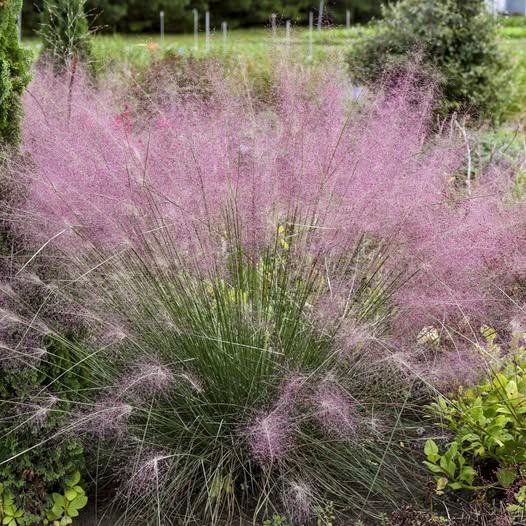
17. Mexican Feather Grass (Nassella tenuissima)
Mexican feather grass is one of those plants that gardeners either fall instantly in love with or overlook entirely. Those who love it describe it as essential — an irreplaceable element of fine-textured, movement-rich border design. Its extraordinarily fine, hair-like foliage and flower stems create a soft, smoky, flowing effect that is unlike any other small grass in the border.
It moves in the slightest air movement, responding to the gentlest breeze with a swaying, liquid quality that adds a kinetic dimension to the border that heavier, coarser plants cannot provide. Its color transitions from bright fresh green in spring through warm gold and buff by late summer, providing a quiet but consistent seasonal narrative.
Its primary limitation is self-seeding potential in mild climates — it can spread readily in Mediterranean-type climates and is invasive in parts of California, Texas, and Australia. In climates where this is not a concern, it is a spectacular, self-sufficient border plant of the highest ornamental quality.
Hardiness: USDA Zones 6–10 | Height: 18–24 inches | Light: Full sun | Soil: Well-drained, lean | Type: Evergreen (in mild climates)
18. Dwarf Mondo Grass (Ophiopogon japonicus ‘Nanus’)
Dwarf mondo grass may be the smallest plant in this guide — it reaches only two to three inches in height — but in the front edge of a border, that low scale is precisely its value. It forms a dense, uniform, dark green carpet that provides a clean, precise visual boundary between the border and the pathway, lawn, or paving beyond.
Black mondo grass (Ophiopogon planiscapus ‘Nigrescens’) is a related cultivar with near-black foliage that brings a dramatic, contemporary edge to border design. In modern garden styles where dark foliage colors and contrasting plant relationships are used deliberately, black mondo grass is one of the most effective small border plants available — particularly when placed alongside silver or golden-leafed companions.
Both forms are fully evergreen, highly tolerant of shade, heat, and drought once established, and require virtually no maintenance beyond occasional division when clumps become congested. They spread slowly but steadily to fill border edges cleanly.
Hardiness: USDA Zones 6–11 | Height: 2–4 inches (dwarf); 6–10 inches (standard) | Light: Partial to full shade | Soil: Moist, well-drained | Type: Evergreen
19. Variegated Liriope (Liriope muscari ‘Variegata’)
Variegated liriope functions as an outstanding small border grass in warm to temperate climates, bringing year-round foliage interest alongside a genuine late-season flowering display. Its broad, strap-like, dark green leaves edged with creamy-yellow margins provide a crisp, well-defined variegation that holds its character through every season. In late summer, upright spikes of small violet-purple flowers rise above the foliage — a display that arrives when most summer-flowering border plants have finished and provides a welcome continuation of seasonal interest.
It is remarkably adaptable: it tolerates deep shade and full sun, dry soil and moderate moisture, heat and coastal conditions with equal equanimity. This breadth of tolerance makes it an exceptionally useful plant for border edges and front-of-border positions where conditions may be variable or challenging.
It benefits from a light shear in late winter to remove any tired or frost-damaged foliage before new growth begins. Beyond that single annual task, it requires nothing.
Hardiness: USDA Zones 5–10 | Height: 12–18 inches | Light: Full sun to full shade | Soil: Adaptable; drought-tolerant once established | Type: Evergreen
20. Pennsylvania Sedge (Carex pensylvanica)
Pennsylvania sedge closes this list as one of the most quietly invaluable small border plants available. Its fine-textured, soft green foliage stays low — under ten inches — and forms a dense, spreading carpet that naturalizes beautifully at the front of shaded borders, along woodland edges, and under the canopy of deciduous trees and shrubs.
Its tolerance for dry shade is exceptional — it is one of the most shade- and drought-tolerant small grass-like plants available and can survive and look good in the challenging combination of tree-root competition and limited moisture that defeats most other border plants. Once established, it requires essentially no supplemental watering, no fertilization, and no significant maintenance beyond an optional trim in early spring.
For borders in partially or heavily shaded positions — under trees, alongside north-facing walls, or in the dry shadow of large shrubs — Pennsylvania sedge is the front-of-border plant that simply makes the problem disappear. Its ecological value as a native plant adds another dimension to its considerable practical worth.
Hardiness: USDA Zones 3–8 | Height: 6–10 inches | Light: Partial to full shade | Soil: Dry to moist; tolerates poor, compacted soil | Type: Evergreen
Design Strategies for Using Small Grasses in Borders
Selecting the right plants is only the first layer of good border design. The way small grasses are arranged, combined, and positioned within a border determines whether the result looks intentional and beautiful or simply well-planted but unremarkable.
Use repetition to create rhythm. Repeating a single variety of small grass at regular intervals through a border — every four to six feet along the length, for example — creates a visual pulse that gives the planting coherence and a sense of movement even before the wind touches it. Blue fescue, ‘Evergold’ sedge, and dwarf fountain grass are all excellent choices for this kind of rhythmic repetition.
Position grasses to catch the light. Ornamental grasses are at their most beautiful when light passes through or catches their foliage and flower heads at a low, oblique angle. Place translucent, fine-textured grasses like prairie dropseed and Mexican feather grass where morning or evening light will illuminate them from behind or from the side. Position Japanese blood grass where low autumn sun can catch its red-tipped leaves from behind.
Combine textures deliberately. The fine, linear foliage of small grasses creates its most powerful visual effect when placed beside plants with distinctly different leaf forms: the broad, rounded leaves of hostas, the bold texture of bergenia, the airy umbels of fennel or astrantia. These texture contrasts generate visual interest that sustains itself through every season.
Layer the border front to back. Place the smallest grasses — dwarf mondo, Pennsylvania sedge, blue fescue — at the very front edge of the border, where they provide a clean, defined boundary and can be closely observed. Place medium grasses — dwarf fountain grass, little bluestem, ‘Shenandoah’ switchgrass — in the middle zone. Reserve the taller small grasses — Karl Foerster, ‘Overdam’ — for the back section, where their vertical forms provide backdrop rather than blocking the view of smaller companions.
Allow naturalistic intermingling. In informal and naturalistic border styles, allowing fine-textured grasses to grow into and among neighboring plants creates a natural, spontaneous quality that is very difficult to achieve by formal arrangement. Mexican feather grass, prairie dropseed, and Pennsylvania sedge all naturalize beautifully in this way, weaving through other plants with an organic grace that looks effortless — even though it was entirely intentional.
Planting and Care Essentials for Border Grasses
Successful establishment is the foundation of any long-lasting border planting. Small grasses, like all ornamental grasses, establish most reliably when planted in spring or early autumn when temperatures are moderate and moisture is more consistent.
Prepare the border soil thoroughly before planting, removing weeds — particularly perennial weeds whose roots can be very difficult to remove once grasses are established — and incorporating organic matter to improve soil structure. Space plants according to their mature spread, not their purchase size, to avoid overcrowding as they develop.
Water consistently through the first growing season. Even drought-tolerant species are vulnerable during establishment before their root systems are fully developed. A two to three inch layer of mulch along the border maintains moisture, moderates soil temperature, and reduces weed competition during this critical period.
Most small border grasses require the annual spring cutback — trimming deciduous species to within a few inches of the ground before new growth begins, and combing out or lightly trimming evergreen species to remove tired older foliage. Beyond that single task, a light application of balanced slow-release fertilizer in spring is sufficient for the great majority of the plants in this guide.
Dividing congested clumps every three to five years — lifting the root mass, splitting it into sections with a sharp spade, and replanting the vigorous outer portions — keeps plants performing at their best over the long term and provides additional plants for expanding or diversifying the border.
Suggested For You:
15 Evergreen Ornamental Grasses: Year-Round Beauty for Every Landscape
20 Ornamental Grasses for Full Sun: The Complete Growing and Design Guide
15 Tall Ornamental Grasses for Privacy: A Complete Screening Guide
15 Ornamental Grasses for Winter Interest: Identification and Features
Kentucky Bluegrass vs Tall Fescue: Which Grass Is Right for Your Lawn?
Final Thoughts
Small ornamental grasses are the quiet heroes of the border. They do not demand the attention that a tall, dramatic specimen commands, nor the admiration that a spectacular flower display invites. What they offer instead is something more enduring: a consistent, textured, seasonally responsive presence that makes every border they inhabit feel more alive, more complete, and more genuinely beautiful across every month of the year.
In a well-designed border, small grasses are the thread that holds everything together — invisible when done well, but unmistakably missed if they are not there. Plant them generously, position them thoughtfully, and give them time to settle. The rewards will accumulate slowly at first, and then, one early morning when the light is low and a breeze passes through the border, suddenly and completely.
References
- Penn State Extension – Ornamental Grasses for the Home Landscape https://extension.psu.edu/ornamental-grasses
- North Carolina State University Extension – Ornamental Grasses: Culture and Uses in the Landscape https://content.ces.ncsu.edu/ornamental-grasses
- University of Minnesota Extension – Selecting and Growing Ornamental Grasses https://extension.umn.edu/planting-and-growing-guides/ornamental-grasses
- University of Illinois Extension – Ornamental Grasses in the Border and Landscape https://extension.illinois.edu/global/ornamental-grasses-landscape
- USDA Plant Hardiness Zone Map – Official Cold Hardiness Reference https://planthardiness.ars.usda.gov

Tim M Dave is a gardening expert with a passion for houseplants, particularly cacti and succulents. With a degree in plant biology from the University of California, Berkeley, he has vast experience in gardening. Over the years, he has cultivated a vast collection of desert plants and learned a great deal about how to grow and care for these unique companions.