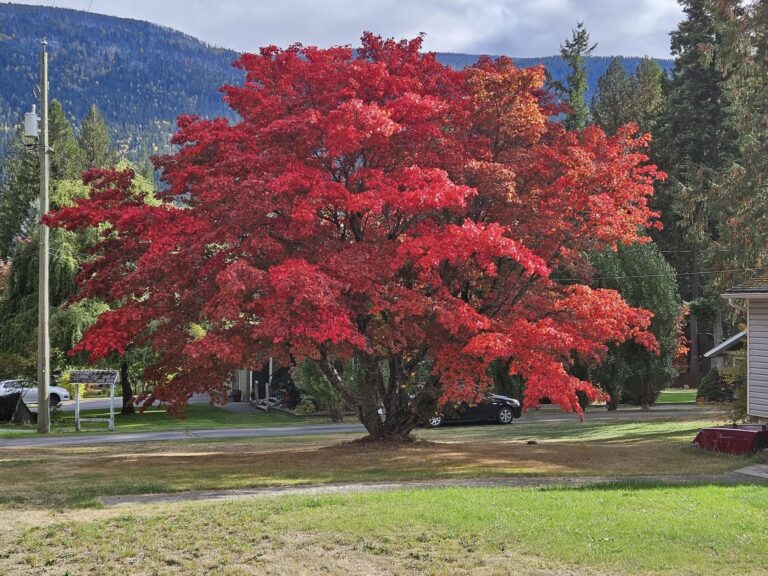
Red Mulberry (Morus rubra): Identification, Cultivation, Problems, and More
Scientific Classification
- Kingdom: Plantae
- Order: Rosales
- Family: Moraceae
- Genus: Morus
- Species: Morus rubra
- Common Names: Red Mulberry, American Mulberry
- Native Range: Eastern and Central United States and Southern Ontario, Canada
- USDA Hardiness Zones: 4b – 9a
There is a particular kind of joy in finding a Red Mulberry tree heavy with ripe fruit in midsummer. The berries stain your fingers dark purple within seconds, and the flavour — sweet, slightly tart, deeply rich — is unlike anything you will find in a supermarket.
That experience, simple as it sounds, has been shared by humans and wildlife alike for thousands of years across the Eastern United States.
Red Mulberry (Morus rubra) is one of North America’s most valuable native fruiting trees. It is ecologically generous, culturally significant, and increasingly important to conservationists who recognise how much pressure the species faces.
At a Glance: Red Mulberry is a medium to large deciduous tree native to the eastern half of North America. It produces edible, dark-purple to black fruits that ripen in early to midsummer. The tree is dioecious or occasionally monoecious, and it supports an extraordinary range of wildlife through its fruit, foliage, and structure.
How to Identify Red Mulberry
Red Mulberry can be confused with the introduced White Mulberry (Morus alba) and, less often, with Texas Mulberry (Morus microphylla). Accurate identification matters — both ecologically and practically.
Leaves
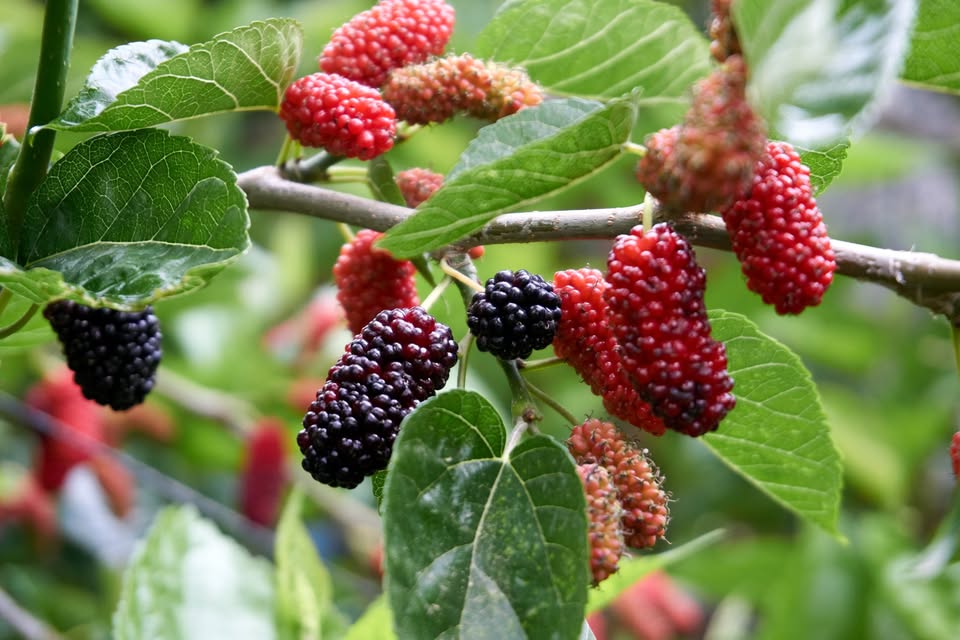
The leaves of Red Mulberry are perhaps its most distinctive feature. They are large, broadly ovate, and often deeply lobed, with some leaves on the same branch appearing unlobed while others show two to five distinct lobes. This variability is completely normal and characteristic of the genus.
What separates Red Mulberry from White Mulberry most reliably is the leaf texture. The upper surface of a Red Mulberry leaf is noticeably rough to the touch, almost sandpaper-like, due to short, stiff hairs. The underside is softly hairy as well. White Mulberry leaves, by contrast, are smooth and glossy on top.
Leaf size ranges from 7 to 20 centimetres in length. The margins are sharply serrated, and the leaf base is often unequal or heart-shaped. In autumn, the leaves turn a clear, clean yellow before falling.
Fruit
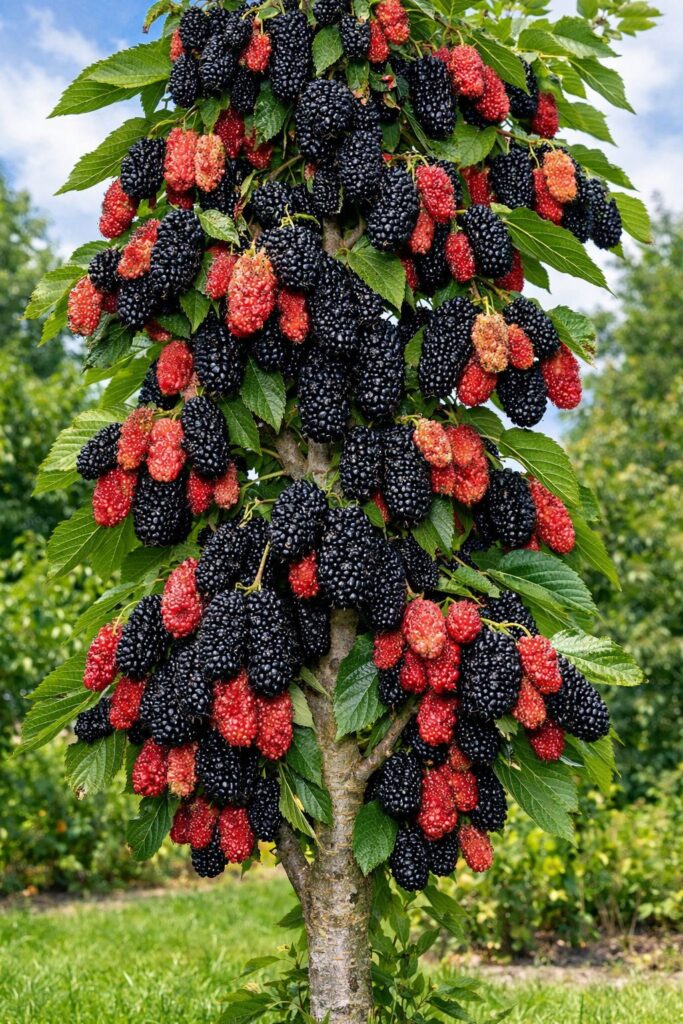
The fruit of Red Mulberry is an aggregate drupe — technically not a true berry, though it is universally called one. Individual fruits are cylindrical, 2 to 4 centimetres long, and progress from white to red to a deep purple-black as they ripen. The flavour at full ripeness is sweet and slightly acidic, with a complexity that raw sugar cannot replicate.
Fruits ripen from May through July depending on latitude, with trees further south ripening earliest. They are produced abundantly in good years and fall freely when ripe, which means the ground beneath a mature Red Mulberry can become a significant wildlife feeding station.
Bark and Trunk
Young branches have a milky sap visible when broken — this is one of the genus’s defining traits. The bark on mature trunks is brown to orange-brown, breaking into long, narrow, scaly ridges. The overall texture is rougher and more furrowed than White Mulberry.
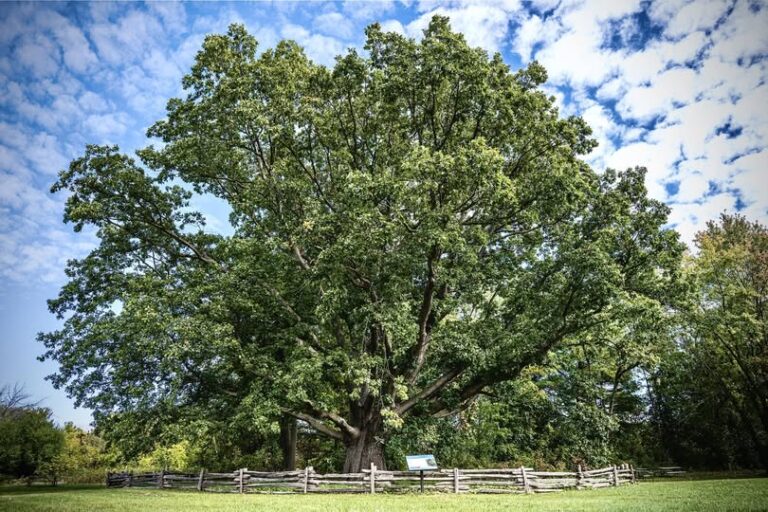
The trunk is often short and branching, supporting a broad, rounded crown that can spread considerably wider than the tree’s height. Mature trees typically reach 10 to 15 metres in height, though occasional specimens exceed 20 metres in ideal conditions.
Flowers
Red Mulberry flowers are small, greenish, and not particularly showy. They appear in spring — generally April to May — on hanging catkin-like structures. Male and female flowers are typically on separate trees, though some individual trees produce both. Pollination is primarily by wind, making a nearby compatible tree important for reliable fruit production.
Native Range and Natural Habitat
Red Mulberry’s native range covers much of the eastern half of North America. It extends from southern Ontario and New England in the north, south through Florida, and west to Nebraska, Kansas, and central Texas. It is absent from the northernmost tier of states and from most of the Great Plains.
| Region | Typical Habitat | Notes |
| Mid-Atlantic States | Rich, moist bottomlands, forest edges | Common in floodplain forests |
| Southeast | Mixed hardwood forests, disturbed areas | Often found near streams |
| Midwest | River valleys, woodland margins | Decreasing abundance westward |
| Appalachian Region | Cove forests, lower slopes | Prefers rich, deep soils |
| Gulf Coast | Hammocks, mixed woodlands | More scattered distribution |
| Great Lakes Region | Bottomlands, lakeshores | Increasingly threatened by M. alba hybridisation |
In its natural habitat, Red Mulberry is most at home on rich, moist, well-drained soils — particularly in floodplain forests, stream corridors, and the sheltered lower slopes of hills where organic matter accumulates.
This tree tolerates a range of soil types but consistently performs best where moisture and fertility are adequate.
It is a species of forest edges and disturbed ground as much as interior forest. You are most likely to find it at the margins — along fence rows, roadsides, stream banks, and the transitional zones between open fields and closed woodland.
This edge-loving tendency makes it a natural coloniser of disturbed habitats, though it is also a legitimate member of mature forest communities.
Ecological Importance
Few native trees in Eastern North America match Red Mulberry’s ecological generosity. When it fruits, it feeds an extraordinary diversity of animals — and even when it is not fruiting, it contributes meaningfully to the ecosystems it inhabits.
Wildlife Food Source
The fruits of Red Mulberry are consumed by more than 50 species of birds in North America. This is not a small claim. Species including the Baltimore Oriole, Cedar Waxwing, Gray Catbird, American Robin, Red-headed Woodpecker, Wood Thrush, Eastern Kingbird, and many others rely on mulberry fruits during the summer ripening window.
The timing is particularly valuable — mulberry fruits arrive early in summer, before many other native fruits ripen, making them a critical bridge food source.
Mammals benefit enormously as well. White-tailed deer, raccoons, opossums, red foxes, grey squirrels, and black bears all consume the fruits. In regions where bears are present, a fruiting Red Mulberry can become a significant seasonal food resource.
The fallen fruits attract ground-feeding birds and small mammals long after the tree has finished dropping them.
Beyond fruit, the leaves serve as larval food for several moth and butterfly species, including the Cecropia Moth — one of North America’s largest and most spectacular insects. The tree is also the primary food plant for commercial silkworm cultivation, though that association is more strongly tied to its relative, Morus alba.
Habitat Structure
Mature Red Mulberry trees provide nesting habitat for cavity-nesting birds such as woodpeckers, which excavate cavities in older, softer-wooded trunks. These cavities are subsequently used by secondary nesters including Eastern Bluebirds, Tree Swallows, and various owls.
The dense summer canopy offers shade and shelter. Fallen leaves decompose relatively quickly, contributing to soil organic matter and supporting the invertebrate communities that form the base of forest food webs.
Riparian Function
In its favoured floodplain and stream-side habitats, Red Mulberry plays a role in bank stabilisation and streamside canopy formation. Its roots help anchor moist soils, and its overhanging canopy provides thermal regulation for stream temperatures — a factor that benefits cold-water fish species including trout.
Cultural and Historical Significance
The history between humans and Red Mulberry in North America is long and richly documented. Indigenous peoples throughout the tree’s native range used it extensively — for food, fibre, medicine, and practical materials.
The fruits were eaten fresh, dried for winter storage, and incorporated into breads, porridges, and fermented beverages. The Cherokee, Choctaw, Ojibwe, and numerous other nations developed sophisticated uses of the tree across every part of its anatomy.
The inner bark was a valued fibre source. Several southeastern tribes wove cloth and rope from stripped mulberry bark — a practice documented by early European explorers who noted the quality of the resulting textiles. This bark cloth tradition was widespread and technically sophisticated, producing garments and bags of considerable durability.
Medicinally, various parts of the tree were used to treat dysentery, ringworm, and weakness. The milky sap was applied topically. Leaf preparations were used as treatments for conditions ranging from headaches to urinary complaints.
While modern herbalism should always be approached with caution, the breadth of traditional use points to a long, careful relationship between these communities and this tree.
When European colonists arrived, attempts were made to use Red Mulberry in silk production. Silkworm cultivation — sericulture — had been a significant industry in Asia and Europe, and colonial administrators saw the mulberry’s abundance as an opportunity.
These efforts largely failed. Red Mulberry leaves, it turned out, were not as palatable to silkworms as the leaves of the Asian White Mulberry (Morus alba), which was subsequently introduced and is now naturalised across much of the continent.
That introduction would have lasting and troubling consequences for Red Mulberry — a story continued in the conservation section below.
The mulberry’s cultural presence extended into American folk life as well. The nursery rhyme “Here We Go Round the Mulberry Bush” — though of British origin — kept the tree present in the cultural imagination of generations of children.
By the 19th century, mulberry trees were common fixtures in farmyards and kitchen gardens across the East, valued for their abundant, easily harvested fruit.
Growing Red Mulberry: Cultivation Guide
Red Mulberry is an excellent choice for home gardens, wildlife plantings, and restoration projects. It is a fast grower, adaptable to a range of conditions, and phenomenally productive once established. Here is what you need to know to grow it well.
Soil Requirements
Red Mulberry is adaptable but performs best in deep, rich, moist, well-drained soils. It tolerates a moderately wide pH range — roughly 5.5 to 7.0 — and grows in sandy loam, clay loam, and silty soils. What it dislikes most is prolonged waterlogging, though it can handle temporary flooding.
Incorporate organic matter into the planting area if your soil is poor or compacted. This is particularly important in urban settings where soil quality is often degraded. A generous planting hole filled with compost-amended soil gives the tree the best possible start.
Light Requirements
Red Mulberry grows in full sun to partial shade. In full sun, it produces the largest fruit crops and develops the fullest, most vigorous canopy. In partial shade, it grows reasonably well but with reduced fruiting. Deep shade is not suitable for productive growth.
In hotter climates — southern zones 8 and 9 — afternoon shade can reduce heat and moisture stress during the most intense months, without significantly impacting overall productivity.
Watering and Establishment
Like most trees, Red Mulberry needs consistent moisture during its first two to three years after planting. Deep, infrequent watering is preferable to shallow, frequent irrigation — it encourages the roots to descend into the soil rather than remaining near the surface.
Once established, the tree is moderately drought-tolerant, particularly in zones 5 to 7. In hotter, drier climates, supplemental irrigation during dry summer periods will protect fruit quality and overall tree health. A mulch layer of 7 to 10 centimetres around the root zone conserves moisture and moderates soil temperature.
Fruit Production and Pollination
Most Red Mulberry trees are dioecious — that is, individual trees are either male or female, and only female trees produce fruit. To ensure reliable fruiting, you need a male tree within reasonable range for wind pollination.
Some trees are monoecious, bearing both male and female flowers, and these can fruit without a companion — but this is not guaranteed.
When sourcing trees, ask the nursery whether trees are sexed. This saves years of waiting for a tree that turns out to be male. Female-selected cultivars are available and worth seeking out for garden use.
Fertilisation
Red Mulberry is not a demanding feeder. An annual top-dressing of compost or a balanced slow-release fertiliser in early spring is typically sufficient. Avoid excessive nitrogen, which promotes rapid leafy growth but can come at the expense of fruit production and structural wood strength. Trees growing in naturally fertile soils may need no supplemental feeding at all.
Pruning
Red Mulberry requires relatively little pruning. The ideal time is late winter to early spring, before bud break. The tree bleeds sap readily when cut — this is the milky latex that characterises the genus — so pruning during dormancy minimises stress.
Remove dead, crossing, or structurally weak branches. Shape lightly to maintain a clear central leader in young trees. Avoid heavy pruning, which can stimulate excessive sappy growth and increase susceptibility to disease.
In fruit-garden settings, some gardeners prune for a lower canopy to make harvest easier.
Pests and Diseases
Red Mulberry is generally robust, but several issues are worth knowing about:
- Bacterial Blight (Pseudomonas syringae) — Causes dark, water-soaked lesions on young shoots and leaves in cool, wet spring conditions. Remove affected tissue and improve air circulation.
- Mulberry Leaf Spot (Cercospora moricola) — Produces small, angular spots on leaves. Rarely serious; managed by raking and disposing of infected leaf litter in autumn.
- Cankers — Various fungal and bacterial pathogens can cause cankers on branches. Prune affected wood well below the lesion margin and disinfect tools between cuts.
- Popcorn Disease (Ciboria carunculoides) — A fungal disease that causes individual drupelets to enlarge and turn white or grey, resembling popped corn. Remove and destroy affected fruits. More a nuisance than a serious threat in most years.
- Scale Insects and Mealybugs — Occasional infestations on branches. Treat with horticultural oil during the dormant season when populations are high.
- Root Rot — Most often associated with poorly drained soils. Prevention through proper site selection is the most effective strategy.
Notable Cultivars and Varieties
Red Mulberry cultivar development has been less extensive than for some commercial fruit trees, but several selections are available:
- ‘Illinois Everbearing’ — Widely regarded as one of the best fruiting mulberry cultivars available. Technically a Morus rubra × Morus alba hybrid, it produces large, sweet, black fruits over an extended season. It is monoecious and self-fertile, making it practical for single-tree plantings.
- ‘Hicks’ — A Red Mulberry selection noted for large fruit and reliable production. Available from some specialist native plant nurseries in the Southeast.
- ‘Johnson’ — A selection prized for fruit sweetness and size. Recommended for Zone 5 and warmer.
- ‘Travis’ — A Texas-adapted selection with good heat and drought tolerance, suited to the southern and southwestern edges of the native range.
When selecting cultivars, prioritise named female selections or self-fertile types unless you are planting multiple trees and can accommodate both male and female individuals.
Landscape Uses
Red Mulberry fits naturally into a wide range of landscape contexts, from large rural properties to suburban wildlife gardens.
As a fruiting specimen, it is one of the most productive native trees you can plant. A mature tree can produce truly extraordinary quantities of fruit — enough to sustain your household, your neighbourhood’s birds, and a significant population of mammals simultaneously. For anyone interested in growing food, Red Mulberry delivers abundance with minimal intervention.
In wildlife gardens and native plantings, it is an anchor species. Paired with Eastern Redbud, Pawpaw, Serviceberry, and native viburnums, it creates a diverse, multi-season food and habitat matrix that supports biodiversity at every level of the food web.
For shade and canopy, the broad, rounded crown of a mature Red Mulberry is a genuine asset. It leafs out relatively early in spring and holds its canopy late, providing a long season of shade. The large leaves give it a bold, tropical character that contrasts well with finer-textured companion plants.
One practical note: plant Red Mulberry away from paved surfaces, patios, and light-coloured structures. The falling fruits stain everything they contact, and the mess during peak ripening is considerable. This is a tree best sited where its fruit production is a feature, not a liability.
Conservation Status and Threats
This is where the story of Red Mulberry becomes urgent. While the species is not yet globally threatened, it faces serious conservation challenges — particularly in Canada and across the northern parts of its range.
The primary threat is hybridisation with the introduced White Mulberry (Morus alba). White Mulberry was imported from Asia centuries ago to support silk production. It has since naturalised extensively across North America and readily hybridises with Red Mulberry.
The resulting hybrids are often fertile and vigorous, and they introgress genetic material from White Mulberry back into Red Mulberry populations across generations.
The result is that genetically pure Morus rubra is becoming increasingly rare, particularly at the edges of its range. In southern Ontario, Canada, Red Mulberry is listed as Endangered under Canada’s Species at Risk Act — one of the first tree species to receive that designation in the country.
The population there is small, isolated, and under intense pressure from hybridisation, habitat loss, and development.
Habitat fragmentation is the second major threat. As the forest edges and floodplain habitats that Red Mulberry favours are cleared for agriculture and development, populations become smaller and more isolated. Smaller populations are more vulnerable to local extinction events and less capable of maintaining genetic diversity.
Deer browse affects regeneration in areas with overabundant white-tailed deer populations. Young trees and seedlings are heavily browsed, preventing recruitment into the adult population.
Conservation efforts include seed banking, ex-situ cultivation of genetically vetted specimens, and habitat protection programs — particularly in Canada. For gardeners and landowners in the native range, planting genetically pure Morus rubra from reputable, locally sourced nurseries is one of the most direct ways to support conservation of this species.
Conclusion
There is a quality to Red Mulberry that rewards those who pay attention. It is generous almost beyond reason — producing fruit by the kilogram, feeding dozens of species, stabilising streambanks, and hosting entire communities of insects, birds, and mammals within its canopy.
In an era when native plant advocacy has rightly moved to the forefront of landscape design and conservation thinking, Morus rubra stands out as a tree that earns its place many times over. If you have the right site and the will to plant something that matters, this is a tree worth knowing, growing, and protecting.
References
- University of Kentucky College of Agriculture, Food and Environment. Morus rubra — Red Mulberry. Department of Horticulture, University of Kentucky. https://www.uky.edu/hort/Red-Mulberry
- NC State Extension Plants Database. Morus rubra — Red Mulberry. North Carolina State University. https://plants.ces.ncsu.edu/plants/morus-rubra/
- USDA Forest Service, Silvics of North America. Morus rubra L. — Red Mulberry. United States Department of Agriculture, Forest Service. https://www.srs.fs.usda.gov/pubs/misc/ag_654/volume_2/morus/rubra.htm
- University of Florida IFAS Extension. Morus rubra: Red Mulberry. Environmental Horticulture, University of Florida. https://edis.ifas.ufl.edu/publication/ST420
- Government of Canada — Species at Risk Public Registry. Red Mulberry (Morus rubra) — COSEWIC Assessment and Status Report. Environment and Climate Change Canada. https://www.canada.ca/en/environment-climate-change/services/species-risk-public-registry/cosewic-assessments-status-reports/red-mulberry-2018.html

Tim M Dave is a gardening expert with a passion for houseplants, particularly cacti and succulents. With a degree in plant biology from the University of California, Berkeley, he has vast experience in gardening. Over the years, he has cultivated a vast collection of desert plants and learned a great deal about how to grow and care for these unique companions.