15 Best Ornamental Grasses for Pots: A Complete Container Growing Guide
Container gardening has changed the way people think about outdoor spaces. A balcony, a paved courtyard, a narrow doorstep — none of these places need to feel bare or uninspired. With the right plants in the right pots, even the smallest outdoor area can become a living, textured, seasonally changing landscape.
Ornamental grasses are among the finest plants you can grow in containers. Their fountaining forms, fine-textured foliage, and graceful movement in the breeze bring a quality to pot arrangements that flowering annuals simply cannot replicate. They are also, for the most part, genuinely easy to manage in pots — undemanding, long-lasting, and visually rewarding from the moment they are planted until the last days of winter.
This guide covers 15 of the best ornamental grasses for pots, chosen for their suitability to container life, their ornamental impact, and their adaptability to a range of growing conditions. Whether you are furnishing a sunny terrace, a shaded courtyard, or a rooftop garden, there is a grass on this list that will perform beautifully.
Why Ornamental Grasses Work So Well in Containers
Before exploring the plant list, it is worth understanding why ornamental grasses are such strong container candidates. The qualities that make them appealing in the open garden are, if anything, even more pronounced when they are grown in pots.
Movement and texture. Grasses respond to air movement with a fluidity that no other container plant quite matches. Even on a still day, the slightest air current sets their leaves in motion. On a breezy day, a large container grass becomes a kinetic sculpture — alive, dynamic, and endlessly interesting in a way that a static flowering shrub or annual display is not.
Long season of interest. Most ornamental grasses look good from spring through winter. Their foliage, flower heads, and seed heads provide continuous interest across multiple seasons without the need for replanting or constant deadheading. In a container setting — where every plant is in close proximity and closely observed — this sustained performance is particularly valuable.
Architectural versatility. Grasses range from low, mounding forms suitable for window boxes to tall, upright varieties that serve as dramatic focal points in large statement pots. This range of scale and form makes them useful in virtually every container context, from formal symmetrical arrangements to relaxed, naturalistic groupings.
Low care requirements. Container gardening always involves more maintenance than in-ground planting, due to the constraints of limited soil volume and the need for supplemental watering. But ornamental grasses are among the least demanding of all container plants. Many are drought-tolerant, few are prone to pests or diseases, and most require only an annual cutback to stay in peak condition.
Key Principles for Growing Ornamental Grasses in Pots
Growing any plant in a container involves managing a more constrained environment than the open garden. For ornamental grasses, a few specific principles make the difference between a plant that merely survives and one that genuinely thrives.
Choose the right pot size. Ornamental grasses develop substantial root systems, and confining them in a pot that is too small leads to rapid root-binding, reduced vigor, and increased drought stress. As a general rule, choose a pot that is at least two to three times the diameter of the plant’s root ball at purchase, and expect to repot every two to three years as the plant grows.
Prioritize drainage. This is the single most important factor in container growing for grasses. Most ornamental grasses are intolerant of waterlogged soil, which leads to root rot and rapid decline. Always use a pot with at least one large drainage hole, and use a free-draining potting mix rather than heavy garden soil. Adding perlite or horticultural grit to a standard potting compost improves drainage significantly.
Water consistently but not excessively. Container grasses dry out more quickly than in-ground plants, especially in summer. Check the moisture level regularly by pressing a finger into the top inch of compost — if it feels dry, water thoroughly. If it still feels moist, wait. Overwatering is as harmful as underwatering for most ornamental grasses.
Feed moderately. A light application of a balanced, slow-release fertilizer in spring supports healthy growth without encouraging the lush, floppy growth that excessive feeding promotes. Most grasses do not need heavy feeding and perform better — and look better — when kept on the lean side.
Consider winter protection. In cold climates, container plants are more vulnerable to frost damage than their in-ground counterparts because the pot provides no soil insulation around the roots. Move pots of borderline-hardy grasses to a sheltered position — against a wall, in an unheated greenhouse, or wrapped in horticultural fleece — during severe cold spells.
15 Best Ornamental Grasses for Pots
1. Japanese Forest Grass (Hakonechloa macra ‘Aureola’)
Japanese forest grass is, without question, the premier ornamental grass for container growing. In a pot, its cascading, waterfall-like form and radiant golden-yellow and green striped foliage create an impact that very few other container plants can match. The way its arching leaves spill over the rim of a dark or glazed pot is genuinely beautiful — one of those plant and container combinations that looks like it was designed by a professional.
‘Aureola’ is the most widely grown and most beloved cultivar, with vivid yellow and green striped leaves that glow in partial shade settings. ‘All Gold’ is an entirely golden-yellow form that is equally spectacular. ‘Nicolas’ is compact — under twelve inches — and ideal for smaller containers or mixed pot arrangements.
In containers, Japanese forest grass benefits from consistent moisture and good organic matter in the potting mix. It performs best in partial shade to shade, making it an outstanding choice for shaded terraces and north-facing courtyards where many other grasses would struggle. In autumn, the foliage flushes to warm pink and bronze before dying back in winter.
Hardiness: USDA Zones 4–9 | Height in Pots: 1–2 feet | Light: Partial shade to shade | Water Needs: Moderate to high
2. Blue Fescue (Festuca glauca ‘Elijah Blue’)
Blue fescue is the ideal small ornamental grass for container growing. Its intensely silver-blue, spiky, hedgehog-like tussocks have a clean, sculptural quality that works brilliantly in formal pot arrangements, on windowsills, and in groups of matching containers flanking a doorway. The color is remarkable — a cool, steel blue that appears almost metallic in bright light.
‘Elijah Blue’ is among the most widely available and most reliably blue of all cultivars. ‘Boulder Blue’ and ‘Siskiyou Blue’ are also excellent choices with subtle color variations. All form compact, rounded mounds that stay well within the bounds of a medium-sized container.
In pots, blue fescue needs excellent drainage and full sun to maintain its best color. It is notably drought-tolerant, which reduces the watering burden in dry summer periods. It benefits from division every two to three years when the center of the clump begins to die out — a simple task that keeps the plants looking fresh and youthful.
Hardiness: USDA Zones 4–8 | Height in Pots: 8–12 inches | Light: Full sun | Water Needs: Low to moderate
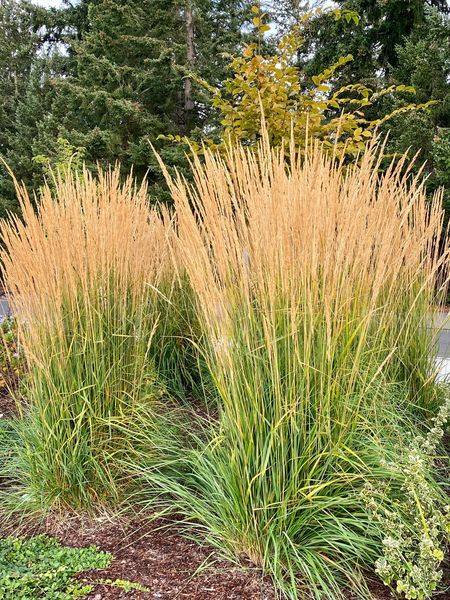
3. Karl Foerster Feather Reed Grass (Calamagrostis x acutiflora ‘Karl Foerster’)
Karl Foerster may seem like an unusual choice for a container — it reaches five to six feet in flower — but in a large, substantial pot, it is utterly magnificent. Its strict, upright habit and minimal spread make it uniquely suited to container growing among tall grasses, because it does not flop or sprawl as it grows. It stays narrow, vertical, and precise, which is exactly what a statement container plant needs to be.
In a large terracotta urn or a modern concrete planter, Karl Foerster creates an instant focal point. Its feathery, pink-tinged flower spikes emerge in late spring and age to warm golden wheat tones through summer and autumn. The dried seed heads remain architectural and attractive through winter.
It performs best in full sun with consistent moisture. In containers, it benefits from a larger pot than most grasses — at least 18 to 24 inches in diameter — and regular watering during summer. Given these conditions, it is a long-lived, utterly reliable container performer.
Hardiness: USDA Zones 4–9 | Height in Pots: 4–6 feet | Light: Full sun to partial shade | Water Needs: Moderate
4. Purple Fountain Grass (Pennisetum setaceum ‘Rubrum’)
Purple fountain grass is one of the most popular ornamental grasses for container growing worldwide, and it is easy to understand why. Its cascading, burgundy-purple foliage and rosy-pink, bottlebrush flower spikes bring a dramatic, almost tropical richness to summer container arrangements that few other plants can match.
It is a natural “thriller” in the container design language of “thriller, filler, spiller” — its bold height and rich color provide the vertical drama that anchors a mixed pot planting and gives the arrangement its focal point. It pairs beautifully with golden or chartreuse annuals like Bidens or calibrachoa at the base.
In warm climates (Zones 9–11), it is a true perennial that can be left in its pot year-round. In cooler climates, it performs as a warm-season annual or can be overwintered indoors as a houseplant. It is sterile, so it does not set viable seed and poses no invasive risk. It thrives in full sun and tolerates heat and moderate drought exceptionally well.
Hardiness: USDA Zones 9–11 (annual elsewhere) | Height in Pots: 3–4 feet | Light: Full sun | Water Needs: Low to moderate
5. Dwarf Fountain Grass (Pennisetum alopecuroides ‘Hameln’)
‘Hameln’ is a compact cultivar of fountain grass that is perfectly proportioned for medium to large containers. Its fine-textured, arching, dark green foliage forms a graceful, rounded mound, and its creamy-white, bottlebrush-like flower spikes appear in mid-summer — earlier than many other fountain grass cultivars — and persist attractively into autumn.
In autumn, the foliage transitions from green through golden-yellow tones before the plant goes dormant for winter. Unlike purple fountain grass, ‘Hameln’ is a true perennial across a wide hardiness range and can remain in the same container for several years. It is drought-tolerant once established and thrives in full sun, making it well-suited to warm, sunny terrace settings.
Its compact, tidy habit requires no staking or correction — it holds its form throughout the season with no intervention whatsoever, beyond the annual spring cutback.
Hardiness: USDA Zones 5–9 | Height in Pots: 2–3 feet | Light: Full sun | Water Needs: Low to moderate
6. Variegated Moor Grass (Molinia caerulea ‘Variegata’)
Variegated moor grass is an elegant, compact grass with cream and green striped foliage and a graceful, gently arching habit. It is one of the most refined and understated of all ornamental grasses — not a plant that shouts for attention, but one that rewards close observation with its quiet beauty and delicate texture.
In a container, it creates a soft, billowing mound of fine-textured variegated foliage that works beautifully in both formal and informal arrangements. In late summer, it produces slender, upright flower stems with small, purple-tinged spikelets that add a vertical, airy element above the foliage. In autumn, the entire plant turns clear, warm gold before dying back.
It is a cool-season grass that performs best in the cooler months of spring and autumn. In containers, it benefits from consistent moisture and performs well in partial shade as well as full sun. Its naturally compact size — rarely exceeding eighteen inches — makes it suitable for medium-sized pots and mixed container arrangements.
Hardiness: USDA Zones 4–9 | Height in Pots: 12–18 inches | Light: Full sun to partial shade | Water Needs: Moderate
7. ‘Evergold’ Sedge (Carex oshimensis ‘Evergold’)
‘Evergold’ sedge is one of the most popular and widely planted ornamental sedges in the world, and its performance in containers is outstanding. Its arching, narrow leaves with a broad, creamy-yellow central stripe and dark green margins create a vivid, bright focal point that illuminates shaded container displays with a warm, golden quality.
It is evergreen in most climates, which means it provides year-round interest in the container — a significant advantage over deciduous grasses that leave pots bare through winter. Its compact, mounding habit stays tidy and attractive without any pruning, and it is genuinely one of the lowest maintenance container plants available.
‘Evergold’ performs well in partial shade to shade, making it invaluable for shaded courtyards, covered terraces, and north-facing balconies where full-sun grasses would fail. It tolerates a range of moisture conditions and is largely deer-resistant — though deer pressure is admittedly less of a concern in most container garden settings.
Hardiness: USDA Zones 5–9 | Height in Pots: 12–18 inches | Light: Partial shade to full shade | Water Needs: Moderate
8. Fiber Optic Grass (Isolepis cernua)
Fiber optic grass is one of the most charming and unusual ornamental grasses for container growing. Its very fine, hair-like, bright green stems arch gracefully outward and each one is tipped with a tiny, silvery seed head that catches light like a fiber optic filament — a quality that gives the plant its evocative common name.
It is a compact, low-growing plant that reaches only eight to twelve inches in height, making it ideal for small pots, window boxes, and mixed container arrangements where it serves as a soft, flowing edge plant. Its naturally weeping habit creates a beautiful spilling effect over the rim of a raised pot or container.
It thrives in moist to wet conditions and is one of the few ornamental grasses genuinely suited to pots that are kept consistently wet — near outdoor water features, for instance, or in climates with high rainfall. In hot, dry conditions, it requires more frequent watering than most grasses. It is often grown as an annual in colder climates.
Hardiness: USDA Zones 8–11 (annual in cooler zones) | Height in Pots: 8–12 inches | Light: Full sun to partial shade | Water Needs: High
9. Blue Oat Grass (Helictotrichon sempervirens)
Blue oat grass brings a striking, architectural quality to container arrangements that few other small-to-medium grasses can match. Its stiff, spiky, silver-blue foliage forms a tight, rounded mound with a strong sculptural presence — it looks as though it belongs in a contemporary landscape design rather than a cottage garden, and in a sleek modern pot, that quality is fully realized.
In containers, its steel-blue color contrasts powerfully with warm-toned companions and dark-colored pots. In early summer, it sends up tall, oat-like flower spikes that age from silver-green to golden wheat — adding a graceful vertical element above the tight foliage mound. In autumn and winter, the seed heads remain attractive.
Excellent drainage is essential. Blue oat grass does not tolerate wet or waterlogged conditions, and containers that hold moisture can be problematic. Use a very free-draining potting mix and ensure the pot has good drainage holes. Given these conditions, it is a reliable, long-lived container plant that requires almost no maintenance beyond the annual spring tidy.
Hardiness: USDA Zones 4–8 | Height in Pots: 2–3 feet | Light: Full sun | Water Needs: Low
10. Japanese Blood Grass (Imperata cylindrica ‘Red Baron’)
Japanese blood grass is one of the most visually arresting ornamental grasses available for container growing. Its upright, strap-like leaves emerge green at the base and transition to an intense, luminous blood-red at the tips — a color combination that intensifies through the season and becomes almost incandescent when backlit by low autumn or morning sun.
In a container, where the light conditions can be managed and the plant is close enough to observe in detail, this color effect is genuinely spectacular. It is best planted in a position where sunlight can illuminate it from behind — placed on the edge of a terrace or balcony where morning or afternoon sun catches the red tips is ideal.
It is clump-forming and non-invasive in most climates, though the straight species (Imperata cylindrica) is highly invasive — always ensure you are purchasing the named ornamental cultivar ‘Red Baron’. It tolerates partial shade but produces its most intense red coloration in full sun. It needs consistent moisture and is not as drought-tolerant as many other container grasses.
Hardiness: USDA Zones 5–9 | Height in Pots: 12–18 inches | Light: Full sun to partial shade | Water Needs: Moderate to high
11. Feather Grass (Nassella tenuissima)
Feather grass — sometimes called Mexican feather grass or silky thread grass — is one of the most ethereally beautiful grasses for container growing. Its extremely fine, hair-like leaves and flower stems create a soft, flowing, smoke-like effect that moves with extraordinary delicacy in even the gentlest air movement. In a pot near an outdoor seating area, watching it move in the breeze is genuinely relaxing.
Its color transitions from bright, fresh green in spring through warm gold and wheat tones by late summer, providing a quiet seasonal narrative that rewards attention. It is compact — rarely exceeding two feet — and its naturally tidy, mounding habit requires no pruning or staking to maintain.
In containers, it performs best in full sun with excellent drainage and lean, not overly rich, potting mix. Fertile, moisture-retentive compost encourages floppy growth that undermines its natural grace. Note that in mild climates it can self-seed freely, which is less of a concern in containers than in the open garden.
Hardiness: USDA Zones 6–10 | Height in Pots: 18–24 inches | Light: Full sun | Water Needs: Low
12. Tufted Hair Grass (Deschampsia cespitosa ‘Goldtau’)
‘Goldtau’ (Golden Dew) tufted hair grass is a superb container grass for partially shaded positions. Its dense, dark green tussocks of fine-textured foliage are clean and attractive throughout the growing season. But its crowning glory appears in early summer, when it sends up tall, billowing clouds of tiny, golden-bronze flower spikelets that catch light with extraordinary delicacy and shimmer at the slightest movement.
In a container, these flower heads create a halo of golden mist above the pot — an effect that is especially beautiful when the container is placed where morning or evening light can illuminate the flower heads from an oblique angle. The display lasts for several weeks and the seed heads remain attractive long after flowering has finished.
It tolerates partial shade and consistently moist potting mix, which makes it particularly useful for shaded terraces where maintaining moisture is easier than providing adequate sun. It is a well-behaved, non-invasive grass that stays in its container without attempting to spread beyond it.
Hardiness: USDA Zones 4–9 | Height in Pots: 2–3 feet (4 feet in flower) | Light: Partial shade to full sun | Water Needs: Moderate to high
13. Zebra Grass (Miscanthus sinensis ‘Little Zebra’)
‘Little Zebra’ is a compact cultivar of the celebrated zebra grass — bred specifically for smaller garden spaces and, conveniently, for container growing. It inherits the distinctive horizontal golden banding of its parent but in a more manageable package that reaches only three to four feet rather than the six to eight feet of the full-sized form.
The horizontal banding on the wide, arching leaves is genuinely unusual and immediately eye-catching. It intensifies as the season progresses and summer temperatures warm. In late summer, it produces coppery-pink flower plumes that age to silver, adding a further layer of seasonal interest.
In a large container — at least 18 inches in diameter — ‘Little Zebra’ makes a superb statement plant. It is drought-tolerant once established and performs best in full sun. Like other Miscanthus, it is clump-forming and non-invasive, making it a long-term container resident that improves with each passing year.
Hardiness: USDA Zones 5–9 | Height in Pots: 3–4 feet | Light: Full sun | Water Needs: Low to moderate
14. ‘Ice Dance’ Sedge (Carex morrowii ‘Ice Dance’)
‘Ice Dance’ is a reliable, evergreen sedge with dark green arching leaves bordered by clean, bright white margins. It is one of the most versatile container sedges available — equally at home in formal arrangements or relaxed, naturalistic pot groupings, and equally effective in full shade or partial sun positions.
Its year-round evergreen character makes it a particularly valuable container plant for winter displays, when most deciduous grasses have disappeared and the container garden needs structure and color to remain interesting. In mixed winter pots, it provides a crisp, fresh element that complements cyclamens, hellebores, or winter pansies with quiet elegance.
It tolerates low light levels better than most container grasses, making it the go-to choice for deeply shaded balconies, covered entrances, and north-facing courtyard spaces where light is genuinely scarce. It is also among the most drought-tolerant of the sedges once established, which reduces the watering burden in drier periods.
Hardiness: USDA Zones 5–9 | Height in Pots: 12–18 inches | Light: Partial to full shade | Water Needs: Low to moderate
15. Leatherleaf Sedge (Carex buchananii)
Leatherleaf sedge offers something genuinely different to container arrangements: its narrow, upright, copper-bronze foliage is unlike any other grass-like plant in color, and in a pot where every element is closely observed, that distinction becomes a significant ornamental asset.
Its warm, reddish-brown tone works beautifully as a contrast element in mixed container plantings — placed alongside golden or lime-green companions, it creates a rich, autumnal palette even in summer. Its naturally upright habit adds gentle vertical structure without the rigidity of an architectural grass like Karl Foerster.
In containers, it performs well in partial shade to full sun and tolerates a reasonable range of moisture conditions, though it prefers consistently moist potting mix. It is a New Zealand native that is slightly less cold-hardy than many of the other grasses in this guide, so in cold climates, winter protection for container specimens is advisable.
Hardiness: USDA Zones 6–9 | Height in Pots: 18–24 inches | Light: Full sun to partial shade | Water Needs: Moderate
Container Design Principles for Ornamental Grasses
Understanding which grasses grow well in pots is only part of the picture. Using them skillfully in container arrangements makes the difference between a pleasant display and a genuinely outstanding one.
The thriller, filler, spiller approach. This classic container design framework works beautifully with ornamental grasses. A tall, upright grass like Karl Foerster or purple fountain grass serves as the “thriller” — the vertical focal point at the center or back of the pot. Lower-growing, mounding plants fill the middle ground. Trailing or cascading plants soften the pot rim. Japanese forest grass is an exceptional “spiller,” its cascading foliage flowing naturally over the edge of a raised container.
Single-variety statement pots. Not every container arrangement needs to be a mixed planting. A single large grass in a beautifully chosen pot can be just as effective — often more so — than a complicated mixed display. A large specimen of ‘Aureola’ Japanese forest grass in a dark-glazed pot, or blue fescue in a series of matching white ceramic pots along a pathway, makes a clean, confident statement that stands on its own.
Use repetition for visual continuity. Repeating the same grass in matching pots along a terrace, at regular intervals along steps, or flanking a doorway creates a strong sense of rhythm and order that visually ties a space together. This is particularly effective with upright grasses like Karl Foerster or compact blue fescue.
Mix foliage colors deliberately. The range of foliage colors among container grasses is remarkable: steel blue, golden yellow, cream-white, copper-bronze, blood red, deep green. Combining complementary or contrasting colors — blue fescue with amber leatherleaf sedge, ‘Evergold’ with dark green ‘Ice Dance’ — creates visual interest that sustains itself through the season without relying on flowers.
Seasonal Care for Container Grasses
Spring is the time for the annual cutback — trim deciduous grasses back to within a few inches of the base before new growth begins. Refresh the top layer of potting mix with fresh compost and apply a slow-release balanced fertilizer.
Summer requires regular watering as container grasses are at their most active growth phase. Check moisture levels daily in hot weather. Watch for the emergence of flower spikes — this is the highlight of the growing season for many container grasses.
Autumn brings the most spectacular display for many species — seed heads, warm foliage tones, and the last flush of movement before the season ends. Resist cutting back. Move tender grasses indoors if frost threatens.
Winter is a time of rest. Evergreen sedges continue to provide structure and color. Deciduous grasses offer dried architectural forms that catch frost beautifully. Provide frost protection for borderline-hardy species by moving pots to a sheltered position or wrapping with horticultural fleece during severe cold snaps.
Suggested For You:
Perennial Ryegrass vs Annual Ryegrass – Comparisons + Which to Choose for Your Winter Lawn
15 Best Ornamental Grasses for Shade: A Complete Growing Guide
15 Low Maintenance Ornamental Grasses: Beauty Without the Work
15 Evergreen Ornamental Grasses: Year-Round Beauty for Every Landscape
20 Small Ornamental Grasses for Borders: The Complete Planting Guide
Final Thoughts
Container growing asks something of every plant — it demands adaptability, resilience, and the ability to perform in a constrained environment. The ornamental grasses in this guide not only meet that demand; many of them seem to relish it. In pots, their forms are more clearly defined, their textures more closely observed, and their movement more intimately experienced than in the open garden.
Whether you are furnishing a small balcony with a single statement pot or designing a large terrace planting with grasses as the structural backbone, these 15 varieties offer the range, the reliability, and the genuine beauty that container growing requires.
Choose well, pot them generously, and let them grow. The results will reward you in ways that go well beyond what the garden center label ever promised.
References
- Penn State Extension – Container Gardening with Ornamental Grasses https://extension.psu.edu/container-gardening-ornamental-grasses
- University of Illinois Extension – Ornamental Grasses in the Landscape and Containers https://extension.illinois.edu/global/ornamental-grasses-landscape
- North Carolina State University Extension – Ornamental Grasses: Selection and Care https://content.ces.ncsu.edu/ornamental-grasses
- University of Maryland Extension – Growing Plants in Containers https://extension.umd.edu/resource/growing-plants-containers
- USDA Plant Hardiness Zone Map – Official Cold Hardiness Reference for Plant Selection https://planthardiness.ars.usda.gov

Tim M Dave is a gardening expert with a passion for houseplants, particularly cacti and succulents. With a degree in plant biology from the University of California, Berkeley, he has vast experience in gardening. Over the years, he has cultivated a vast collection of desert plants and learned a great deal about how to grow and care for these unique companions.