20 Ornamental Grasses for Full Sun: The Complete Growing and Design Guide
Sun is one of the greatest gifts a garden can have. A site that receives six or more hours of direct sunlight each day opens the door to one of the most spectacular and diverse plant categories in all of horticulture: full-sun ornamental grasses.
These are plants built for brightness, warmth, and open skies. They thrive in conditions that stress other plants, delivering movement, texture, and seasonal color with a reliability and ease that makes them among the most rewarding choices for sunny gardens of every size and style.
Yet for all their obvious appeal, ornamental grasses for full sun are still underused in many home landscapes. Gardeners reach for flowering perennials, flowering shrubs, and flowering annuals — and end up with borders that are busy in summer but lifeless in winter, and that rely entirely on flowers for their impact. Grasses offer something different. They provide structure that lasts all year. They move in the wind. They catch the light in a way that no flower can replicate. And in a sunny site, they do all of this with very little effort on the gardener’s part.
This guide covers 20 of the best ornamental grasses for full sun — from compact border plants to dramatic landscape specimens — with detailed growing information, design guidance, and care advice to help you use them well.
What “Full Sun” Means for Ornamental Grasses
Full sun is defined as a minimum of six hours of direct sunlight per day, though many of the grasses in this guide perform best with eight or more hours. This is the condition found in open gardens without significant tree cover, on south-facing slopes, along west-facing borders, and in unshaded front yards and terraces.
For ornamental grasses, full sun is not simply tolerated — it is actively beneficial. Most ornamental grasses evolved in open, exposed habitats: prairies, meadows, coastal dunes, and dry hillsides. These are places where sunlight is abundant, competition from trees is absent, and the wind moves freely. In full sun garden conditions, grasses grow with maximum vigor, produce their most abundant flowering, develop their richest foliage colors, and maintain the upright, compact habits that make them most ornamentally effective.
In partial sun conditions — four to six hours of sun per day — most full-sun grasses still perform reasonably well. However, some may become slightly lax or floppy, produce fewer flowers, or lose some of the intensity of their foliage color. Understanding this helps set realistic expectations and supports better planting decisions.
One important consideration for very hot, humid climates is that some cool-season grasses — those that perform their most active growth in spring and autumn — benefit from afternoon shade in the warmest months. Where this applies to specific grasses in this guide, it is noted in the individual entries.
The Ornamental Value of Full-Sun Grasses Through the Seasons
One of the most compelling reasons to use ornamental grasses in full-sun landscapes is their sustained ornamental performance across all four seasons. No other plant category delivers quite the same breadth of year-round value in a sunny, open site.
Spring brings fresh green or blue-tinted growth as grasses emerge from dormancy or accelerate out of their winter resting state. For warm-season grasses — those that grow most vigorously in summer heat — spring growth is slow and deliberate, building gradually before the heat of summer triggers rapid development.
Summer is the season of peak growth, abundant flowering for many species, and the full expression of foliage color — whether silver-blue, golden-yellow, burgundy, or the clean, bright green of native prairie species. The movement of tall grasses in summer wind is one of the most evocative and beautiful things a garden can offer.
Autumn is, for many ornamental grasses, the finest season of all. Foliage colors deepen and warm into golds, oranges, coppers, and reds. Seed heads mature and catch morning light with a glowing, translucent quality. The garden takes on a richness and warmth that summer, for all its exuberance, rarely achieves.
Winter reveals the structural quality of ornamental grasses most clearly. Dried foliage and seed heads stand against the low winter sky, catching frost and snow, moving in the wind with a quiet, persistent grace. In a well-designed full-sun landscape, ornamental grasses make the winter garden genuinely beautiful rather than merely endurable.
20 Best Ornamental Grasses for Full Sun
1. Karl Foerster Feather Reed Grass (Calamagrostis x acutiflora ‘Karl Foerster’)
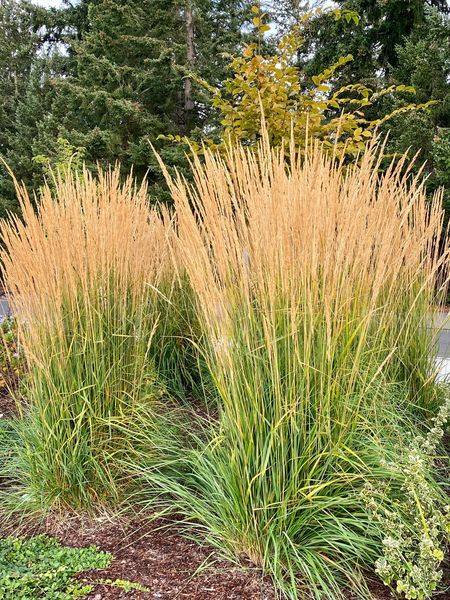
Karl Foerster is the most widely planted ornamental grass in North America, and no list of full-sun grasses would be complete without it. Its reputation rests on a foundation of consistent, reliable, outstanding performance across a wide range of growing conditions — from clay soils to sandy loam, from USDA Zone 4 cold to Zone 9 heat.
Its strictly upright habit — forming a narrow, vertical column of dark green foliage topped with feathery, pink-tinged flower spikes from late spring — makes it uniquely versatile in landscape design. It provides strong vertical structure without the lateral spread that makes many large grasses difficult to accommodate in planting borders. Its flowering begins earlier than almost any other ornamental grass, and the seed heads persist attractively through winter.
For sunny borders, contemporary landscapes, and any design that requires a reliable, architectural grass that performs across all four seasons, Karl Foerster is the benchmark against which all other grasses are measured.
Hardiness: USDA Zones 4–9 | Height: 5–6 feet in flower | Spread: 2–3 feet | Light: Full sun to partial shade | Soil: Adaptable; tolerates clay
2. Maiden Grass (Miscanthus sinensis ‘Gracillimus’)
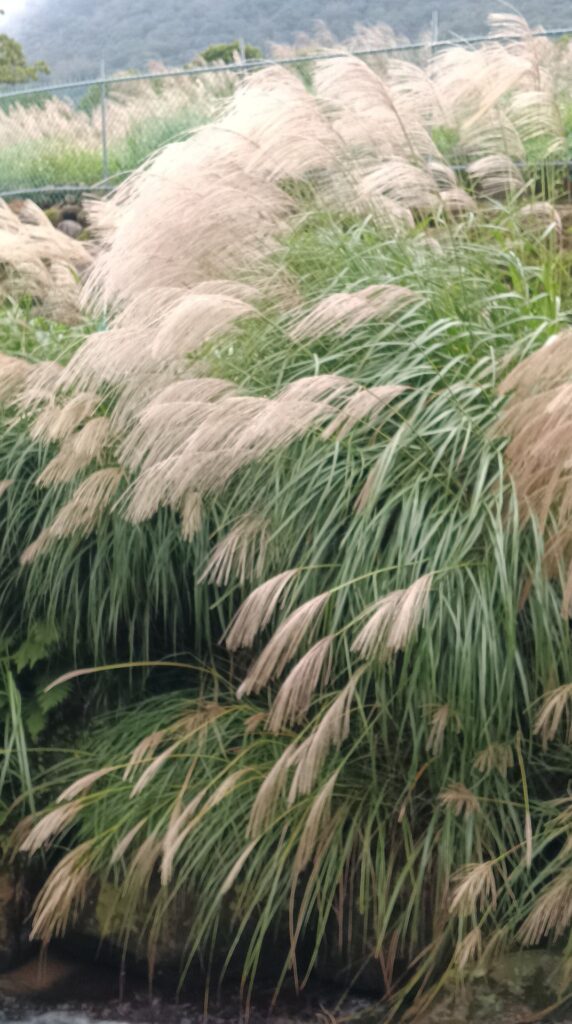
Maiden grass is a classic large ornamental grass that brings elegance, movement, and multi-season beauty to full-sun landscapes. Its graceful, arching clumps of narrow, dark green leaves with a silver midrib reach five to six feet in height, and its silvery-white flower plumes in late summer age to a warm, tawny gold that persists beautifully through winter.
‘Gracillimus’ is one of the most refined Miscanthus cultivars — its narrower leaf blades give it a finer texture than many of its relatives, and its naturally vase-shaped form is exceptionally graceful. In a full-sun border, it functions as both a specimen plant and a season-extending background element that makes everything planted in front of it look better.
It is clump-forming, long-lived, and requires only the annual spring cutback. It is drought-tolerant once established and adapts to a range of soil types. Select sterile or low-fertility cultivars where self-seeding could be a concern in warmer climates.
Hardiness: USDA Zones 5–9 | Height: 5–7 feet | Spread: 3–5 feet | Light: Full sun | Soil: Moist, well-drained; adaptable
3. Little Bluestem (Schizachyrium scoparium)
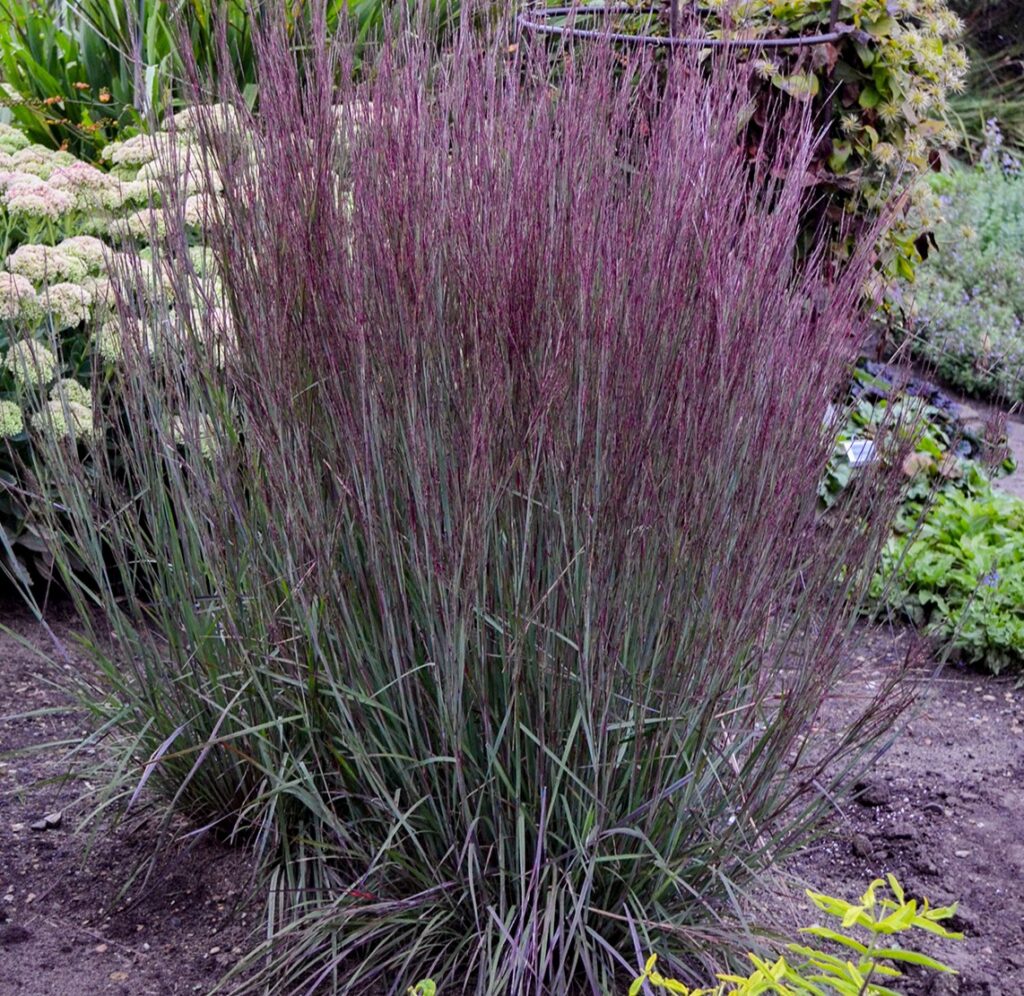
Little bluestem is a native North American prairie grass of exceptional ornamental quality and outstanding ecological value. In full sun, its fine-textured, blue-green foliage forms upright, compact clumps through spring and summer, providing a cool, glaucous quality that contrasts beautifully with warm-colored flowering companions. Then autumn arrives — and the transformation is nothing short of spectacular.
The entire plant turns vivid shades of copper, orange, crimson, and burgundy, and its fluffy white seed heads catch morning light with a soft, incandescent glow. Few ornamental grasses deliver autumn color of this intensity and richness, and in a full-sun position where the plant receives maximum light, the display is truly outstanding.
It thrives in poor to moderately fertile, well-drained soil and is extremely drought-tolerant. Rich, moist soil encourages flopping. It is deer-resistant, wildlife-friendly, and one of the most ecologically valuable small grasses available for North American gardens.
Hardiness: USDA Zones 3–9 | Height: 2–4 feet | Spread: 1–2 feet | Light: Full sun | Soil: Poor to moderately fertile, well-drained; drought-tolerant
4. Switchgrass (Panicum virgatum)
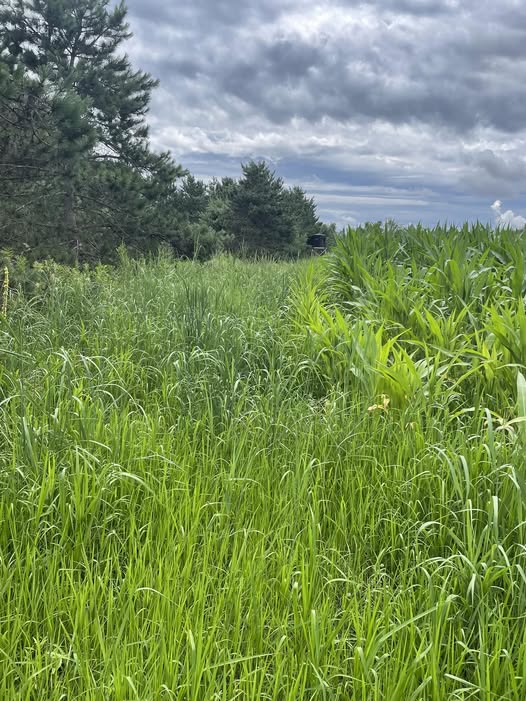
Switchgrass is a native North American prairie grass with an extraordinary range of ornamental cultivars, each offering slightly different foliage color, height, and autumn performance. ‘Shenandoah’ has vivid red autumn color. ‘Heavy Metal’ offers strictly upright, steel-blue foliage. ‘Northwind’ is tall, wind-tolerant, and an excellent choice for screens and large borders. ‘Prairie Fire’ develops deep red tones from midsummer onward.
What all switchgrass cultivars share is the quality of their summer flower panicles — enormous, cloud-like, airy structures that appear in late summer above the foliage and create a shimmering, translucent effect that is especially beautiful in full sun, where light passes through the flower heads and illuminates them from within.
Switchgrass tolerates wet soil, dry soil, clay, and coastal conditions with remarkable equanimity — a breadth of adaptability that makes it one of the most practically useful native grasses for North American landscapes.
Hardiness: USDA Zones 3–9 | Height: 3–6 feet (varies by cultivar) | Spread: 2–3 feet | Light: Full sun to partial shade | Soil: Adaptable; wet to dry, clay to sand
5. Blue Oat Grass (Helictotrichon sempervirens)
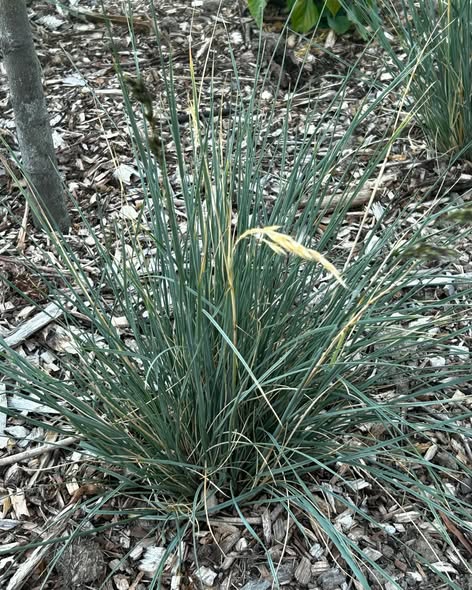
Blue oat grass is the most strongly architectural of all small full-sun ornamental grasses. Its stiff, spiky, steel-blue foliage forms a tight, rounded mound with a sculptural precision that looks as though it was designed rather than grown. The color — a deep, metallic silver-blue — is among the most distinctive in the ornamental grass palette, and it holds this quality year-round as an evergreen plant.
In early summer, tall, oat-like flower spikes rise above the foliage mound and age gracefully from silver-green to warm golden wheat, adding a vertical element that contrasts with the compact, contained form below. It is a cool-season grass that performs most actively in spring and autumn, and in hot, humid climates it benefits from some afternoon shade and good air circulation to prevent summer dormancy.
Excellent drainage is its primary requirement. It does not tolerate wet or waterlogged conditions and performs best in free-draining, moderately fertile soil. Given these conditions, it is a long-lived, almost entirely self-sufficient garden plant.
Hardiness: USDA Zones 4–8 | Height: 2–3 feet (4 feet in flower) | Spread: 2 feet | Light: Full sun | Soil: Well-drained; tolerates poor soil
6. Pampas Grass (Cortaderia selloana)
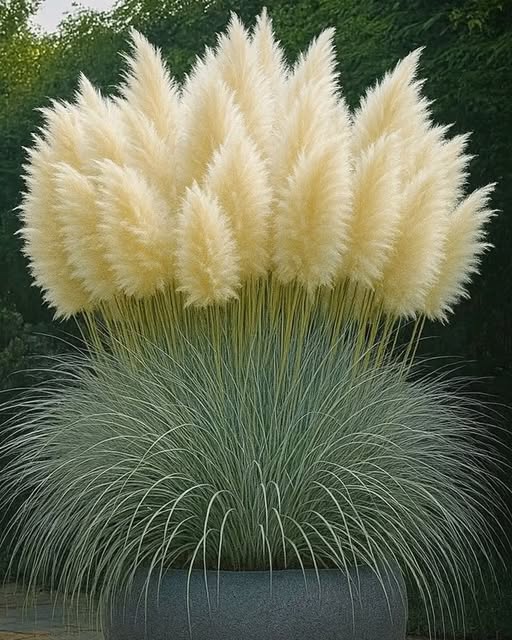
Pampas grass is one of the most dramatic ornamental grasses in the world. Its enormous, creamy-white or pink flower plumes — rising five to ten feet above a broad, arching clump of sharp-edged foliage — create a landscape statement that is impossible to ignore. In a full-sun position with room to develop, a mature pampas grass becomes an unmistakable focal point that defines the entire landscape around it.
It is exceptionally drought-tolerant once established, largely pest-free, and requires only the annual late-winter cutback to maintain its performance. In suitable climates, it is one of the most self-sufficient of all large ornamental grasses.
One important consideration: pampas grass is invasive in parts of California, New Zealand, and Australia, where it spreads aggressively in mild, moist climates. Always consult local invasive species guidelines before planting. Where it is not invasive, it is a genuinely spectacular and reliably low-maintenance landscape plant for full-sun positions.
Hardiness: USDA Zones 7–11 | Height: 6–10 feet (12 feet in flower) | Spread: 6–8 feet | Light: Full sun | Soil: Well-drained; tolerates poor soil and drought
7. Big Bluestem (Andropogon gerardii)
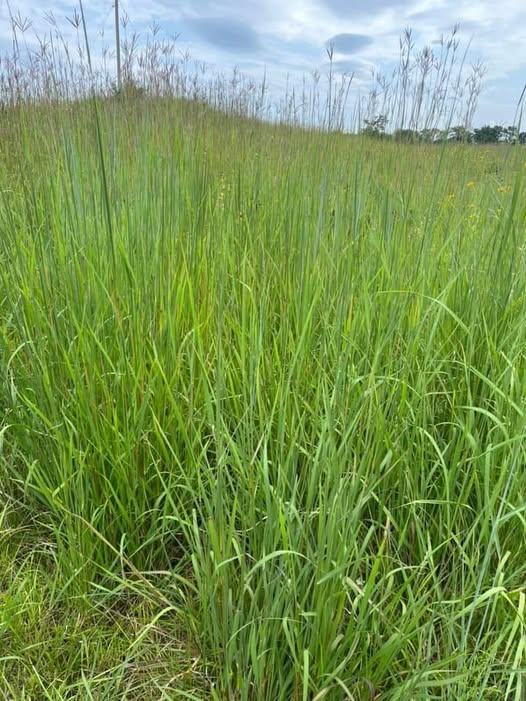
Big bluestem was once the dominant grass of the vast North American tallgrass prairie — so abundant that the Great Plains region became known as the “sea of grass.” In the full-sun garden, it brings that same sense of scale and ecological authenticity, along with outstanding ornamental qualities that make it as beautiful as it is historically significant.
Through the growing season, its upright, blue-green foliage has a clean, strong presence in the border. In autumn, it transforms into one of the most richly colored of all native grasses — its foliage turning vivid shades of copper, burgundy, and orange that glow in low autumn light. Its distinctive three-parted seed heads — which give it the nickname “turkey foot” — remain attractive through winter and provide valuable seed food for birds.
It is extremely drought-tolerant, long-lived, and highly adaptable to a range of soil conditions. Beyond the annual spring cutback, it requires virtually nothing.
Hardiness: USDA Zones 3–9 | Height: 4–6 feet | Spread: 2–3 feet | Light: Full sun | Soil: Dry to medium; tolerates poor soil
8. Fountain Grass (Pennisetum alopecuroides ‘Hameln’)
‘Hameln’ dwarf fountain grass is one of the most perfectly proportioned and complete small ornamental grasses available. Its fine-textured, arching, dark green foliage forms a graceful, rounded mound that is attractive from the moment it emerges in spring. From midsummer, creamy-white, bottlebrush-like flower spikes arch above the foliage — arriving earlier than most fountain grass cultivars — and persist through autumn, aging to warm buff tones as the season advances.
In autumn, the entire plant transitions to warm golden tones, maintaining its ornamental contribution right through to the first hard frosts. It is drought-tolerant once established, clump-forming, and long-lived. In full sun, it performs at its absolute best — the foliage remains tight and compact, the flowering is abundant, and the autumn coloration is richest.
It is an outstanding choice for the middle or front of sunny borders, for grouping in large landscape plantings, and for containers on sunny terraces and balconies.
Hardiness: USDA Zones 5–9 | Height: 2–3 feet | Spread: 2–3 feet | Light: Full sun | Soil: Well-drained; drought-tolerant once established
9. Blue Fescue (Festuca glauca ‘Elijah Blue’)
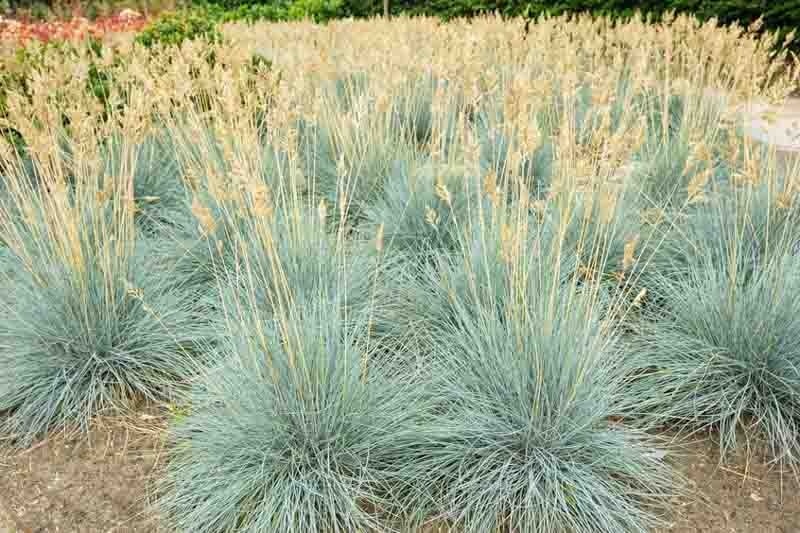
Blue fescue is the quintessential small full-sun ornamental grass. Its intensely silver-blue, spiky, hedgehog-like tussocks have become one of the most recognizable elements of contemporary garden design — used as border edging, repeating accent plants, rock garden specimens, and container plants with equal effectiveness.
Its compact, rounded mound — typically under a foot tall — holds its shape throughout the year as an evergreen plant, providing consistent color and form across every season. In early summer, slender flower spikes rise above the foliage before aging to straw gold. The blue foliage color is most vivid in full sun, which is where this grass should always be positioned.
It benefits from division every two to three years to prevent the center of the clump from dying out — a simple, quick task that keeps the plants consistently fresh and youthful. It is exceptionally drought-tolerant and performs best in lean, well-drained soil.
Hardiness: USDA Zones 4–8 | Height: 8–12 inches | Spread: 10–12 inches | Light: Full sun | Soil: Well-drained, dry to moderately moist
10. Zebra Grass (Miscanthus sinensis ‘Zebrinus’)
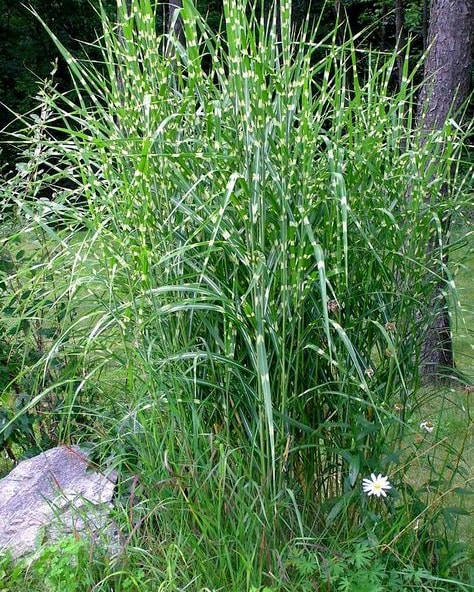
Zebra grass is one of the most visually distinctive ornamental grasses available for full-sun landscapes. While most variegated grasses carry striping along the length of the leaf, zebra grass has horizontal bands of golden-yellow across its wide, arching, dark green leaves — a pattern that is genuinely unusual and immediately eye-catching. The banding becomes more pronounced as summer temperatures warm, and by midsummer the contrast between gold and green is at its most vivid.
In late summer, it produces coppery-pink flower plumes that age gracefully to silver through autumn and winter. Its broad, arching habit gives it a relaxed, naturalistic character that suits informal borders, meadow-style plantings, and woodland-edge designs.
It requires a large, open position in full sun where its distinctive foliage can be appreciated from a distance. It is clump-forming, long-lived, and requires only the annual spring cutback. Give it space — it can reach six to eight feet and spread generously — and it will reward that generosity magnificently.
Hardiness: USDA Zones 5–9 | Height: 6–8 feet | Spread: 4–6 feet | Light: Full sun | Soil: Moist, well-drained; adaptable
11. Prairie Dropseed (Sporobolus heterolepis)
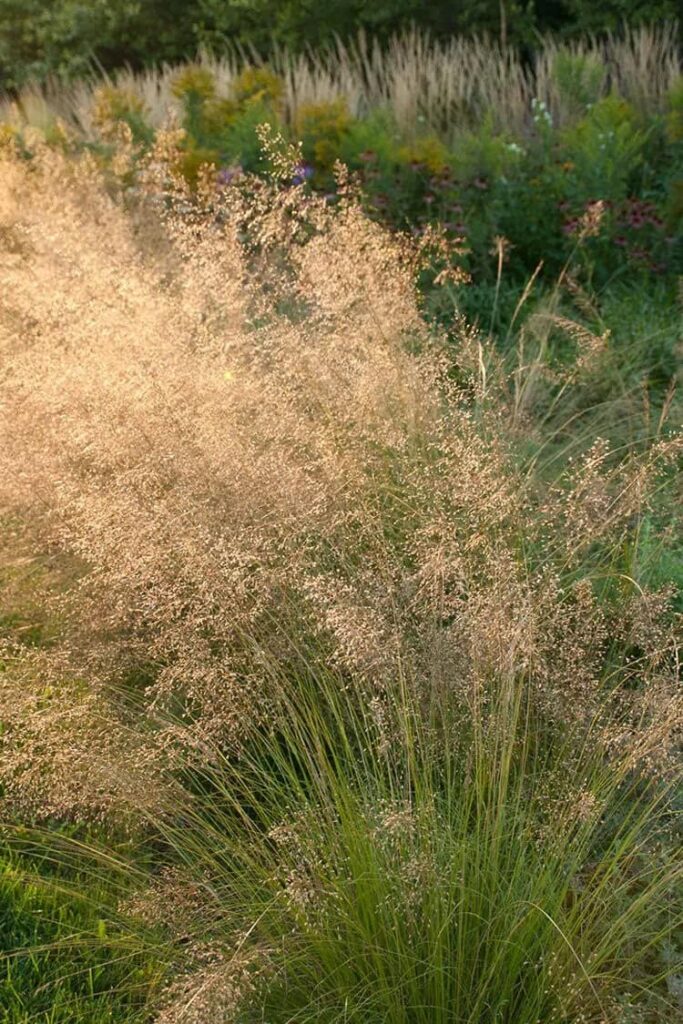
Prairie dropseed is a native North American grass of extraordinary grace and longevity. Its extraordinarily fine, thread-like foliage forms elegant, fountain-shaped clumps that are among the most beautifully proportioned of any full-sun ornamental grass. It is slow to establish — this is the single quality that causes gardeners to underestimate it — but once settled, it can persist for many decades in a full-sun position with virtually no maintenance.
In late summer, its delicate, airy flower panicles emerge with a distinctive fragrance — described variously as buttered popcorn, coriander, or fresh cilantro — that makes it the only ornamental grass in this guide with a meaningful olfactory contribution to the landscape. In autumn, its foliage transitions through warm amber and orange tones before the plant settles into its winter form.
For naturalistic prairie gardens, dry meadow plantings, and any full-sun landscape that values ecological authenticity alongside refined beauty, prairie dropseed is a plant of genuine distinction.
Hardiness: USDA Zones 3–9 | Height: 18–24 inches (3 feet in flower) | Spread: 18–24 inches | Light: Full sun | Soil: Well-drained; drought-tolerant
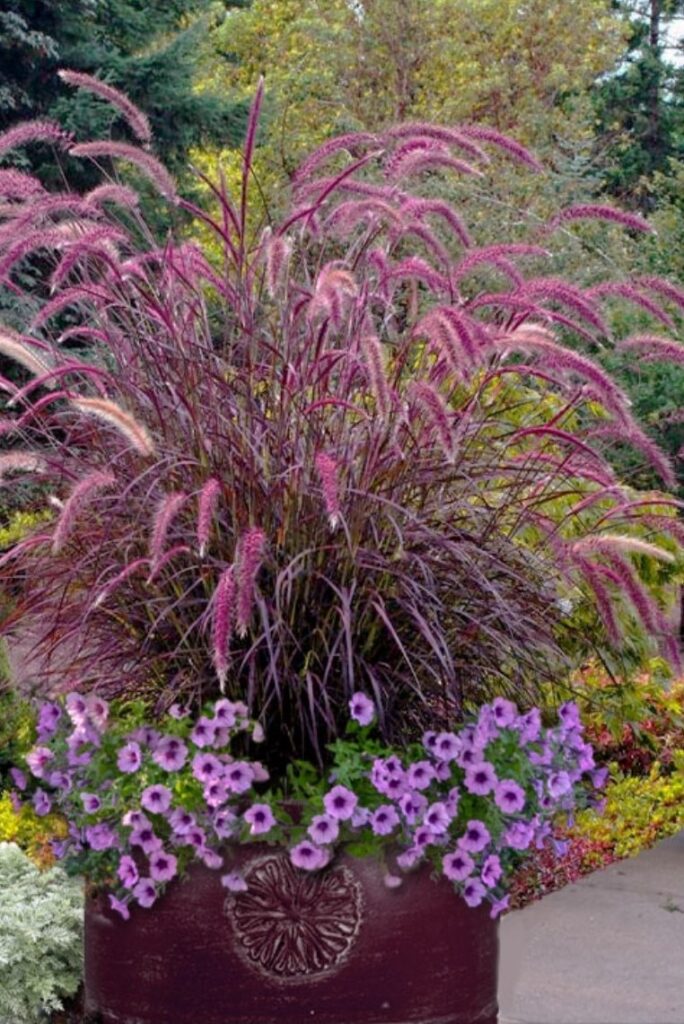
12. Purple Fountain Grass (Pennisetum setaceum ‘Rubrum’)
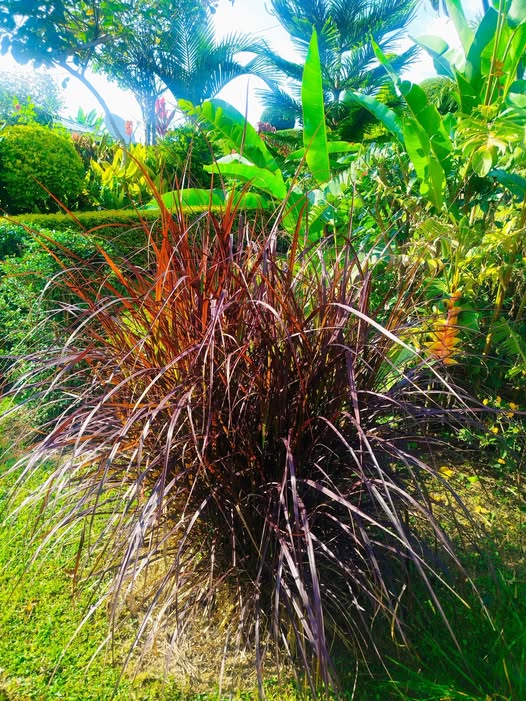
Purple fountain grass is one of the most visually dramatic ornamental grasses for full-sun gardens and containers. Its cascading, burgundy-purple, arching foliage and rosy-pink, bottlebrush flower spikes bring a rich, almost tropical intensity to summer plantings that few other grasses can match. In full sun, the purple foliage color is most vivid, deepening to a near-black in the hottest months and maintaining its dramatic presence right through until the first autumn frosts.
It is one of the finest “thriller” plants in container design and works equally well as a bold specimen in a sunny mixed border where its rich color creates a focal point that anchors the entire planting. It is sterile, producing no viable seed, which eliminates any invasive concern.
In USDA Zones 9 and warmer it is a true perennial. In cooler zones it is grown as an annual or overwintered as a houseplant. In either role, its ornamental impact in a full-sun position is exceptional.
Hardiness: USDA Zones 9–11 (annual in Zones 5–8) | Height: 3–4 feet | Spread: 2–3 feet | Light: Full sun | Soil: Well-drained; drought-tolerant
13. ‘Morning Light’ Japanese Silver Grass (Miscanthus sinensis ‘Morning Light’)
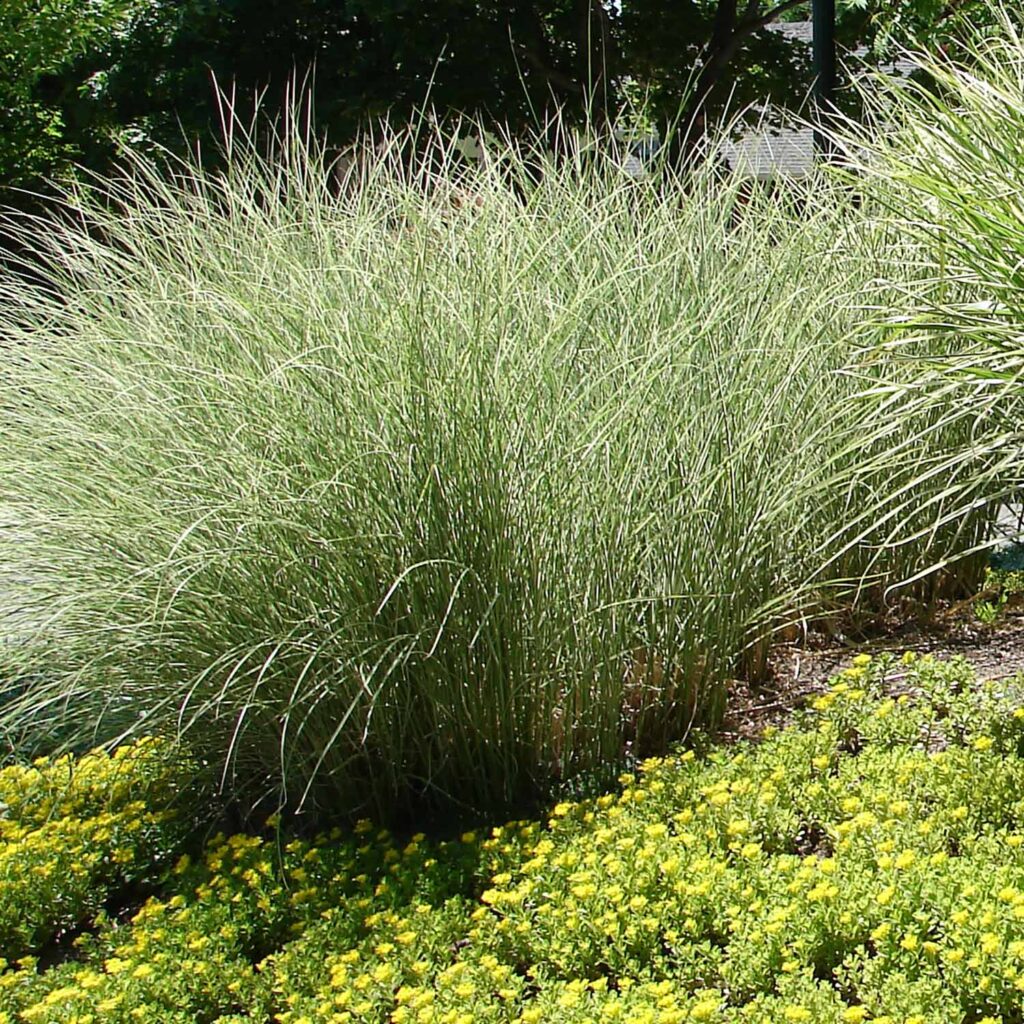
‘Morning Light’ is widely regarded as the most refined and elegant of all Miscanthus cultivars. Its very narrow, dark green leaves carry a delicate white margin and a silver midrib that gives the entire clump a luminous, frosted quality — particularly beautiful in early morning or late afternoon light, when it appears almost to glow from within. The name is entirely earned.
It forms a graceful, vase-shaped clump that reaches five to six feet in height in full sun. In mid to late autumn — later than most Miscanthus cultivars — it produces delicate, copper-red flower plumes that age to silver, adding a final seasonal element that extends the plant’s ornamental contribution well into winter.
Its fine texture and luminous quality make it a natural choice for positions where light quality matters — at the end of a border where evening light catches it, at the edge of a lawn where morning sun illuminates its frosted margins, or beside water where its reflection doubles the effect.
Hardiness: USDA Zones 5–9 | Height: 5–6 feet | Spread: 3–4 feet | Light: Full sun | Soil: Moist, well-drained; adaptable
14. Mexican Feather Grass (Nassella tenuissima)
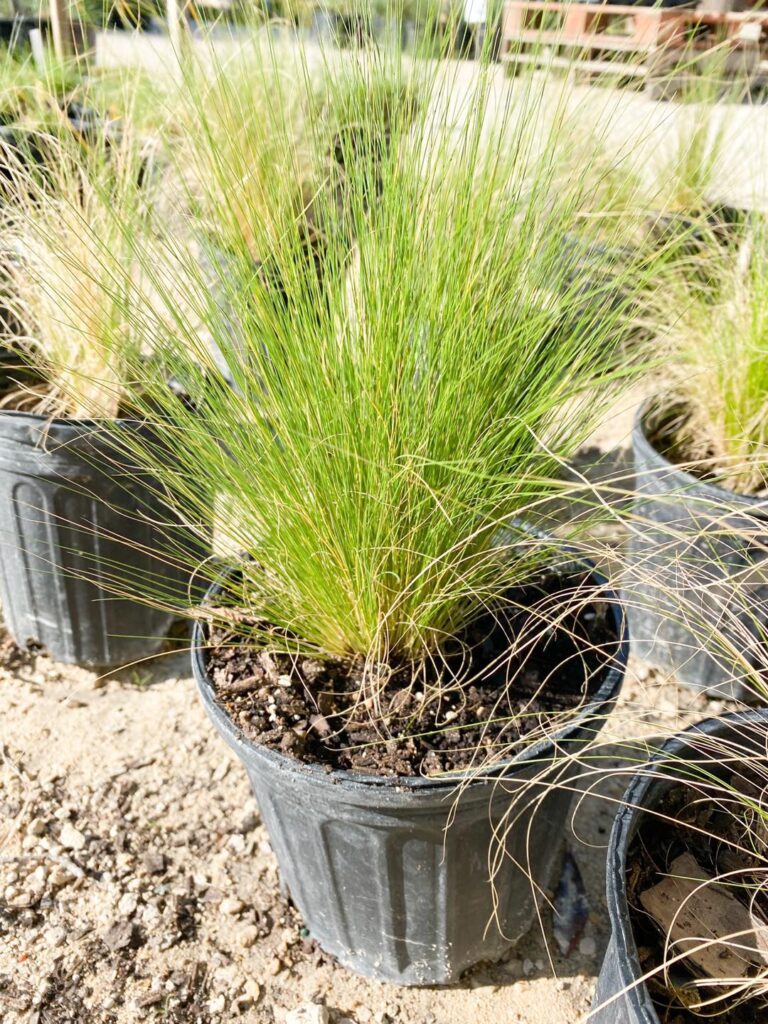
Mexican feather grass is the most ethereally beautiful of all full-sun ornamental grasses. Its extraordinarily fine, hair-like foliage and flower stems create a soft, flowing, gossamer effect — a living cloud of fine texture that responds to the slightest air movement with a swaying, liquid grace that no other grass can replicate. In a full-sun position with space around it, the play of sunlight on its fine stems creates an effect that is genuinely magical.
Its color transitions from fresh, bright green in spring through warm gold and buff tones by late summer, providing a quiet but consistent seasonal narrative across the growing year. It is compact, self-sufficient, and requires very lean, well-drained soil — excess fertility produces floppy, untidy growth that undermines its natural grace.
Note that it can self-seed prolifically in mild climates and is listed as invasive in parts of California, Texas, and Australia. In regions where this is not a concern, it is one of the most beautiful and self-sufficient full-sun grasses available.
Hardiness: USDA Zones 6–10 | Height: 18–24 inches | Spread: 12–18 inches | Light: Full sun | Soil: Well-drained, lean; drought-tolerant
15. ‘Shenandoah’ Switchgrass (Panicum virgatum ‘Shenandoah’)
‘Shenandoah’ is a compact switchgrass cultivar that delivers outstanding autumn color in a border-friendly size. Its fine-textured, upright, green foliage begins to show red tips in midsummer — unusually early for a switchgrass — and by autumn the entire plant is suffused with rich, deep red tones that make it one of the most colorful small grasses of the season.
Its airy, cloud-like flower panicles in late summer add a delicate, translucent quality above the increasingly red foliage, catching afternoon light with extraordinary delicacy. The combination of red foliage and feathery panicles in full late-summer sun is one of those genuinely moving garden moments that rewards every decision that led to it.
It is a native grass with high ecological value, tolerating wet to dry conditions, clay to sandy soils, and coastal exposures with equal adaptability. For full-sun borders where autumn performance is a priority, it is one of the finest choices available.
Hardiness: USDA Zones 3–9 | Height: 3–4 feet | Spread: 2–3 feet | Light: Full sun | Soil: Adaptable; wet to dry
16. Indian Grass (Sorghastrum nutans)
Indian grass is a tall, upright native prairie grass that brings an elegant, stately quality to full-sun landscapes. Its blue-green foliage through the growing season is clean and distinctive. In late summer, it produces beautiful, golden-orange flower panicles — among the most ornamentally refined of any native grass — that age to rich amber and persist through autumn and winter.
In autumn, the foliage turns deep orange-yellow, creating a warm, glowing contribution to the late-season garden that is particularly valuable in naturalistic prairie plantings where this color is a dominant theme. It pairs beautifully with purple coneflower, black-eyed Susan, and other native prairie perennials in full-sun meadow designs.
It is drought-tolerant, long-lived, and ecologically important — its seeds are a significant food source for birds, and its dense clumps provide nesting habitat for ground-nesting insects. It performs best in moderately fertile, well-drained soil in full sun.
Hardiness: USDA Zones 4–9 | Height: 4–7 feet | Spread: 2–3 feet | Light: Full sun | Soil: Well-drained; tolerates dry and clay soils
17. Blue Grama Grass (Bouteloua gracilis)
Blue grama grass is a native North American prairie grass that offers a unique ornamental feature: its summer seed heads are shaped like small, horizontal combs or eyelashes held at a right angle to the stem — a configuration that is unlike any other grass and that creates a distinctive, charming effect that makes visitors look twice and lean closer.
It is a compact, fine-textured grass that forms low, dense mats in full sun and extremely well-drained soil. It is one of the most drought-tolerant ornamental grasses in cultivation — evolved for the hot, dry conditions of the North American Great Plains, it can survive extended dry periods that would devastate most ornamental plants.
Its ecological value is outstanding. It provides critical habitat and food for a range of native insects and birds, and as a true prairie native, it supports the full range of organisms that evolved alongside it. For dry, sunny, ecologically focused landscapes, blue grama grass is one of the finest and most authentic choices available.
Hardiness: USDA Zones 3–10 | Height: 12–18 inches | Spread: 12–18 inches | Light: Full sun | Soil: Well-drained, dry to medium; tolerates poor soil
18. Feather Reed Grass ‘Overdam’ (Calamagrostis x acutiflora ‘Overdam’)
‘Overdam’ brings all the structural excellence of Karl Foerster to a variegated form with additional foliage interest. Its narrow, upright leaves are striped in green, cream, and pink — with the pink tones most vivid in spring and early summer when new growth is at its freshest. Like Karl Foerster, it maintains a strictly upright, columnar habit that provides clean vertical structure in full-sun borders without the lateral spread that makes wider grasses difficult to accommodate.
Its feathery flower spikes emerge in late spring and age through summer from pink-tinged silver to warm buff — providing the same reliable, long-lasting flower display as Karl Foerster while adding the variegated foliage dimension that makes it additionally useful in mixed plantings where foliage character matters as much as form.
It shares Karl Foerster’s excellent tolerance for clay soil, varying moisture conditions, and urban pollution, making it a versatile choice for a wide range of full-sun situations from residential gardens to public landscape plantings.
Hardiness: USDA Zones 5–9 | Height: 4–5 feet in flower | Spread: 2 feet | Light: Full sun to partial shade | Soil: Adaptable; tolerates clay
19. Ravenna Grass (Saccharum ravennae)
Ravenna grass — sometimes called hardy pampas grass — is one of the most dramatic and impressive large ornamental grasses for full-sun landscapes in colder climates where true pampas grass is not reliably hardy. Its bold, arching foliage clumps reach six to eight feet, and its enormous, silvery-white flower plumes — rising to ten to fourteen feet — create a landscape statement of considerable power and presence.
It is a large, commanding plant that needs adequate space to develop its full potential. In a full-sun position with room to spread, it becomes an unmistakable focal point — a specimen plant that organizes the entire landscape around it and provides dramatic vertical interest from late summer through winter.
It is more cold-hardy than pampas grass, surviving winters in USDA Zone 5 with protection. It is drought-tolerant once established and performs best in full sun with well-drained soil. Unlike pampas grass, it is not listed as invasive in North America or Europe.
Hardiness: USDA Zones 5–9 | Height: 6–8 feet (10–14 feet in flower) | Spread: 4–6 feet | Light: Full sun | Soil: Well-drained; tolerates drought and poor soil
20. Potentilla — Silver Spike Grass (Achnatherum calamagrostis)
Silver spike grass is a medium-sized, clump-forming grass with fine, arching foliage and outstanding silvery-white flower spikes that appear from midsummer through autumn — one of the longest flowering seasons of any ornamental grass. The flower panicles are held in dense, feathery, silver-white spikes that shimmer and wave gracefully in full-sun positions, creating a long-lasting display that carries the border’s ornamental energy well into the second half of the growing season.
Its foliage is fine-textured and arching, forming a graceful, fountain-like mound that holds its form attractively through the season. It is drought-tolerant once established, performs best in well-drained to dry soil in full sun, and is largely trouble-free from pests and diseases.
It is an excellent choice for sunny gravel gardens, dry meadow plantings, Mediterranean-style landscapes, and mixed borders where a long-blooming, silvery-textured grass is needed to bridge the gap between the summer flowering season and the end of the growing year.
Hardiness: USDA Zones 5–9 | Height: 2–3 feet (3–4 feet in flower) | Spread: 2 feet | Light: Full sun | Soil: Well-drained, dry to moderately moist; drought-tolerant
Design Principles for Full-Sun Ornamental Grass Landscapes
Choosing the right grasses is essential. Using them thoughtfully is what transforms a collection of good plants into a genuinely outstanding landscape.
Work with light direction. Full-sun grasses are at their most spectacular when light passes through their foliage and flower heads at low, oblique angles — early morning and late afternoon light in particular. Position translucent, fine-textured grasses like Mexican feather grass, switchgrass, and prairie dropseed where the sun will backlight them regularly. Place Japanese silver grass at the end of a border where evening light catches its silvery margins. These light moments are the defining experiences of a well-designed grass landscape, and they cost nothing beyond thoughtful positioning.
Combine warm and cool tones. The palette of full-sun grasses ranges from cool silver-blue (blue fescue, blue oat grass) through neutral green (Karl Foerster, prairie dropseed) to warm gold and bronze (maiden grass, feather grass, zebra grass) and deep burgundy (purple fountain grass). Combining plants from opposite ends of this temperature range creates visual tension and interest that holds across the seasons as each plant moves through its color changes at its own pace.
Scale plants to the space. Large grasses — pampas grass, maiden grass, Ravenna grass, zebra grass — need adequate space to develop their natural form and to be appreciated from the right distance. In a small garden, a large grass confined to a tight space looks uncomfortable and creates a maintenance burden. In a large, open landscape, the same grass is magnificent. Scale your plant choices honestly to the dimensions of your space.
Create rhythm through repetition. Repeating a single grass variety at regular intervals through a long border or across an open landscape creates visual rhythm and cohesion that unifies the planting. Karl Foerster planted every six to eight feet along a border provides a consistent vertical structure that connects every section of the planting into a coherent whole. Blue fescue in groups of three or five, repeated through a gravel garden, creates a punctuation pattern that gives the entire design its character.
Use native grasses for ecological depth. Little bluestem, switchgrass, big bluestem, Indian grass, blue grama, and prairie dropseed are all native North American species that provide not just ornamental value but genuine ecological function — supporting native insects, feeding birds, providing habitat, and contributing to the biological health of the landscape in ways that non-native species cannot replicate. In a full-sun landscape, incorporating native grasses alongside non-native ornamentals creates a garden that is both beautiful and ecologically meaningful.
Planting and Establishment in Full-Sun Conditions
Full-sun positions can be demanding for newly planted grasses, particularly in regions with hot summers and limited rainfall. Successful establishment requires attention to timing, soil preparation, and early care.
Plant in spring for warm-season grasses. Warm-season grasses — those that grow most actively in summer heat, including switchgrass, little bluestem, big bluestem, fountain grass, and purple fountain grass — establish most reliably when planted in spring, after the last frost date, when warming soil temperatures immediately encourage root development.
Plant in autumn for cool-season grasses. Cool-season grasses — those that grow most actively in spring and autumn, including Karl Foerster, blue oat grass, and blue fescue — establish well in early autumn when temperatures moderate and autumn rainfall reduces the irrigation burden.
Prepare the soil thoroughly. Remove all perennial weeds before planting — they are very difficult to remove from established grass clumps without disturbing the plant. Incorporate organic matter into very sandy or very clay-heavy soils to improve drainage and water retention respectively. For drought-tolerant species like blue fescue and blue grama, avoid over-enriching the soil, which encourages the lush, floppy growth that undermines their natural form.
Water consistently through the first season. Even drought-tolerant grasses are vulnerable during establishment before their root systems are fully developed. Water deeply but infrequently during the first growing season — this encourages deep root development rather than shallow surface roots that are more vulnerable to drought stress.
Mulch to conserve moisture. A two to three inch layer of mulch around newly planted grasses conserves moisture, moderates soil temperature, and reduces competition from weeds. Keep mulch away from the crown of the plant to prevent crown rot, particularly for species that are sensitive to winter moisture.
Suggested For You:
20 Small Ornamental Grasses for Borders: The Complete Planting Guide
15 Tall Ornamental Grasses for Privacy: A Complete Screening Guide
15 Ornamental Grasses for Winter Interest: Identification and Features
Kentucky Bluegrass vs Tall Fescue: Which Grass Is Right for Your Lawn?
Bermuda Grass vs St. Augustine Grass: Which Warm-Season Grass Is Right for Your Lawn?
Annual Care Summary
The annual care requirements for full-sun ornamental grasses are intentionally simple — one of the qualities that makes them so appealing for busy gardeners.
Late winter or early spring: Cut back deciduous grasses to within three to six inches of the ground before new growth begins. For larger grasses, use loppers, a string trimmer, or hedge shears. Tie the clump loosely before cutting to contain the debris and make cleanup easier. For evergreen grasses, comb out dead material by hand or use scissors to trim lightly rather than cutting to the ground.
Spring: Apply a light dressing of balanced slow-release fertilizer around the base of each plant. Most full-sun grasses perform better in lean to moderately fertile conditions, so avoid heavy feeding.
Summer: Water newly planted grasses during prolonged drought. Established grasses generally manage without supplemental irrigation in all but the most extreme dry conditions.
Autumn: Leave all grasses standing. The dried foliage and seed heads are one of the finest features of the full-sun grass garden through autumn and winter — structurally beautiful, ecologically valuable, and a source of quiet, sustained pleasure through the quietest months of the gardening year.
Final Thoughts
A full-sun landscape planted with the right ornamental grasses is one of the most rewarding and genuinely beautiful garden styles available to any gardener. It is a style that works with natural light, seasonal change, and the movement of air rather than against them. It asks for patience in the early years and relatively little effort thereafter.
The twenty grasses in this guide represent the finest options across a wide range of sizes, forms, climates, and design styles. Choose plants that suit your specific conditions and your personal vision, plant them in the right positions, and give them time to settle and mature. What develops over the following seasons — the texture, the movement, the color, the ecological life — will exceed anything a catalog description or a planting plan could fully anticipate.
That is, in the end, what makes ornamental grasses in full sun so worth growing. They become more than the sum of their qualities. They become the character of the garden itself.
References
- Penn State Extension – Ornamental Grasses: Selection and Landscape Use https://extension.psu.edu/ornamental-grasses
- University of Minnesota Extension – Ornamental Grasses for Full Sun Landscapes https://extension.umn.edu/planting-and-growing-guides/ornamental-grasses
- North Carolina State University Extension – Ornamental Grasses for Sunny Sites https://content.ces.ncsu.edu/ornamental-grasses
- Kansas State University Extension – Native and Ornamental Grasses for Prairie Landscapes https://www.ksre.k-state.edu/news/stories/2021/06/ornamental-grasses.html
- USDA Plant Hardiness Zone Map – Official Cold Hardiness Reference for Plant Selection https://planthardiness.ars.usda.gov

Tim M Dave is a gardening expert with a passion for houseplants, particularly cacti and succulents. With a degree in plant biology from the University of California, Berkeley, he has vast experience in gardening. Over the years, he has cultivated a vast collection of desert plants and learned a great deal about how to grow and care for these unique companions.