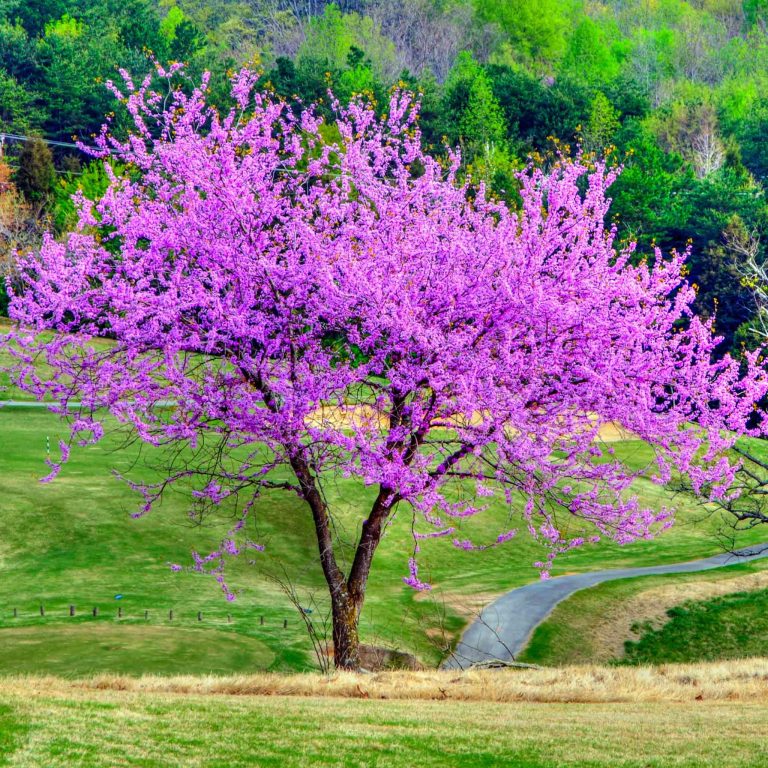
Understanding Mexican Plum (Prunus mexicana): Identification, Uses, Problems, and More
There is a particular kind of native tree that horticulturists call a “workhorse.” It is not always the most famous plant in the genus. It does not dominate nursery catalogs or garden center displays. But once gardeners discover it — truly discover it — they rarely look back.
The Mexican Plum (Prunus mexicana) is that tree for the South-Central United States.
In early spring, often as early as February, it erupts into a cloud of fragrant white blossoms before a single leaf has emerged — a display so pure and generous that it has earned the loyalty of native plant gardeners across Texas, Oklahoma, Arkansas, and the Gulf States for generations.
Those flowers give way to dark purple, sweet-tart plums that ripen in late summer and fuel one of the most diverse assemblages of wildlife feeding on any single native species in the region.
Beyond the flowers and fruit, the Mexican Plum is tough, adaptable, drought-tolerant, modestly sized, and deeply connected to the cultural foodways of Indigenous and settler communities across its range.
This guide covers the Mexican Plum completely — its identity, ecology, cultural history, edible fruit, landscape value, wildlife benefits, and practical growing guidance.
Quick Summary About Mexican Plum
| Feature | Detail |
| Scientific Name | Prunus mexicana |
| Family | Rosaceae |
| Common Names | Mexican Plum, Big Tree Plum, Texas Plum, Wild Plum |
| Native Range | South-Central U.S. through northeastern Mexico (Zones 5–9) |
| Mature Height | 15–25 feet |
| Crown Form | Rounded to spreading; single or multi-trunked |
| Bark | Dark, scaly, peeling; reddish inner bark |
| Thorns | Present on young growth |
| Bloom Time | February–March (on bare branches) |
| Flower Color | White, fragrant |
| Fruit | Dark purple plums; ripe August–September |
| Fruit Edibility | Fully edible; jams, jellies, wine, fresh eating |
| Fall Color | Yellow to orange-red (modest) |
| Soil Tolerance | Excellent — including alkaline limestone soils |
| Drought Tolerance | High — once established |
| Wildlife Value | Exceptional — pollinators, birds, mammals |
| Hardiness Zones | USDA Zones 5–9 |
What Is the Mexican Plum?
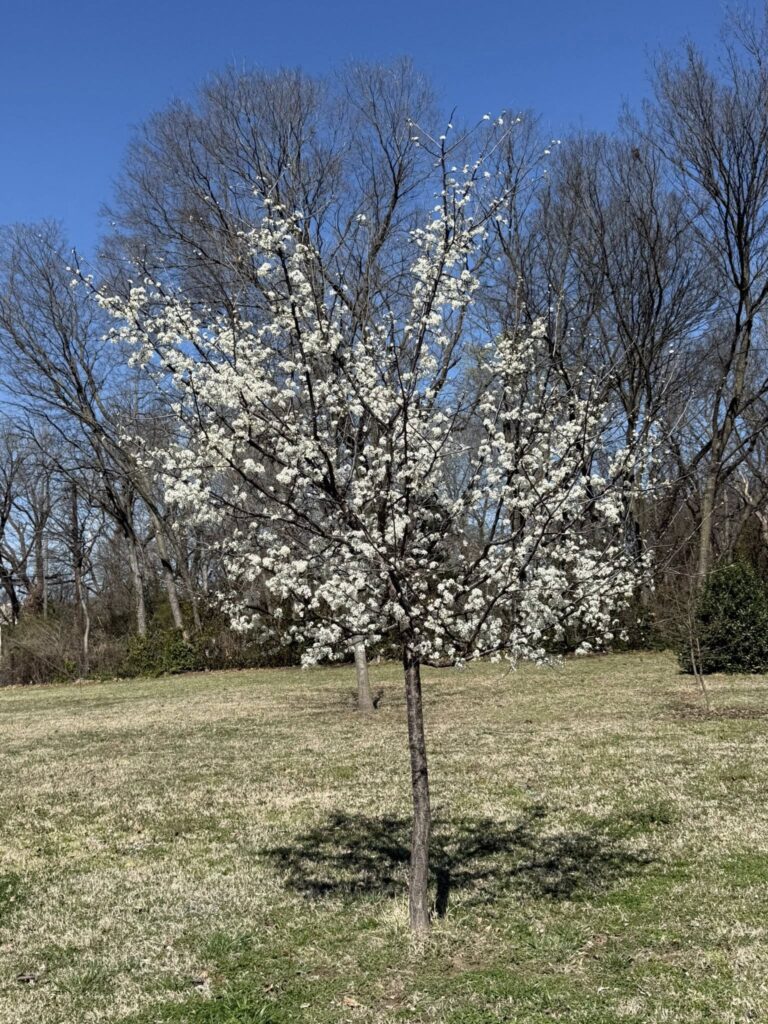
The Mexican Plum belongs to the family Rosaceae — the rose family — and to the genus Prunus, which is one of the most horticulturally important plant genera in the world, encompassing cherries, peaches, apricots, almonds, and all the cultivated plums.
Within Prunus, the Mexican Plum is classified in the section Prunus — the true plums — which distinguishes it from cherries, bird cherries, and chokecherries within the broader genus.
Its scientific name, Prunus mexicana, was assigned by Samuel Botsford Buckley in 1860, based on specimens collected in Texas.
Despite the species name mexicana, the tree is not exclusively Mexican in distribution — it is native across a broad region of south-central and central North America, ranging well into the United States. The name reflects where early botanical specimens were collected and described, not the tree’s full range.
Common names are more varied than the clean, direct scientific name suggests:
- Mexican Plum — the standard common name; widely accepted in botanical and horticultural literature
- Big Tree Plum — used in Texas and Oklahoma, referencing its larger stature compared to other native plums
- Red Plum — used in some regional contexts, though the ripe fruit is typically dark purple rather than red
- Texas Plum — occasionally used to emphasize its abundance and significance in the Texas landscape
- Wild Plum — a generic name applied across numerous native Prunus species; used casually but imprecise when applied to this specific species
Among the native plums of the south-central United States — a group that includes the Chickasaw Plum (Prunus angustifolia), the Creek Plum (Prunus rivularis), and the American Plum (Prunus americana) — the Mexican Plum is notably larger in stature.
Native Range and Natural Habitat
The Mexican Plum is native to a broad region of south-central and central North America, with its range centered on the Cross Timbers, Edwards Plateau, and Gulf Coastal Plains of Texas and extending north through Oklahoma and Arkansas, east through Missouri, Tennessee, and into parts of Alabama, Georgia, and Florida, and south into northeastern Mexico.
Texas is the heart of Mexican Plum country. Growing from the Piney Woods of East Texas across the blackland prairies, through the limestone hills of the Hill Country, and into the eastern edge of the Trans-Pecos region, it is one of the most abundant and widely distributed native fruiting trees in the state.
Few native trees are as reliably present across such a diverse range of Texas landscapes.
Within its range, the Mexican Plum is highly habitat-flexible. It grows along creek banks and stream margins, on rocky limestone hillsides, at the edges of cedar and oak woodlands, in fencerows and old field margins, and on the rocky soils of the Edwards Plateau that challenge many other species.
It is particularly characteristic of the ecotone — the transitional zone between woodland and open grassland or prairie — where it often forms the outer margin of woody vegetation along woodland edges and draws.
In these positions, it functions ecologically as a pioneer and edge species, its dense thorny branches creating shelter for birds and small mammals while its fruit feeds a broad community of wildlife.
The Mexican Plum is also common on calcareous, alkaline soils — the rocky limestone-derived soils of the Edwards Plateau and Cross Timbers that are notoriously challenging for many ornamental plants.
This limestone tolerance is one of its most practically valuable landscape traits for gardeners in central Texas and similar calcareous soil regions.
Physical Characteristics
Size and Form
The Mexican Plum is a small deciduous tree, typically reaching 15 to 25 feet (4.5–7.5 meters) in height, with a spread of 10 to 20 feet. It is one of the larger native plum species in North America — significantly taller and more tree-like than the Chickasaw Plum or the thicket-forming American Plum.
Unlike most other native plums, which spread aggressively by root suckers and form dense thickets, the Mexican Plum typically grows as a single-trunked tree or a small multi-trunked specimen with a defined crown. This more upright, tree-like habit makes it far more compatible with formal landscape settings than its suckering relatives.
The crown is broadly rounded to spreading, often with a slightly irregular, natural character that gives mature specimens a pleasantly informal, woodland-edge quality. Old trees develop considerable girth and character — their trunks becoming thick, rugged, and deeply textured with age.
Bark — Dark, Furrowed, and Peeling
The bark of the Mexican Plum is one of its most distinctive identification features. On young trunks and branches, it is dark gray to almost black, smooth, and marked by horizontal lenticels — the characteristic breathing pores of the cherry-plum group, visible as horizontal dashes across the smooth bark.
As the tree matures, the bark develops into thick, dark, blocky scales that peel away in irregular plates, revealing reddish-brown inner bark beneath. On old trees, the trunk is deeply and dramatically textured — rough, dark, and rugged in a way that contrasts handsomely with the white spring flowers and provides strong winter ornamental interest.
The peeling bark pattern on mature Mexican Plum trunks is one of the more ornamentally interesting bark features of any native Texas tree — something that rewards close examination throughout the year.
Thorns
Mexican Plum branches frequently terminate in sharp, stiff thorns — a defensive adaptation shared with many other wild plums. On young, vigorous growth, thorns can be quite prominent. On older, slower-growing branches, they become less pronounced.
The thorns are a practical consideration in landscape siting — the tree should not be planted immediately adjacent to paths, play areas, or seating where people routinely brush against it. Placed appropriately, however, they add to the tree’s value as a wildlife shelter plant — dense, thorny interior branches provide protection from predators for nesting birds.
Leaves
The leaves are simple, alternate, and broadly elliptical to ovate, measuring 2 to 4 inches (5–10 cm) in length, with finely toothed margins and a slightly wrinkled surface. They are dark green and glossy in summer, paler beneath, with a somewhat leathery texture.
In autumn, the foliage turns yellow to orange-red — modest rather than spectacular, but a genuine seasonal contribution in the south-central landscape where reliable fall color trees are fewer than in the Northeast.
The leaves have a faint characteristic scent when crushed — the mild, slightly bitter almond-like smell characteristic of the Prunus genus, caused by trace amounts of hydrogen cyanide compounds in the plant’s tissues.
The Flowers — Spring’s Most Generous Display
The flowers are the Mexican Plum’s most celebrated ornamental feature, and their timing is what makes them genuinely extraordinary.
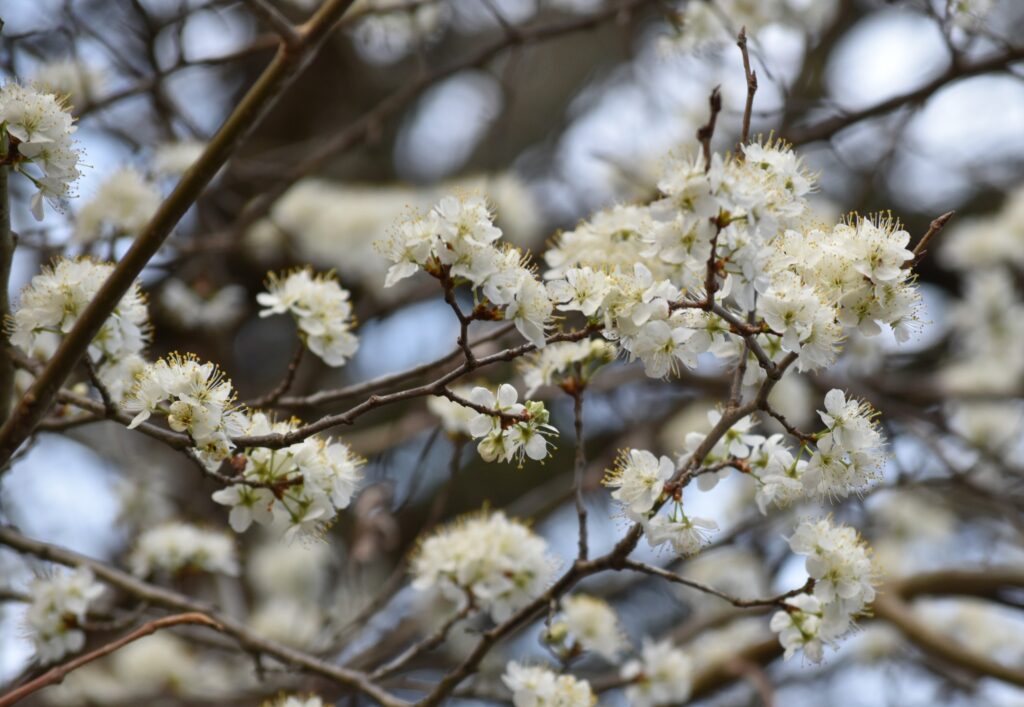
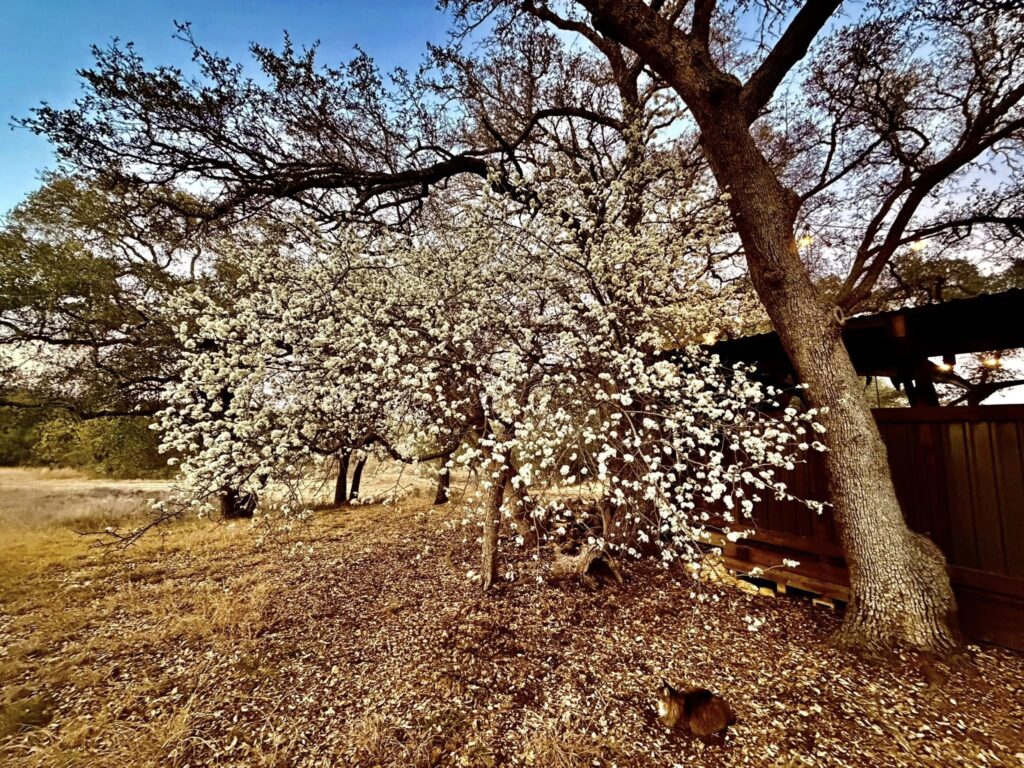
Mexican Plum blooms in late winter to very early spring — February in central Texas, sometimes as early as late January in warm years, extending into March in cooler northern parts of the range. It blooms on bare branches before the leaves emerge, creating the clean, white-on-gray display that is among the finest early-season spectacles in the native landscape.
Each flower is approximately ¾ to 1 inch (2–2.5 cm) across, with five white petals and a cluster of central stamens — the classic rose-family floral structure. Flowers are borne in clusters of 3 to 5 along the bare twigs, covering the branches so densely that the entire tree appears white during peak bloom.
The flowers are distinctly and pleasantly fragrant — a sweet, almond-accented floral scent that carries noticeably on warm late-winter air. On a still February morning, the fragrance of a Mexican Plum in full bloom can reach you before the tree itself comes into view.
There is something deeply affecting about a Mexican Plum in full bloom on a gray February day in Texas — white flowers against bare gray bark, the scent drifting across a still winter landscape, the promise of spring delivered weeks before anything else has awakened. I have returned to the same trees in the same February spots more years than I can count, and the display never diminishes.
Bloom duration is approximately 7 to 14 days — short by some standards, but intensely beautiful within that window.
The Fruit — Sweet, Tart, and Deeply Valuable
The Mexican Plum produces one of the finest edible wild fruits in the south-central United States — a quality that has been recognized by Indigenous peoples, early settlers, and contemporary foragers alike.
Fruit Description
The plums ripen in late summer — August through September across most of the range. They are round to slightly oval, approximately ¾ to 1¼ inches (2–3 cm) in diameter, with a thin skin and juicy flesh surrounding a single hard pit.
Ripe fruit is dark purple to red-purple, with a whitish bloom (the natural waxy coating common to plums) that partially obscures the deep color. Beneath the skin, the flesh is yellow to orange-yellow, juicy, and richly flavored.
Flavor varies between individual trees, which is characteristic of a genetically diverse wild species. Some individuals produce sweeter fruit; others are more tart. Finding and returning to a particularly good tree is one of the pleasures of foraging this species.
Edibility and Culinary Uses
The fruit is fully edible raw when ripe, though the skin can be slightly astringent. The best culinary applications include:
- Jams and preserves — the traditional and most common use; the high pectin content of the skin produces naturally firm, full-flavored jams
- Jellies — strained from the cooked fruit; a classic Texas folk preparation
- Fruit butters and sauces — cooked and strained; excellent with game meats
- Wines and fermented beverages — wild plum wine is a long-standing tradition in rural Texas and Oklahoma
- Cobblers, crisps, and pies — the tartness balances well with sweetener in baked applications
- Dried plum leather — traditional Indigenous preservation method
- Fresh eating — particularly from sweet-fruited individual trees
Mexican Plum jelly has been a staple of Central Texas folk cuisine for generations. It appears at farmhouse tables, church cookbooks, and roadside stands across the Hill Country and Cross Timbers — a living culinary tradition directly tied to this single native tree.
Nutritional Value
Wild plums are nutritionally comparable to cultivated plums — providing vitamin C, vitamin A precursors, dietary fiber, potassium, and antioxidant compounds including anthocyanins (responsible for the dark skin color) that have been associated with cardiovascular and anti-inflammatory benefits in dietary research.
Wild fruit generally contains higher levels of antioxidant phenolics than cultivated counterparts bred for sweetness and uniformity — the same trade-off that applies across most wild vs. cultivated fruit comparisons.
Cultural and Historical Significance
Indigenous Uses
Indigenous peoples across the Mexican Plum’s range relied heavily on this and related wild plums for food, medicine, and material culture. Tribes including the Comanche, Kiowa, Caddo, Cherokee, and numerous others consumed the fruit fresh, and dried it for winter storage.
The fruit was also fermented into beverages, and the inner bark and roots were used medicinally — as astringents for digestive complaints, topical treatments for skin conditions, and in various ceremonial preparations.
Dried wild plums were among the most portable and energy-dense preserved foods available to Plains and Southeastern tribes — an important caloric resource during long migrations, winter camps, and war parties when fresh food was unavailable.
Early Settler and Pioneer Uses
European and American settlers moving through Texas and the South-Central region adopted wild plum use directly from Indigenous peoples, and the tradition of wild plum jelly-making became embedded in rural Southern and Texan domestic culture in the nineteenth century.
The Mexican Plum was one of the most important wild foods available to early settlers in a region where cultivated fruit orchards were not yet established and grocery infrastructure did not exist.
Ecological Value and Wildlife Benefits
The Mexican Plum is an ecologically productive species whose benefits extend far beyond the visual spectacle of its flowers.
Pollinators — Early-Season Lifeline
Because the Mexican Plum blooms in February — weeks before most other flowering plants in its range — its nectar and pollen provide a critical early-season resource for native bees, honeybees, and other pollinators emerging from winter dormancy when food sources are nearly nonexistent.
This early bloom timing is not incidental — it is one of the Mexican Plum’s most significant ecological contributions.
Native bee colonies that survive winter on stored reserves depend on early-blooming plants like Mexican Plum to begin rebuilding their populations and food stores before the main spring bloom season arrives.
Bumblebees, mason bees, mining bees, and honeybees all work Mexican Plum flowers intensively during bloom. On warm February days, the sound of bees working a flowering Mexican Plum is one of the first ecological sounds of the approaching spring.
Birds
The fruit is consumed by a wide diversity of native bird species, including:
- Northern Mockingbird — one of the most consistent consumers and defenders of Mexican Plum fruit
- American Robin — particularly during fall migration
- Cedar Waxwing — consumes fruit in flocks during migration
- Eastern Bluebird
- Wild Turkey — consumes fallen fruit
- Various woodpeckers — forages both fruit and insects in the bark
- Yellow-rumped Warbler and other warblers during fall migration
The dense, thorny branching of the Mexican Plum also provides excellent nesting habitat for songbirds — the interior of the crown is physically protected from predators by thorns, making it favored nesting territory for mockingbirds, thrashers, cardinals, and other species.
Mammals
White-tailed deer browse heavily on Mexican Plum fruit, twigs, and foliage — the tree is among the most deer-browsed native species in Texas. This attention from deer means that young transplants must be protected from deer damage until established above browse height.
Raccoons, foxes, coyotes, opossums, and skunks all consume fallen plums. Gray and fox squirrels take the fruit from the tree and cache seeds.
Small mammals — cotton rats, white-footed mice, and others — consume fallen fruit and seeds throughout the ripening season.
Lepidoptera Host Plant
The Mexican Plum and other native Prunus species are larval host plants for numerous moth and butterfly species, including the Coral Hairstreak butterfly (Satyrium titus), the Henry’s Elfin butterfly (Callophrys henrici), the Eastern Tiger Swallowtail, and numerous native moth species.
This caterpillar-supporting function makes the Mexican Plum an important component of the insect food web that sustains insectivorous birds — particularly during the breeding season when protein-rich caterpillars are the primary food for nestlings.
Landscape and Garden Uses
For gardeners across the south-central United States, the Mexican Plum is one of the most practically valuable and versatile native trees available.
Specimen and Ornamental Tree
As a spring-flowering specimen, it rivals any ornamental tree in the regional native palette. The February-March bloom — fragrant, white, profuse — creates a display that larger-flowered exotic alternatives in the same bloom season cannot improve upon.
Position it where the February flowers will be seen from a primary window or garden path. The bloom season is short — two weeks — but it is the garden event of late winter, and viewing it casually from indoors on a cold February morning is one of the genuine pleasures of growing this tree.
Wildlife Garden and Food Plot
For wildlife gardeners and land managers, Mexican Plum is an essential planting. Few native trees in its range provide comparable value across pollinators, cavity birds, nesting songbirds, deer, and migrating fruit-eating birds simultaneously.
In food plots and wildlife management areas across central Texas and Oklahoma, Mexican Plum is planted specifically for deer, turkey, and songbird habitat — its early-season pollen, summer fruit, and year-round cover value make it among the highest-value plantings.
Limestone and Alkaline Soil Applications
For gardeners in central Texas and other calcareous limestone regions, the Mexican Plum’s proven tolerance of alkaline, rocky, thin soils makes it one of the most reliable ornamental flowering trees.
This tree is available for difficult site conditions where acid-loving species like dogwoods, azaleas, and many ornamental cherries fail.
This is not a minor point. Alkaline soil intolerance is one of the most significant limitations on ornamental tree selection across large parts of Texas — and the Mexican Plum navigates this limitation naturally, without soil amendment or intervention.
Edible Landscape and Food Forest
For edible landscape designers, the Mexican Plum combines genuine ornamental value with productive fruit — a rare combination in a tree that also provides significant wildlife value. In food forest designs for Texas and the south-central region, it serves well as a productive mid-story tree.
Hardiness and Adaptability
Mexican Plum is hardy in USDA Zones 5 through 9 — covering the entire range from central Texas north through Oklahoma and the Midwest, east through the Southeast, and into the Mid-Atlantic.
Heat and drought tolerance are exceptional — far superior to most cultivated ornamental Prunus species — making it reliable in the hot, dry summers characteristic of the south-central United States.
How to Plant and Grow Mexican Plum
Sourcing Plants
Purchase from reputable native plant nurseries carrying locally sourced stock. Mexican Plum is widely available through Texas, Oklahoma, and Arkansas native plant suppliers. Container-grown plants establish well and are significantly easier to establish than wild-collected specimens.
Site Selection
- Choose full sun to partial shade — best flowering, fruiting, and natural form develop in full sun.
- Soil flexibility is broad — Mexican Plum tolerates sandy, loamy, and rocky calcareous soils, and a wide pH range (6.0–8.0). It does not require soil amendment in most Texas sites.
- Drainage is the primary requirement — avoid permanently waterlogged areas.
- Allow adequate clearance from paths — thorny branches at the crown margin can be hazardous in close proximity to foot traffic.
Planting Instructions
- Plant in autumn or early spring — autumn planting allows root establishment before the demands of spring bloom and leaf-out.
- Dig the planting hole two to three times wider than the root ball and no deeper.
- Set the root flare at grade — deep planting is a primary cause of long-term decline.
- Backfill with native soil — no amendment is typically necessary in most Texas soils.
- Mulch generously — 3 to 4 inches of wood chip mulch extending well beyond the root ball, keeping mulch clear of the trunk.
- Water consistently during the first two growing seasons — once established, the Mexican Plum is remarkably drought-tolerant and requires minimal supplemental irrigation.
Pruning
Minimal pruning is required. Remove suckers from the base if a single-trunk tree form is desired — though some multi-stem forms have their own ornamental benefits. Prune dead or crossing branches in late summer after the bloom season and fruit ripening are complete.
Avoid heavy pruning in late winter, which removes flower buds.
Pests, Diseases, and Common Problems
The Mexican Plum is considerably more pest and disease resistant than cultivated plum varieties — a characteristic of native species adapted to local conditions through thousands of years of natural selection.
Plum Curculio
The Plum Curculio (Conotrachelus nenuphar) — the primary pest of cultivated plums — also attacks Mexican Plum, causing characteristic crescent-shaped egg scars on developing fruit and premature fruit drop.
In wildlife plantings and naturalistic gardens, this damage is generally acceptable — affected fruit still provides wildlife food value. In edible landscape settings where human harvest is intended, management requires timing and monitoring that may be impractical without commercial-level intervention.
Black Knot Fungus
Black Knot (Apiosporina morbosa) causes distinctive elongated, black, warty growths on branches — a widespread Prunus disease. Prune out infected branches at least 4 inches below the visible gall and destroy the removed material. Avoid wetting foliage with overhead irrigation, which promotes spread.
Deer Browsing
As noted above, deer pressure on young transplants is severe in most of the Mexican Plum’s native range. Tree tubes or individual wire cages are essential for protecting transplants until the tree grows above 4 to 5 feet, after which deer browsing is primarily limited to accessible lower branches and fruit.
Final Thoughts
The Mexican Plum is one of those native plants that gives and gives across every season — white February flowers for the first bees of the year, thorny shelter for nesting mockingbirds in spring, purple plums for deer and cedar waxwings in August, fragrant jelly for the farmhouse pantry in September, and rugged peeling bark for the winter garden.
It asks very little in return: decent drainage, full sun, and enough space to spread its thorny, bird-sheltering crown. It does not need rich soil. It does not need supplemental irrigation after establishment. It does not need coddling through Texas summers that challenge far more pampered ornamental trees.
What it offers — early fragrance, generous fruit, ecological productivity, cultural continuity with the Indigenous and settler foodways of its region, and simple, honest, white-flowered spring beauty — is more than most trees twice its size provide.
For gardeners in Texas and the south-central United States, it is not merely a good choice. It is, in many circumstances, the obvious one.
References
- Texas A&M AgriLife Extension — Mexican Plum (Prunus mexicana) https://aggie-horticulture.tamu.edu/ornamental/a-reference-guide-to-plant-care-handling-and-merchandising/trees/mexican-plum/
- North Carolina State University Cooperative Extension — Prunus mexicana Plant Profile https://plants.ces.ncsu.edu/plants/prunus-mexicana/
- Lady Bird Johnson Wildflower Center — Native Plant Database — Prunus mexicana https://www.wildflower.org/plants/result.php?id_plant=PRME
- USDA Forest Service — Fire Effects Information System (FEIS) — Prunus mexicana https://www.fs.usda.gov/database/feis/plants/tree/prume/all.html
- Missouri Botanical Garden — Plant Finder — Prunus mexicana https://www.missouribotanicalgarden.org/PlantFinder/PlantFinderDetails.aspx?taxonid=286323

Tim M Dave is a gardening expert with a passion for houseplants, particularly cacti and succulents. With a degree in plant biology from the University of California, Berkeley, he has vast experience in gardening. Over the years, he has cultivated a vast collection of desert plants and learned a great deal about how to grow and care for these unique companions.