20 Low Maintenance Garden Trees for Beginners: A Complete Guide
Starting a garden is exciting. Keeping one going is where most beginners quietly struggle. Plants that need frequent pruning, precise watering schedules, specific soil amendments, or expert pest management can quickly turn gardening from a pleasure into a chore. Trees, in particular, can feel daunting to a newcomer — they are permanent decisions, after all. Get the wrong one and you may be dealing with the consequences for decades.
The good news is that plenty of trees ask very little of their owners. Once established, the right tree will take care of itself through rain and drought, summer and winter, with minimal intervention required. These are not compromise trees — many of them are genuinely beautiful, ecologically valuable, and capable of transforming a garden for generations.
This guide covers 20 of the best low maintenance garden trees for beginners. Each entry explains what the tree looks like, what it needs, what it gives back, and why a first-time tree planter can feel confident choosing it.
What Makes a Tree “Low Maintenance”?
Before getting into the list, it is worth being clear about what low maintenance actually means in the context of trees.
A truly low maintenance tree should tick most of the following boxes. It should establish well without fussy soil preparation. It should tolerate a reasonable range of moisture conditions — neither dying in a brief dry spell nor rotting in a wet winter. It should not require regular, skilled pruning to remain healthy or attractive.
It should be resistant or tolerant of common pests and diseases. And it should not create excessive nuisance — through aggressive roots, toxic berries, or invasive seedlings — that demands ongoing management.
No tree is entirely maintenance-free. Every tree benefits from watering in its first year or two and from mulching at planting. But the trees on this list require far less ongoing attention than most, making them ideal for beginners who want results without relentless effort.
20 Low Maintenance Garden Trees for Beginners
1. Silver Birch (Betula pendula)
Mature height: 15–20 metres
Growth rate: Fast
Hardiness: Fully hardy
The silver birch is a beginner’s dream. It is one of the most naturally elegant trees available, with its distinctive white, papery bark and delicate, triangular leaves that move in the lightest breeze. It establishes quickly, tolerates poor sandy soils, and requires almost no attention once planted.
In spring, it produces long, golden-yellow catkins. In autumn, its small leaves turn butter-yellow before falling. The white bark provides year-round interest. It is a light-canopied tree that allows grass and underplanting to grow beneath it, which reduces the shaded dead zones common with denser trees. For a beginner wanting a graceful tree that largely looks after itself, silver birch is a standout choice.
2. Rowan (Sorbus aucuparia)
Mature height: 5–15 metres
Growth rate: Moderate
Hardiness: Fully hardy
The rowan is one of the most reliably multi-seasonal trees for a beginner. It produces creamy-white flower clusters in spring, soft green pinnate foliage through summer, brilliant orange-red berries in late summer, and warm orange-red leaf colour in autumn. Then the berries persist through winter, attracting thrushes, waxwings, and redwings to the garden.
It tolerates poor soils, exposed positions, and cold climates that would challenge more delicate trees. It rarely suffers from serious pest or disease problems. It is a native tree in many parts of the UK and northern Europe, which means it is genuinely adapted to local conditions without any help from the gardener.
3. Hawthorn (Crataegus monogyna)
Mature height: 5–15 metres
Growth rate: Moderate
Hardiness: Fully hardy
If there is a more forgiving tree than the common hawthorn, it is difficult to name one. Hawthorn tolerates almost every soil type — including heavy clay, thin chalk, and waterlogged ground — and thrives in exposed, windy positions where other trees fail. It flowers in May with masses of white or pale pink blossom and produces bright red berries in autumn that wildlife finds irresistible.
It can be grown as a multi-stemmed garden tree, a single-stemmed specimen, or a dense informal hedge. It needs no specialist pruning, copes well with neglect, and provides one of the highest ecological values of any tree in temperate gardens. Beginners who plant hawthorn rarely regret the decision.
4. Crab Apple (Malus ‘Evereste’)
Mature height: 5–7 metres
Growth rate: Moderate
Hardiness: Fully hardy
Crab apples are among the most rewarding small trees a beginner can plant, and ‘Evereste’ is widely regarded as the best all-round cultivar. It flowers in April and May with white blossom opening from red-pink buds, then produces masses of orange-red fruits in autumn that last well into winter.
It has a naturally tidy, conical shape that requires little or no pruning to maintain. It tolerates a wide range of soils, including heavier clays that many ornamental trees dislike. It is fully hardy, disease-resistant compared to many other crab apple cultivars, and provides food and shelter for wildlife throughout the year. It is genuinely one of the easiest ornamental trees available.
5. Amelanchier (Amelanchier lamarckii)
Mature height: 5–10 metres
Growth rate: Moderate
Hardiness: Fully hardy
Amelanchier — sometimes called snowy mespilus or serviceberry — is a tree that earns its place in the garden through four genuine seasons of interest. In April, white star-shaped flowers and coppery-bronze young leaves emerge together. In summer, small purple-black berries appear. In autumn, the foliage turns brilliant shades of orange and red.
It is tolerant of most soils in sun or partial shade and requires no regular pruning. It rarely suffers from pests or diseases. Its naturally elegant, multi-stemmed form looks attractive from its first year in the ground. For a beginner wanting maximum seasonal reward with minimum fuss, amelanchier consistently delivers.
6. Japanese Maple (Acer palmatum)
Mature height: 2–8 metres (depending on cultivar)
Growth rate: Slow to moderate
Hardiness: Hardy with some shelter
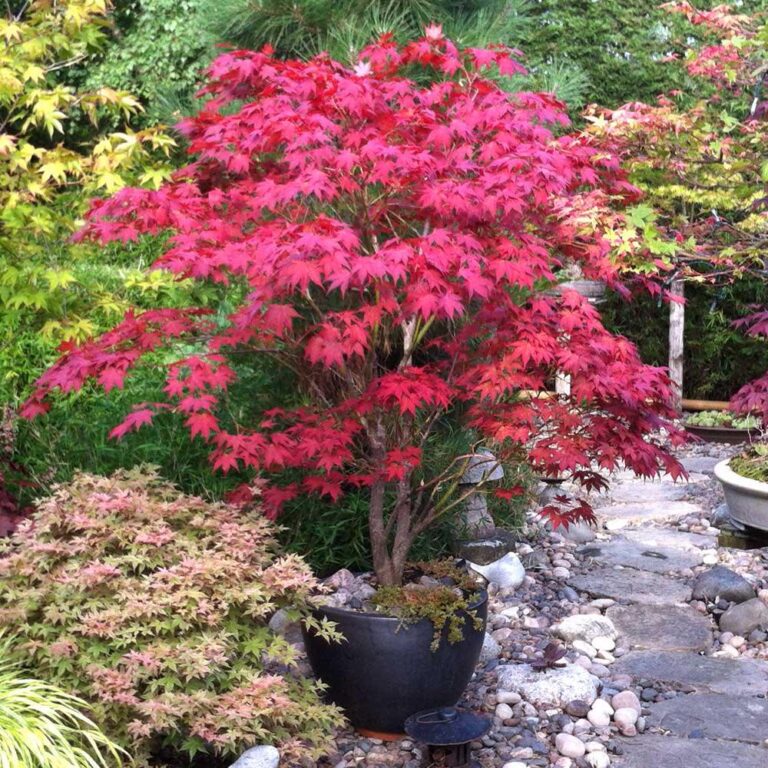
Japanese maples have a reputation for being temperamental, but many cultivars are genuinely easy to grow, provided two conditions are met: a sheltered position away from cold, drying winds, and moist but well-drained, slightly acidic soil. Given those conditions, they require very little attention.
Their foliage — deeply cut, often purple, red, or green — provides outstanding colour through the growing season and turns to fiery tones in autumn. They are naturally slow-growing and maintain a neat, graceful form without pruning. For a smaller garden or a container, they are ideal. Cultivars such as ‘Bloodgood’ and ‘Osakazuki’ are widely recommended for beginners.
7. Ornamental Pear (Pyrus calleryana ‘Chanticleer’)
Mature height: 8–10 metres
Growth rate: Moderate to fast
Hardiness: Fully hardy
‘Chanticleer’ is a tree that experienced gardeners recommend to beginners without hesitation. Its narrow, columnar form fits restricted spaces — driveways, small gardens, narrow side passages — without ever becoming a problem. It flowers in March with white blossom, carries attractive glossy foliage through summer, and delivers rich red-purple autumn colour.
It tolerates compacted soil, urban pollution, and a wide range of conditions that would defeat more sensitive trees. It requires virtually no pruning to maintain its shape. It is resistant to most pests and diseases. It is, in many ways, one of the most beginner-proof flowering trees in cultivation.
8. Holly (Ilex aquifolium)
Mature height: 3–15 metres (can be managed smaller)
Growth rate: Slow
Hardiness: Fully hardy
Holly is sometimes overlooked as a garden tree because it is so familiar — found in hedges and wild corners throughout the British countryside — but as a specimen tree or managed garden plant, it is superb. It is evergreen, providing year-round structure and colour. Female plants produce bright red berries from autumn through winter, which birds such as thrushes and blackbirds depend upon.
It tolerates most soils, deep shade, exposed positions, and coastal conditions. It is naturally slow-growing, which means it stays manageable for many years without pruning. Variegated cultivars such as ‘Silver Queen’ and ‘Golden King’ add ornamental interest and grow equally well.
9. Hornbeam (Carpinus betulus)
Mature height: 10–25 metres (can be managed smaller)
Growth rate: Moderate
Hardiness: Fully hardy
Hornbeam is one of the most structurally useful trees a beginner can plant. It tolerates heavy clay soil, waterlogged ground, and deep shade — conditions that eliminate many alternatives. When grown as a standard tree, it develops a graceful, rounded crown with neatly pleated mid-green leaves that turn gold in autumn. Like beech, it retains its brown dead leaves through winter when clipped, which adds to its value as a screen or hedge.
It is virtually pest and disease free. It requires no regular pruning when grown as a tree. It is long-lived and becomes increasingly beautiful with age. For difficult corners of the garden where other trees struggle, hornbeam is often the answer.
10. Elder (Sambucus nigra)
Mature height: 3–6 metres
Growth rate: Fast
Hardiness: Fully hardy
The common elder is extraordinarily accommodating. It grows almost anywhere — in full sun or deep shade, in wet soil or dry, in clay or sand. It produces large, flat-headed clusters of white flowers in June, followed by glossy black berries in autumn that are eagerly taken by garden birds and widely used by humans for cordials, wines, and preserves.
Ornamental cultivars such as ‘Black Lace’ (deep purple, finely cut leaves) and ‘Golden Tower’ (bright yellow foliage) offer outstanding decorative value alongside the plant’s natural resilience. It responds well to hard pruning if needed, but equally grows attractively without it. Few garden plants of any kind are more beginner-friendly.
11. Field Maple (Acer campestre)
Mature height: 8–20 metres (can be maintained smaller)
Growth rate: Moderate
Hardiness: Fully hardy
The field maple is Britain’s only native maple species and one of the most undervalued garden trees available. It is completely unfussy about soil — growing equally well in acidic or alkaline, wet or dry, heavy or light conditions. It develops a neat, rounded crown and requires no regular pruning.
Its lobed leaves are a pleasant fresh green in spring and summer, then turn clear yellow and sometimes orange-red in autumn. It tolerates clipping and can be maintained as a hedging plant or pollarded, giving it flexibility in smaller gardens. It supports a wide range of insects — particularly aphids, which in turn support populations of predatory insects and many bird species. A genuinely valuable native tree that asks almost nothing of its gardener.
12. Tibetan Cherry (Prunus serrula)
Mature height: 6–8 metres
Growth rate: Moderate
Hardiness: Fully hardy
The Tibetan cherry is a tree worth planting for its bark alone. The mahogany-red, polished surface — which peels in horizontal strips to reveal fresh, gleaming new bark beneath — provides extraordinary winter interest. Small white flowers appear in April, and the autumn leaf colour is a pleasant warm yellow.
It requires no specialist pruning beyond the removal of any crossing or dead branches. It tolerates most well-drained soils in a sunny position. Because its ornamental value comes primarily from its bark rather than heavy flowering or fruiting, it is a particularly low-effort tree to maintain. For a position near a path or seating area where the bark can be appreciated close up, it is a natural choice.
13. Whitebeam (Sorbus aria ‘Lutescens’)
Mature height: 8–12 metres
Growth rate: Moderate
Hardiness: Fully hardy
Whitebeam is a tree that catches the eye in spring, when its emerging leaves — covered in a dense, white-silver felt on their undersides — shimmer in the wind almost like silver coins. In May, clusters of white flowers appear. In autumn, bright red berries bring birds to the garden while the leaves turn russet-gold before falling.
It is one of the most chalk-tolerant trees available, thriving in the thin, alkaline soils over limestone and chalk that defeat many ornamental trees. It is also wind-hardy, drought-tolerant once established, and resistant to most pests and diseases. For beginners on challenging alkaline soil, whitebeam is often the single best tree to choose.
14. Witch Hazel (Hamamelis × intermedia)
Mature height: 3–5 metres
Growth rate: Slow
Hardiness: Fully hardy
Witch hazel blooms in January and February, when almost nothing else is in flower. Its spidery, ribbon-petalled flowers in shades of yellow, orange, and copper appear on bare branches and release a sweet, distinctive fragrance on mild winter days. It is a genuinely moving experience to smell something so lovely on a cold January morning.
It grows slowly into a spreading, architectural shrub-tree and requires no regular pruning. It prefers moist, slightly acidic soil in partial shade. Its autumn leaf colour — brilliant orange, yellow, and red — is among the finest of any temperate garden plant. It is slow to establish and slow to grow, but once it finds its feet, it is essentially permanent and problem-free.
15. Ginkgo (Ginkgo biloba)
Mature height: 20–30 metres (stays smaller for many years)
Growth rate: Slow to moderate
Hardiness: Fully hardy
The ginkgo is one of the oldest tree species on Earth — it has changed so little in 200 million years that it is considered a living fossil. It is also one of the most pest and disease resistant trees in cultivation, because few insects or pathogens have evolved alongside it in temperate regions. This makes it exceptionally easy to grow.
Its fan-shaped leaves are unlike those of any other tree and turn clear, luminous yellow in autumn — one of the most striking autumn displays available from any deciduous tree. Female trees produce fruits with an unpleasant odour, so male-only cultivars such as ‘Saratoga’ or ‘Fastigiata’ are recommended for gardens. It tolerates urban pollution, compacted soils, and a wide range of moisture conditions.
16. Juneberry / Serviceberry (Amelanchier canadensis)
Mature height: 4–8 metres
Growth rate: Moderate
Hardiness: Fully hardy
Closely related to Amelanchier lamarckii, the Canadian serviceberry is similarly easy and similarly rewarding. In April it produces masses of white flowers on a multi-stemmed framework, followed by purple-black sweet berries in June — edible by both birds and humans, with a flavour similar to blueberries — and vibrant orange-red autumn colour.
It grows well in moist soils and tolerates partial shade, making it suitable for spots that challenge many other small trees. It requires no regular pruning and is resistant to most pests and diseases. It is an excellent choice for beginners who want wildlife value and edible interest alongside ornamental beauty.
17. Strawberry Tree (Arbutus unedo)
Mature height: 4–8 metres
Growth rate: Slow
Hardiness: Hardy in most of the UK; some shelter needed in colder areas
The strawberry tree is an unusual and attractive evergreen that flowers and fruits simultaneously in autumn — small, white, urn-shaped flowers and round, strawberry-like red fruits appearing together on the same plant. The fruit is edible, though mild in flavour. The dark, shredding bark adds character in winter.
It is one of the few evergreen flowering trees that performs reliably in the UK’s oceanic climate. It tolerates acidic, free-draining soil and coastal conditions, and is resistant to honey fungus — a serious soil pathogen that kills many garden trees. It grows slowly and needs no regular pruning. In a sheltered, sunny spot, it is one of the most distinctive low-maintenance choices available.
18. Alder (Alnus glutinosa)
Mature height: 10–25 metres
Growth rate: Fast
Hardiness: Fully hardy
For gardens with persistently wet or waterlogged soil — a condition that defeats most ornamental trees — the common alder is one of the very few large trees that genuinely thrives. It grows naturally along riverbanks and in boggy woodland and is perfectly adapted to conditions that would kill a conventional garden tree within a few seasons.
It produces attractive purple-red catkins in late winter before the leaves emerge and develops small, woody cone-like fruits that persist through winter, providing food for siskins and redpolls. Its roots fix atmospheric nitrogen, gradually improving soil fertility around the tree. For beginners dealing with a wet, poorly-drained garden, alder is often the most practical and most ecologically valuable choice.
19. Scots Pine (Pinus sylvestris)
Mature height: 20–35 metres
Growth rate: Moderate
Hardiness: Fully hardy
The Scots pine is one of only three trees native to both Britain and continental northern Europe, and it is among the most characterful of all garden conifers. Its blue-green needles, orange-red upper bark, and naturally sculptural form become increasingly beautiful with age. It requires absolutely no pruning, no special soil preparation beyond basic drainage, and no pest or disease management under normal conditions.
It prefers full sun and well-drained, acidic to neutral soil. It tolerates poor, sandy conditions admirably. For beginners who want a genuinely permanent, large-scale tree that will outlive them and their children, the Scots pine is an outstanding choice — particularly in larger gardens where its eventual size can be accommodated.
20. Dogwood (Cornus alba)
Mature height: 2–3 metres
Growth rate: Fast
Hardiness: Fully hardy
Technically a large shrub rather than a tree, Cornus alba is included here because it provides one of the most effortless and striking winter garden features available to any beginner. Its stems — brilliant red in most cultivars, vivid yellow in ‘Sibirica Aurea’ — glow in winter sunlight and low winter light in a way that genuinely lifts the garden through its dullest months.
In summer, it carries clusters of small white flowers followed by white or pale blue berries. Its foliage turns red-purple in autumn. It tolerates wet soil, shade, cold, and most other difficult conditions. Hard pruning in early spring to encourage the brightly coloured young stems is the only maintenance it really benefits from — and even that is optional.
General Tips for Beginner Tree Planting
Buy the right size. Larger trees in pots seem appealing, but a young, smaller tree often establishes more quickly and overtakes a larger specimen within a few years. A tree that is 60–90 cm tall at planting will often be more vigorous at five years than one planted at 1.5 metres.
Water in the first year. This is the single most important thing a beginner can do. Even drought-tolerant trees need consistent moisture during their first growing season while their roots are establishing. Once established — usually after one to two full growing seasons — most trees on this list will manage on rainfall alone in most climates.
Mulch generously. A 7–10 cm layer of bark mulch or wood chips spread in a 1-metre circle around the base of the tree makes an enormous difference. It retains moisture, suppresses weeds, and gradually improves soil structure. Keep the mulch away from direct contact with the trunk.
Avoid over-fertilising. Many beginners assume that feeding a tree will help it grow faster. In most cases, particularly in the first year, it simply encourages soft, vulnerable top growth at the expense of root development. A balanced slow-release fertiliser applied in spring after the first year is usually all that is needed, if anything.
Do not panic about slow growth. Trees establish slowly because they are building root systems before investing in visible growth. A tree that appears to have done very little in its first summer may put on half a metre or more in its second year, once its roots are properly in place. Patience is the most valuable tool a new tree planter has.
How to Choose the Right Tree for Your Garden
Start with your site conditions rather than your aesthetic preferences. A tree that is beautiful but wrong for your soil and climate will always disappoint. A tree that is perfectly suited to your conditions will often look better than you imagined, because it is simply doing what it was designed to do.
Consider how much space you have in 10, 20, and 30 years — not just today. Many beginner mistakes involve planting a tree too close to a building, fence, or path and facing difficult decisions years later when it has outgrown its space.
Finally, choose trees with multiple seasons of interest. A tree that flowers beautifully in May but does nothing else for the rest of the year is using valuable garden space less efficiently than one that offers blossom, summer foliage, autumn colour, and winter bark or berries. The best garden trees earn their place in the landscape every single month of the year.
Final Thoughts
Beginning with trees is one of the most rewarding things a gardener can do. Unlike perennials and annuals, trees grow into something permanent — something that changes the character of a garden and, over time, of a whole neighbourhood. The 20 trees in this guide are among the most forgiving and rewarding available to a new planter. They ask little. They give generously. And they improve, often remarkably, with every passing year.
Choose one that suits your conditions, plant it with care, and then step back. Nature will do the rest.
References
- Royal Horticultural Society (RHS) — Trees for Gardens: Selection and Establishment
The RHS provides comprehensive guidance for UK and temperate-climate gardeners on selecting, planting, and establishing garden trees, with species profiles and cultivation advice.
https://www.rhs.org.uk/plants/types/trees/establishing-trees - Penn State Extension — Low Maintenance Landscaping with Trees and Shrubs
Pennsylvania State University Extension offers research-based guidance on selecting low maintenance woody plants for residential landscapes, with an emphasis on pest resistance and soil adaptability.
https://extension.psu.edu/low-maintenance-landscaping - University of Florida IFAS Extension — Beginner’s Guide to Planting Trees
A practical, research-backed guide from the University of Florida covering tree selection, planting techniques, establishment care, and the characteristics that define low maintenance landscape trees.
https://edis.ifas.ufl.edu/publication/ST060 - USDA Forest Service — Benefits of Urban Trees and Species Selection
The United States Department of Agriculture Forest Service provides scientific data on the ecological and practical value of trees in residential and urban settings, including guidance on species that minimise management demands.
https://www.fs.usda.gov/managing-land/urban-forests - Purdue University Extension — Tree Establishment and Low Maintenance Landscape Trees
Purdue University’s horticulture extension resources cover the principles of tree establishment, identifying low maintenance characteristics, and matching tree species to site conditions for long-term success.
https://www.purdue.edu/hla/sites/yardandgarden/trees-and-shrubs/

Tim M Dave is a gardening expert with a passion for houseplants, particularly cacti and succulents. With a degree in plant biology from the University of California, Berkeley, he has vast experience in gardening. Over the years, he has cultivated a vast collection of desert plants and learned a great deal about how to grow and care for these unique companions.