Understanding Kanzan Cherry (Prunus serrulata ‘Kanzan’): History, Features, Problems, Care, and More
Kanzan Cherry, Prunus serrulata ‘Kanzan’, is a deciduous ornamental flowering tree and one of the most widely planted ornamental cherry cultivars in the world. It belongs to the species Prunus serrulata — the Japanese flowering cherry — and is classified within the sato-zakura group, a collective term for the cultivated ornamental cherries that have been selected, named, and grown in Japan for centuries.
The cultivar name ‘Kanzan’ (関山) is Japanese in origin. The tree is also widely sold and referenced under the name ‘Kwanzan’ — a romanisation of the same Japanese characters used in older Western horticultural literature. Both names refer to the same cultivar. If you see either name, you are looking at the same tree.
Additional synonyms used in the trade include ‘Sekiyama’ and ‘Hisakura’, though ‘Kanzan’ and ‘Kwanzan’ are by far the most commonly encountered names in English-speaking markets.
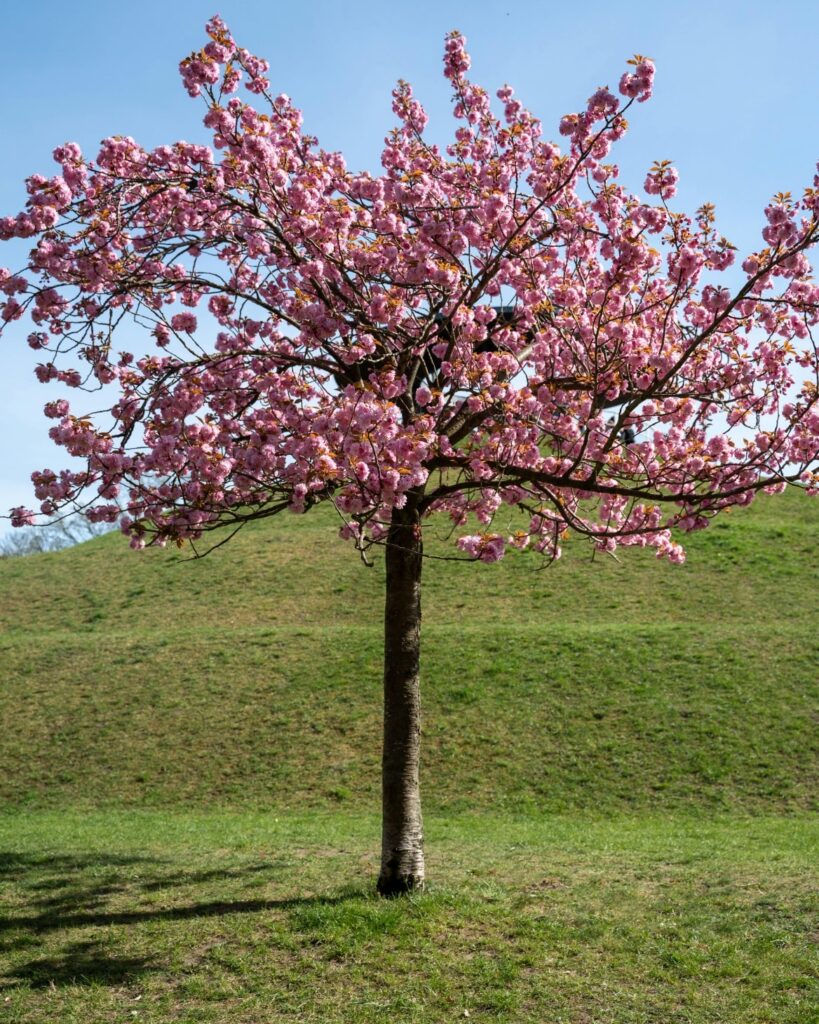
Its most distinctive feature is its fully double flowers — each bloom containing 28 to 30 petals, producing a dense, pom-pom-like appearance quite unlike the simple five-petalled flowers of wild cherries.
Combined with the deep purplish-pink colour and the abundance of flowers per branch, this creates a flowering display of remarkable visual intensity.
Key Characteristics at a Glance
Mature Height: 25 to 40 feet (7.5 to 12 metres), depending on rootstock and growing conditions.
Mature Spread: 15 to 25 feet (4.5 to 7.5 metres). Young trees have a strongly vase-shaped, upright habit; mature trees develop a broader, more rounded crown.
Growth Rate: Moderate — typically 13 to 24 inches per year.
Bloom Time: Mid to late spring — April to early May in most temperate climates. It blooms approximately two weeks after Yoshino Cherry, making it the centrepiece of the later part of the ornamental cherry season.
Flower Colour: Deep purplish-pink to rose-pink, fully double, with 28 to 30 petals per flower. Flowers are large — up to 2.5 inches in diameter — and carried in dense hanging clusters.
Foliage: Large, oval leaves with serrated margins. Young foliage emerges in a rich bronze-copper colour before maturing to dark green — a feature that creates a striking contrast with the deep pink flowers during peak bloom. Autumn colour is orange to bronze.
Bark: Grey-brown with prominent horizontal lenticels, smooth when young.
Fruit: Kanzan rarely sets fruit, as the double flowers lack functional reproductive structures. This is typical of many double-flowered ornamental cultivars.
USDA Hardiness Zones: 5 to 9, making it one of the more widely adaptable ornamental cherries in terms of climate range.
Lifespan: Typically 15 to 25 years in landscape settings — relatively short-lived, as is common with many intensively bred ornamental cherry cultivars.
Origins and History
Prunus serrulata is native to China, Japan, and Korea, and has been cultivated as an ornamental in Japan for over a thousand years. The intensive development and naming of specific ornamental cherry cultivars — a tradition known as hanami culture — reached its peak during the Edo period (1603–1868).
‘Kanzan’ was selected during this era for its large, fully double, intensely coloured flowers. It was among the cultivars introduced to Western horticulture in the early 20th century, arriving in Britain and North America at a time when interest in Japanese ornamental plants was at a cultural peak.
Its rise to global prominence accelerated dramatically after World War II. Large-scale cherry planting programmes in cities across the United Kingdom, the United States, Canada, and Western Europe — many with memorial significance — frequently selected ‘Kanzan’ for its reliable performance, visual impact, and availability in commercial nursery production.
The famous Batsford Arboretum in Gloucestershire, England, and the National Cherry Blossom Festival in Washington D.C. both feature significant plantings of ‘Kanzan’, cementing its status as a defining ornamental cherry of the modern era.
In Japan, it is planted widely in parks and along roadsides, and is one of the cherries most commonly associated with hanami — the tradition of gathering beneath flowering cherry trees in spring.
The Flower: What Makes Kanzan Distinctive
Understanding the Kanzan flower explains most of the tree’s popularity — and also some of its limitations.
The flowers are fully double, meaning the stamens and pistil — the reproductive organs at the centre of a flower — have been replaced through centuries of selection by additional petals. Each flower contains 28 to 30 petals, creating a dense, rounded bloom significantly larger and more complex than any single-petalled ornamental cherry.
This doubling produces a flower of extraordinary visual weight and richness. Where a single-flowered cherry produces blossoms that are delicate and airy, Kanzan produces flowers that are bold and full — almost peony-like in their density.
The colour is deep purplish-pink, which is saturated and vivid in bud and during the first days of opening, then gradually fades to a softer rose-pink as flowers age. This colour shift across the blooming period gives mature flower clusters a multi-toned appearance.
The bronze-copper young foliage emerges simultaneously with the flowers, creating a distinctive colour combination — deep pink blooms against warm copper-toned young leaves — that is unique among ornamental cherries and instantly recognisable.
The trade-off of double flowers is the absence of fruit and reduced wildlife value. Since the reproductive structures have been replaced by petals, Kanzan flowers produce no pollen or nectar accessible to bees and no fruit for birds. Gardeners who prioritise ecological function alongside ornamental value should consider this limitation carefully.
Why Choose Kanzan Cherry?
For the right situation, the reasons are clear and compelling.
Maximum visual impact. No other commonly available ornamental cherry produces as dense, as large, or as boldly coloured a flower as Kanzan. For situations where sheer flowering drama is the primary goal — a landmark planting, a street avenue, a park focal point, a ceremonial or memorial landscape — nothing quite matches it.
Reliable performance. Kanzan is one of the most commercially proven ornamental cherries in existence. It has been grown in nurseries and planted in landscapes for well over a century. Its cultural requirements are well-understood, its performance is predictable, and its availability is consistent. What you see in the nursery is very close to what you will get in the garden.
Adaptability across climates. Zone 5 to 9 tolerance gives it a broader climate range than many ornamental cherries, making it viable in gardens from the American Midwest and New England through the warm-temperate climates of the South and Pacific Coast.
The bronze foliage-flower combination. The simultaneous emergence of copper-toned young leaves and deep pink double flowers is a colour combination found in few other ornamental trees. For designers working with warm, rich colour palettes, this is a distinctive and valuable feature.
Ideal Growing Conditions
Sunlight
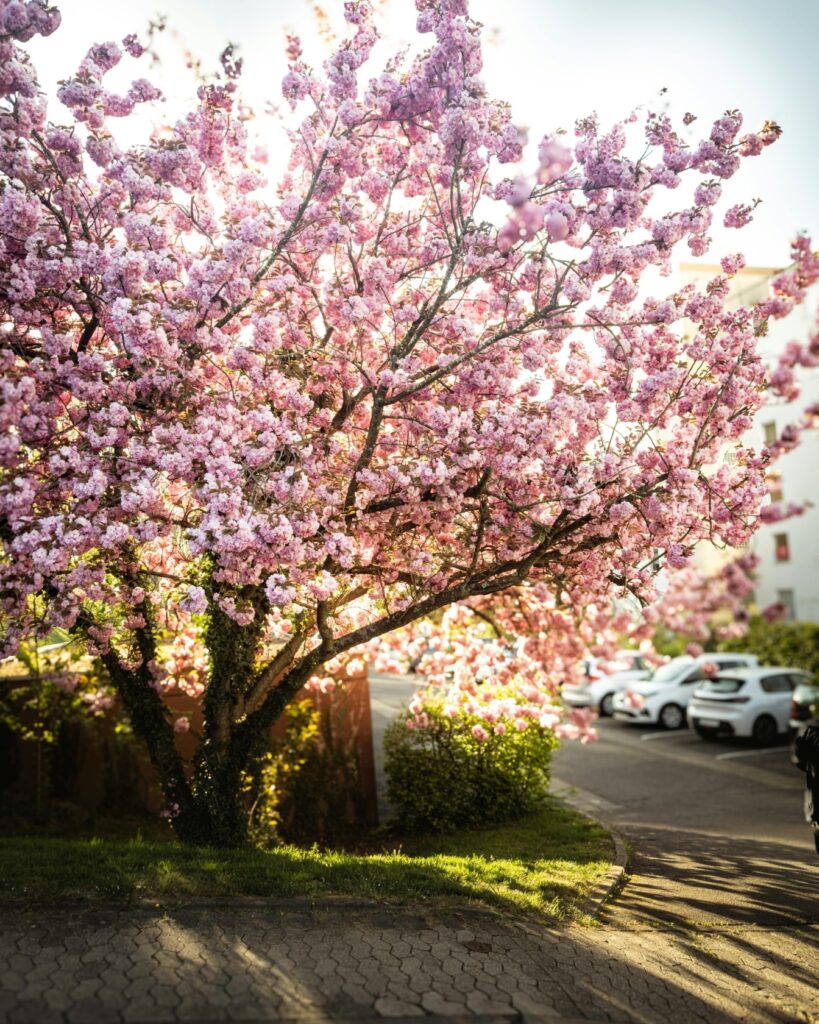
Full sun is essential. Kanzan Cherry requires six to eight or more hours of direct sunlight daily. In full sun, the flowering display is at its most spectacular, the vase-shaped young form develops cleanly, and the tree’s resistance to disease is at its best.
In partial shade, flowering is reduced, the canopy becomes uneven, and fungal disease pressure — always a concern with ornamental cherries — increases significantly.
Soil
Performs best in moist, well-drained, moderately fertile soil with a pH of 5.5 to 7.0. It adapts to loamy, sandy-loam, and moderately clay soils provided drainage is adequate.
Waterlogged soil is the most common cause of decline in Kanzan plantings. Root rot sets in rapidly in poorly drained conditions, often manifesting as progressive canopy dieback that is mistaken for disease when the cause is underground. Check drainage carefully before planting.
Water
Young trees need consistent moisture during the establishment period — the first two to three growing seasons. Water deeply and infrequently to build a strong, deep root system. Supplemental irrigation during summer drought benefits flowering performance in the following spring.
Once established, Kanzan has moderate drought tolerance but performs better with consistent summer moisture. In urban and streetscape settings where root zones are restricted and soil compaction is a factor, irrigation management is particularly important for long-term health.
Climate
Hardy in Zones 5 to 9. In Zone 5, it handles winter temperatures to approximately -20°F (-29°C). In Zones 8 and 9, it generally performs reliably in cooler coastal and elevated positions, though very warm and dry summers can reduce its vigour.
Planting Instructions
Best planting time: Early spring before bud break, or autumn after leaf drop. Container-grown trees can be planted throughout the growing season with adequate post-planting irrigation.
Planting hole: Dig a hole two to three times wider than the root ball and only as deep as the root ball height. Set the tree so the root flare — the widening at the base of the trunk — sits at or very slightly above the surrounding soil grade. Deep planting is one of the most damaging mistakes with ornamental cherries.
Backfill: Use original excavated soil without added fertiliser or compost in the planting hole. Amendments in the planting hole can discourage roots from expanding into native soil.
Mulching: Apply 2 to 3 inches of organic mulch over the root zone, maintaining a 6-inch clearance around the trunk. Mulch against bark creates conditions for crown rot and provides access for pests.
Staking: Stake young trees temporarily if wind rocking is a risk. Use a single, low stake with flexible ties and remove after the first growing season.
Watering: Water thoroughly at planting and maintain consistent moisture through the first full growing season.
Fertilisation
Kanzan does not require intensive feeding. In most garden soils, a single early-spring application of balanced slow-release fertiliser — a 10-10-10 formulation or a dedicated tree and shrub product — is sufficient.
Avoid high-nitrogen fertilisers. Excess nitrogen promotes rapid, soft vegetative growth that is vulnerable to pest and disease attack and comes at the cost of flower production. Kanzan is a tree that rewards moderate nutrition over heavy feeding.
Annual soil testing every two to three years helps identify genuine deficiencies and avoids the common and counterproductive habit of routine over-feeding.
Pruning
Kanzan develops its characteristic vase shape naturally in youth and broadens into a rounded crown with age. It requires minimal pruning when given adequate space and performs best when its natural form is respected rather than managed aggressively.
Prune immediately after flowering — late spring, as the last blossoms fade, typically in May. This timing avoids removing next season’s flower buds, which form on the current year’s growth through summer, and reduces wound exposure during the cooler, wetter parts of the year.
Remove dead, damaged, and diseased wood first. Then thin any crossing or rubbing branches to maintain airflow through the increasingly dense, maturing canopy. Good air circulation is a primary defence against the fungal diseases that affect all ornamental cherries.
Do not top or heavily cut back. Large pruning wounds on Prunus species heal slowly and are common entry points for silver leaf disease, bacterial canker, and wood-boring insects.
If size control is a long-term concern, select an appropriately sized cultivar at the outset rather than managing an oversized tree with repeated heavy pruning.
Pests and Diseases
Kanzan shares the pest and disease profile common to Prunus serrulata cultivars. Its relatively short lifespan in landscape settings is partly attributable to the accumulation of disease pressure over time — understanding the common problems helps extend the tree’s productive years.
Common Pests
Aphids colonise new spring growth, causing distorted leaves and sticky honeydew deposits. Natural predators, insecticidal soap, or strong water jets manage most infestations without chemical intervention.
Tent caterpillars build communal nests in branch forks and can rapidly defoliate sections of the canopy. Remove nests manually while small, or apply Bacillus thuringiensis (Bt) to young larvae.
Cherry bark tortrix (Enarmonia formosana) and related moth larvae can damage bark and cambium, particularly in urban trees. Maintaining tree vigour and protecting bark from mechanical damage reduces risk.
Japanese beetle (Popillia japonica) feeds on foliage and flowers in areas where this pest is established. Hand-picking and trapping are the most practical controls for small infestations.
Common Diseases
Silver leaf disease (Chondrostereum purpureum) is one of the most serious threats to Kanzan. It enters through pruning wounds and bark damage, causing leaves to develop a characteristic silvery sheen before branches progressively die back. Prune only during dry weather and sterilise tools between cuts. There is no effective chemical treatment; affected branches must be removed.
Black knot (Apiosporina morbosa) produces distinctive elongated black galls on branches. Remove and destroy infected material promptly, cutting at least 4 inches below visible symptoms. Do not compost infected material.
Bacterial canker (Pseudomonas syringae) causes sunken dark lesions on bark and progressive branch dieback, most common in cool, wet spring conditions. Prune in dry weather and protect bark from injury.
Brown rot blossom blight (Monilinia spp.) browns and collapses flowers during wet spring weather. The large, dense, fully double flowers of Kanzan — which trap moisture more effectively than single flowers — can be particularly susceptible. Good air circulation and avoiding overhead irrigation are the primary preventive measures.
Landscape Uses and Design Applications
Kanzan Cherry’s visual drama makes it a powerful landscape tool when used with understanding of its strengths and limitations.
As a specimen tree in a lawn or park, a mature Kanzan in full bloom is one of the most spectacular displays in the spring garden. The scale of the flowering — every branch covered in large, double, deep pink blooms — creates a visual impact that is difficult to achieve with any other single tree.
In formal avenue plantings, rows of Kanzan Cherry along a wide path, driveway, or boulevard create one of horticulture’s classic spring effects — a corridor of deep pink blossoms that draws visitors and creates memorable seasonal photographs. This is the application for which it is most celebrated in public landscape design.
In memorial and ceremonial landscapes, Kanzan has a long tradition of use as a tree of commemoration — planted in war memorials, civic parks, and institutional grounds across Britain, North America, and beyond. Its association with spring renewal and the transience of beauty connects naturally to memorial planting traditions.
In mixed ornamental plantings, the bronze-copper young foliage and deep pink double flowers create striking contrasts with pale-flowered or white-flowered companion plants. White-flowered Yoshino Cherry, pale narcissus, and blue-flowered Camassia all create effective colour contrasts when planted in the vicinity of Kanzan.
A note on scale: Kanzan is not a small garden tree. At 25 to 40 feet at maturity, with a broad canopy and an assertive flowering presence, it suits larger gardens, parks, and public spaces. In very small gardens, the more compact ornamental cherries — ‘Snow Fountains’, ‘Amanogawa’, or ‘Accolade’ — are more proportionate choices.
An Honest Assessment: Strengths and Limitations
Any article that claims a tree has only virtues is not being fully honest. Kanzan Cherry has real strengths and real limitations, and knowing both helps you make a sound planting decision.
Its strengths are well documented: unmatched double-flower display, reliable and commercially proven performance, wide climate adaptability, and the iconic bronze foliage and deep pink flower combination.
Its limitations are equally real. It is relatively short-lived — 15 to 25 years in landscape settings is significantly shorter than the 40 to 60 years achievable with Sargent Cherry or the multi-decade longevity of other ornamental trees. It produces no fruit and minimal wildlife value due to its double flowers.
And the sheer intensity of its flowering display — magnificent for two weeks — means that for the remaining 50 weeks of the year, it is a tree of modest distinction rather than outstanding beauty.
These limitations do not disqualify it. They contextualise it. Kanzan Cherry is the right tree when peak spring drama is the primary goal — in public parks, formal avenues, memorial landscapes, and large gardens where spring is the main season. For multi-season interest in smaller gardens, other cherries serve better.
Frequently Asked Questions
What is the difference between ‘Kanzan’ and ‘Kwanzan’? They are the same cultivar. ‘Kwanzan’ is an older Western romanisation of the Japanese name; ‘Kanzan’ is the more modern and currently preferred transliteration. Both names appear in nursery catalogues and are used interchangeably.
Why is my Kanzan Cherry not blooming well? The most common causes are insufficient sunlight, late frost damage to buds, pruning at the wrong time, drought stress in the previous summer, or the tree being in early establishment years. A young tree may take three to five years to produce a full flowering display.
How long does the bloom last? Peak flowering typically lasts ten to fourteen days. Warm temperatures accelerate petal fall; cool conditions extend the display. The full flowering season from first bud to last petal spans approximately three weeks.
Does it produce cherries? Rarely, and only when conditions allow occasional partial seed-set. The double flowers lack functional reproductive structures in most cases. Fruit production is not a feature of this cultivar.
Can it be grown as a street tree? Yes, and it has a long track record in streetscape plantings. However, urban conditions — soil compaction, restricted root zones, reflected heat, and air pollution — reduce its already-limited lifespan. For long-term urban street tree use, hardier and longer-lived alternatives such as ‘Accolade’ or Sargent Cherry cultivars may be more appropriate.
Suggested For You:
Understanding Kojo-no-mai (Prunus incisa ‘Kojo-no-mai’): History, Features, Problems, Care, and More
Understanding Autumnalis Cherry (Prunus subhirtella ‘Autumnalis’): History, Features, Problems and Care Details
Final Thoughts
The Kanzan Cherry earned its global status honestly. For two weeks in mid-spring, it produces a flowering display that is genuinely unmatched in the ornamental tree world — dense, double, deep pink, abundant, and unapologetically spectacular.
It is the cherry tree for people who want the maximum possible spring impact from a single planting. For parks, avenues, memorial landscapes, and large garden settings where that impact is the primary goal, it delivers without reservation.
Go into it with clear eyes: it is short-lived compared to some alternatives, it offers modest off-season interest, and it contributes nothing to the wildlife garden. But when it blooms — and it will bloom, reliably and magnificently, year after year — those limitations fade into irrelevance.
Few trees command a space the way a Kanzan Cherry does in April. Plant it where that matters. It will not disappoint.
References
- North Carolina State University Extension – Prunus serrulata ‘Kanzan’ Plant Profile https://plants.ces.ncsu.edu/plants/prunus-serrulata/
- University of Connecticut Plant Database – Prunus serrulata https://hort.uconn.edu/detail.php?pid=293
- Arnold Arboretum of Harvard University – Cherry Collection: Japanese Flowering Cherries https://arboretum.harvard.edu/plants/highlighted-plants-and-collections/cherry-collection/
- Virginia Tech Dendrology – Prunus serrulata Fact Sheet https://dendro.cnre.vt.edu/dendrology/syllabus/factsheet.cfm?ID=106
- Pennsylvania State University Extension – Ornamental Cherry Tree Care and Selection https://extension.psu.edu/ornamental-cherry-trees

Tim M Dave is a gardening expert with a passion for houseplants, particularly cacti and succulents. With a degree in plant biology from the University of California, Berkeley, he has vast experience in gardening. Over the years, he has cultivated a vast collection of desert plants and learned a great deal about how to grow and care for these unique companions.