Understanding Ginkgo (Ginkgo biloba): History, Uses, Problems, Cultivation, and More
There is a tree growing in temple gardens across China and Japan that was already old when the dinosaurs walked the Earth. It survived the mass extinction event that ended the Cretaceous period. It survived the last Ice Age.
And on the morning of August 6, 1945, six Ginkgo trees within two kilometres of the Hiroshima atomic bomb blast survived that too — re-sprouting from their scorched trunks within months, while nearly everything else within that radius had been incinerated.
Ginkgo biloba is not just a tree. It is a testament to biological endurance without parallel in the plant kingdom.
Today, Ginkgo is planted on streets from Beijing to Berlin, studied in pharmacology laboratories, debated in clinical trials, revered in Buddhist and Taoist traditions, and used as a street tree in some of the world’s most polluted cities — because it simply refuses to be harmed by things that kill other trees.
This article covers everything worth knowing about Ginkgo: its evolutionary history, physical characteristics, ecology, medicinal uses, cultivation, and cultural significance.
Taxonomy: A Kingdom of One
Ginkgo biloba occupies one of the most isolated positions in the entire plant kingdom. It is the sole living species of the division Ginkgophyta, the class Ginkgoopsida, the order Ginkgoales, and the family Ginkgoaceae.
Scientific classification:
- Kingdom: Plantae
- Division: Ginkgophyta
- Class: Ginkgoopsida
- Order: Ginkgoales
- Family: Ginkgoaceae
- Genus: Ginkgo
- Species: G. biloba
- Full name: Ginkgo biloba L.
Every taxonomic category above species level contains only one member — Ginkgo biloba itself. There is no other living plant even in the same order. It is, in the most literal taxonomic sense, alone.
The species name biloba means “two-lobed,” referring to the characteristic shape of the leaf. The genus name Ginkgo is believed to derive from a mistransliteration of the Japanese gin kyo (銀杏), meaning “silver apricot” — a reference to the fruit.
The common names for this tree include Ginkgo, Maidenhair Tree (for its resemblance to the maidenhair fern), and in East Asia, Bai Guo (白果, “white fruit”).
The Living Fossil: 270 Million Years of History
The term “living fossil” was coined by Charles Darwin, and no plant exemplifies it more completely than Ginkgo.
Ginkgo-like plants first appear in the fossil record during the Permian period, approximately 270 million years ago. The genus Ginkgo itself is identifiable in fossils from the Jurassic period, around 170 million years ago — and those ancient leaves are almost indistinguishable from the leaves on trees growing today.
To put that in perspective: dinosaurs lived alongside Ginkgo trees. The supercontinent Pangaea was beginning to break apart when this tree’s basic design was already established. Since then, the Earth has changed almost beyond recognition and Ginkgo has remained essentially unchanged.
During the Jurassic and Cretaceous periods, Ginkgo-type trees were distributed across most of the Northern Hemisphere. Then, as the climate cooled and dried through the Cenozoic era, the genus contracted.
By the time humans appeared, it survived in the wild only in a small, mountainous region of Zhejiang province in eastern China — specifically in the Tianmu Mountains.
It may have gone extinct entirely in the wild had Buddhist and Taoist monks not cultivated it for centuries in temple gardens, effectively preserving the species. Some botanists debate whether any truly wild Ginkgo populations exist today, or whether all known trees descend from cultivated lineages.
Either way, human stewardship played a direct role in saving this ancient tree from extinction.
Physical Description: Recognising Ginkgo
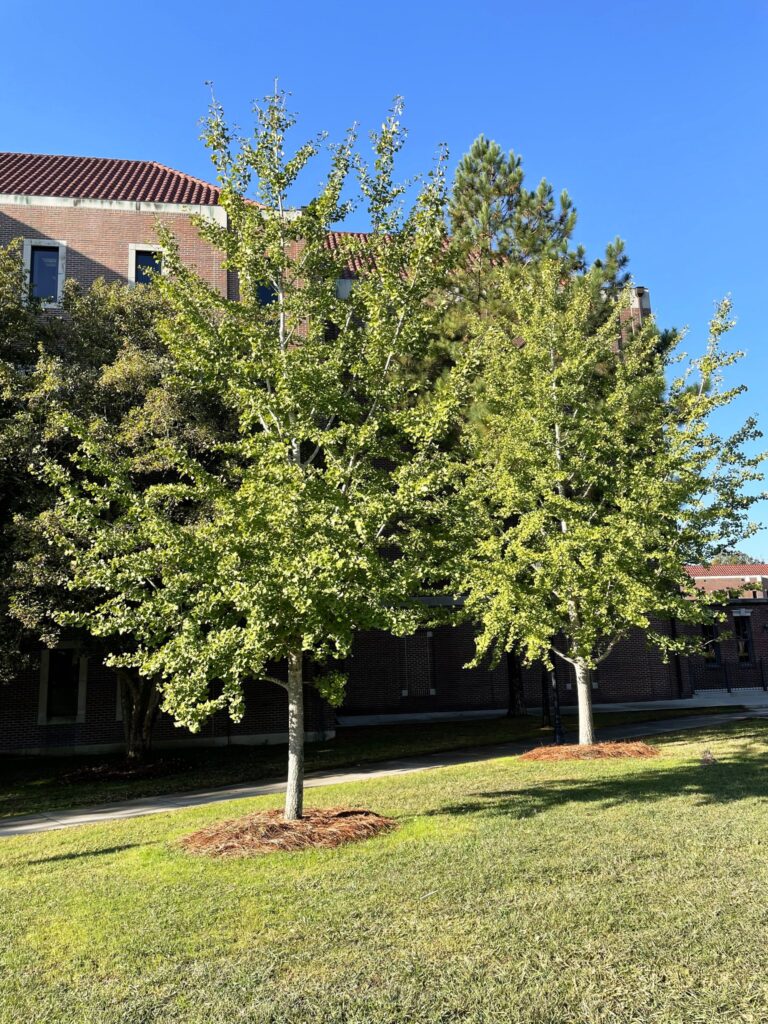
Ginkgo is unmistakable once you know it. No other tree looks quite like it.
Size and Form
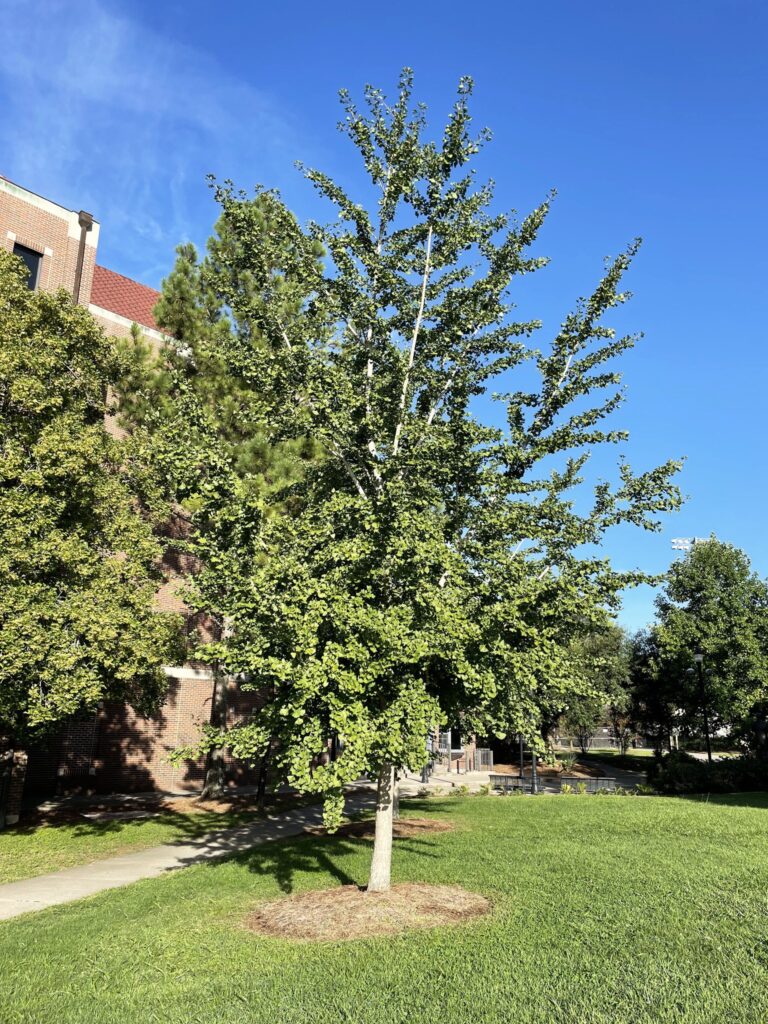
A mature Ginkgo is a large, long-lived deciduous tree, typically reaching 20 to 35 metres in height in cultivation, with some ancient specimens in China exceeding 40 metres. Young trees tend to be narrow and somewhat irregular; old trees develop broad, majestic crowns.
Male and female trees have subtly different forms. Male trees tend to be more upright and columnar; female trees often develop a broader, more spreading crown with age.
Growth is slow to moderate — about 30–60 cm per year in good conditions — but Ginkgo is exceptionally long-lived. Trees in China are documented at over 1,000 years old, and one specimen in Guizhou province is believed to be around 3,500 years old.
The Leaves
The leaves are the defining feature. They are fan-shaped (flabellate), typically 5–8 cm wide, and divided by a central notch into two lobes — hence biloba. The venation is dichotomous (veins fork repeatedly but never reconnect), a primitive pattern found in no other living tree.
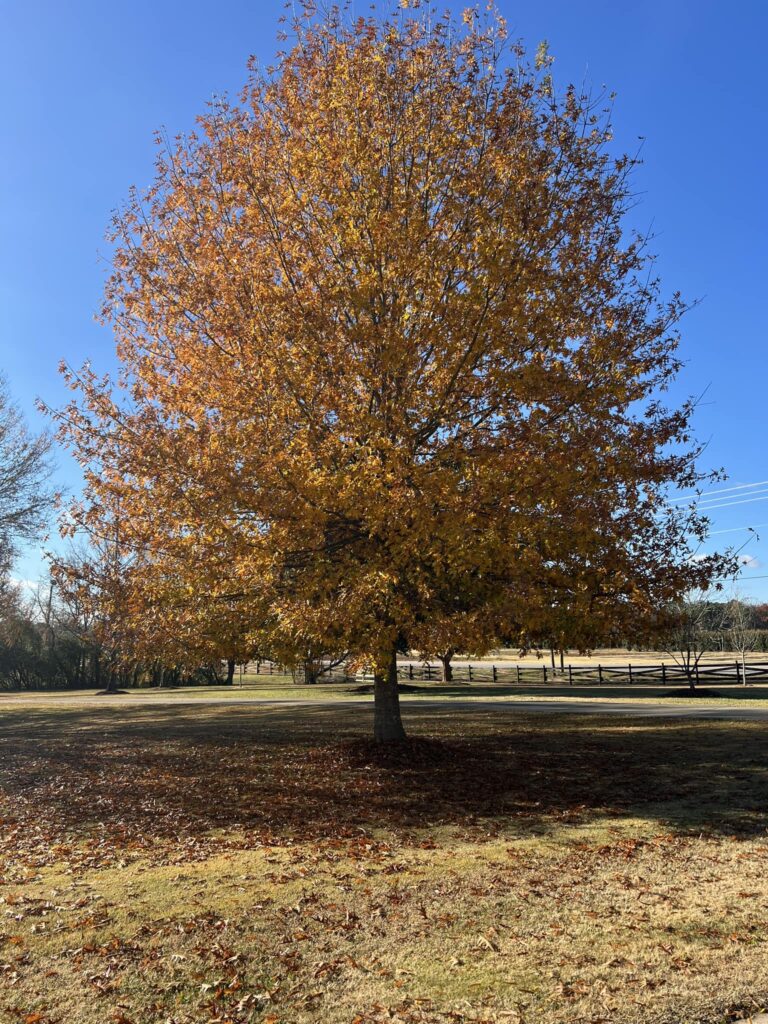
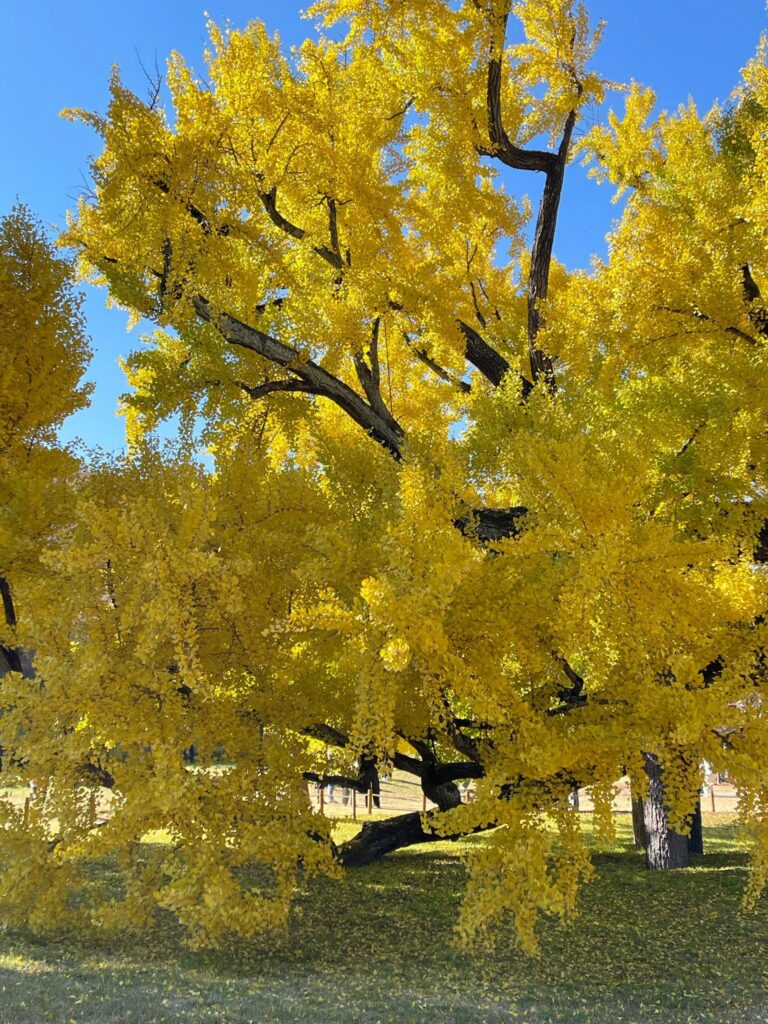
In autumn, the leaves turn a brilliant, pure golden yellow — one of the most striking and clean autumn displays of any tree. The colour is uniform across the entire crown and transforms almost simultaneously. The spectacle lasts only a week or two, but it is extraordinary.
After the colour peaks, the leaves fall quickly, often dropping in a single day or two after the first hard frost — creating a perfect golden carpet beneath the tree.
Reproduction: A Gymnosperm in a World of Flowering Plants
Ginkgo is a gymnosperm — it produces seeds not enclosed in a fruit but exposed, borne on stalks. This places it in an ancient reproductive category shared with conifers and cycads — far older than the flowering plants that dominate today’s flora.
Male trees produce small, catkin-like structures that release pollen in spring. Female trees produce paired ovules that, when fertilised, develop into the seed.
The seed is encased in a fleshy outer layer (the sarcotesta) that turns yellow-orange at maturity and has an intensely unpleasant smell — often compared to rancid butter. This is caused by butyric acid and short-chain acids in the outer coat.
Inside that layer, the inner seed — the “nut” — is clean and has been used in East Asian cuisine for thousands of years.
The Female Tree Problem: Smell, Seeds, and the Urban Controversy
This is the most frequently searched practical topic related to Ginkgo, and it deserves a direct answer.
Female Ginkgo trees produce seeds with an intensely foul smell when the outer seed coat decomposes in autumn. It is not subtle — it is a strong, pervasive odour that can render a pavement or garden deeply unpleasant for several weeks.
For this reason, most urban plantings use only male trees. Many cultivars sold for street and garden use are selected male clones, propagated vegetatively to guarantee no seed production.
However, even a tree labelled as male can surprise the planter. Under certain conditions, Ginkgo trees have been documented to partially or fully change sex — a phenomenon observed in old trees and occasionally in younger stressed specimens.
Contact dermatitis risk: The outer seed coat contains ginkgolic acids, chemically similar to the allergenic compounds in poison ivy. Handling fallen seeds bare-handed can cause skin irritation. Those who harvest seeds should always wear gloves.
The inner nut itself is safe to eat when properly cooked, and is a valued ingredient in East Asian cooking.
Ginkgo Nuts: Culinary Uses and Safety
Inside the malodorous outer shell, the Ginkgo nut (bai guo in Chinese, ginnan in Japanese) is a genuine culinary ingredient with a long tradition of use.
Flavour and Texture
Ginkgo nuts have a mild, slightly bitter, starchy flavour with a soft texture when cooked. The taste is subtle and savoury — more reserved than a walnut or chestnut.
Culinary Applications
- Congee and savoury rice dishes in Chinese cuisine
- Chawanmushi — the Japanese steamed egg custard
- Buddhist temple vegetarian cuisine in China and Japan
- Roasted as a skewered street snack at Japanese festivals (yakiginnan)
- Stir-fries and braised dishes, used in small quantities
Critical Safety Note
Ginkgo nuts contain 4′-O-methylpyridoxine (MPN), a compound that interferes with vitamin B6 metabolism. In large quantities, it causes nausea, vomiting, and seizures. Children are particularly vulnerable. Traditional guidance recommends no more than 5–10 nuts per day for adults, and ginkgo nuts should not be given to young children. This is not a food to consume casually in large amounts.
Medicinal Uses and the Science Behind Them
This is where Ginkgo becomes one of the most studied — and most debated — plants in modern pharmacology.
Traditional Medicine Background
In Traditional Chinese Medicine (TCM), Ginkgo seeds have been used for at least 1,000 years for respiratory conditions including asthma and bronchitis, and for urinary complaints. Leaf preparations were used for circulatory and cognitive concerns.
Systematic scientific study of Ginkgo leaf extract began in Germany in the 1960s, when researchers identified and isolated its unique bioactive compounds.
Key Bioactive Compounds
- Flavonol glycosides (quercetin, kaempferol, isorhamnetin derivatives): Potent antioxidants that protect cells from oxidative damage
- Ginkgolides A, B, C, and J: Terpenoid compounds unique to Ginkgo with anti-inflammatory and neuroprotective properties; ginkgolide B is a potent PAF (platelet-activating factor) antagonist
- Bilobalide: A sesquiterpene with neuroprotective activity
- Ginkgolic acids: Potentially toxic; removed from standardised extracts
The Standard Extract: EGb 761
The most widely studied form is EGb 761, a standardised extract containing 24% flavonol glycosides and 6% terpene lactones. This is used in most clinical research and sold as a dietary supplement globally.
What Research Actually Shows
Circulation: Ginkgo consistently improves microcirculation (blood flow in small vessels) and has antithrombotic properties. It is used as a prescription treatment for peripheral vascular disease in Germany and several European countries.
Dementia and cognitive decline: This is the most researched and most disputed area. Some older European clinical trials found benefits in slowing cognitive decline in early Alzheimer’s and vascular dementia patients.
However, two large American trials — the Ginkgo Evaluation of Memory (GEM) study and the GuidAge trial — found that Ginkgo supplementation did not significantly reduce dementia risk in healthy older adults.
The current consensus from major institutions, including the National Institutes of Health (NIH) and the National Center for Complementary and Integrative Health (NCCIH), is that evidence for preventing dementia in healthy people is insufficient.
Tinnitus: Some clinical evidence supports benefits for tinnitus, though results are inconsistent.
Altitude sickness: Early trials suggest possible preventive benefit, but evidence is not conclusive.
Drug Interaction Warning
Ginkgo has anticoagulant properties and interacts with:
- Warfarin and other blood thinners
- Aspirin
- SSRIs and certain antidepressants
- Some diabetes medications
Always consult a doctor before taking Ginkgo supplements if you are on any prescription medication. The phrase “natural supplement” does not mean “safe to combine with drugs.”
Why Cities Choose Ginkgo: Unmatched Urban Toughness
Urban foresters and city landscape managers have a simple, practical reason for planting Ginkgo: it survives conditions that kill almost every other tree.
Ginkgo tolerates:
- Air pollution — among the most pollution-resistant trees known; withstands ozone, sulphur dioxide, and particulates
- Soil compaction — grows in the hard, oxygen-deprived soils beneath urban pavements
- Drought — once established, remarkably tolerant of extended dry periods
- Road salt — outperforms most street trees in salt-exposure tolerance
- Urban heat — handles the elevated temperatures of city heat islands
- Pests and diseases — essentially no serious pathogens attack Ginkgo; no known pest causes significant damage
There is no simple explanation for this resistance. The leading hypothesis is that Ginkgo’s 270 million years of evolution have produced an organism that has already survived every stress condition the planet can produce. Urban pollution is, comparatively, a minor challenge.
Cultivation Guide: Growing Ginkgo Successfully
Growing Ginkgo is genuinely straightforward across most of the temperate world.
Site and Soil Requirements
- Hardiness zones: USDA Zones 3–9; tolerates −30°C when established
- Soil: Adaptable to sandy, loamy, and clay soils; wide pH tolerance (4.5–8.0); best in moist, well-drained loam
- Sunlight: Full sun; tolerates partial shade but autumn colour is best in full sun
- Moisture: Regular watering in the first two seasons; drought-tolerant once established
Planting Advice
- Plant container-grown trees in spring or early autumn
- Water deeply at planting and throughout the first growing season
- Mulch generously around the base (avoid mulch against the trunk)
- Never plant an unverified female tree near walkways, seating areas, or building entrances
Growth and Patience
Young Ginkgo trees grow slowly and can appear unremarkable for the first few years. Do not be discouraged — the tree is establishing a deep root system. Once settled, growth accelerates and the tree begins to show its character. A Ginkgo planted today will very likely outlive the person who plants it.
Pruning
Minimal pruning is needed. Remove dead or crossing branches in late winter. The natural form is elegant and should be respected, not over-shaped. Young trees can be trained to a single central leader if a formal form is desired for street use.
Recommended Male Cultivars
- ‘Autumn Gold’: Wide-spreading crown; reliable brilliant yellow autumn colour
- ‘Princeton Sentry’: Narrow, columnar — ideal for street planting and confined spaces
- ‘Fastigiata’: Strongly upright, very narrow form
- ‘Magyar’: Dense, reliable male; compact form
- ‘Saratoga’: Single-leader form with graceful structure; consistent performance
Cultural and Spiritual Significance
Ginkgo holds deep cultural weight across East Asian civilisation — and has made its mark in Western culture too.
In China and Japan, Ginkgo trees are planted at Buddhist and Taoist temples as symbols of longevity, endurance, and the persistence of life. Specimens over 500 years old stand at temple complexes throughout the region, their massive trunks considered sacred.
Goethe wrote a celebrated poem (Ginkgo biloba, 1815) inspired by the divided leaf, using it as a metaphor for duality and union. It remains one of the most referenced literary mentions of a specific plant in all of Western literature.
Ginkgo is the official tree of Tokyo and appears on the city’s emblem. It is also the symbol of several Japanese universities and institutions.
After the Hiroshima atomic bombing in 1945, six surviving Ginkgo trees near the hypocentre became symbols of resilience and hope. They still stand today. One was at the Housenbou temple, near which a simple inscription was later placed: “No more Hiroshima.”
Conservation Status
Despite being one of the most widely planted trees in the world in urban and garden settings, Ginkgo biloba is listed as Endangered on the IUCN Red List. Wild or semi-wild populations in China remain small, fragmented, and incompletely documented.
The paradox — a tree found on every continent in cultivation, yet endangered — reflects the critical difference between planted abundance and genuine wild conservation. Temple trees are not truly wild populations.
Genetic diversity in cultivated Ginkgo is relatively narrow, and truly wild populations, if they persist at all, are confined to isolated valleys in Zhejiang and Guizhou provinces.
Conservation work in China focuses on protecting known old-growth specimens, establishing seed gene banks, and researching the genetics of remaining semi-wild populations.
Final Thoughts
Ginkgo biloba is not fashionable in the way that trendy ornamentals are fashionable. It does not flash with summer flowers or bark drama. What it has is something rarer and more profound: depth.
It carries 270 million years of evolutionary history in its fan-shaped leaves. It fed and healed people across Asia long before Western science discovered it. It outlasts concrete, pollution, drought, and — on at least one documented occasion — nuclear devastation. And it still turns pure, brilliant gold every autumn, exactly on schedule, as reliably as it has for tens of millions of years.
Planting a Ginkgo is not simply choosing a tree. It is joining a story that began before our species existed — and will, in all likelihood, continue long after we are gone.
References
- National Institutes of Health — National Center for Complementary and Integrative Health (NCCIH) Ginkgo: What the Science Says — Safety, Efficacy, and Clinical Research Overview https://www.nccih.nih.gov/health/ginkgo
- Purdue University — NewCROP (New Crop Resource Online Program) Ginkgo biloba — Medicinal Uses, Phytochemistry, and Commercial Production https://hort.purdue.edu/newcrop/med-aro/factsheets/GINKGO.html
- University of Florida, Institute of Food and Agricultural Sciences (UF/IFAS) — Edis Ginkgo biloba: Maidenhair Tree — Landscape Profile, Cultivar Selection, and Urban Tolerance https://edis.ifas.ufl.edu/publication/ST279
- USDA Natural Resources Conservation Service (NRCS) — PLANTS Database Ginkgo biloba L. — Classification, Introduced Range, and Ecological Data Profile https://plants.usda.gov/home/plantProfile?symbol=GIBI
- North Carolina State University — Extension Gardener Plant Toolbox Ginkgo biloba — Detailed Horticultural Profile Including Cultivars, Pests, and Landscape Use https://plants.ces.ncsu.edu/plants/ginkgo-biloba/

Tim M Dave is a gardening expert with a passion for houseplants, particularly cacti and succulents. With a degree in plant biology from the University of California, Berkeley, he has vast experience in gardening. Over the years, he has cultivated a vast collection of desert plants and learned a great deal about how to grow and care for these unique companions.