15 Best Flowers to Plant Around Your Pool (And How to Make Them Stunning)
A pool without planting around it is just a hole filled with water. That might sound blunt, but anyone who has stood beside a beautifully landscaped pool — flowers in bloom, fragrance drifting across the water, colour reflecting off the surface — understands the difference immediately.
The right plants transform a pool from a functional feature into a proper outdoor living space. The challenge is that pools are demanding environments for plants. Chlorinated water splashes onto foliage.
Reflected heat from pool decking raises temperatures well above ambient levels. Foot traffic is constant. And nobody wants petals, seeds, or leaves clogging a pool filter every morning.
This guide focuses on fifteen flowers that genuinely thrive in poolside conditions — plants that look beautiful, behave responsibly around water, and reward the effort of planting them.
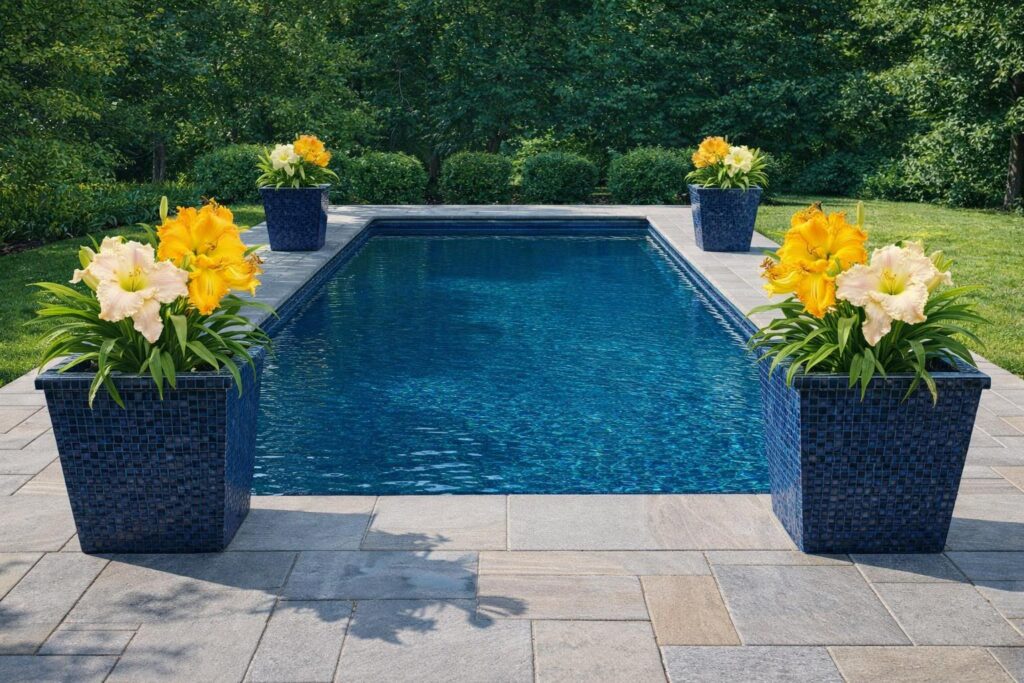
1. Agapanthus (Agapanthus africanus and hybrids)
Agapanthus — commonly called African Lily or Lily of the Nile — is one of the most reliably beautiful poolside plants available. Its tall, architectural flower stems rise above strappy green foliage, producing globe-shaped clusters of blue, violet, or white flowers that bloom through summer precisely when the pool is in most use.
It tolerates heat and reflected light exceptionally well. The leaves are clean and minimal, dropping almost nothing into the pool. It is drought-tolerant once established and requires very little maintenance beyond occasional division every few years.
Plant agapanthus in full sun to partial shade, in well-drained soil or large containers. The containerised form is particularly useful for renters or those who want flexibility in their poolside layout.
Why it works poolside: Clean foliage, low litter, heat tolerance, and long-lasting blooms through the swimming season.
Best climate: USDA zones 8–11. Grown as an annual or container plant in colder regions.
2. Bougainvillea (Bougainvillea spp.)
Few plants deliver the kind of vivid, sustained colour that bougainvillea offers. The papery bracts — often mistaken for petals — come in deep magenta, coral, orange, white, and crimson, and they persist for months rather than days, providing a continuous backdrop of colour along pool fencing, walls, or pergolas.
Bougainvillea thrives in heat and full sun. It is drought-tolerant once established and actually flowers more prolifically when slightly stressed. It can be trained along a fence or trellis to frame a pool area beautifully.
One honest note: bougainvillea does drop its spent bracts. In a high wind or after a heavy bloom cycle, there will be some tidying to do. However, the bracts are light and dry, making cleanup straightforward.
Why it works poolside: Exceptional heat tolerance, long bloom season, dramatic visual impact when used on vertical structures.
Best climate: Zones 9–11. Grown in containers and brought indoors in frost-prone regions.
3. Catmint (Nepeta spp.)
Catmint is a quietly excellent poolside perennial. It produces masses of small lavender-blue flowers on soft, silvery-grey foliage from late spring through early autumn, creating a hazy, cottage-style softness that complements the clean lines of modern pool design surprisingly well.
It is virtually maintenance-free. Deadhead after the first flush of bloom by cutting it back by about a third, and it will reflower reliably through the season. It tolerates heat, poor soil, and moderate drought without complaint.
Catmint is also a pollinator magnet — bees and butterflies visit it consistently — which adds ecological life to the pool area.
Why it works poolside: Long bloom season, low maintenance, non-invasive root system, no litter.
Best climate: Zones 3–8. Exceptionally cold-hardy for a long-blooming perennial.
4. Lantana (Lantana camara)
Lantana is almost custom-built for hot, exposed poolside conditions. It thrives in full sun and heat, produces clusters of small multi-coloured flowers in combinations of yellow, orange, red, pink, and white, and blooms continuously from late spring until first frost with minimal care.
It is drought-tolerant, requires no deadheading, and stays relatively compact in well-chosen cultivars. ‘Landmark Sunrise’ and ‘Bandana’ series varieties are particularly tidy and well-suited to container planting.
One important caution: lantana is considered invasive in parts of the southeastern United States, Australia, and other warm regions. Check local guidance before planting in the ground. In containers, it is safe to use almost anywhere.
Why it works poolside: Unmatched heat tolerance, continuous bloom, no litter, excellent in containers.
Best climate: Zones 9–11 as a perennial; grown as an annual in cooler zones.
5. Plumbago (Plumbago auriculata)
Plumbago is a plant that people often discover at a garden centre, buy without knowing its name, and then wonder how they ever landscaped without it.
Its soft, sky-blue flowers are small and produced in generous clusters over a long season, creating a relaxed, airy look that pairs beautifully with pool blues and aquas. It is a vigorous, spreading shrub in warm climates and a well-behaved container plant where winters are cold.
It tolerates heat, full sun, and occasional drought. The flowers drop cleanly and in small enough quantities to cause no meaningful pool maintenance burden.
Why it works poolside: The blue flower colour is genuinely rare in the plant world and complements pool water beautifully. Low maintenance, long season.
Best climate: Zones 9–11 as a perennial; container cultivation elsewhere.
6. Rosemary (Salvia rosmarinus, formerly Rosmarinus officinalis)
Rosemary might seem like an unusual choice for a flower list, but its small blue-violet blooms are genuinely attractive, and the plant as a whole earns its place on any considered poolside planting list.
Prostrate rosemary varieties cascade beautifully over pool deck edges or raised planters, producing dense, fragrant grey-green foliage that tolerates heat, reflected light, drought, and salt spray better than almost any ornamental plant. The flowers appear in late winter to spring in warm climates and attract bees and other beneficial insects.
The fragrance is an undeniable bonus. There is something particularly pleasant about the scent of rosemary drifting across a sun-warmed pool deck.
Why it works poolside: Exceptional heat and drought tolerance, fragrant, evergreen, no litter, edible as a culinary herb.
Best climate: Zones 7–11. Some cold-hardy cultivars survive in zone 6.
7. Gaillardia / Blanket Flower (Gaillardia × grandiflora)
Blanket flower is the cheerful, sun-loving perennial that poolside gardens were made for. It produces bold, daisy-like flowers in vivid combinations of red, orange, and yellow — colours that echo the warmth of summer sun and look striking against the blue of pool water.
It flowers from late spring through autumn with exceptional heat tolerance and requires very little water once established. It is not a long-lived perennial in very rich or moist soils, but in the lean, dry conditions often found near pool decking, it positively thrives.
Deadheading spent flowers extends the bloom period and keeps the planting tidy. The seed heads, if left, also attract small birds in autumn.
Why it works poolside: Thrives in dry, reflected heat; long and vivid bloom season; compact and tidy.
Best climate: Zones 3–10. Exceptionally wide range for a perennial with this heat tolerance.
8. Bird of Paradise (Strelitzia reginae)
Bird of paradise is the architectural showpiece of the poolside garden. Its striking orange and blue flowers, emerging from paddle-shaped leaves on upright stems, create an unmistakably tropical atmosphere that complements the resort-like quality of a well-designed pool area.
It is tough — genuinely tough. Bird of paradise tolerates heat, drought, reflected light, and salt spray with equanimity. Once established, it requires almost no care and will bloom repeatedly year after year.
It does not litter. The flowers are large and long-lasting, producing no messy dropped petals. The foliage is clean and evergreen. It is, in many respects, the ideal poolside plant in warm climates.
Why it works poolside: Tropical drama, zero litter, exceptional durability, long-lived blooms.
Best climate: Zones 9–11. Widely grown in containers in colder regions.
9. Salvia (Salvia spp.)
The salvia family is large and varied, but most members share the qualities that make them excellent poolside candidates: heat tolerance, long bloom season, minimal litter, and strong visual impact.
Salvia ‘Hot Lips’ (red and white), Salvia nemorosa (violet-blue), and Salvia guaranitica (deep blue) are among the best choices. They attract hummingbirds and butterflies while remaining tidy and manageable. Most salvias bloom from late spring through autumn and require only light pruning to reflower.
The compact forms — particularly the nemorosa cultivars — are excellent at the front of poolside border plantings or in raised containers.
Why it works poolside: Long season, wide colour range, pollinator-friendly, no litter.
Best climate: Varies by species; many are hardy to zones 4–9.
10. Portulaca / Moss Rose (Portulaca grandiflora)
For hot, dry, sandy pool surrounds with little soil depth, portulaca is an almost miraculous solution. It produces bright, jewel-toned flowers in magenta, yellow, orange, cream, and coral, and it flourishes in conditions that would kill most other flowering plants.
Portulaca loves full sun and dry soil. It tolerates reflected heat, poor fertility, and irregular watering. The flowers close at night and on cloudy days — a quirk some gardeners find charming and others find limiting.
It is typically grown as an annual but self-seeds prolifically in warm climates, often returning without replanting. The plant stays low — usually under six inches — making it ideal for ground-level planting along pool edges without blocking sightlines.
Why it works poolside: Thrives in extreme heat and dry conditions; low growing; no litter; excellent gap-filler.
Best climate: Annual in most zones; perennial in zones 10–11.
11. Gazania (Gazania rigens and hybrids)
Gazania is another sun-worshipper that excels in poolside conditions. Its bold, daisy-like flowers in orange, yellow, red, and bi-colour combinations open in full sun and close in shade or at night, making them a constant bright presence on sunny pool days.
It tolerates heat, wind, and poor, sandy soils. It is drought-resistant, low-growing, and produces no meaningful litter. Regular deadheading keeps it blooming consistently through the warmer months.
Gazania looks particularly good in mass plantings along pool deck edges, where its uniform height and vivid colour create a clean, designed look.
Why it works poolside: Extremely heat and drought tolerant; bold colour; low and tidy; thrives in sandy or poor soils.
Best climate: Zones 9–11 as a perennial; treated as an annual in colder regions.
12. Hibiscus (Hibiscus rosa-sinensis)
Tropical hibiscus is synonymous with pool-side luxury. Its large, bold flowers — available in deep red, coral, peach, yellow, and white — open for a day and are then replaced by the next bud, creating a continuous succession of dramatic blooms throughout the warm season.
It thrives in full sun, warm temperatures, and regular moisture. In containers, it can be moved indoors in winter and brought out again each spring. Hardy hibiscus species (Hibiscus moscheutos) offer similar floral drama for colder climates, dying back to the ground in winter and re-emerging each spring.
The individual flowers drop after one day, which creates a small litter consideration. However, they are soft and lightweight, causing no practical pool maintenance issues.
Why it works poolside: Unmistakably tropical presence, continuous bloom, available in container and hardy forms for most climates.
Best climate: Tropical hibiscus, zones 9–11; hardy hibiscus, zones 4–9.
13. Canna Lily (Canna × generalis)
Canna lily offers something few other poolside plants can match: dramatic tropical foliage combined with bold upright flowers in red, orange, yellow, and coral. The large paddle leaves — often with bronze, burgundy, or striped variegation — create a lush, resort-style atmosphere around the pool even before the flowers appear.
Cannas thrive in heat and full sun. They tolerate moist soils and can even be grown in shallow water at pond margins, making them highly adaptable to the variable moisture conditions around pool areas.
They are best planted a reasonable distance from the pool edge — two to three metres — as their large leaves and spent flowers can produce some debris. In the right position, they are outstanding anchor plants.
Why it works poolside: Exceptional tropical impact, heat and moisture tolerant, dramatic foliage throughout the season.
Best climate: Zones 8–11 as a perennial; grown from rhizomes annually in colder zones.
14. Dianthus / Carnation (Dianthus spp.)
Dianthus is a compact, fragrant flowering plant that brings both colour and scent to the poolside garden. The small, fringed flowers come in pink, red, white, coral, and bi-colours, and many varieties carry a clove-like fragrance that is genuinely lovely in a poolside setting.
It tolerates heat, dry conditions, and reflected light from paving. Modern cultivars like the ‘Fruit Punch’ and ‘Floral Lace’ series bloom from spring through autumn with minimal deadheading. The plants stay compact — typically six to twelve inches — making them excellent for container arrangements or low border edging.
Dianthus also tolerates slightly alkaline soil — a useful quality in garden areas where concrete leaches lime into the surrounding soil.
Why it works poolside: Fragrant, compact, alkaline-soil tolerant, long bloom season, excellent in containers.
Best climate: Varies by species; many are hardy to zones 3–9.
15. Scaevola / Fan Flower (Scaevola aemula)
Scaevola is an Australian native that has become a favourite in warm-climate gardens worldwide — and for excellent reason. Its distinctive fan-shaped flowers in lavender-blue, pink, or white bloom continuously from spring through autumn without any deadheading, and the plant cascades gently from containers or tumbles over deck edges in a way that softens hard landscaping beautifully.
It is extremely heat-tolerant, drought-resistant once established, and produces no meaningful litter. It is resistant to salt spray, making it particularly useful in coastal pool gardens.
I have seen scaevola used along the front edge of raised pool planters with stunning effect — the cascading growth softening the concrete edge and the flowers providing constant colour at eye level when sitting beside the pool.
Why it works poolside: No deadheading required, salt and heat tolerant, cascading form softens hard edges, continuous bloom.
Best climate: Zones 9–11 as a perennial; widely grown as an annual in cooler zones.
What to Look for in a Poolside Flower
Before choosing plants, it helps to understand what makes some flowers better suited to pool environments than others.
Low litter is the most underappreciated quality. Flowers that drop large petals, seed pods, or sticky residue create ongoing filter problems and slippery deck surfaces. The best poolside flowers are either non-messy or produce debris small enough to be inconsequential.
Heat and reflected light tolerance matters more than most gardeners expect. Pool decking — particularly light-coloured concrete or stone — reflects significant radiant heat upward. Plants close to the pool edge must tolerate this additional heat stress without scorching or wilting.
Salt and chlorine tolerance is relevant for plants in the splash zone. Occasional exposure to chlorinated water should not cause lasting damage to well-chosen species.
Root behaviour deserves consideration for in-ground pools. Aggressive, deep-rooting plants planted too close to pool walls or underground plumbing can eventually cause structural problems. This guide notes where root caution applies.
Wind tolerance matters in exposed gardens. Pool areas are often more exposed than sheltered garden beds, and taller flowers need sufficient stem strength to avoid flopping or breaking.
Poolside Flowers at a Glance
| Flower | Bloom Season | Sun Need | Litter Level | Best Feature |
| Agapanthus | Summer | Full/Part | Very low | Architectural, long-lasting |
| Bougainvillea | Spring–Autumn | Full | Low–Moderate | Vivid colour on vertical surfaces |
| Catmint | Spring–Autumn | Full/Part | Very low | Long season, pollinator-friendly |
| Lantana | Spring–Frost | Full | Very low | Best heat tolerance on this list |
| Plumbago | Spring–Autumn | Full/Part | Low | Rare true blue in warm climates |
| Rosemary | Late Winter–Spring | Full | Very low | Fragrant, edible, evergreen |
| Gaillardia | Late Spring–Autumn | Full | Low | Thrives in dry, lean soil |
| Bird of Paradise | Variable | Full | Very low | Tropical drama, zero maintenance |
| Salvia | Spring–Autumn | Full/Part | Very low | Wide colour range, pollinators |
| Portulaca | Summer–Autumn | Full | Very low | Best for dry, hot microclimates |
| Gazania | Spring–Autumn | Full | Very low | Bold colour in poor soil |
| Hibiscus | Summer–Autumn | Full | Low | Classic tropical statement |
| Canna Lily | Summer–Autumn | Full | Moderate | Foliage + flower drama |
| Dianthus | Spring–Autumn | Full | Very low | Fragrant, compact, alkaline-safe |
| Scaevola | Spring–Autumn | Full/Part | Very low | Cascading, no deadheading needed |
Planting Tips for a Beautiful Poolside Garden
Choosing the right flowers is only part of the equation. How and where you plant them shapes both the look and the practical success of the garden.
Keep a one-metre buffer from the pool edge. This protects both the pool structure and the plants — soil near the pool edge tends to get more splash, more foot traffic, and more heat stress. A small buffer of deck, gravel, or pavers between the planting bed and the pool coping makes maintenance easier and looks more intentional.
Use containers strategically. Containers allow you to change plants seasonally, move plants for cleaning, and grow cold-tender species in climates where they would not survive in the ground. Large, heavy containers also serve as natural barriers that guide foot traffic and define the pool area.
Choose soil and drainage carefully. Pool areas often have compacted, poor soils due to construction activity. Improve planting beds with compost before establishing perennials, and ensure drainage is adequate — waterlogged soils near pool structures can create problems over time.
Favour low-pollen flowers if allergies are a concern. Several of the flowers on this list — agapanthus, salvia, scaevola — are low-pollen species. Avoid high-pollen plants like sunflowers or heavily flowering ornamental grasses directly beside the pool seating area.
Think in layers. The most attractive poolside plantings use a combination of heights: tall architectural plants like agapanthus, bird of paradise, or canna lily at the back or in corners; mid-height plants like salvia, hibiscus, or plumbago in the middle; and low-growing plants like catmint, portulaca, or scaevola at the front edge.
A Note on Fragrance
One dimension of poolside planting that is easy to overlook is fragrance. The warmth radiating from pool decking intensifies the scent of nearby plants considerably.
Rosemary, dianthus, and catmint are the standouts on this list for fragrance. Placed near seating areas or along the path to the pool, they add a sensory dimension that elevates the entire experience of the space.
Avoid planting heavily fragrant flowers directly downwind of the prevailing breeze if any household members are sensitive to strong scents. For most people, though, the gentle fragrance of poolside planting is one of its most memorable qualities.
Frequently Asked Questions
What flowers are safe to plant close to a pool? Low-litter, non-invasive flowering plants with compact or controlled root systems are the safest choices. Agapanthus, catmint, salvia, portulaca, scaevola, and dianthus are all excellent options that cause no structural or maintenance problems close to pool edges.
What flowers are best for hot, sunny pool areas? Lantana, gaillardia, gazania, portulaca, and bird of paradise all excel in intense sun and reflected heat from pool decking. These species are specifically adapted to high-temperature, high-light conditions.
Can I plant flowers in pots around the pool instead of in the ground? Absolutely — and in many cases, containers are preferable. They allow you to rearrange the garden, replace plants seasonally, protect cold-tender species in winter, and keep roots away from pool infrastructure entirely.
Which poolside flowers attract the least insects? If minimising insects near the pool is a priority, avoid highly fragrant or high-nectar flowering plants. Agapanthus, bougainvillea, portulaca, and gazania attract fewer insects than catmint, salvia, or rosemary. That said, most insects attracted by flowering plants are beneficial pollinators, not nuisances.
How do I prevent leaves and flowers from clogging the pool? Choose low-litter species (as this guide recommends), maintain a buffer between planting beds and the pool edge, and use a pool skimmer regularly. Trees and large shrubs are typically the main source of pool debris — keeping them at distance and choosing tidy, small-flowered species eliminates most of the problem.
Final Thoughts
A poolside garden done well is one of the most rewarding garden projects you can undertake. The combination of water, reflected light, warmth, and well-chosen flowering plants creates an environment that genuinely changes how a space feels and how much it gets used.
The fifteen flowers in this guide represent a range of climates, styles, and budgets. Whether you are working with a sun-baked courtyard pool in a Mediterranean climate, a family backyard pool in the suburbs of Atlanta, or a container garden on a rooftop terrace in a colder city, several of these plants will suit your situation.
Start with two or three species that fit your climate and aesthetic. See how they perform. Then build the planting out over time. A poolside garden does not need to be completed in a single season — some of the best ones grow more beautiful with each passing year.
References
- University of Florida IFAS Extension — Landscape Plants for Florida https://gardeningsolutions.ifas.ufl.edu/plants/ornamentals/
- University of California Cooperative Extension — Drought-Tolerant Landscaping https://ucanr.edu/sites/UrbanHort/Water_Use_of_Turfgrass_and_Landscape_Plant_Materials/
- Clemson University Cooperative Extension — Heat-Tolerant Annuals and Perennials https://hgic.clemson.edu/category/flowers/
- University of Arizona Cooperative Extension — Desert Gardening: Flowering Plants for Hot Climates https://extension.arizona.edu/gardening
- North Carolina State University Extension — Perennial Plant Profiles https://plants.ces.ncsu.edu/

Tim M Dave is a gardening expert with a passion for houseplants, particularly cacti and succulents. With a degree in plant biology from the University of California, Berkeley, he has vast experience in gardening. Over the years, he has cultivated a vast collection of desert plants and learned a great deal about how to grow and care for these unique companions.