Understanding Eastern White Pine (Pinus strobus): Identification, Uses, Problems, Cultivation and More
There is a reason the Eastern White Pine appears on the flags of Maine and Massachusetts. There is a reason colonial-era British naval officers marked the finest specimens with the King’s Broad Arrow — a symbol of royal claim — and why those acts of appropriation helped spark a revolution.
Eastern White Pine (Pinus strobus) is not simply a large tree. It is a tree that shaped the history of a continent.
For centuries, it provided the tallest, straightest timber in the temperate world — the perfect material for the masts of sailing ships. It built the first colonial homes. It reforested millions of acres of abandoned farmland across the northeastern United States.
What’s more, it shelters songbirds and feeds squirrels and provides canopy for trout streams. And in winter, when everything else is bare and grey, its long soft needles hold their blue-green colour like a quiet reassurance that the forest is still alive.
This guide covers everything you need to know about Eastern White Pine: its taxonomy, physical characteristics, native range, ecology, timber history, medicinal uses, and how to cultivate it successfully.
It is one of the most important trees in North American ecological and cultural history, and it deserves a thorough account.
Taxonomy and Classification
Eastern White Pine belongs to the pine family (Pinaceae) and the large, globally distributed genus Pinus.
Scientific classification:
- Kingdom: Plantae
- Division: Pinophyta
- Class: Pinopsida
- Order: Pinales
- Family: Pinaceae
- Genus: Pinus
- Subgenus: Strobus (soft pines / white pines)
- Species: P. strobus
- Full name: Pinus strobus L.
- Common names: Eastern White Pine, Northern White Pine, Weymouth Pine (UK), Soft Pine
The species name strobus was used by pre-Linnaean botanists and refers to an ancient term for certain resinous trees.
The name “Weymouth Pine” — still used in the United Kingdom — comes from Lord Weymouth, who planted large numbers of the species on his English estate in the early 18th century, introducing it to British horticulture.
Eastern White Pine belongs to the subgenus Strobus — the “soft” or “white” pines — distinguished from “hard” pines by having needles in bundles of five (most hard pines have two or three needles per bundle).
The five-needle arrangement is one of the quickest and most reliable identification features in the field.
Physical Description: Knowing Eastern White Pine on Sight
Eastern White Pine is the tallest native conifer in eastern North America and one of the largest trees on the continent by height. It is unmistakable once you know it.
Size and Form
Mature Eastern White Pines typically reach 21 to 37 metres (70–120 feet) in height in managed or second-growth forests. Historic old-growth specimens regularly exceeded 50 metres (165 feet) — the tallest known historical trees may have reached 60 metres or more.
Today, a few exceptional individuals in old-growth remnants approach or exceed 50 metres.
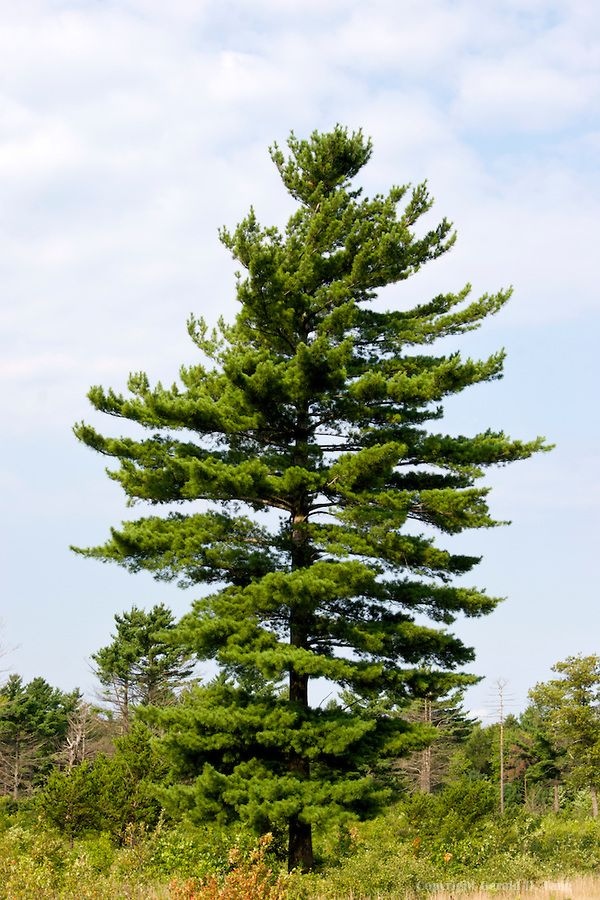
In youth, the form is regularly pyramidal, with whorled branches giving it a classic, symmetrical Christmas-tree silhouette. With age and exposure, the crown becomes more irregular and broadly spreading — old trees develop flat-topped or wind-sculpted crowns with massive, horizontal limbs that spread widely from the upper trunk.
Growth rate is relatively fast for a large conifer: 30–60 cm per year under good conditions in youth, slowing as the tree matures.
Needles
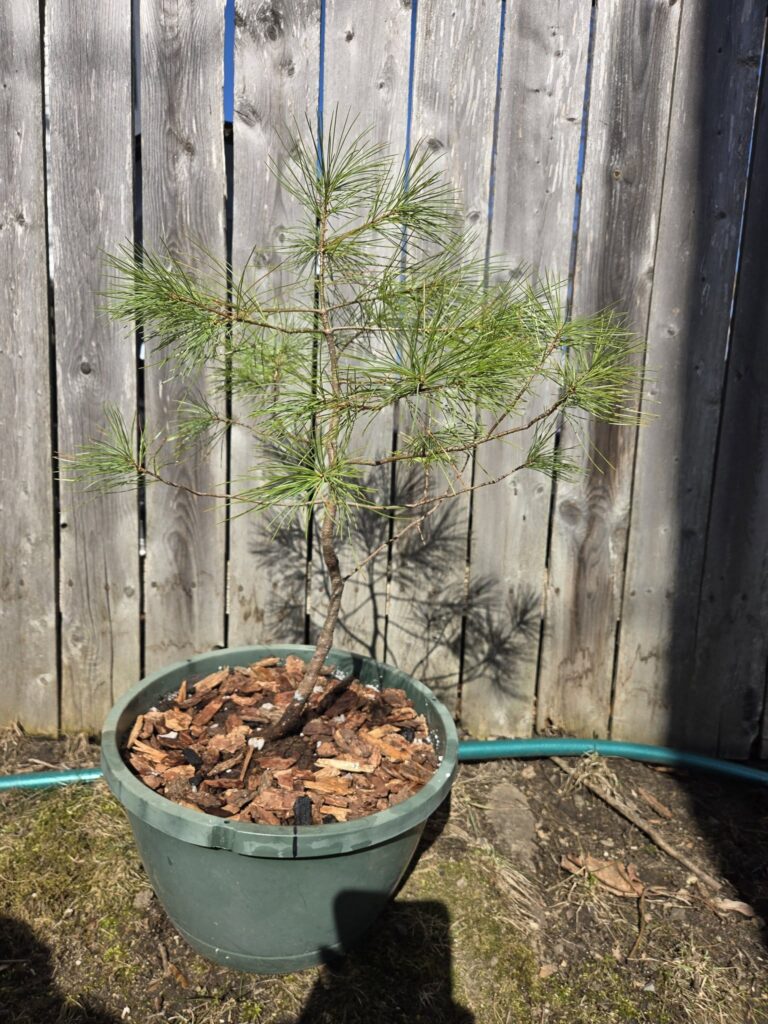
The needles are the defining identification feature. Eastern White Pine has five needles per bundle (fascicle) — always five, without exception. The needles are:
- 7–13 cm long — relatively short compared to many pines
- Soft, flexible, and straight — not stiff or sharp like many hard pines
- Blue-green with a slight glaucous (waxy, greyish) bloom
- Finely serrated along the edges — visible under magnification
The “five-needled soft pine” combination — five needles per bundle, soft texture — is an instant identification feature. In the field, running a handful of needles through your fingers is enough. If they are soft and silky and come in fives, it is almost certainly Pinus strobus in eastern North America.
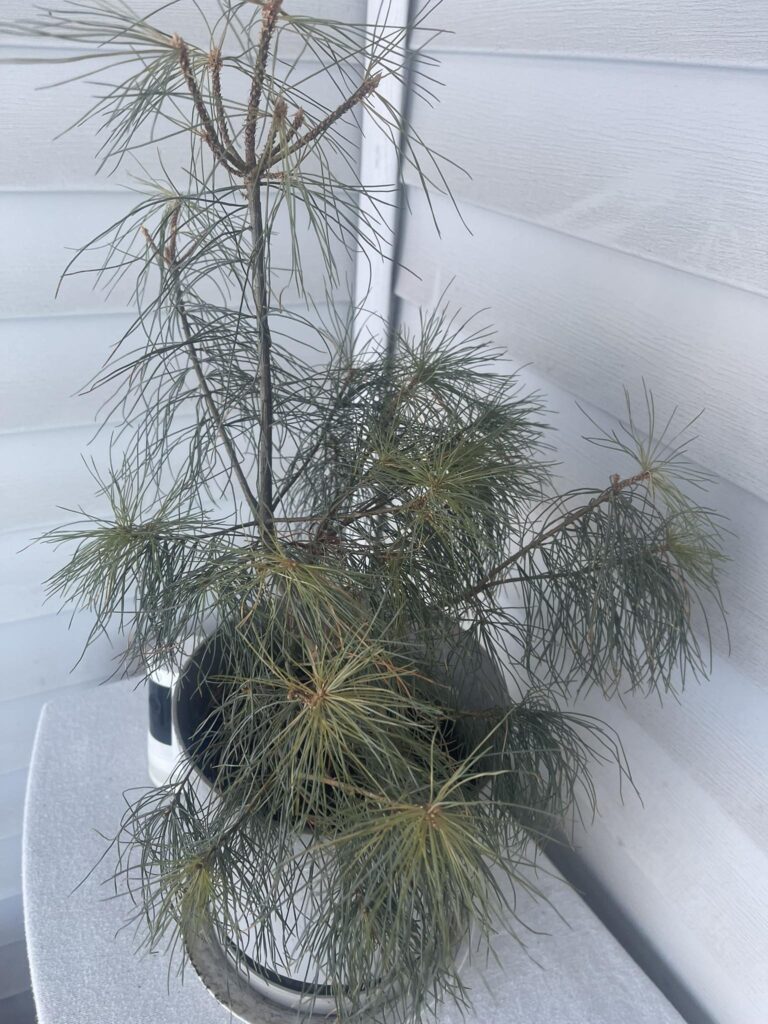
Needles persist for 2–3 years before dropping. Needle shed in early autumn — when the older inner needles yellow and drop — occasionally alarms new growers who fear the tree is dying. This is a normal seasonal process.
Bark
Bark changes significantly with age. On young trees, it is smooth, thin, and greenish-grey, sometimes almost silvery. On mature trees, it becomes deeply furrowed into long, broad, dark grey ridges — a thick, rough, vertically plated bark that protects the trunk in fire-influenced landscapes.
Cones
The cones are elongated, slightly curved, and 8–20 cm long — longer and more slender than most eastern pines. They are resinous, with thin, flexible scales, and typically hang from the branches rather than standing upright.
Green cones turn brown and open to release their winged seeds in late summer and autumn of their second year.
The seeds are small and winged, dispersed by wind but also cached and consumed by squirrels, chipmunks, nuthatches, crossbills, and many other species.
Flowers (Strobili)
Eastern White Pine is monoecious — male and female reproductive structures occur on the same tree.
Male strobili are small, yellow, clustered at the base of new growth in spring, and release pollen in large, visible clouds — a phenomenon that annually alarms suburban residents who notice their cars and porch furniture coated in yellow-green dust. The pollen is abundant but short-lived.
Female strobili are small, reddish-purple, and borne near the tips of new growth. After pollination, they develop slowly over two full years before maturing into the characteristic elongated cone.
Native Range and Natural Distribution
Eastern White Pine has a broad but clearly defined native range across eastern North America.
Geographic boundaries:
- Northern limit: Newfoundland, Nova Scotia, and the Gaspe Peninsula (Canada); northwest to Manitoba
- Southern limit: Northern Georgia, western North Carolina, and the mountain ridges of Tennessee
- Eastern limit: The Atlantic seaboard from Nova Scotia to New Jersey
- Western limit: Eastern Minnesota, Iowa, and Illinois
The species also has significant disjunct populations in the Appalachian Mountains, where it occurs at higher elevations south of its main range, and small isolated populations in Iowa and Illinois.
Habitat preferences:
Eastern White Pine is broadly adaptable but grows best in:
- Sandy, well-drained, slightly acidic soils (pH 4.5–6.0)
- Moist loams of valley floors and lower slopes
- Rocky ridges and lake shores — it colonises rocky outcrops remarkably well
- Forest edges and open woodlands with moderate to high light
It tolerates a wide range of soil types, from dry, nutrient-poor sands to moist, fertile loams, but does not tolerate waterlogged or poorly drained soils, urban air pollution well, or the alkaline soils found in much of the Midwest.
Eastern White Pine grows across USDA Hardiness Zones 3–8, and is remarkably cold-tolerant — established trees survive temperatures well below −30°C in the northern portions of its range.
Ecological Role: What Eastern White Pine Gives to the Forest
Eastern White Pine is an ecologically foundational species in the forests of northeastern North America. Its contributions span every level of the food web.
Wildlife Food and Habitat
The seeds are a critical food source for an impressive range of wildlife:
- Red and White-winged Crossbills — these birds are practically evolutionary specialists on white pine; their crossed bill tips are precisely adapted to pry open pine cone scales
- Red Squirrels — harvest and cache enormous quantities of cones; a single red squirrel may store thousands of cones for winter
- Gray Squirrels and Chipmunks
- White-breasted Nuthatches, Red-breasted Nuthatches
- Pine Siskins and Common Redpolls in irruption years
- Black Bears — consume both seeds and inner bark (cambium) in spring when other food is scarce
The dense canopy and large, layered branching of mature White Pines provides winter roosting cover that few other trees match. Species that depend on White Pine stands for winter shelter include:
- Bald Eagles — use large White Pines as communal winter roost trees
- Great Horned Owls — nest in the large, wind-protected cavities of old pines
- Long-eared and Barred Owls
- Wild Turkeys — roost in the canopy during deep snow conditions
White-tailed deer browse young White Pines in winter — a browsing pressure that can significantly limit regeneration in high deer-density areas.
Soil Building and Stream Protection
Eastern White Pine’s dense needle litter creates a deep, acidic soil horizon that, over decades, builds a distinctive forest floor community supporting acid-loving wildflowers, fungi, and invertebrates.
The root systems of mature White Pines stabilize streambanks and provide shade that keeps water temperatures cold enough for brook trout and other cold-water species.
The loss of White Pines from riparian zones — as occurred extensively after colonial-era logging — caused measurable warming of streams and loss of cold-water fish habitat. Riparian White Pine is now actively planted in stream restoration projects across the Northeast.
Forest Succession
Eastern White Pine is a mid-successional species — it establishes readily in old fields and disturbed areas, growing quickly and eventually producing a closed canopy that eventually supports the establishment of more shade-tolerant hardwoods beneath it.
Many White Pine forests in New England occupy fields that were farmed in the 18th and 19th centuries and subsequently abandoned. The Pine moved in first. The hardwoods follow beneath it.
The Timber History: How White Pine Shaped North America
The timber history of Eastern White Pine is, in large part, the economic history of colonial North America.
The Mast Trade
The Royal Navy of 18th-century Britain faced a chronic shortage of straight, tall timber for ships’ masts. The largest European trees — typically Baltic pines and firs — were adequate for smaller vessels but fell short in length for the largest ships of the line.
Eastern White Pine solved the problem. A straight, old-growth White Pine could reach 30–50 metres with a trunk diameter of 1–2 metres — perfect for the masts of first-rate warships.
Beginning in the mid-17th century, the British Crown established a systematic programme of reserving the largest White Pines in the American colonies for naval use. Royal surveyors marked qualifying trees with the King’s Broad Arrow — three axe cuts forming a crow’s foot symbol — to indicate Crown ownership.
Colonial settlers resented this bitterly. Timber was their economic lifeblood, and being forbidden from harvesting the finest trees on their own land generated sustained, deep anger. The Broad Arrow Policy became one of the specific grievances that fed the resistance movement preceding the American Revolution.
The Pine Tree Riot of 1772, in which New Hampshire colonists assaulted British officials enforcing the Broad Arrow Policy, is considered one of the early acts of organised colonial defiance — predating Lexington and Concord by three years.
The Lumber Era
After American independence, White Pine was harvested with extraordinary — and ultimately catastrophic — intensity. By the mid-19th century, logging had largely stripped the White Pine forests of New England and New York.
The industry then moved to Michigan, Wisconsin, and Minnesota, consuming the Great Lakes White Pine forests between approximately 1840 and 1900. By 1900, the original White Pine forests of the Lake States were effectively gone.
The loss of these forests — millions of acres of old-growth White Pine — is considered one of the most significant ecological events in American history.
The reforestation of the Northeast, largely on abandoned farmland from the late 19th century onward, has restored substantial White Pine coverage, but second-growth forests are a fundamentally different ecological entity from the original old growth.
Timber Properties and Uses
Eastern White Pine produces soft, lightweight, easily worked timber that was the standard construction material in eastern North America for centuries.
Wood characteristics:
- Colour: Light cream to pale yellow-brown; knot-free “clear” grades are particularly valued
- Texture: Fine and even; straight grain
- Weight: Light — approximately 430 kg/m³; among the lightest commercial softwoods
- Workability: Excellent — planes, cuts, nails, and finishes easily; minimal splitting
- Durability: Moderate indoors; limited outdoor durability without treatment
Primary timber uses:
- Historical construction — exterior and interior framing, flooring, sheathing, and cladding of colonial and 19th-century buildings
- Millwork — window frames, door frames, trim, and interior mouldings
- Pattern and model making — lightweight and easily carved
- Boxes and crates — historically a major use
- Wood carving and sculpture — fine, even grain responds beautifully to hand tools
- Cabinetry — particularly for rustic and cottage-style interiors
- Pulpwood — used in paper production
Medicinal and Ethnobotanical Uses
Eastern White Pine has a substantial history of medicinal use across its native range.
Indigenous Medicinal Traditions
Multiple Native American nations used Eastern White Pine extensively in their medical practices:
- Ojibwe (Chippewa): Inner bark decoctions used for coughs, colds, and respiratory infections; pitch used as a wound poultice and drawing agent for splinters and infections
- Iroquois (Haudenosaunee): Needle and bark preparations for coughs and fevers; resin used topically for skin conditions
- Algonquin: Inner bark preparations for colds and respiratory complaints
- Potawatomi: Resin used as a salve for cuts, burns, and skin infections
Vitamin C and Scurvy Prevention
One of the most historically documented uses of Eastern White Pine comes from the journals of Jacques Cartier’s 1535–1536 expedition to the St. Lawrence River region, where a large portion of his crew was dying of scurvy.
Local Iroquoian people showed them how to make a decoction from the bark and needles of what is believed to be Eastern White Pine (or possibly Eastern White Cedar — the identification is debated by historians).
The crew recovered. Whatever the exact tree, the preparation provided sufficient Vitamin C to reverse the scurvy. The exchange may have saved the French colonial enterprise in Canada.
Eastern White Pine needles are genuinely rich in Vitamin C — ripe green needles contain significant concentrations of ascorbic acid and were recognised as an antiscorbutic long before the concept of vitamins existed.
Modern Herbal and Folk Uses
Today, White Pine needle tea is consumed by herbalists and foragers for its Vitamin C content, its mild expectorant properties, and its pleasant, resinous flavour. Fresh green needles (the current year’s growth) can be steeped in hot water — the resulting tea has a clean, piney, slightly citrusy taste.
Turpentine, derived from the resin of White Pine and related species, was historically used in medical preparations as an antiseptic, counterirritant, and vermifuge (anti-parasitic treatment). It appeared in 19th-century American pharmacopoeias and is still used in some veterinary preparations.
White Pine Blister Rust: The Greatest Threat
Any comprehensive account of Eastern White Pine must address its most serious disease.
White Pine Blister Rust (Cronartium ribicola) is a devastating fungal disease introduced from Asia to North America around 1900. It is not native to this continent, and Eastern White Pine evolved without any resistance to it.
The Disease Cycle
Blister Rust has a complex, two-host life cycle. It cannot spread directly from pine to pine — it requires an alternate host in the Ribes genus (currants and gooseberries) to complete its life cycle.
- On White Pine: The fungus infects the needles and spreads into the bark, forming orange-yellow cankers on branches and the main trunk. As cankers girdle branches or the main stem, the wood above dies. Trunk cankers are eventually fatal.
- On Ribes: The rust produces different spore types on currant and gooseberry leaves — orange pustules visible on the undersides — before releasing spores that return to infect White Pines.
Impact and Control
Blister Rust has killed tens of millions of Eastern White Pines since its introduction. In some regions, it eliminated White Pine as a dominant species for decades. The western cousin, Western White Pine (Pinus monticola), was even more severely affected — some Idaho populations lost over 90% of mature trees.
Management strategies include:
- Ribes eradication — removing currant and gooseberry plants near White Pine plantations (historically practised, now largely abandoned as impractical)
- Resistance breeding — ongoing at USDA Forest Service research stations; some partially resistant individuals have been identified
- Fungicide treatments — used in nurseries and high-value plantings
- Pruning — removing lower branches reduces infection pathways since the rust infects low foliage first
Cultivation and Landscape Use
Despite Blister Rust and some demanding requirements, Eastern White Pine is an excellent landscape tree for appropriate sites.
Growing Requirements
- Hardiness zones: USDA Zones 3–8
- Soil: Sandy to loamy, well-drained, acidic (pH 4.5–6.0); not tolerant of heavy clay, alkaline soils, or waterlogging
- Sunlight: Full sun; tolerates light shade in youth but requires adequate light for good form
- Moisture: Moderate; tolerates dry, rocky sites once established; not drought-tolerant in its first two years
- Air quality: Sensitive to air pollution, particularly ozone and salt spray; not recommended for roadsides with heavy salt application or urban centres with poor air quality
Landscape Value
- Specimen tree on large properties — magnificent at maturity; few conifers are more elegant
- Screening and windbreak — one of the most effective large evergreen screens available in the Northeast and Midwest
- Naturalistic woodland planting — blends beautifully in mixed conifer-hardwood landscapes
- Restoration planting — used extensively in old-field reforestation
Pruning and Form
Young White Pines can be lightly sheared to maintain a more compact, formal shape — useful for screens and hedges. However, the natural, unpruned form is magnificent and should be allowed to develop on specimen trees. Never cut back into old wood beyond the current year’s growth — White Pine does not regenerate from old wood.
Caution: Salt Sensitivity
Eastern White Pine is highly sensitive to road salt — both airborne spray and soil accumulation. Planting within 30 metres of heavily salted roads will cause browning, needle drop, and eventual decline. Choose salt-tolerant species for roadside exposures.
Eastern White Pine in Culture and Symbol
The Pine Tree Flag — bearing a White Pine and the motto “An Appeal to Heaven” — was carried by American forces in the early Revolutionary War. It remains one of the iconic symbols of early American independence.
Maine adopted the White Pine cone and tassel as its state flower in 1895 — an unusual choice of a conifer reproductive structure as a floral symbol, but entirely apt for a state whose identity is inseparable from its pine forests.
The White Pine is the state tree of both Maine and Michigan — two states where the timber, ecology, and cultural history of this species are woven into the landscape itself.
For generations of children across the Northeast and Midwest, climbing a large White Pine — its rough bark, the view from high in its swaying crown, the smell of resin on your hands — has been a formative experience of what it means to be alive in a forested landscape.
Some trees are loved. Eastern White Pine is, by any measure, one of them.
Final Thoughts
Pinus strobus built colonial America. It re-forested abandoned farmland. It shelters eagles in winter. It feeds crossbills adapted to no other food source. It cured scurvy on the banks of the St. Lawrence. It helped start a revolution.
And it is still growing — in second-growth forests, in suburban yards, in stream-side restoration plantings, in the rocky thin soils of northern lake shores where almost nothing else can establish.
To plant a White Pine is to participate in a very long story. It is a story about timber and ecology, about indigenous knowledge and colonial hubris, about the patience required to grow something that will not reach its full grandeur in your lifetime — but will outlast you, and shelter the generations that follow.
That, ultimately, is what the best trees do.
References
- USDA Forest Service — Silvics of North America Pinus strobus L. — Eastern White Pine: Complete Silvicultural and Ecological Profile https://www.srs.fs.usda.gov/pubs/misc/ag_654/volume_1/pinus/strobus.htm
- University of Maine Cooperative Extension Eastern White Pine: Identification, Ecology, Management, and Timber Value in Maine Forests https://extension.umaine.edu/forestry/maine-trees/conifers/eastern-white-pine/
- Penn State Extension — College of Agricultural Sciences White Pine Blister Rust: Biology, Identification, and Management in Pennsylvania https://extension.psu.edu/white-pine-blister-rust
- North Carolina State University — Extension Gardener Plant Toolbox Pinus strobus — Full Horticultural Profile: Cultivars, Pests, Landscape Uses, and Growing Guide https://plants.ces.ncsu.edu/plants/pinus-strobus/
- USDA Natural Resources Conservation Service (NRCS) — PLANTS Database Pinus strobus L. — Classification, Native Distribution Maps, and Ecological Data https://plants.usda.gov/home/plantProfile?symbol=PIST

Tim M Dave is a gardening expert with a passion for houseplants, particularly cacti and succulents. With a degree in plant biology from the University of California, Berkeley, he has vast experience in gardening. Over the years, he has cultivated a vast collection of desert plants and learned a great deal about how to grow and care for these unique companions.