15 Drought Tolerant Shrubs: The Best Choices for Dry Gardens and Water-Wise Landscapes
Water is no longer something gardeners in most parts of the world can take for granted. Prolonged summer droughts, hosepipe bans, rising water costs, and shifting rainfall patterns have changed the way thoughtful gardeners approach plant selection. What once felt like an occasional inconvenience — a dry spell here, a brown lawn there — has become, for many, a defining reality of modern gardening.
The response, increasingly, is to plant differently. Not to abandon beauty or ambition, but to choose plants that work with drier conditions rather than against them. Drought tolerant shrubs are among the most practical and rewarding tools available for this purpose. Once established, they require minimal supplemental watering, hold their form and foliage through dry summers, and often deliver their best performance in the very conditions — lean soil, full sun, limited moisture — that would cause less adapted plants to struggle.
This guide covers 15 of the best drought tolerant shrubs, selected for their genuine resilience, ornamental value, and suitability across a wide range of climates and regions. Whether you garden on the sun-baked slopes of California, the dry chalk downlands of southern England, the hot continental summers of South Africa, the arid inland gardens of southern Australia, or the increasingly dry summers of the American Southwest and the Mediterranean basin, this list offers reliable, field-tested options.
What Drought Tolerance Really Means
Drought tolerance is not an on-off switch. It exists on a spectrum, and it almost always comes with an important qualification: most drought tolerant shrubs still need regular watering during their first one to two growing seasons while their root systems establish. It is after establishment — when roots have spread deep and wide enough to access moisture from a larger volume of soil — that drought tolerance becomes a genuine, practical quality.
It is also worth noting that drought tolerance is often linked to specific soil conditions. Many Mediterranean-climate shrubs, for example, are drought tolerant precisely because they grow naturally in sharply drained, nutrient-poor soils. Plant them in heavy, waterlogged clay and they may rot rather than thrive. Matching the plant to the soil is as important as matching it to the rainfall.
With these points in mind, the 15 shrubs that follow represent the most consistently reliable choices across a wide range of dry-garden conditions worldwide.
1. Lavender (Lavandula spp.)
Lavender is perhaps the defining drought tolerant shrub of the temperate and Mediterranean world. Its grey-green, aromatic foliage — adapted to reflect intense sunlight and minimise water loss — makes it naturally equipped for dry summers, and it performs most spectacularly in exactly the lean, free-draining soils and full sun that other shrubs find challenging.
English lavender (Lavandula angustifolia) grows in USDA Hardiness Zones 5–8 and is widely grown across the UK, northern France, the cooler parts of North America, and New Zealand. French lavender (Lavandula stoechas) and lavandin hybrids (Lavandula × intermedia) suit warmer, drier climates — southern Europe, California, parts of Australia, and South Africa — where they bloom more prolifically and grow more vigorously.
In the garden, lavender earns its keep in multiple ways: long spikes of purple, pink, or white flowers from early summer through midsummer, exceptional attraction to bees and butterflies, year-round aromatic foliage, and a tidy, rounded habit that suits borders, pathways, and low hedging. A light trim after flowering keeps plants compact and extends their productive lifespan considerably.
Best for: UK, Mediterranean Europe, California, South Africa, southern and western Australia, New Zealand, cool temperate North America.
2. Rosemary (Salvia rosmarinus, formerly Rosmarinus officinalis)
Rosemary is a shrub that belongs, in the most natural sense, to dry and sunny landscapes. Native to the rocky coastal cliffs and scrubland of the Mediterranean basin, it has evolved over millennia to survive hot, dry summers with almost no supplemental moisture. Its needle-like leaves are coated in aromatic oils that reduce water loss, and its deep root system can access moisture from soil levels that shallow-rooted plants cannot reach.
It grows in Zones 7–11 and is widely planted across the Mediterranean, California, South Africa, coastal Australia, and the milder, drier parts of the UK and New Zealand. In borders, it provides silver-grey to deep green evergreen foliage throughout the year, small blue, white, or pink flowers in early spring that are among the first nectar sources of the season, and the familiar culinary fragrance that makes it doubly useful as both a garden and kitchen plant.
Upright cultivars such as ‘Tuscan Blue’ and ‘Miss Jessopp’s Upright’ suit the back of borders. Prostrate forms cover dry banks and retaining walls effectively, providing ground-level colour and texture where bare soil would otherwise erode. In deer-prone gardens, rosemary’s strong scent makes it consistently among the least browsed of all ornamental shrubs.
Best for: Mediterranean Europe, California, South Africa, coastal and southern Australia, southern and coastal UK, New Zealand.
3. Russian Sage (Salvia yangii, formerly Perovskia atriplicifolia)
Russian sage is built for dry conditions. Native to the dry steppes and rocky slopes of central Asia — Afghanistan, Pakistan, and western China — it has evolved in some of the most arid and wind-exposed habitats on the continent. In the garden, this translates to a shrub of exceptional drought resilience and late-summer beauty.
From midsummer through early autumn, it produces tall, airy columns of tiny lavender-blue flowers on silver-white, aromatic stems. The effect in the border is light and almost luminous — a quality that is particularly effective when planted in large groups or combined with darker-foliaged companions. It grows in Zones 5–9 and is widely planted across the continental United States, particularly in the Midwest, the Rocky Mountain region, and the Mid-Atlantic states. It is also increasingly grown in the drier parts of the UK, continental Europe, and temperate parts of Australasia and South Africa.
It grows best in full sun with sharply drained, even poor, soil. It is cut back hard to the ground in early spring and regrows vigorously, flowering on the new season’s growth. It is highly resistant to browsing by deer — another practical quality in regions where deer pressure is a constant concern.
Best for: Continental United States, Mediterranean Europe, drier parts of the UK, central and eastern Europe, South Africa, New Zealand.
4. Cistus — Rock Rose (Cistus spp.)
Cistus is a shrub that positively thrives in conditions that most plants find hostile. Dry heat, poor stony soil, full relentless sun, salt-laden coastal wind — cistus meets all of these with equanimity and responds with one of the most cheerful and prolific flower displays of the summer garden. Its papery, five-petalled flowers in white, pink, crimson, and magenta open freshly each morning and drop their petals by afternoon, but such is their abundance that the display continues for weeks.
Native to the Mediterranean basin and the Canary Islands, cistus grows in Zones 7–10 and is one of the most drought resistant shrubs in cultivation — able to survive entirely without irrigation once established in climates with warm, dry summers. It is widely grown in Mediterranean Europe, California, South Africa, coastal and southern Australia, and the warmer, drier parts of the UK — particularly southwest England, Wales, and Ireland, where mild winters allow it to thrive outdoors year-round.
Commonly grown species include Cistus × purpureus (purple-crimson with a darker basal blotch), Cistus ladanifer (white with maroon spots, strongly fragrant), and Cistus × hybridus (pure white, compact). All require excellent drainage and full sun; on heavy or wet soil, they decline rapidly.
Best for: Mediterranean Europe, California, South Africa, coastal and southern Australia, southern and western UK and Ireland.
5. Caryopteris — Bluebeard (Caryopteris × clandonensis)
Caryopteris is a late-summer shrub of great practical value in dry gardens. It flowers when many other drought tolerant shrubs have already finished — from late summer through early autumn — producing dense clusters of vivid blue or violet flowers on silvery, aromatic stems that are irresistible to bees and butterflies. It fills a critical gap in the late-season garden calendar and does so with minimum fuss and minimum water.
It is a hybrid of Asian origin, growing in Zones 5–9, and is widely grown in the UK, continental Europe, and the United States, where it is particularly valued in the Midwest, Mid-Atlantic, and Mountain West regions. It grows best in full sun with well-drained, even poor, soil and exhibits notable drought tolerance once established. It tolerates alkaline soils well — a quality useful in many dry-garden situations where chalk or limestone dominates.
Caryopteris is cut back hard in early spring and flowers on the resulting new growth. Popular cultivars include ‘Worcester Gold’ — blue flowers against golden foliage — and ‘Heavenly Blue,’ a compact and prolific bloomer. In cold winters, plants may die back to the roots but regenerate reliably in spring from Zones 5 upward.
Best for: UK, continental Europe, eastern and midwestern United States, parts of South Africa, temperate Australia and New Zealand.
6. Butterfly Bush (Buddleja davidii)
Butterfly bush is one of the most naturally drought resistant of all flowering shrubs. Native to the rocky, limestone hillsides and stream margins of central and western China, it grows in conditions that are alternately very dry and periodically wet — conditions that have given it a resilience that serves it well in gardens across the temperate world.
From midsummer through early autumn, it produces long, cone-shaped flower spikes in purple, pink, white, red, and yellow that are among the most powerfully attractive to butterflies, bees, and other pollinators of any garden plant. It grows in Zones 5–9 and is widely planted across the UK, continental Europe, the eastern and southern United States, and parts of Australasia and South Africa.
As noted in other guides in this series, sterile or low-seed cultivars — such as ‘Miss Molly,’ ‘Pugster Blue,’ and the ‘Buzz’ series — are the responsible choice in regions where the species has become invasive, including the Pacific Northwest of the United States, New Zealand, and parts of Australia. Where these restrictions apply, sterile cultivars deliver the same garden performance without the ecological risk.
Hard pruning in late winter encourages the vigorous new growth that carries the summer flowers and keeps plants at a manageable size.
Best for: UK, continental Europe, eastern and southern United States; sterile cultivars in Pacific Northwest, New Zealand, and parts of Australia.
7. Potentilla — Shrubby Cinquefoil (Dasiphora fruticosa)
Shrubby cinquefoil is one of those quietly remarkable plants that performs consistently well across an extraordinary range of difficult conditions. It is cold-hardy to Zone 2, drought tolerant once established, unfazed by poor or alkaline soils, tolerant of full sun and partial shade, and flowers continuously from late spring through autumn in shades of yellow, white, orange, pink, and red. Few shrubs offer this combination of toughness and prolonged colour.
Native to the cooler, drier regions of the Northern Hemisphere — including the Rocky Mountains of North America, the steppes of central Asia, and mountain regions of Europe — it is a genuinely adaptable plant. In the garden, it grows in Zones 2–7 and is particularly valuable for gardeners in Canada, the northern and mountain United States, Scandinavia, and upland regions of the UK and continental Europe, where cold winters and dry summers combine to make plant selection genuinely challenging.
Cultivars such as ‘Goldfinger,’ ‘Abbotswood,’ and ‘Pink Beauty’ are widely available in North American and European nurseries. Plants grow to a manageable 0.5–1.5 metres and suit borders, low hedges, and exposed rock gardens where other flowering shrubs would falter.
Best for: Canada, Scandinavia, northern UK, Rocky Mountain and northern United States, upland and cold-climate regions of central Europe.
8. Salvia — Ornamental Sage (Salvia spp.)
The salvia genus contains some of the most drought tolerant flowering plants available to temperate and warm-climate gardeners. Several shrubby species are outstanding border plants, combining the genus’s characteristic aromatic foliage — which reduces water loss and deters grazing animals — with long, colourful flowering seasons and exceptional heat tolerance.
Salvia officinalis — common sage — is a small, semi-evergreen shrub that grows in Zones 5–9 and is widely grown across the UK, continental Europe, and temperate North America for both culinary and ornamental purposes. Its soft, grey-green, textured leaves and spikes of blue-purple summer flowers make it an attractive border plant as well as a kitchen herb.
Salvia microphylla and Salvia greggii — the autumn sages — are small, shrubby salvias native to Mexico and the American Southwest that grow in Zones 7–10 and produce vivid red, pink, coral, or white flowers from summer through the first frosts. They are widely grown in California, the American South, Mediterranean Europe, South Africa, and coastal Australia, where they deliver exceptional colour through the hottest and driest months of the year.
All shrubby salvias perform best in full sun with sharply drained soil. Light pruning after each flowering flush extends the blooming season.
Best for: UK (S. officinalis); California, American South, Mediterranean Europe, South Africa, coastal Australia (S. microphylla, S. greggii); widely adaptable across warm temperate zones.
9. Oleander (Nerium oleander)
In warm, dry climates, oleander is one of the most reliable and colourful large shrubs available. It produces abundant clusters of flowers in pink, red, white, yellow, and salmon from late spring through autumn, tolerates intense heat, full sun, coastal wind, salt spray, and extended drought with remarkable equanimity, and grows vigorously in conditions that defeat most ornamentals.
It is native to the Mediterranean basin, the Middle East, and South Asia and grows in Zones 8–11. It is a dominant landscape shrub across the Mediterranean countries — Spain, Italy, Greece, Morocco, and Turkey — as well as in California, the American Southwest, South Africa, and inland and coastal Australia, where it is widely planted in public landscapes, road medians, and private gardens.
One important and non-negotiable point: all parts of oleander are highly toxic to humans, pets, and livestock. It must never be planted where children or animals have unsupervised access, and garden waste from pruning should be handled carefully and never burned, as the smoke can cause irritation. With this clearly understood, oleander is an extraordinary drought tolerant shrub for appropriate warm-climate settings.
Best for: Mediterranean Europe, California, American Southwest, South Africa, coastal and inland Australia, Middle East.
10. Smoke Bush (Cotinus coggygria)
Smoke bush is grown primarily for its foliage — large, rounded leaves in shades of deep purple, burgundy, or blue-green depending on the cultivar — and for the extraordinary, smoke-like plumes of tiny flowers and stalks that billow above the plant in midsummer, creating a hazy, almost ethereal effect in the border. It is also genuinely drought tolerant, making it a practical as well as beautiful choice for dry gardens.
Native to southern Europe and central Asia, it grows naturally on rocky, well-drained slopes and in the dry woodland margins of its native range. It grows in Zones 4–8 and is widely planted across continental Europe, the UK, the eastern and central United States, and temperate parts of Australasia. It performs best in full sun with poor to moderately fertile, well-drained soil. Excessively rich, moist soil encourages leafy growth at the expense of the smoke-like flower display.
Purple-leaved cultivars such as ‘Royal Purple,’ ‘Grace,’ and ‘Velvet Cloak’ are among the most widely grown in gardens. For autumn interest, smoke bush delivers brilliant shades of orange, red, and scarlet before leaf drop — a four-season plant of genuine distinction.
Best for: UK, continental Europe, eastern and central United States, temperate Australasia, South Africa.
11. Fremontodendron — Flannel Bush (Fremontodendron californicum)
Fremontodendron is a shrub that most gardeners outside California and the warmest parts of the UK have never encountered, but those who grow it rarely forget it. Its large, vivid yellow flowers — up to 6 centimetres across and produced in extraordinary abundance from late spring through autumn — are among the most spectacular of any drought tolerant shrub in cultivation.
Native to California and the mountains of Baja California, it grows in Zones 8–10 and is adapted to the classic Mediterranean-climate pattern of hot, dry summers and mild, wet winters. In the UK, it is best grown against a south- or west-facing wall in sheltered positions in southern England, where the reflected warmth supports its growth and protects it from cold winter winds. It is also widely grown in California, coastal Australia, South Africa, and similar warm-climate gardens.
It requires excellent drainage and full sun. Once established, it must not be overwatered — in its native habitat, summer drought is not a stress but a requirement. The stems and leaves are covered in fine hairs that can irritate skin; gloves are advisable when handling the plant.
Best for: California, southern and coastal UK (sheltered positions), South Africa, coastal and southern Australia, Mediterranean Europe.
12. Phlomis (Phlomis fruticosa and Phlomis italica)
Phlomis is a Mediterranean shrub of great architectural and textural quality. Its large, softly felted, grey-green leaves — woolly with fine hairs that reduce moisture loss and reflect intense sunlight — give it a distinctive, almost sculptural presence in the border. Its whorled yellow or pink-purple flowers, arranged in distinctive tiered rings around the stems in summer, add a structural flower form that is unusual and interesting rather than conventionally pretty.
Phlomis fruticosa — Jerusalem sage — grows in Zones 7–10 and is native to the Mediterranean basin, where it grows on dry, rocky hillsides in full sun. It is widely grown in Mediterranean Europe, southern and western UK, California, South Africa, and coastal Australia. Phlomis italica is a smaller species with pink-mauve flowers, suited to similar conditions but somewhat more compact in habit.
Even after flowering, phlomis retains its ornamental value. The seed heads persist attractively through autumn and winter, and the felted foliage holds its grey-green colour through the year, providing reliable evergreen structure in the dry border.
Best for: Mediterranean Europe, southern and western UK, California, South Africa, coastal and southern Australia.
13. Hebe (Hebe spp.)
Hebe is a large genus of evergreen shrubs native to New Zealand, where it has evolved across an extraordinary range of habitats — from coastal cliffs to mountain scree — producing species adapted to a wide variety of conditions. Many hebes are notably drought tolerant once established, particularly the smaller-leaved, whipcord types and the robust garden cultivars bred for general landscape performance.
The garden hebe cultivars — including ‘Great Orme,’ ‘Midsummer Beauty,’ ‘Autumn Glory,’ and ‘Margret’ — are widely planted across New Zealand, coastal and temperate Australia, the UK, Ireland, and coastal North America. They grow in Zones 7–10, produce spikes of white, pink, purple, or blue flowers from summer through autumn, and offer year-round evergreen foliage in an attractive range of leaf sizes and colours.
In the UK, hebes are widely grown in coastal and sheltered gardens across England, Wales, Ireland, and western Scotland, where mild maritime conditions closely resemble New Zealand’s coastal climate. They are less reliably hardy in cold, continental climates or in areas subject to prolonged hard frost. In New Zealand, South Africa, and coastal California, they are among the most widely planted general-purpose shrubs.
Best for: New Zealand, coastal and temperate Australia, UK and Ireland, coastal North America, South Africa.
14. Genista — Broom (Genista spp. and Cytisus spp.)
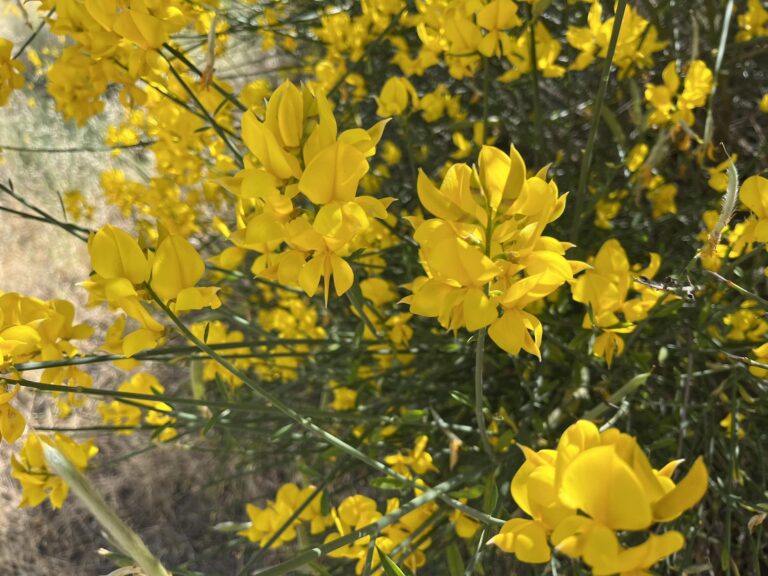
Brooms are fast-growing, sun-loving shrubs that produce masses of small, pea-like yellow flowers in spring and early summer, covering their arching green stems in colour so completely that the foliage beneath is almost invisible. They are deeply adapted to dry, poor, free-draining soils — the kind of impoverished ground that most ornamental shrubs would refuse to inhabit — and once established, they require virtually no supplemental moisture.
Genista hispanica — Spanish gorse — is a dense, spiny, mound-forming species native to Spain and southwestern France, growing in Zones 6–9. Cytisus scoparius — common broom — is native to western and central Europe and is widely grown in the UK, continental Europe, and temperate parts of North America, Australasia, and South Africa (though it has become invasive in several of these regions, particularly the Pacific Northwest and parts of New Zealand and Australia — always check local regulations before planting).
Where they are appropriate, brooms are outstanding drought tolerant shrubs for banks, slopes, exposed coastal sites, and areas of poor soil where establishing other plants has proved difficult. They are relatively short-lived — often declining after 10–15 years — but grow so rapidly that replacement plants establish quickly.
Best for: UK, continental Europe, drier parts of North America and Australasia (check local invasive species status before planting).
15. Artemisia — Wormwood (Artemisia spp.)
Artemisia closes this list as one of the most reliably drought tolerant groups of shrubs available to gardeners in dry climates. Its silver or grey foliage — deeply aromatic, finely divided, and coated in fine hairs that reflect light and reduce moisture loss — makes it among the most naturally adapted of all garden plants to hot, dry, and exposed conditions.
Artemisia ‘Powis Castle’ is the most widely grown ornamental artemisia in UK and European gardens, forming a large mound of feathery silver foliage that acts as an exceptionally effective foil for darker or more colourful neighbouring plants. It grows in Zones 6–9 and is widely grown across the UK, continental Europe, California, and South Africa. Artemisia absinthium — common wormwood — is a more upright species with similar silver foliage and considerable drought tolerance, growing in Zones 3–8 and suitable for colder gardens in Canada, Scandinavia, and the northern United States.
In mixed dry borders, artemisia is invaluable as a linking plant — its silver foliage connects and harmonises disparate colours and textures while contributing its own distinctive quality to the planting. It requires full sun and excellent drainage; in heavy or wet soils, it declines rapidly.
Best for: UK, continental Europe, California, South Africa, New Zealand; cold-hardy species for Canada, Scandinavia, and northern United States.
Key Principles for Establishing Drought Tolerant Shrubs
Getting drought tolerant shrubs through their first season is the most critical step. Even the most naturally resilient plants need support until their roots are well-established.
Water deeply but infrequently during establishment. Deep, infrequent watering encourages roots to grow deep into the soil in search of moisture — exactly the root habit that gives drought tolerant shrubs their long-term resilience. Frequent shallow watering produces shallow roots and plants that are less, not more, drought resistant over time.
Mulch generously. A 5–8 centimetre layer of gravel, crushed stone, or organic mulch around newly planted shrubs dramatically reduces surface moisture evaporation, keeps roots cooler in summer heat, and suppresses competing weeds. In dry Mediterranean-climate gardens, gravel mulch is particularly effective and aesthetically appropriate.
Improve drainage where needed. Most of the shrubs on this list prefer well-drained to sharply drained soil. On heavy or clay soils, incorporating horticultural grit or coarse sand at planting, or raising the planting level slightly above the surrounding grade, helps prevent the waterlogging that can kill drought tolerant shrubs more reliably than drought itself.
Plant in autumn in dry climates. In Mediterranean and similar dry-summer climates, autumn planting takes advantage of winter rainfall to establish root systems before the dry season begins. Spring planting, by contrast, gives plants very little time to establish before heat and drought arrive. In cold-winter climates, spring planting is generally preferable to avoid frost damage to newly planted roots.
Suggested For You:
25 Low Maintenance Shrubs: Beautiful Choices That Take Care of Themselves
20 Evergreen Shrubs for Borders: Structure, Colour, and Year-Round Presence
15 Shrubs for Clay Soil: The Best Choices for Wet Ground
15 Deer Resistant Shrubs: The Best Choices for Gardens Under Pressure
15 Shrubs That Bloom All Summer: A Complete Guide for Gardeners
Final Thoughts
Drought tolerant gardening is not about accepting a reduced or compromised garden. It is about making choices that are better matched to the actual conditions of the site and the climate — choices that result in plants that are healthier, more resilient, and ultimately more beautiful than those grown in constant conflict with their environment.
The 15 shrubs in this guide represent some of the finest drought tolerant plants available to gardeners worldwide. They come from the rocky hillsides of the Mediterranean, the dry steppes of central Asia, the coastal cliffs of New Zealand, and the sun-scorched mountains of California. What they share is a deep, evolved capacity to endure and flourish through dry conditions — and to bring colour, structure, and life to gardens that many plants would simply give up on.
Choose them, establish them carefully, and they will repay you with decades of performance that needs neither irrigation system nor constant attention. In an era when water conservation matters more than ever, that is a genuinely valuable quality.
References
- University of California Cooperative Extension — Drought-Tolerant Plants for California Gardens https://ucanr.edu/sites/scmg/Drought_Tolerant_Plants/
- Colorado State University Extension — Water-Wise Landscaping: Drought Tolerant Shrubs https://extension.colostate.edu/topic-areas/yard-garden/water-wise-landscaping/
- North Carolina State University Cooperative Extension — Drought Tolerant Landscape Shrubs https://plants.ces.ncsu.edu/find_a_plant/?habit=shrub&water=drought+tolerant
- Royal Horticultural Society (RHS) — Drought Tolerant Plants: Shrubs for Dry Gardens https://www.rhs.org.uk/plants/types/shrubs/drought-tolerant
- University of Arizona Cooperative Extension — Drought Tolerant Shrubs for the Southwest https://extension.arizona.edu/drought-tolerant-landscape-plants

Tim M Dave is a gardening expert with a passion for houseplants, particularly cacti and succulents. With a degree in plant biology from the University of California, Berkeley, he has vast experience in gardening. Over the years, he has cultivated a vast collection of desert plants and learned a great deal about how to grow and care for these unique companions.