Understanding Catalpa (Catalpa bignonioides): Identification, History, Problems, and Cultivation Details
If you have ever stood beneath a tree with leaves the size of dinner plates, watched long cigar-like pods dangle from its branches, and heard bees working loudly through its white trumpet-shaped flowers — you have likely met Catalpa bignonioides, commonly known as the Southern Catalpa or Indian bean tree.
This is one of those trees that people notice but rarely name. It is bold, generous in shade, and surprisingly rich in history. From its native range in the American South to its widespread planting across Europe, Asia, and beyond, the Southern Catalpa has become a globally recognized ornamental and ecological asset.
This guide covers everything you need to know about Catalpa bignonioides — its taxonomy, physical characteristics, native habitat, ecological role, medicinal history, horticultural use, and care requirements.
Taxonomy and Classification
Catalpa bignonioides belongs to the family Bignoniaceae, a family best known for its showy, tubular flowers. The genus Catalpa includes around 11 species distributed across North America, the Caribbean, and East Asia.
The name “Catalpa” is believed to derive from the Cherokee word “kutuhlpa”, meaning “head with wings” — a reference to the flower’s distinctive shape. The species epithet bignonioides means “resembling Bignonia,” reflecting the tree’s affinity with that genus in terms of flower structure.
The full taxonomic hierarchy is as follows:
- Kingdom: Plantae
- Order: Lamiales
- Family: Bignoniaceae
- Genus: Catalpa
- Species: Catalpa bignonioides Walter
The tree was formally described by the botanist Thomas Walter in 1788 in his work Flora Caroliniana, making it one of the earlier documented native trees of the southeastern United States.
Common names include Southern Catalpa, Indian bean tree, cigar tree, catawba, and fish bait tree. The last name tells you something useful — fishermen long regarded catalpa worms (the larvae of the catalpa sphinx moth) as outstanding bait.
Physical Description
Size and Form
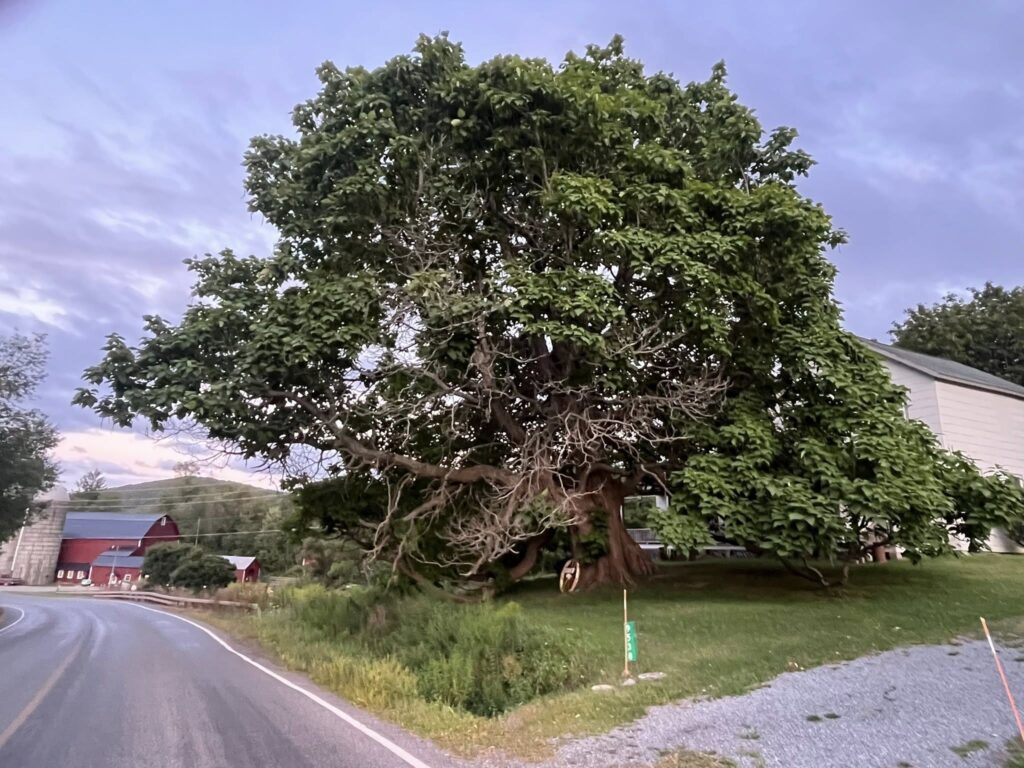
The Southern Catalpa is a medium to large deciduous tree, typically reaching 9 to 18 metres (30–60 feet) in height at maturity, with a spread that can match or exceed its height. The crown is broadly rounded, sometimes irregular, giving the tree a full, sheltering canopy.
In open landscapes, particularly when planted as a specimen tree, its wide-spreading canopy creates dense, valuable shade — a quality that has made it a popular choice for parks, large gardens, and roadsides throughout temperate regions worldwide.
Leaves
The leaves are among the most immediately recognizable features of this tree. They are large, heart-shaped (cordate), and entire-margined, measuring 20 to 30 centimetres (8–12 inches) in length and nearly as wide. The upper surface is a bright mid-green, while the underside is paler and slightly hairy, particularly along the main veins.
One practical note: the leaves release a mildly unpleasant odour when crushed, which deters some grazing animals. They appear late in spring and drop early in autumn, giving the tree a relatively short leaf season by deciduous standards.
Flowers
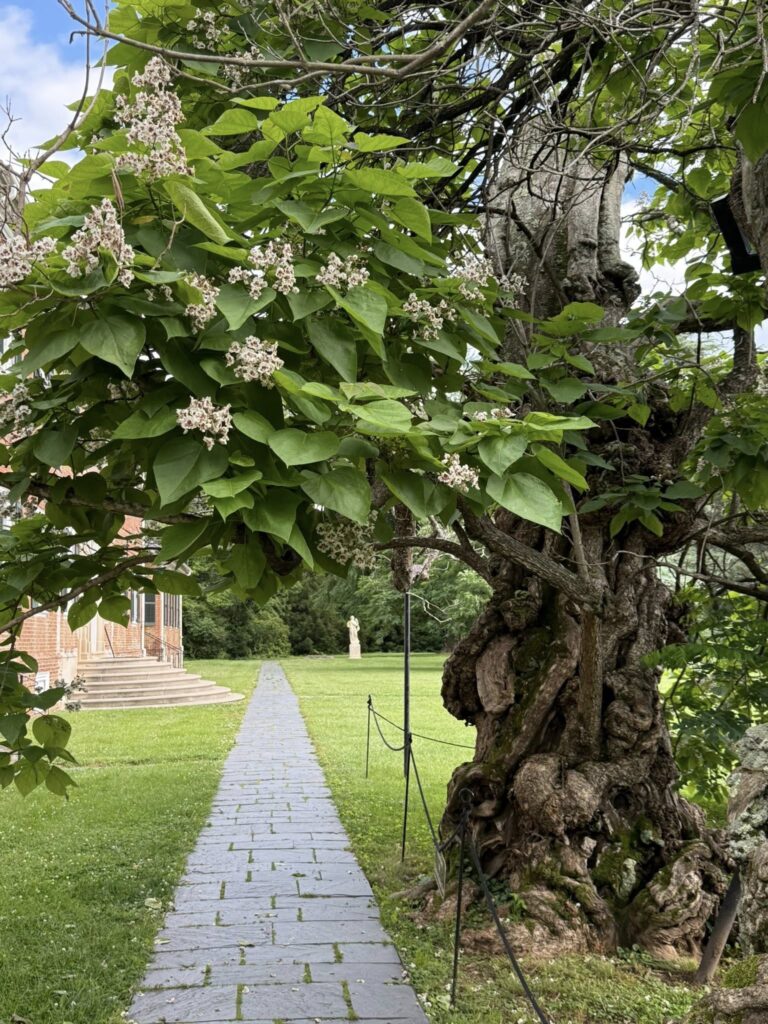
The flowers are the showpiece of the tree. They appear in late spring to early summer, typically between May and July depending on location. The flower clusters (panicles) are upright, 20–30 centimetres tall, and carry dozens of individual blooms.
Each flower is trumpet-shaped and white, approximately 3–5 centimetres across, with two yellow stripes and purple-spotted markings on the inner throat. This patterning is not merely decorative — it serves as a nectar guide for pollinators, directing bees directly to the flower’s reproductive structures.
The flowers are fragrant, and during peak flowering, a mature catalpa in full bloom is one of the most spectacular sights in a temperate garden.
Fruit and Seeds
After flowering, the tree produces its most distinctive feature: long, narrow seed pods that hang from the branches like strings of cigars. This characteristic earned it the common name “cigar tree.”
The pods are 15 to 50 centimetres long (6–20 inches) and only about 1 centimetre wide. They are green in summer, turning brown and dry by late autumn. Each pod contains numerous flattened seeds, each equipped with tufts of white, hair-like wings that allow for wind dispersal.
The pods often persist on bare branches through winter, giving the tree a striking silhouette in the cold months.
Bark and Trunk
The bark on mature trees is greyish-brown and develops shallow, scaly ridges with age. Young branches are smooth and glossy. The trunk is generally short and stout, branching relatively low on the tree.
Native Range and Natural Habitat
Catalpa bignonioides is native to a small region of the southeastern United States, specifically the states of Alabama, Mississippi, Georgia, and Florida. This original native range is surprisingly restricted given how widely the tree has since been planted.
In its native habitat, the Southern Catalpa grows along riverbanks, floodplains, and the edges of bottomland forests — areas with fertile, moist, and occasionally disturbed soil. It is well-adapted to periodic flooding and tolerates poor drainage better than many other tree species.
It occupies a niche typical of what ecologists describe as pioneer or early-successional trees — species that establish quickly after disturbance, grow fast, and help stabilize open ground while slower-growing forest species take hold behind them.
Today, Catalpa bignonioides has been widely naturalized well beyond its original range, growing throughout much of North America, Europe, the United Kingdom, China, and parts of Australia. In many of these regions, it can naturalize and spread into disturbed woodland margins and roadsides.
Ecological Significance
The Catalpa Sphinx Moth
No discussion of the ecology of Catalpa bignonioides would be complete without mentioning the catalpa sphinx moth (Ceratomia catalpae). This species is a specialist — its caterpillars feed almost exclusively on catalpa foliage.
The larvae, commonly called catalpa worms, can defoliate entire trees during heavy infestations. While this looks alarming, healthy mature trees almost always recover and re-leaf within the same growing season.
The relationship is a classical example of specialist herbivory, where a single plant species supports a unique insect adapted specifically to it.
The caterpillars are themselves a food source for birds and other predators, making the catalpa a meaningful link in the local food web wherever it grows.
Pollinator Value
The flowers are highly attractive to bumblebees and other native bees, which are the primary pollinators. The nectar guides — those yellow and purple markings inside the flower throat — are visible to bees in ultraviolet light, which helps them navigate to the reward efficiently.
During peak flowering, a Southern Catalpa can attract a remarkable diversity of pollinator species, contributing meaningfully to the local insect community.
Wildlife Use
Beyond the sphinx moth and pollinators, catalpa trees offer general wildlife value. The dense canopy provides nesting and roosting habitat for birds. The persistent seed pods are occasionally eaten by birds in winter, though catalpa seeds are not a major food source for most species.
In riparian settings, the roots help stabilize streambanks and reduce soil erosion, adding a useful structural role in vulnerable landscapes.
Historical and Cultural Uses
Native American Uses
Several Indigenous peoples of the southeastern United States made practical use of the catalpa tree. The bark and seed pods were reportedly used in folk medicine, with preparations applied for various purposes including treatments for snakebite, as a mild laxative, and as a treatment for certain skin conditions.
The wood, being lightweight, soft, and very resistant to rot, was used by some groups for fence posts, poles, and basic construction where ground contact was involved.
19th-Century Commercial Planting
In the late 19th century, there was considerable interest in catalpa as a commercial timber crop, particularly in the American Midwest. Farmers planted large catalpa orchards — sometimes called “catalpa groves” — to produce rot-resistant fence posts and railroad ties.
The species Catalpa speciosa (Northern Catalpa) was more commonly used for this purpose, but Catalpa bignonioides was also planted. The venture did not ultimately succeed as a large-scale industry, but many of those planted groves persist as remnant woodlots today.
The Fishing Connection
Perhaps the most enduring folk use of the Southern Catalpa is its role in fishing culture. Landowners in the American South would plant catalpa trees specifically to attract catalpa worms, which were (and still are) prized as fishing bait, particularly for catfish and bass.
Some small-scale catalpa worm operations continue to this day.
Medicinal and Pharmacological Notes
Catalpa bignonioides has attracted interest from researchers because of several compounds found in its leaves, bark, and seeds.
Catalposide, a compound found in catalpa seeds and bark, has been studied for potential anti-inflammatory properties. Some traditional preparations used catalpa bark tea as a mild sedative and antispasmodic. The leaves contain compounds that may have weak antibacterial effects.
It is important to note that catalpa seed pods are mildly toxic if consumed in significant quantities. The seeds contain compounds that can cause gastrointestinal discomfort in humans and animals. The tree should not be confused with edible bean-producing plants despite its common name “Indian bean tree.”
Formal pharmaceutical application of catalpa compounds remains limited, but the tree is an active subject of phytochemical research.
Horticultural Uses and Landscape Value
As a Specimen Tree
The Southern Catalpa is most often planted today as a large specimen or shade tree in parks, public spaces, and spacious private gardens. Its size means it is not suited to small residential plots, but in the right setting, it is genuinely magnificent.
The combination of enormous leaves, spectacular summer flowers, and the winter silhouette of hanging pods gives it four-season ornamental interest — unusual for a tree that is often described simply as a shade tree.
Popular Cultivars
Several cultivars of Catalpa bignonioides have been selected for garden use:
‘Aurea’ is perhaps the best-known cultivar, featuring golden-yellow foliage that emerges in spring. It is widely used in European and North American ornamental horticulture.
It is often grafted onto standard rootstocks to create a compact, mop-headed lollipop form known as the “standard catalpa” or “umbrella catalpa.” These are commonly seen in formal gardens and urban streetscapes.
‘Nana’ is a compact, non-flowering dwarf form that is grown almost exclusively for its dense, rounded foliage. It rarely flowers and produces no fruit, making it tidier than the standard species.
Street and Urban Planting
Catalpa bignonioides shows good tolerance for urban conditions, including compacted soils, air pollution, and reflected heat from paved surfaces. This makes it a practical choice for urban forestry, though its large leaf litter and seed pods should be considered in maintenance planning.
Growing and Care Guide
Climate and Hardiness
The Southern Catalpa is hardy to USDA Zones 5–9, tolerating winter temperatures as low as -20°C (-4°F) when fully dormant. It performs best in warm temperate climates with long, hot summers, which promote vigorous growth and reliable flowering.
It grows well across much of the United Kingdom, northern and central Europe, the eastern United States, and similar temperate zones globally.
Soil Requirements
This tree is notably adaptable in terms of soil. It will grow in clay, loam, or sandy soils, and tolerates both acidic and moderately alkaline pH ranges. Moist, fertile, well-drained soils produce the best growth, but the tree can handle periodically wet conditions with some resilience.
Good drainage is preferred for long-term health, as prolonged waterlogging can cause root problems in mature trees.
Sunlight
Catalpa bignonioides requires full sun to partial shade. Full sun exposure — at least 6 hours of direct sunlight daily — produces the most vigorous growth and the best flowering.
Trees planted in heavy shade tend to grow slowly, produce fewer flowers, and develop a more open, leggy structure.
Watering
Young trees should be watered regularly during their first two or three growing seasons to help establish a strong root system. Once established, catalpas are reasonably drought-tolerant, though extended dry spells in hot summers will cause leaf stress.
In typical temperate conditions, natural rainfall is generally sufficient for established specimens.
Pruning
Pruning is largely a matter of preference and purpose:
- For standard/umbrella forms (‘Nana’, grafted ‘Aurea’): Regular pruning of the head to maintain shape is expected and generally done in late winter.
- For free-growing specimens: Minimal pruning is needed. Remove dead or crossing branches in late winter. Avoid heavy pruning in late summer or autumn, as this can stimulate new growth that may not harden before winter.
- Pollarding: In some European traditions, catalpa trees are heavily pollarded — cut back to the main trunk or primary scaffold branches — every one to two years. This stimulates production of exceptionally large leaves, making for a dramatic foliage feature. The ‘Aurea’ cultivar is especially popular for this treatment.
Pests and Diseases
The primary pest is the catalpa sphinx moth caterpillar, already discussed. While heavy defoliation looks dramatic, established trees recover without lasting harm.
Other occasional issues include powdery mildew (Erysiphe species) on leaves in humid conditions, verticillium wilt in some soils, and minor aphid infestations. None of these typically cause serious long-term problems in otherwise healthy trees.
Propagation
Catalpa bignonioides can be propagated by:
- Seed: Sow fresh seeds in autumn or stratified seeds in spring. Germination is generally reliable.
- Softwood cuttings: Taken in early summer with rooting hormone.
- Root cuttings: Sections of root taken during dormancy can produce new plants.
- Grafting: Used commercially to produce standard forms of ‘Aurea’ and ‘Nana’.
Comparison with Northern Catalpa (Catalpa speciosa)
A common point of confusion is the distinction between Catalpa bignonioides (Southern Catalpa) and Catalpa speciosa (Northern Catalpa). The two species are closely related and can look similar, but there are reliable differences:
| Feature | C. bignonioides (Southern) | C. speciosa (Northern) |
| Native range | SE USA (AL, MS, GA, FL) | Central USA (AR, TN, IL) |
| Mature height | 9–18 m | 15–30 m |
| Flower clusters | Dense, many-flowered | Fewer flowers per cluster |
| Flower markings | More prominent spots/stripes | Less pronounced |
| Pod wall thickness | Thin | Thicker, more rigid |
| Cold hardiness | Zone 5–9 | Zone 4–8 |
C. speciosa is generally the larger and more cold-hardy of the two, while C. bignonioides produces more ornamental flowers relative to its size.
Environmental Considerations
While Catalpa bignonioides is not generally classified as an invasive species in most of its introduced range, it can self-seed freely and naturalize along roadsides, riparian corridors, and disturbed ground outside cultivation.
Gardeners in regions where it has naturalized — including parts of the United Kingdom and central Europe — are advised to monitor for seedling establishment in natural areas and remove unwanted seedlings before they become established.
In its native range, it is considered a valuable native tree and is actively encouraged in restoration planting projects.
Final Thoughts
The Southern Catalpa is a tree that rewards those who take the time to know it. Its flowers are genuinely spectacular, its ecological connections are fascinating, and its tolerance for difficult growing conditions makes it a practical landscape choice in many settings.
It is a tree of contrasts — huge and tropical-looking, yet cold-hardy; fast-growing, yet long-lived; widely planted, yet not always recognized.
Whether you are a gardener planning a specimen tree, a naturalist studying native plant ecology, or simply someone who wants to understand the world better, Catalpa bignonioides is well worth your attention.
References
- University of Florida IFAS Extension — Catalpa bignonioides Fact Sheet https://edis.ifas.ufl.edu/publication/ST129
- Virginia Tech Dendrology — Catalpa bignonioideshttps://dendro.cnre.vt.edu/dendrology/syllabus/factsheet.cfm?ID=74
- NC State Extension Gardener Plant Toolbox — Catalpa bignonioides https://plants.ces.ncsu.edu/plants/catalpa-bignonioides/
- University of Connecticut Plant Database — Catalpa bignonioides https://hort.uconn.edu/detail.php?pid=87
- Purdue University Extension — Hardwood Tree Identification: Catalpa https://www.extension.purdue.edu/extmedia/FNR/FNR-238-W.pdf

Tim M Dave is a gardening expert with a passion for houseplants, particularly cacti and succulents. With a degree in plant biology from the University of California, Berkeley, he has vast experience in gardening. Over the years, he has cultivated a vast collection of desert plants and learned a great deal about how to grow and care for these unique companions.