Understanding American Persimmon (Diospyros virginiana): History, Features, Uses, Problems, and Full Cultivation Details
There are trees that simply belong to a landscape — trees so deeply woven into the ecology and culture of a place that removing them would leave a gap nothing else could fill. The American Persimmon (Diospyros virginiana) is one of those trees.
Native to the eastern United States, the American Persimmon has fed Indigenous peoples, early settlers, wildlife, and foragers for centuries. Its fruit is the subject of folklore, seasonal rituals, and genuine culinary tradition. Its wood is among the hardest produced by any North American tree.
This guide covers everything worth knowing about the American Persimmon: its biology, ecology, cultural history, edible fruit, landscape value, and how to grow it successfully. Whether you are a gardener, forager, naturalist, or farmer, there is something here for you.
Before we dive in, here is a quick understanding of this wonderful tree.
| Scientific Name | Diospyros virginiana |
| Family | Ebenaceae |
| Common Names | American Persimmon, Common Persimmon, Possumwood |
| Native Range | Eastern and central North America (Zones 4–9) |
| Mature Height | 35–60 feet |
| Light | Full sun (best); tolerates partial shade |
| Soil | Highly adaptable; prefers well-drained, slightly acidic |
| Growth Rate | Moderate (12–18 inches/year) |
| Fruit Ripening | After first hard frost (October–November) |
| Wildlife Value | Extremely high |
| Wood Hardness | Among the hardest native North American woods |
What Is the American Persimmon?
The American Persimmon belongs to the family Ebenaceae (the ebony family), a group known globally for producing extremely hard, dense wood. Its genus, Diospyros, translates from Greek as “fruit of the gods,” a name that feels entirely appropriate once you taste a properly ripened persimmon on a cold autumn morning.
It is the only persimmon species native to eastern North America, and it is distinct from the Asian persimmon (Diospyros kaki) commonly sold in grocery stores.
While the Asian variety has been widely commercialized, the American species is smaller-fruited, more cold-hardy, more ecologically rich, and — when fully ripe — arguably more flavorful.
Common names include:
- Common Persimmon
- Eastern Persimmon
- Possumwood — for its popularity with opossums
- Date Plum — used historically in some regions
- Simmon — a folk abbreviation still used in parts of the American South
Native Range and Natural Habitat
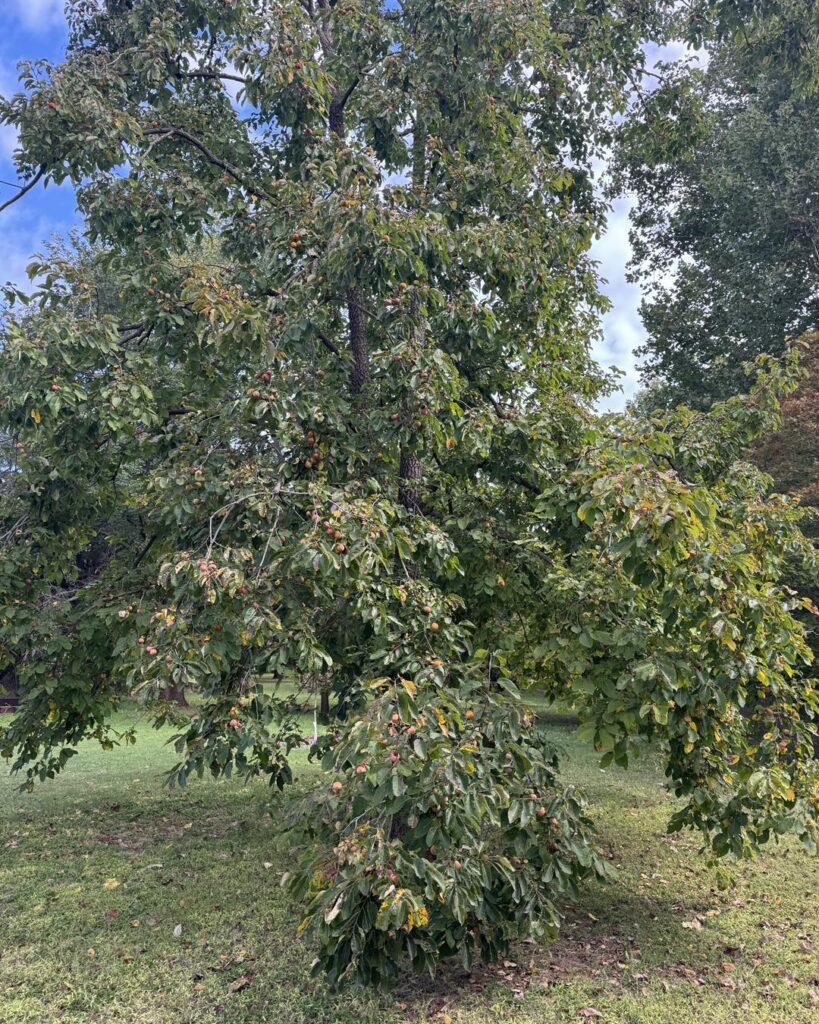
The American Persimmon is native to a broad swath of eastern and central North America. Its range extends from southern Connecticut and Long Island south through Florida, and west through Kansas, Oklahoma, and into Texas.
It reaches its greatest abundance across the southeastern United States, where it is a common sight along roadsides, old fields, forest margins, and disturbed ground.
Unlike many native trees with narrow habitat requirements, the American persimmon grows in rich bottomlands and dry upland ridges, in poor clay soils and sandy coastal plains, in full sun and partial shade. This adaptability is one of its greatest strengths.
It frequently colonizes old fields and disturbed areas, spreading by root sprouts and forming thickets over time. This makes it an important pioneer species in ecological succession — one of the first woody plants to reclaim abandoned farmland or clear-cut forest edges.
Physical Characteristics
Size and Form
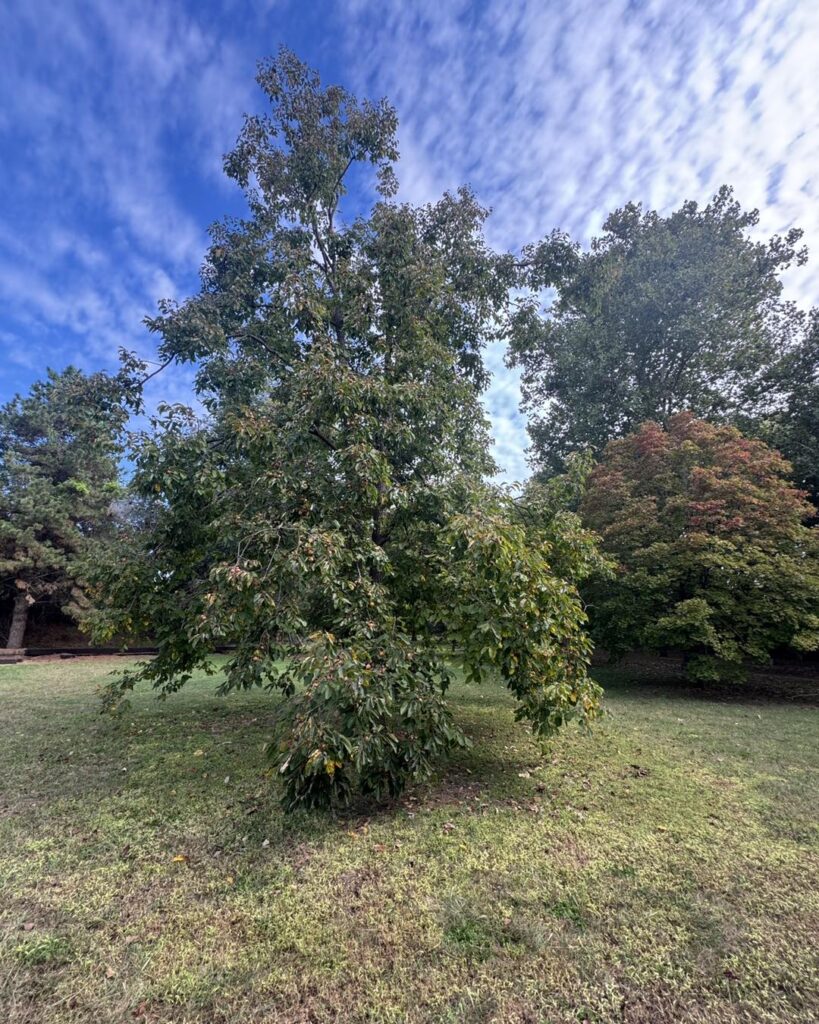
The American Persimmon is typically a small to medium-sized tree, reaching 35 to 60 feet (10–18 meters) under favorable conditions, though many specimens in old fields or dry sites remain shorter — around 15 to 25 feet.
The crown is rounded to oval, often with slightly drooping branch tips that give the tree an elegant, graceful silhouette.
In open settings, it develops a broad, spreading crown. In woodland conditions, it grows taller and narrower, reaching for light.
Bark — Deeply Distinctive
The bark of the American Persimmon is one of its most recognizable features. It is thick, dark gray to almost black, and broken into distinctive square or rectangular blocks — giving it a deeply textured, almost mosaic-like appearance.
This blocky, checkered pattern is sometimes described as resembling alligator hide or a chocolate bar broken into squares.
Once you know this bark, identification becomes effortless — even in winter, even at a distance.
Leaves
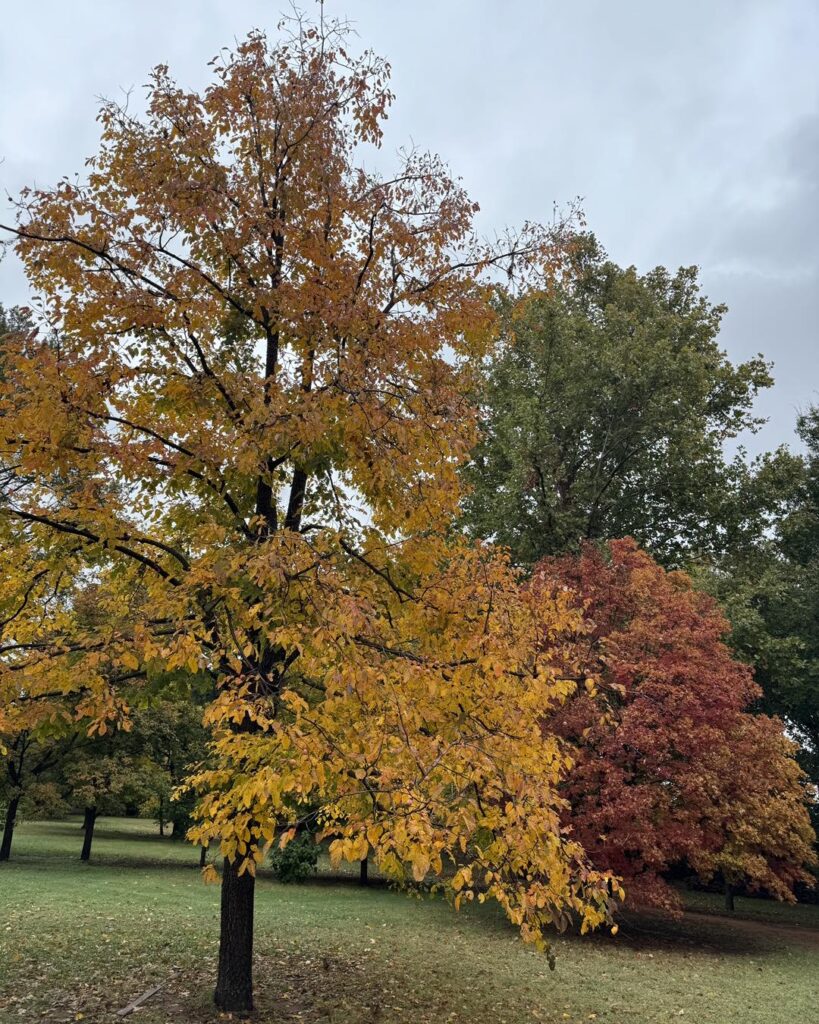
The leaves are simple, alternate, and oval to elliptical, measuring 4 to 6 inches (10–15 cm) long. They are thick and leathery, dark glossy green on top and paler beneath. In autumn, they turn yellow to purplish-red, providing attractive fall color before dropping.
The leaves of the persimmon have a slightly waxy feel and remain on the tree relatively late into the season.
Flowers
The American Persimmon is typically dioecious — meaning male and female flowers are borne on separate trees.
This is an important fact for anyone hoping to grow fruit: you generally need at least one male tree near a female tree for reliable fruiting, though some female trees can produce fruit parthenocarpically (without fertilization) with small, seedless fruit.
Flowers appear in late spring to early summer, after the leaves have emerged. They are small, tubular, and creamy white — not especially showy, but pleasantly fragrant. Male flowers appear in small clusters; female flowers are usually solitary.
Bees are the primary pollinators.
Fruit — The Star of the Show
The fruit is, without question, the American Persimmon’s most celebrated feature. The berries are round to slightly oval, typically ¾ to 1½ inches (2–4 cm) in diameter, with a persistent, star-shaped calyx (the leafy base) that remains attached even when ripe.
Unripe persimmons are famously astringent — almost painfully so. They contain high levels of soluble tannins that cause an intense drying, puckering sensation in the mouth. This astringency disappears completely once the fruit is fully ripe.
Fruit ripening occurs after the first hard frost of autumn, when the fruit softens, sweetens, and develops rich, complex flavors ranging from honey and brown sugar to apricot and vanilla.
Ripe fruit ranges in color from yellow-orange to deep orange-red, sometimes with a faint blue-gray bloom. It is soft, almost pudding-like in texture — and extraordinary in flavor.
The Persimmon Fruit: Flavor, Ripeness, and Foraging
Few wild fruits in North America inspire the loyalty that ripe American Persimmons do among those who know them. The flavor is genuinely difficult to describe — rich, intensely sweet, with caramel undertones and a silky texture that has no real equivalent among cultivated fruits.
The key word is ripe. A persimmon picked even a week too early is almost inedible. But patience is richly rewarded. Many foragers wait until persimmons fall naturally from the tree — a reliable indicator of full ripeness. Others wait for two or three hard frosts before harvesting.
The best American Persimmons I have tasted came from old trees at the edge of an abandoned pasture in late October, after two good frosts had done their work. They were so sweet and soft they barely needed chewing. That experience alone explains why Indigenous peoples held this fruit in such high regard.
Nutritional Value
American Persimmons are genuinely nutritious. They are rich in:
- Vitamin C — significant immune-support value
- Vitamin A — from high beta-carotene content
- Dietary fiber — supports digestive health
- Manganese, copper, and potassium — essential minerals
- Antioxidants — including tannins, flavonoids, and carotenoids
Gram for gram, ripe American Persimmons compare favorably with many cultivated fruits in nutritional density.
Culinary and Historical Uses
Indigenous Use
Long before European contact, Indigenous peoples across eastern North America relied heavily on the American Persimmon. The Algonquian word putchamin or pessamin — from which the English “persimmon” derives — reflects how central this fruit was to Native foodways.
Tribes including the Cherokee, Chickasaw, and many others dried persimmons into cakes or loaves for winter storage, fermented them into beverages, mixed them with cornmeal, and ate them fresh.
The dried fruit reportedly kept well for months and provided valuable calories and nutrition during lean winter months.
Colonial and Early American Use
Early European settlers quickly adopted persimmon as a food source. Captain John Smith wrote admiringly of the fruit in the early 1600s, noting that when ripe, it was “as delicious as an apricot,” though unripe fruit was “as harsh and chokie as a green sloe.”
Persimmon beer and persimmon bread were common in colonial Appalachian and Southern communities.
The tradition of persimmon pudding — a dense, sweet, baked dessert — survives in parts of Indiana, Virginia, and North Carolina to this day, where persimmon festivals celebrate the harvest every autumn.
Modern Culinary Applications
Today, American Persimmon pulp is used in:
- Persimmon pudding — the most traditional preparation
- Breads, muffins, and cakes
- Ice cream and frozen desserts
- Jams and preserves
- Wine and fermented beverages
- Smoothies and fruit sauces
The pulp freezes exceptionally well, making it easy to preserve a harvest for year-round use. Simply freeze the whole fruit or extracted pulp in sealed containers.
Wood Properties and Commercial Uses
The American Persimmon belongs to the ebony family for good reason. Its heartwood is extremely dense, hard, and fine-grained — one of the hardest woods produced by any tree native to North America.
Historically and practically, this wood has been used for:
- Golf club heads — persimmon was the premier wood for driver heads before metal woods became standard in the 1980s and 1990s
- Textile shuttles — the hardness and smooth grain made it ideal for weaving machinery
- Tool handles — mallets, chisels, and striking tools
- Billiard cues
- Flooring and specialty furniture
The tree’s small size limits large-scale timber production, but its wood remains prized for specialty applications. Vintage persimmon golf clubs are still sought after by collectors and traditionalist golfers.
Ecological Value and Wildlife Benefits
Few native trees provide the level of wildlife value that the American Persimmon delivers, particularly in autumn and winter when other food sources are scarce.
Mammals
White-tailed deer feed heavily on fallen persimmons throughout the hunting season, making the tree a favorite planting of food plot managers. Raccoons, opossums, foxes, coyotes, black bears, and skunks all consume the fruit eagerly.
The opossum’s affection for persimmons is so well documented that one of the tree’s common names — Possumwood — is a direct tribute to this relationship.
Gray and fox squirrels eat the seeds and cache them, inadvertently planting new trees.
Birds
Robins, cedar waxwings, mockingbirds, starlings, wild turkeys, and woodpeckers all consume the fruit. Because persimmons remain on the tree well into winter, they provide a critical late-season food source when most other fruits are gone.
Insects
The American Persimmon supports numerous native bee species as a nectar and pollen source. It also serves as a larval host plant for several moth species, including the Banded Tussock Moth (Halysidota tessellaris) and other members of the Lepidoptera community.
Understory and Edge Habitat
The tree’s thicket-forming habit — spreading through root sprouts — creates dense, shrubby cover that benefits ground-nesting birds, small mammals, and reptiles. This structural complexity is itself an ecological asset.
Landscape and Garden Uses
The American Persimmon is a genuinely versatile landscape tree. Here is where it excels:
Edible Landscape and Food Forests
For anyone designing a food forest or edible landscape, the American Persimmon is nearly essential. It produces abundant fruit with minimal care, tolerates a wide range of conditions, and provides food for both humans and wildlife simultaneously.
Wildlife Gardens
If attracting deer, birds, and mammals to your property is a goal, few plantings are more effective than a small grove of persimmon trees. Food plot managers across the Southeast routinely cite persimmon as one of their highest-value plantings.
Erosion Control and Disturbed Sites
Because it tolerates poor soils, drought, and site disturbance, American Persimmon works well for erosion control, reclamation planting, and revegetation of disturbed areas.
Ornamental Value
It offers genuine ornamental appeal:
- Deeply textured, sculptural bark in winter
- Glossy, dark green foliage in summer
- Orange-red fruit clusters in autumn
- Yellow to purple fall color
These four-season qualities make it worth planting even where fruit production is not the primary goal.
Growing American Persimmon Tree
Hardiness and Climate
American Persimmon is hardy in USDA Zones 4 through 9. It is more cold-tolerant than the Asian persimmon and better suited to the variable climates of the eastern and central United States.
Soil Requirements
It is remarkably soil-tolerant. It grows well in sandy, clay, loam, and rocky soils across a wide pH range (approximately 6.0–7.5). It tolerates both occasional flooding and moderate drought once established. Avoid waterlogged, permanently saturated soils.
Sun Exposure
Full sun produces the best fruit yields. The tree tolerates partial shade but fruits less abundantly in low-light conditions.
Planting Tips
- Plant in spring after frost risk has passed for best establishment.
- For fruit production, plant at least one male and one female tree within 50 feet of each other. Several nursery-selected cultivars are self-fruitful.
- Bare-root transplants establish better than balled-and-burlapped stock — the persimmon has a deep taproot that resents disturbance.
- Mulch the planting area generously to conserve moisture during establishment.
- Limit fertilization — excess nitrogen promotes leafy growth at the expense of fruit.
Pruning
Persimmons require minimal pruning. Remove dead, diseased, or crossing branches in late winter. Avoid heavy structural pruning, which can reduce fruiting.
Cultivar Selection
Several improved cultivars have been selected for larger fruit, better flavor, or self-fertility:
- ‘Meader’ — cold-hardy, self-fertile, reliable producer
- ‘Early Golden’ — early ripening, large fruit, good flavor
- ‘Garretson’ — large, high-quality fruit
- ‘Szukis’ — self-fertile, productive, excellent flavor
Named cultivars are propagated by grafting and typically begin fruiting earlier (3–5 years) than seedling trees, which may take 7–10 years to produce fruit.
Pests and Diseases
The American Persimmon is a tough, low-maintenance tree with relatively few serious pest or disease problems.
Occasional issues include:
- Persimmon psyllid (Trioza diospyri) — causes leaf curling; rarely serious on healthy trees
- Borer insects — occasional issues on stressed trees
- Persimmon wilt (Cephalosporium diospyri) — a fungal vascular disease; most serious in the Southeast; resistant to chemical treatment; use certified disease-free planting stock
- Anthracnose leaf spot — cosmetic in most cases
- Scale insects — treatable with horticultural oil
Persimmon wilt is the most serious concern for growers in the southeastern United States. It is spread through root grafts between trees, so spacing plantings adequately (at least 25–30 feet apart) reduces the risk of spread.
The Persimmon Seed Weather Forecast: Folklore and Fun
Ask any gardener in the American South about persimmon seeds, and you will likely hear about the folk weather prediction tradition associated with them. According to Appalachian and Southern folklore, cutting open a persimmon seed and examining the cotyledon inside predicts the coming winter:
- A spoon shape — indicates heavy snowfall (the spoon will be needed to shovel)
- A fork shape — indicates a mild winter
- A knife shape — indicates a cold, cutting winter
There is no scientific basis for this prediction, but the tradition persists with real affection across rural communities in the Southeast. It is a charming reminder of how deeply this tree is embedded in American folk culture.
Conservation Status and Outlook
The American Persimmon is currently listed as a species of least concern, with a stable and widespread population. It is not considered threatened or endangered.
That said, several pressures deserve attention:
- Habitat loss through agricultural and urban expansion
- Persimmon wilt disease, which has reduced populations in parts of the Southeast
- Suppression of natural regeneration by deer overbrowsing in some regions
- Displacement in old-field habitats by invasive shrubs and trees
Supporting persimmon by planting it in landscapes, food forests, and restoration sites is a straightforward conservation action with simultaneous ecological, culinary, and aesthetic benefits.
Final Thoughts
The American Persimmon is not a tree that announces itself loudly. It does not have the grandeur of an old-growth oak or the spring spectacle of a flowering cherry. But it rewards attention — with extraordinary fruit, remarkable wood, generous wildlife value, deep cultural roots, and a quiet, dignified beauty that grows more impressive the more closely you look.
Planting an American Persimmon is an act of ecological generosity and cultural continuity. It connects a landscape to thousands of years of North American natural and human history. And every autumn, when the first frosts arrive and the fruit softens into its full sweetness, it delivers a reward that no other native tree quite matches.
References
- University of Florida IFAS Extension — Diospyros virginiana: Common Persimmon https://edis.ifas.ufl.edu/publication/ST220
- Virginia Tech Department of Forest Resources and Environmental Conservation — Dendrology Fact Sheet: Diospyros virginiana https://dendro.cnre.vt.edu/dendrology/syllabus/factsheet.cfm?ID=48
- North Carolina State University Cooperative Extension — Diospyros virginiana Plant Profile https://plants.ces.ncsu.edu/plants/diospyros-virginiana/
- USDA Forest Service — Silvics of North America — Diospyros virginiana L. — Common Persimmon https://www.srs.fs.usda.gov/pubs/misc/ag_654/volume_2/diospyros/virginiana.htm
- Purdue University Center for New Crops and Plant Products — Persimmon: Diospyros virginiana https://hort.purdue.edu/newcrop/morton/persimmon.html

Tim M Dave is a gardening expert with a passion for houseplants, particularly cacti and succulents. With a degree in plant biology from the University of California, Berkeley, he has vast experience in gardening. Over the years, he has cultivated a vast collection of desert plants and learned a great deal about how to grow and care for these unique companions.