American Beech (Fagus grandifolia): Identification, Problems, Cultivation, Uses, and More
Some trees grow in forests. Others define them. The American Beech (Fagus grandifolia) is the latter kind. Walk into a mature beech-maple forest in autumn, and the pale, silver-grey trunks stand out like columns in a cathedral.
The leaves turn a warm bronze-gold, and many cling to the branches through winter — rustling quietly in the cold. It is a tree that holds its presence even when everything else has gone bare.
This is one of North America’s most ecologically significant, culturally rich, and visually striking hardwood trees. It has fed wildlife for thousands of years, sheltered entire forest communities, and left its mark on history — literally, in the form of carved initials that persist in its smooth bark for generations.
This guide covers everything worth knowing about American Beech: its identity, ecology, uses, threats, and cultivation. Whether you are a forester, a nature lover, a student, or a landowner, this article is written for you.
Taxonomy and Classification
American Beech belongs to the beech family, Fagaceae, which also includes oaks and chestnuts. It is the only native beech species in North America.
Scientific classification:
- Kingdom: Plantae
- Order: Fagales
- Family: Fagaceae
- Genus: Fagus
- Species: F. grandifolia
- Full name: Fagus grandifolia Ehrh.
- Common names: American Beech, North American Beech
The genus Fagus contains about 10–13 species worldwide, distributed across the temperate zones of Europe, Asia, and North America. Fagus grandifolia is the only species native to the Americas. Its closest relative is the European Beech (Fagus sylvatica), widely planted as an ornamental tree.
The species name grandifolia comes from Latin, meaning “large-leaved” — a fitting description compared to its European cousin.
Physical Description: Recognising American Beech
American Beech is a large, long-lived deciduous tree that can reach 18 to 30 metres (60–100 feet) in height, with trunk diameters of 60 to 120 cm (2–4 feet) at maturity. In open settings, the crown spreads broadly and symmetrically; in forests, it grows tall and straight, competing for light.
Key identifying features:
Bark
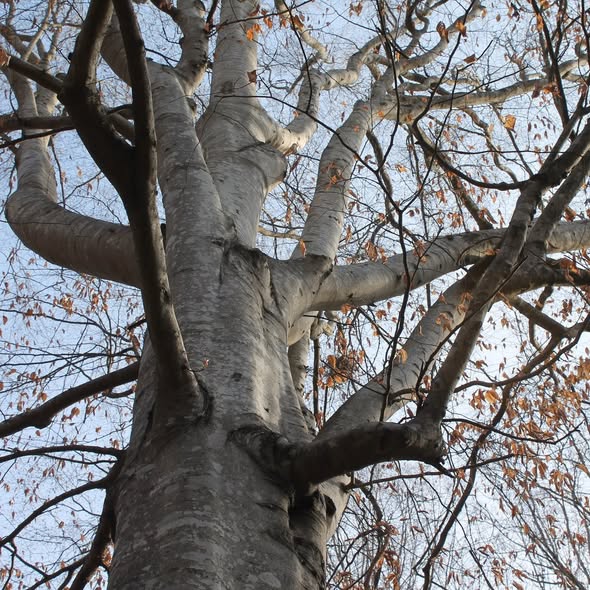
The bark is perhaps the most distinctive feature. It is smooth, thin, and silver-grey — almost metallic in appearance — and remains so throughout the tree’s life, unlike most hardwoods whose bark becomes deeply furrowed with age. This smoothness makes beech bark a favourite canvas for people carving names and initials. Unfortunately, that same characteristic makes it highly vulnerable to disease (more on that later).
Leaves
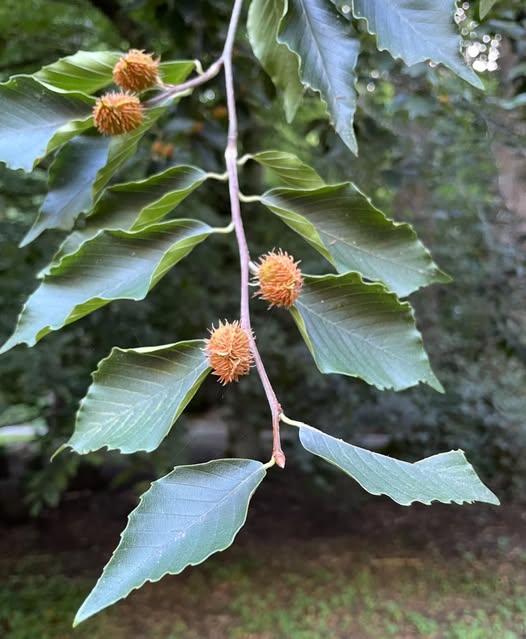
Leaves are simple, alternate, and elliptical, 6–12 cm long, with a pointed tip and sharply toothed margins — each tooth ending in a fine, hair-like tip. The upper surface is a lustrous dark green; the underside is lighter. In autumn, leaves turn golden yellow to bronze. Many remain on younger branches and lower limbs well into winter — a phenomenon called marcescence — giving the tree a warm, tawny appearance in the cold months.
Flowers
American Beech is monoecious — meaning male and female flowers occur on the same tree. Male flowers appear as small, round, hanging catkins. Female flowers are small, paired, and enclosed in a spiny husk. Both emerge in spring as the leaves unfold.
Fruit: The Beechnut
The fruit is a small, triangular nut (beechnut), 1–1.5 cm long, enclosed in a spiny, four-valved husk called a cupule. Each husk typically contains two or three nuts. Beechnuts ripen in autumn (September–October), splitting open to release the seeds.
Beechnuts are small, but their ecological importance is enormous — they are a critical food source for dozens of wildlife species.
Twigs and Buds
Winter buds are long, slender, sharply pointed, and distinctly reddish-brown — almost resembling small cigars. This is a reliable identification feature in winter when leaves are absent.
Native Range and Natural Habitat
American Beech has a broad but defined range across eastern North America.
Geographic distribution:
- Northern boundary: Nova Scotia and New Brunswick (Canada), extending west to southern Ontario and Michigan
- Southern boundary: Northern Florida and the Gulf Coast states
- Western limit: Eastern Texas, Arkansas, and Missouri
- Eastern range: The entire Atlantic seaboard, from Maine to Georgia
It is notably absent from the drier Midwest and Great Plains, where it cannot tolerate the moisture deficit.
Preferred habitat:
American Beech thrives in moist, fertile, well-drained soils — typically loamy, slightly acidic to near-neutral (pH 5.0–6.5). It is a shade-tolerant species, meaning it can establish and grow slowly under a dense forest canopy — a trait that allows it to persist in mature, climax forests.
It is most commonly found in beech-maple, beech-birch-maple, and mixed mesophytic forests — the rich, diverse hardwood forests of the Appalachians and Great Lakes regions, considered among the most ecologically complex temperate forests in the world.
Ecological Role: A Keystone Species
The word “keystone” gets used loosely in ecology. For American Beech, it is genuinely earned.
Wildlife Food Source
The beechnut is among the most nutritious and energy-rich forest mast (seed crop) in eastern North America. Fat content in beechnuts can reach 40–50%, making them a critical calorie source before winter.
Species that depend heavily on beechnuts include:
- Black bears (Ursus americanus) — beechnuts are essential to fall hyperphagia (pre-hibernation feeding)
- White-tailed deer
- Wild turkeys
- Ruffed grouse
- Wood ducks
- Blue jays — which also help disperse the seeds
- Gray and red squirrels
- Chipmunks
- Numerous songbirds
Mast failure years — when beechnut crops are poor — have measurable effects on wildlife populations. Bear health, litter sizes, and survival rates all decline in low-mast years.
Cavity and Shelter Tree
Old beech trees frequently develop cavities in their trunks and limbs, providing nesting and denning sites for wood ducks, owls, raccoons, black bears, and fishers. A single large, old beech may support multiple species simultaneously.
Forest Successional Role
American Beech is a late-successional species — it does not colonise open ground quickly. Instead, it gradually establishes under a forest canopy and eventually becomes a dominant tree in mature, stable forests. Its shade tolerance gives it a competitive edge over more light-demanding species.
Root Sprouting
One of beech’s more unusual traits is its tendency to produce root sprouts (suckers) — new shoots that emerge from shallow lateral roots of the parent tree, sometimes spreading several metres from the trunk. This creates clonal colonies and can be a mechanism for persistence after disturbance.
Wood Properties and Timber Uses
American Beech produces hard, heavy, fine-grained wood — pale, creamy-white to light reddish-brown, with a tight grain and a subtle satiny lustre.
Wood properties:
- Density: Approximately 740 kg/m³ (heavy for a hardwood)
- Janka hardness: 1,300 lbf — harder than black walnut, softer than sugar maple
- Grain: Straight, with a fine, uniform texture
Timber uses:
- Flooring: Beech’s hardness and smooth grain make it an excellent flooring material
- Furniture: Chairs, tables, and cabinetry, particularly in Shaker-style and European-influenced designs
- Tool handles: Mallets, plane bodies, and other hand tools have long been made from beech
- Cooperage: Barrels and containers — beech barrels have been used in brewing and food storage
- Food contact surfaces: Cutting boards and butcher blocks benefit from beech’s smooth, non-porous surface
- Plywood and veneers
- Pulpwood and fuelwood
Beech wood is not naturally durable outdoors — it decays quickly when exposed to moisture — so it is used primarily for interior applications.
Beechnuts: Food and Cultural History
Before the widespread cultivation of grain crops, mast-bearing trees like beech were an essential food source for both indigenous peoples and early European settlers.
Indigenous Uses
Many Native American peoples harvested beechnuts as part of their autumn food gathering. The nuts were eaten raw, roasted, or pressed for oil. The oil was used in cooking and food preparation in a manner similar to how nut oils are used today.
The Cherokee, Iroquois, Potawatomi, and other nations also used various parts of the beech tree medicinally — bark infusions for skin conditions, leaf preparations for swellings, and inner bark extracts for fever and pain relief.
Early Colonial Uses
European settlers quickly recognised the value of beechnuts. Pigs were driven into beech forests in autumn to fatten on fallen nuts — a practice called pannage — echoing centuries-old European traditions in oak and beech forests.
Beechnut oil was used as a cooking fat, a lamp oil, and a hair treatment. Roasted beechnuts were ground as a coffee substitute.
Modern Edibility
Beechnuts are edible raw, though they contain small amounts of a mildly toxic compound called fagin (a tannin-like alkaloid) that can cause mild digestive discomfort when eaten in large quantities. Light roasting largely neutralises this. The flavour is mild, slightly sweet, and pleasant — comparable in richness to a pine nut.
The Beech Bark Disease Crisis
This is the most urgent story in the American Beech’s modern history, and it deserves careful attention.
Beech Bark Disease (BBD) is a devastating, widespread disease complex affecting American Beech trees across their range. It has killed millions of trees over the past century and continues to spread.
How It Works
BBD is not caused by a single pathogen — it is a two-stage disease complex:
- Stage 1 — Beech Scale Insect (Cryptococcus fagisuga): A tiny European scale insect, accidentally introduced to Nova Scotia around 1890, feeds on beech bark by inserting its mouthparts through the smooth outer surface. The feeding creates tiny wounds and stresses the bark tissue.
- Stage 2 — Fungal Infection (Neonectria spp.): The wounds created by the scale allow two species of Neonectria fungi to enter the bark and sapwood. The fungi spread through the cambium layer (the living growth tissue), killing patches of bark and eventually girdling the tree.
Symptoms
- White, woolly patches on the bark (the waxy coating of the scale insect)
- Tarry, oozing spots (early fungal infection)
- Sunken, cracked, or roughened areas on the bark — called “beech snap” cankers
- Crown dieback (progressive dying from the top)
- Sudden stem breakage — infected trees are structurally weakened and prone to snapping at the trunk, sometimes without warning
Geographic Spread
BBD has spread from its introduction point in Nova Scotia throughout the northeastern United States and into the Midwest. It is present in New England, New York, Pennsylvania, the Great Lakes region, and Appalachian states. The disease continues to move southward and westward.
Beech Leaf Disease: A Second Threat
More recently — first identified in Ohio in 2012 — Beech Leaf Disease (BLD) has emerged as a second major threat. Caused by a nematode (Litylenchus crenatae mcdanielae), BLD causes dark striping between leaf veins, leaf distortion, reduced leaf production, and eventual tree death. It spreads faster and kills more quickly than BBD and affects trees of all ages.
BLD has spread rapidly across the northeastern US and into Canada, alarming forest ecologists.
Conservation Response
Researchers at universities and government agencies are actively working on:
- Identifying disease-resistant beech individuals (called “potentially resistant beeches” or PRBs)
- Selective breeding programs to develop resistant populations
- Biological control research for the scale insect
- Silvicultural management strategies to protect remnant healthy trees
The situation is serious. Without effective intervention, the ecological role of American Beech in eastern forests could be severely diminished within decades — a loss comparable in scale to the American Chestnut blight of the 20th century.
Cultivation and Landscape Use
Despite its challenges in the wild, American Beech is a magnificent landscape tree where conditions suit it.
Growing Conditions
- Hardiness zones: USDA Zones 3–9
- Soil: Moist, well-drained, loamy, acidic to neutral; does not tolerate compacted or waterlogged soils
- Sunlight: Full sun to partial shade
- Moisture: Moderate to high; not drought-tolerant
- Growth rate: Slow to moderate (30–60 cm per year in good conditions)
Landscape Value
American Beech offers year-round interest:
- Spring: Emerging pale green leaves with a silky texture
- Summer: Dense, dark green canopy providing deep shade
- Autumn: Golden bronze foliage — one of the richest autumn colours in native hardwoods
- Winter: Persistent bronze leaves on young trees; striking silver bark on mature specimens
It is an excellent specimen tree for large properties, parks, and naturalistic landscapes. Its wide-spreading crown needs space — do not plant it within 15 metres of structures or other trees.
Planting Considerations
- Root zone sensitivity: The shallow, wide-spreading roots of beech are easily damaged by soil compaction, paving, construction, and grade changes. This is a primary cause of beech decline in urban settings.
- Transplanting: Beech transplants poorly when large; plant young container-grown trees and allow them to establish slowly.
- Patience: This is not a tree for the impatient gardener. A beech planted today may not reach its full majesty for 50–100 years.
Cultural Significance
American Beech occupies a quiet but real place in North American cultural history.
Its smooth bark has made it an irresistible canvas for carving — a practice going back centuries. Notably, trees in the American South and Appalachians bearing the inscription “D. Boone killed a bar” have been attributed (sometimes apocryphally) to frontiersman Daniel Boone. Beech carvings, known as arboroglyps, can persist for a century or more — making the trees living historical records.
In literature and folklore, the beech has long been associated with wisdom, patience, and endurance. The old English word for “book” (boc) is derived from the Proto-Germanic word for beech (bōkaz), reflecting an ancient connection between beech wood (used as writing tablets) and the written word.
Final Thoughts
Fagus grandifolia is not just a beautiful tree. It is a foundational species of eastern North American forests — one that feeds bears, shelters owls, builds soil, and anchors entire ecological communities.
It is also a species under serious threat.
Understanding American Beech — its ecology, its vulnerabilities, and its cultural depth — is part of understanding the forest itself. For those with the land, the patience, and the vision, planting a beech tree today is an act of ecological generosity toward future generations.
It is one of the great trees. It deserves every bit of the attention it is receiving from researchers, conservationists, and forests lovers alike.
References
- USDA Forest Service — Silvics of North America Fagus grandifolia Ehrh. — American Beech: Ecology, Range, and Silvical Characteristics https://www.srs.fs.usda.gov/pubs/misc/ag_654/volume_2/fagus/grandifolia.htm
- University of Florida, Institute of Food and Agricultural Sciences (UF/IFAS) — Edis American Beech Tree: Identification, Uses, and Landscape Value https://edis.ifas.ufl.edu/publication/ST232
- Cornell University — College of Agriculture and Life Sciences (CALS) Beech Bark Disease: Biology, Spread, and Management in New York Forests https://www.nnyadevelopment.org/wp-content/uploads/2019/11/Beech-bark-disease-in-NY.pdf
- Michigan State University Extension Beech Leaf Disease — Identification, Biology, and Management https://www.canr.msu.edu/resources/beech-leaf-disease
- USDA Natural Resources Conservation Service (NRCS) — PLANTS Database Fagus grandifolia Ehrh. — American Beech: Classification, Distribution, and Ecological Data https://plants.usda.gov/home/plantProfile?symbol=FAGR

Tim M Dave is a gardening expert with a passion for houseplants, particularly cacti and succulents. With a degree in plant biology from the University of California, Berkeley, he has vast experience in gardening. Over the years, he has cultivated a vast collection of desert plants and learned a great deal about how to grow and care for these unique companions.