Understanding Wild Cherry (Prunus avium): History, Features, Problems and More
Before the centuries of ornamental cherry breeding, before the named cultivars and the grafted specimens and the park avenues of Kanzan and Yoshino — there was the Wild Cherry.
Prunus avium has grown across Europe, western Asia, and North Africa for thousands of years. It predates horticulture. It fed birds and mammals long before it fed humans. Its timber built furniture and musical instruments.
Its blossoms lit up hedgerows and woodland edges in April before anyone thought to select them for garden display. And the sweet cherries in every orchard and supermarket in the world descend directly from this single wild species.
There is something deeply satisfying about a tree with that kind of history. This guide covers the Wild Cherry in full — its biology, ecology, cultural and economic history, growing requirements, landscape uses, and the reasons why it remains one of the most valuable trees you can plant in a garden, a farm, or a restored landscape.
What Is the Wild Cherry?
Wild Cherry, Prunus avium, is a deciduous tree native to Europe, Anatolia, the Caucasus, and western Asia, and widely naturalised across Britain, Ireland, and many parts of North America, Australia, and New Zealand where it has been introduced.
It belongs to the Rosaceae family and the Prunus genus — the same genus that contains all cultivated cherries, plums, peaches, apricots, and almonds. Within that genus, Prunus avium is the parent species of virtually all cultivated sweet cherry varieties (Prunus avium cultivars), making it one of the most agriculturally significant wild trees in temperate regions.
The species name avium is derived from the Latin word for bird — avis — reflecting the tree’s longstanding ecological relationship with fruit-eating birds, which disperse its seeds across the landscape.
Common names used in different regions include Wild Cherry, Sweet Cherry, Gean (particularly in Scotland and northern England), Mazzard, and Bird Cherry — though the last name can cause confusion with Prunus padus, which is a distinct species also sometimes called Bird Cherry.
In Britain, Wild Cherry is a native woodland species, classified as a species of ancient woodland indicator in many regions — meaning its presence in a woodland often signals continuity of woodland cover over centuries.
Key Characteristics at a Glance
Mature Height: 50 to 80 feet (15 to 25 metres) in woodland conditions; typically 30 to 50 feet (9 to 15 metres) in open landscape settings.
Mature Spread: 20 to 40 feet (6 to 12 metres), forming a broadly columnar to ovoid crown when grown in the open.
Growth Rate: Moderate to fast — 18 to 24 inches or more per year in good conditions, particularly in youth.
Bloom Time: Early to mid-spring — March to April in Britain and much of Europe; April in most of North America — coinciding with or just after leaf emergence, depending on the year and location.
Flower Colour: Pure white, single, five-petalled flowers approximately 1 inch in diameter. Carried in clusters of two to six on short lateral shoots.
Foliage: Large, oval to obovate, mid to dark green leaves with serrated margins and a slightly drooping habit when young. Two small red glands are visible at the base of each leaf blade — a characteristic identification feature. Autumn colour is a warm and often spectacular orange to scarlet-red.
Fruit: Small, round cherries — initially yellow-green, ripening through red to dark red or almost black by midsummer. Sweet in flavour in wild trees (sweeter in cultivated selections), with a small hard stone at the centre.
Bark: Distinctly ornamental — glossy, reddish-brown to mahogany, with prominent horizontal grey lenticels. In mature trees, the bark develops a characteristic peeling quality, stripping in horizontal bands. It is one of the most beautiful barks of any native British tree.
USDA Hardiness Zones: 3 to 8.
Lifespan: Typically 60 to 100 years in open conditions; woodland trees can live considerably longer.
Natural Distribution and Ecology
Wild Cherry has a wide native range spanning from the British Isles and western Europe east through Turkey, the Caucasus, and into central Asia. It has been introduced beyond this range so successfully — and for so long — that distinguishing naturalised from native populations is difficult in many regions.
In Britain, it grows naturally in mixed deciduous woodland, hedgerows, scrubland, and woodland edges, typically as a component of ash-oak or lime-oak woodland communities. It is a light-demanding species — it does not persist in deep shade and is naturally associated with woodland edges, clearings, and the upper canopy where it can compete for light.
It is one of the most ecologically valuable flowering trees of the European temperate zone. Its early spring flowers — appearing when few other trees are in bloom — provide a critical nectar and pollen source for early-emerging bees, hoverflies, and other pollinators.
The fruit, ripening in June and July, feeds an enormous range of wildlife: blackbirds, thrushes, starlings, woodpigeons, jays, and dozens of other bird species, as well as mammals including squirrels, foxes, badgers, and dormice.
More than 100 species of insects are associated with Prunus avium and related Prunus species in Britain alone — making it a genuinely significant host plant for invertebrate biodiversity.
It is also a pioneer species in woodland succession. Birds consume the fruit and deposit seeds across the landscape, allowing Wild Cherry to colonise disturbed ground, field margins, and secondary woodland ahead of slower-establishing species.
The Bark: One of Nature’s Great Ornamental Details
The bark of Prunus avium deserves particular attention because it is one of the most ornamentally distinctive of any temperate tree — and it is a quality that is often underappreciated.
Young trees develop a smooth, polished, reddish-brown to mahogany bark with wide, horizontal grey lenticels that circle the trunk like bands. The surface has a subtle sheen — almost lacquered in quality — that catches winter light beautifully.
As the tree matures, the bark develops a peeling habit, with papery horizontal strips curling away from the surface to reveal fresh reddish-brown beneath. This peeling is gradual and adds textural interest without the messiness of heavily exfoliating species like birch or Tibetan cherry.
In winter, when the tree is leafless, the bark is the primary ornamental feature — warm, richly coloured, and architecturally interesting in a way that makes a mature Wild Cherry a genuinely beautiful addition to the winter garden as well as the spring one.
Spring Blossom and Ornamental Value
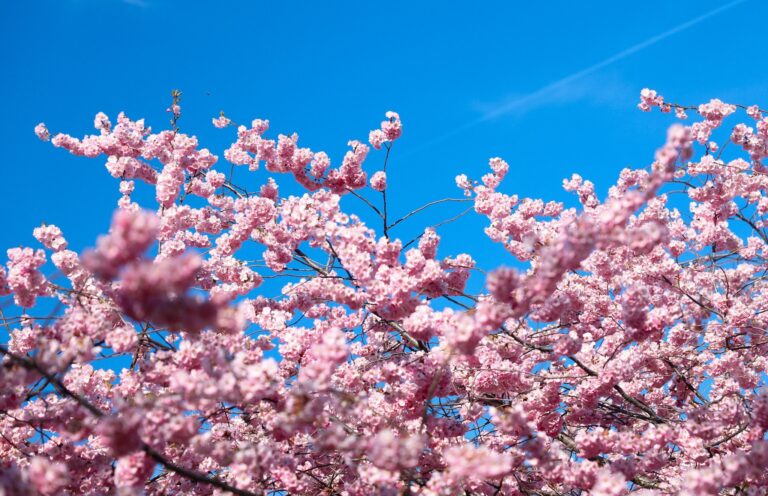
Wild Cherry blooms in early to mid-spring with clusters of pure white, single flowers that open simultaneously with or just after the first leaves emerge. The display is different in character from the cultivated ornamental cherries — less dense and more natural — but it has a quality of its own.
The white flowers against the young, bronze-green emerging leaves create a combination that is more delicate and naturalistic than the massed-flower effect of ‘Kanzan’ or ‘Shirotae’. For gardeners who prefer the wild aesthetic — understated, elegant, seasonal — the Wild Cherry’s blossom is more satisfying than the most elaborate cultivated forms.
The flowers are also excellent for pollinators. Unlike many double-flowered ornamental cultivars whose reproductive structures have been replaced by extra petals, Wild Cherry flowers are fully functional — producing accessible pollen and nectar that feed early bees, solitary wasps, hoverflies, and butterflies at one of the most critical points in the spring season.
Autumn Colour and Year-Round Appeal
The ornamental cherry world tends to be discussed in terms of spring flowers, but Wild Cherry offers one of the most reliable and impressive autumn colour displays of any native British or European tree.
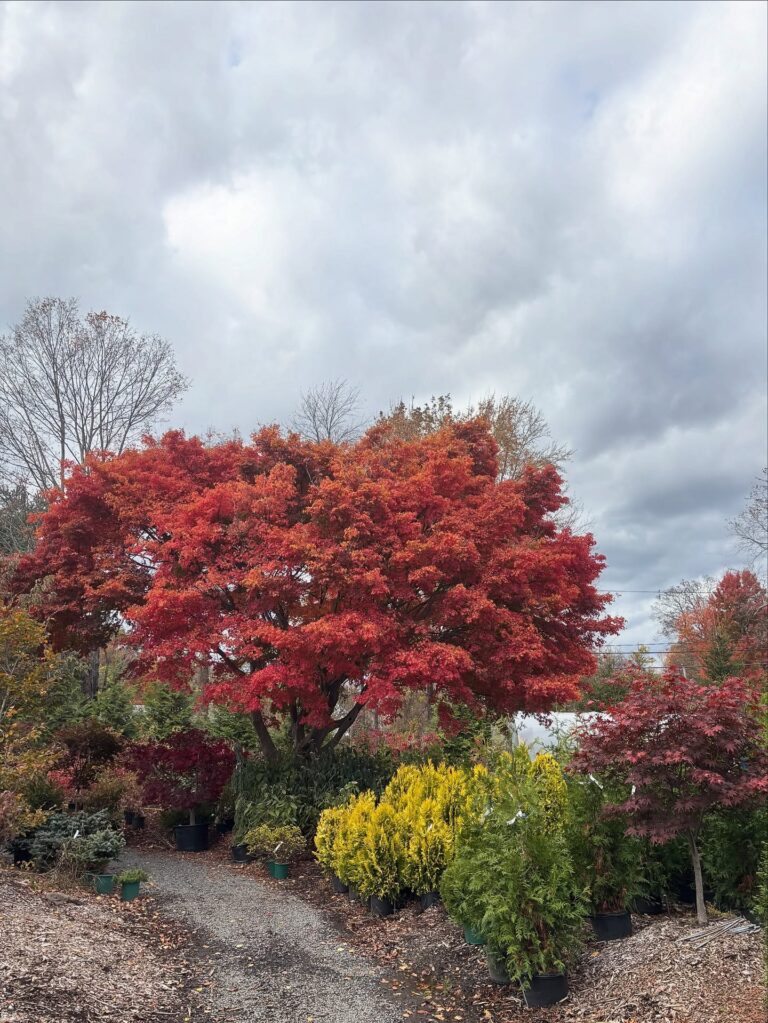
In October, the foliage turns vivid shades of orange, crimson, and scarlet — a display comparable in intensity to the best ornamental maples and rowans, and significantly better than most ornamental cherry cultivars. Combined with the warm mahogany bark and any remaining fruit clusters still attracting birds, a Wild Cherry in autumn is a genuinely spectacular sight.
This autumn performance is a significant reason to choose Wild Cherry over cultivated ornamental cherries in gardens where year-round interest and ecological value are priorities alongside spring blossom.
Timber and Economic History
Few native British trees have been as consistently valued for their timber as the Wild Cherry. Cherry wood is fine-grained, warm-toned, and exceptionally beautiful when worked — qualities that have made it one of the most prized cabinet-making timbers in Europe for centuries.
It is used in high-quality furniture, cabinetry, musical instrument production (particularly for woodwind instruments), wood turning, veneer, and decorative joinery. The warm reddish-brown colour deepens with age and exposure to light, developing over decades into the rich, honey-amber tone associated with antique cherry furniture.
Cherry wood commands a premium price in the timber market, and Wild Cherry grown as timber trees — particularly in agroforestry and mixed woodland systems — represents a valuable long-term investment alongside its ecological and ornamental contributions.
In France and Germany, Wild Cherry has been grown systematically as a timber species in mixed broadleaved woodland for centuries. The French cherry timber trade has a particularly long and distinguished history, with cherry veneer and solid wood exported across Europe for fine furniture production.
The fruit, while smaller and less uniformly sweet than cultivated cherry varieties, was an important food source across Europe historically — eaten fresh, preserved in alcohol, dried, and used in confectionery and cordials. Cherry brandy, cherry schnapps, kirsch, and cherry beer all have long histories of production using wild or semi-wild cherry fruit across central and eastern Europe.
Wild Cherry as a Parent Species of Cultivated Sweet Cherries
One of the most important but least widely appreciated facts about Prunus avium is its central role in the development of the cultivated sweet cherry industry.
Every commercial sweet cherry cultivar — ‘Stella’, ‘Lapins’, ‘Rainier’, ‘Bing’, ‘Sweetheart’, and hundreds of others — descends from Wild Cherry (Prunus avium). Modern sweet cherry varieties are cultivated selections within this species, bred for larger fruit, improved flavour, disease resistance, and self-fertility.
The sour or pie cherry (Prunus cerasus — Morello and Amarelle types) is a separate species, but is itself believed to have originated as a natural hybrid between Prunus avium and Prunus fruticosa (Dwarf Cherry). Even the sour cherry industry thus traces part of its heritage to Wild Cherry.
This makes Prunus avium one of the most economically significant fruit tree species in the world — the wild ancestor of a multi-billion-dollar global industry.
Growing Wild Cherry: Practical Guide
Sunlight
Wild Cherry is a light-demanding species. It requires full sun to partial shade — at least four to six hours of direct sunlight for healthy growth and fruiting. In deep shade, growth is slow and weak, flowering is suppressed, and the tree’s lifespan is reduced.
In landscape plantings, open, sunny positions produce the strongest growth, the best autumn colour, and the most prolific flowering and fruiting.
Soil
Adaptable to a wide range of soil types, including loam, sandy loam, clay loam, and calcareous (chalky) soils — a notable strength that distinguishes it from many ornamental cherry cultivars. It performs best in deep, moderately fertile, well-drained soil with a pH of 5.5 to 8.0.
It tolerates slightly alkaline soils better than most Prunus species, making it suitable for chalk and limestone garden soils where other cherries struggle.
The one consistent requirement is good drainage. Like all Prunus species, Wild Cherry is intolerant of waterlogged or persistently wet soil. Root rot in poorly drained conditions is the most common cause of decline and death.
Water
Young trees benefit from consistent moisture during establishment. Once established, Wild Cherry is notably drought-tolerant compared to many cultivated ornamental cherries — a reflection of its adaptation to a wide range of natural growing conditions.
In garden settings, established trees generally require no supplemental irrigation except during extended drought. Their deep, spreading root systems access moisture from a large soil volume.
Planting
Wild Cherry transplants best when planted as bare-root stock in autumn or early spring during the dormant season, or from containers at any time of year with adequate post-planting irrigation.
Plant at the correct depth — root flare at or slightly above soil grade. Stake young trees in exposed positions for the first two to three years. Mulch the root zone with 2 to 3 inches of organic material, keeping mulch clear of the trunk.
Bare-root whips and transplants are widely available from native tree nurseries at low cost, making Wild Cherry one of the most economically accessible native tree options for large-scale planting projects.
Landscape and Ecological Uses
The versatility of Wild Cherry in landscape applications is one of its greatest strengths.
In native woodland creation and restoration, Wild Cherry is a natural choice — a genuine native species that brings ecological authenticity alongside ornamental and timber value. It establishes quickly, produces early fruit for birds and mammals, and contributes to the full suite of woodland ecological functions: invertebrate habitat, canopy structure, and soil improvement through leaf litter.
In hedgerow planting, it provides spring blossom, summer fruit, and autumn colour in a hedge matrix — and its vigorous growth habit means it establishes quickly alongside hawthorn, blackthorn, and other native hedgerow species.
In farm and agroforestry systems, Wild Cherry is increasingly recognised as a high-value component — combining timber production (with rotation periods of 50 to 70 years for quality veneer timber), wildlife benefit, and landscape amenity in a single planting. Grants and incentive payments for native tree planting in the UK, Europe, and North America often support Wild Cherry establishment as part of agri-environment schemes.
In large gardens and parks, it functions as an outstanding specimen or woodland edge tree — its spring blossom, summer canopy, fruit, autumn colour, and ornamental bark providing genuine year-round interest at a scale appropriate to larger spaces.
In urban street tree and park plantings, Wild Cherry performs well in suitable conditions — it tolerates a range of urban soil types and provides significant biodiversity benefit in urban settings where flowering trees that support pollinators are increasingly valued.
Pests and Diseases
Wild Cherry shares the pest and disease profile of the Prunus genus but is generally considered a robust and resilient species compared to many cultivated cherry cultivars — a reflection of its long evolutionary exposure to native pests and pathogens.
Cherry blackfly (Myzus cerasi) is the most common aphid pest, causing leaf curl and honeydew deposits on new spring growth. Natural predators — ladybirds, lacewings, and parasitic wasps — control populations effectively in most years without intervention.
Cherry fruit fly (Rhagoletis cerasi) can infest fruit in parts of Europe and increasingly in North America. In ornamental plantings, this is a minor concern; in productive orchards, management may be needed.
Bacterial canker (Pseudomonas syringae) causes sunken bark lesions and branch dieback, most problematic in wet spring conditions. Prune in dry weather and protect bark from injury.
Silver leaf disease (Chondrostereum purpureum) enters through pruning wounds. Prune in dry summer conditions and sterilise tools to reduce risk.
Cherry leaf scorch and shot-hole are common fungal leaf diseases in wet summers but rarely threaten the tree’s long-term health.
Frequently Asked Questions
Are wild cherries edible? Yes. Wild cherry fruit is sweet and edible, though typically smaller and more variable in sweetness than cultivated varieties. The fruit is safe to eat fresh and is excellent for preserves, liqueurs, and wine. The stones contain amygdalin and should not be eaten — this applies to all cherries, wild and cultivated.
Is Wild Cherry the same as Bird Cherry? No. Bird Cherry (Prunus padus) is a separate native species with flowers borne in long, drooping racemes (flower spikes) rather than clusters, and with smaller, more bitter fruit. Wild Cherry bears flowers in clusters directly from the branch wood and produces the recognisable round sweet cherry fruit.
How quickly does Wild Cherry grow? In good conditions — full sun, well-drained fertile soil — it is a fast-growing tree in its early decades, adding 18 to 24 inches or more per year. Growth slows as the tree matures but remains moderate throughout a vigorous lifespan.
Does Wild Cherry sucker? Yes. Wild Cherry produces root suckers readily, particularly if the roots are damaged. In garden settings, suckers should be removed at ground level to prevent the development of thickets. In woodland and conservation settings, suckering contributes to regeneration and biodiversity.
Can Wild Cherry be coppiced or pollarded? It tolerates both practices, though neither is traditional for timber-quality trees. For multi-stem woodland edge planting or wildlife hedgerow use, allowing some suckering or light coppicing at wide intervals is acceptable. For timber production, a single-stem, unpollarded tree is preferred.
Final Thoughts
The Wild Cherry does not need to compete with the ornamental cherries bred for garden display. It offers something different — and in many respects, something more.
It is a tree of genuine ecological importance. It feeds hundreds of species of insects, birds, and mammals. It has built furniture and instruments and fed families across Europe for millennia. Its timber is among the most beautiful produced by any native tree. And each April, it covers woodland edges and hedgerows with clusters of pure white flowers that have been doing exactly that, in exactly those places, long before any garden was planted.
For ecological planting, native woodland creation, agroforestry, large-scale landscape restoration, or simply a garden that takes its natural heritage seriously — Wild Cherry (Prunus avium) is not just a good choice. It is a foundational one.
References
- North Carolina State University Extension – Prunus avium Plant Profile https://plants.ces.ncsu.edu/plants/prunus-avium/
- University of Florida IFAS Extension – Prunus avium: Sweet Cherry https://edis.ifas.ufl.edu/publication/CH085
- Virginia Tech Dendrology – Prunus avium Fact Sheet https://dendro.cnre.vt.edu/dendrology/syllabus/factsheet.cfm?ID=103
- Arnold Arboretum of Harvard University – Prunus avium Species Records https://arboretum.harvard.edu/plants/plant-list/
- Penn State Extension – Sweet Cherry Production and Wild Cherry Ecology https://extension.psu.edu/sweet-cherry-production

Tim M Dave is a gardening expert with a passion for houseplants, particularly cacti and succulents. With a degree in plant biology from the University of California, Berkeley, he has vast experience in gardening. Over the years, he has cultivated a vast collection of desert plants and learned a great deal about how to grow and care for these unique companions.