Understanding White Poplar (Populus alba): Identification, Growing, Uses, and Problems
There are trees that blend into the landscape, and then there are trees that announce themselves. The White Poplar (Populus alba) belongs firmly in the second category. When a breeze moves through its canopy, the leaves flip to reveal their bright white undersides.
It is one of the most visually striking effects in the temperate tree world, and once you have seen it, you understand immediately why this tree has been admired and planted for thousands of years.
White Poplar is a tree with range, resilience, and a complicated relationship with the landscapes it inhabits. It is native across a vast belt of Europe and Asia. It has been widely introduced elsewhere — sometimes celebrated as an ornamental, sometimes cursed as an invasive.
White poplar grows fast, spreads aggressively, tolerates punishment that would kill most trees, and produces some of the most distinctive foliage of any broadleaf species.
This guide is for anyone who wants to understand White Poplar fully — its biology, its ecology, its uses, and how to grow or manage it wisely.
| Scientific Name | Populus alba L. |
| Common Names | White Poplar, Silver Poplar, Abele |
| Family | Salicaceae (Willow family) |
| Typical Height | 65–100 ft (20–30 m); occasionally to 130 ft (40 m) |
| Trunk Diameter | Up to 5 ft (1.5 m) on mature specimens |
| Bark | Pale gray-white with diamond-shaped black marks; furrowed at base |
| Leaf (Upper) | Dark green, maple-like lobed shape |
| Leaf (Lower) | Brilliant white-woolly (tomentose) |
| Fall Color | Yellow to pale gold |
| Flowers | Dioecious; pendulous catkins before leaves in spring |
| Fruit | Cottony white seeds released in early summer |
| USDA Hardiness Zones | 3–8 |
| Soil Preference | Adaptable; tolerates sand, clay, saline, and alkaline soils |
| Light Requirement | Full sun |
| Growth Rate | Fast — 3 to 5 ft (1–1.5 m) per year when young |
| Lifespan | 200–300 years under ideal conditions |
| Key Characteristic | Striking silver-white leaf undersides; suckering habit |
What Is White Poplar?
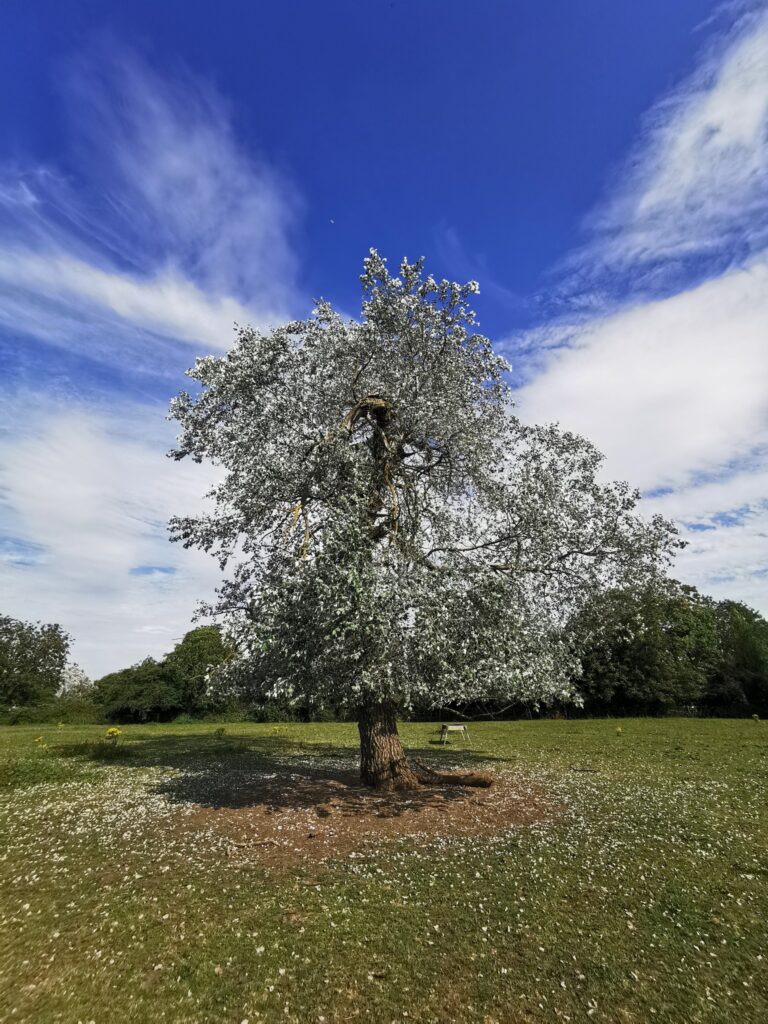
White Poplar is a large, fast-growing deciduous tree in the willow family (Salicaceae). It is one of approximately 35 species within the genus Populus, which also includes aspens, cottonwoods, and other poplars.
Within this genus, Populus alba is most closely related to the Gray Poplar (P. × canescens), which is a natural hybrid between White Poplar and the Common Aspen (P. tremula).
The species name alba is Latin for “white” — a direct reference to the white woolly coating (tomentum) on the undersides of the leaves and on young shoots. This feature is the single most reliable identification clue and the source of all its common names.
The tree has been cultivated for so long and spread so widely that the precise boundaries of its native range are somewhat blurred. It is generally accepted as native to Central and Southern Europe, the Middle East, Central Asia, and into western China.
Identification: Recognizing White Poplar in the Field
Bark
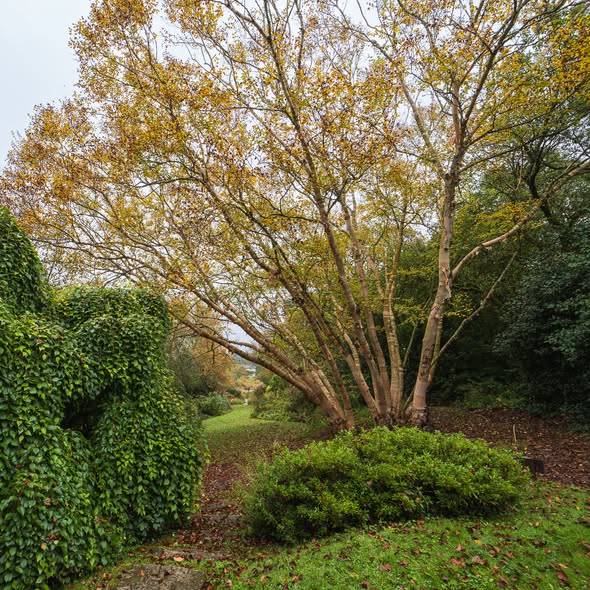
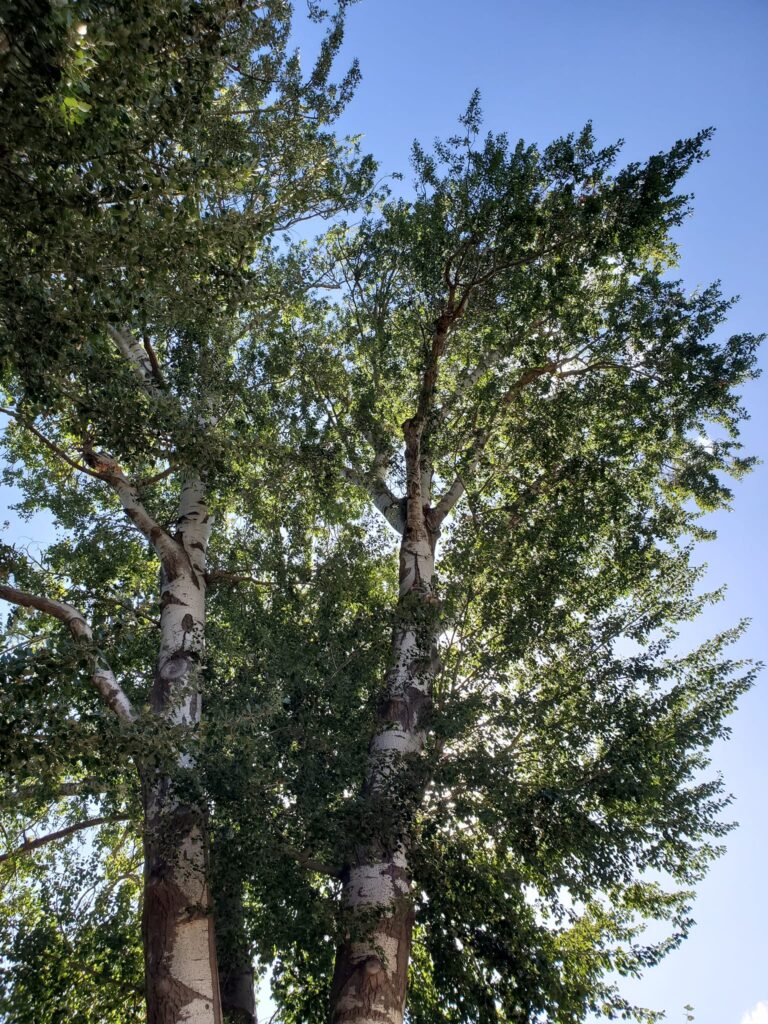
The bark of White Poplar is one of its most distinctive features. On young trees and upper branches, it is smooth, pale gray-white to creamy white, marked with diamond-shaped black lenticels. This pattern gives the upper trunk an almost decorative, graphic appearance.
Toward the base of mature trees, the bark becomes coarsely furrowed and dark gray, losing its pale, smooth character. The contrast between the rough base and the pale upper stem is itself a useful identification feature.
The overall impression of the bark — pale, almost luminous, with precise black markings — gives the tree its “white” identity even without reference to its leaves.
Leaves
The leaves are the most famous feature of this tree, and the reason so many people stop to look at it on a breezy day.
The upper surface is dark green — glossy and smooth, with a shape that varies considerably. Leaves on the long shoots (extension growth) are palmately lobed with 3 to 5 lobes, somewhat resembling a maple leaf.
Leaves on short spur shoots are smaller and more rounded, often with only shallow lobing or coarse teeth.
The lower surface is covered in a dense white woolly coating — technically called tomentum — made up of branched, star-shaped hairs. This coating is so thick that the underside of the leaf looks and feels almost like white felt.
When the wind turns the leaves over, the flash of white from an entire canopy is startling and beautiful.
Young shoots are similarly white-woolly, making the entire growing tip of the tree look pale and soft in spring.
Catkins and Seeds
White Poplar is dioecious — individual trees are either male or female, never both. The flowers appear as pendulous catkins before the leaves emerge in early spring — typically February to April depending on climate.
Male catkins are reddish-purple and about 2 inches long. Female catkins are greenish and longer.
After pollination, female trees produce small capsules containing numerous tiny seeds, each attached to a tuft of white cottony hair — the characteristic “cotton” released in early summer that can drift in enormous quantities.
This cottony seed dispersal is one of the most recognizable — and for some, most frustrating — characteristics of the poplar family.
Roots and Suckering
Perhaps the most ecologically significant feature of White Poplar is its root system and suckering habit. The tree produces extensive, shallow lateral roots that spread far beyond the canopy. These roots generate abundant root suckers.
This suckering is so vigorous that a single planted tree can generate a thicket of stems over time. It is, ecologically, a strategy for vegetative cloning — and it is the primary reason White Poplar becomes invasive where it is not native.
Native Range and Natural Habitat
Where It Grows Naturally
In its native range, White Poplar is a riparian and floodplain species — most commonly found along rivers, streams, lake margins, and in moist lowland forests.
It grows naturally from Portugal and Spain in the west, across Southern and Central Europe, through Turkey, Iran, and Central Asia, to the Altai mountains and western China in the east.
The tree is notably absent from northern Europe in its native form — it does not occur naturally in Scandinavia, the British Isles, or most of northern Germany, though it has been introduced to all of these areas and naturalized in some.
Preferred Conditions
In nature, White Poplar favors:
- Moist to seasonally flooded alluvial soils along river systems
- Open, sunny positions — it is highly shade-intolerant
- Disturbed ground — it colonizes gaps and riverbanks rapidly
- Mild to warm continental climates — it tolerates summer heat better than many poplars
However, the tree’s notable adaptability means it thrives in conditions far beyond its native habitat — from coastal dunes to urban roadsides, and from near-desert margins to humid woodland edges.
Ecological Role and Importance
In Native Ecosystems
Within its native range, White Poplar plays a significant role in riparian forest ecology. Along European and Central Asian river systems, it is a component of the alluvial hardwood forest — a vegetation type that also includes white willows, black poplars, elms, and ash trees.
These forests are among the most productive and biodiverse of all European forest types, supporting large numbers of invertebrate, bird, and mammal species.
The tree’s fast growth and early canopy cover make it an important pioneer species on disturbed floodplains, helping stabilize eroding banks and facilitating the establishment of slower-growing species.
Wildlife Value
White Poplar supports a broad range of wildlife:
- Lepidoptera: Many moth and butterfly species use poplar and willow trees as larval host plants. In the UK, introduced White Poplar supports species including the Poplar Hawk-moth (Laothoe populi) and Puss Moth (Cerura vinula).
- Birds: The tree provides nesting and foraging habitat. Woodpeckers excavate cavities in older trunks. Finches and tits feed on catkin buds in early spring when other food is scarce.
- Mammals: Deer browse young sucker growth. Beavers, where present, use poplar stems as both food and building material.
- Insects: The flowering catkins are an early and important pollen source for bees and other pollinators in late winter and early spring, before most other trees flower.
Invasive Potential
Outside its native range, White Poplar must be managed carefully. In North America, Australia, South Africa, and South America, the tree has naturalized aggressively in many regions.
Its combination of fast growth, prolific suckering, wind-dispersed seeds, and broad environmental tolerance makes it a serious competitor against native riparian vegetation.
In the United States, it is listed as invasive in several states, particularly in the Northeast and Mid-Atlantic. Once established in a riparian area, it is extremely difficult to eradicate.
This invasive character does not diminish the tree’s genuine ornamental and ecological value within its native range. But it does mean that planting decisions outside the native zone must be made with full awareness of the risks.
Landscape and Ornamental Uses
As a Specimen and Shade Tree
Within appropriate climates and non-invasive contexts, White Poplar is a genuinely impressive landscape tree. Its combination of features — silvery leaf undersides, attractive pale bark, fast growth, and broad adaptability — make it a popular choice for:
- Large parks and open spaces where its ultimate size and suckering can be accommodated
- Coastal and seaside plantings where salt spray tolerance is critical — few large trees tolerate coastal exposure as well as White Poplar
- Screening and windbreaks, particularly in exposed, difficult sites
- Riparian and bank stabilization planting within its native range
The tree is not suitable for small gardens or proximity to structures. Its surface roots damage paving, walls, and drainage systems. Its suckers invade surrounding planting areas and lawns. It is a tree that needs space — and honesty from whoever plants it.
Notable Cultivar: Populus alba ‘Richardii’
The ‘Richardii’ cultivar is one of the most distinctive forms in cultivation. It produces leaves with golden-yellow upper surfaces contrasting with the typical white woolly underside. It is slower-growing and less vigorous than the species, making it somewhat more suitable for garden settings.
Populus alba ‘Pyramidalis’ (Bolleana Poplar)
The ‘Pyramidalis’ or ‘Bolleana’ form produces a narrow, columnar crown — similar in silhouette to the Lombardy Poplar but with the White Poplar’s silvery leaf character. It is widely used in formal landscapes, avenue planting, and where vertical accent is required without wide canopy spread.
This cultivar suckers much less vigorously than the species, making it significantly more manageable.
Growth Rate, Hardiness, and Adaptability
Growth Rate
White Poplar is one of the fastest-growing large deciduous trees available in temperate horticulture. Young trees in good conditions regularly grow 3 to 5 feet per year. This pace slows somewhat as the tree matures but remains respectable for a tree of its ultimate size.
This growth rate has made poplars historically important for short-rotation biomass production, windbreak establishment, and rapid landscape screening — applications where quick canopy establishment is the priority.
Climate and Hardiness
Rated for USDA Hardiness Zones 3 to 8, White Poplar tolerates a remarkable range of climatic conditions:
- Cold winters: Survives temperatures to -40°F (-40°C) in Zone 3
- Hot summers: Performs well in continental climates with warm to hot summers
- Coastal exposure: One of the better large trees for salt-laden maritime winds
- Drought: Established trees show reasonable drought tolerance, though they prefer moist conditions
It is less suitable for the hot, humid conditions of the Deep South (Zone 9+) or for areas with mild, wet winters and cool summers that favor fungal diseases.
Soil Adaptability
This is where White Poplar genuinely earns its reputation for toughness. It grows successfully in:
- Sandy, nutrient-poor soils
- Heavy clay soils
- Alkaline and calcareous soils — pH tolerances up to 8.0 and above
- Saline soils — unusually tolerant for a large deciduous tree
- Compacted urban soils
The one significant limitation is poor drainage — although White Poplar tolerates periodic flooding, it does not thrive in permanently waterlogged ground.
Historical and Cultural Significance
Ancient Use and Mythology
White Poplar has a long history in human culture. In Greek mythology, the tree was associated with Heracles (Hercules), who reportedly wore a wreath of white poplar leaves after descending from the underworld.
The white underside of the leaves represented the brightness of the upper world, while the dark green upper surface symbolized the darkness of Hades below.
The tree also appears in the mythology of several other ancient cultures as a symbol of regeneration and resilience — appropriate given its vigorous resprouting and suckering ability.
Historical Timber and Craft Uses
White Poplar wood is lightweight, soft, and resistant to splitting. It was historically used for:
- Shields in ancient and medieval warfare — the combination of lightness and resistance to splitting made it ideal
- Wooden clogs and footwear in rural Europe
- Match production — poplar wood was the primary material for safety matches well into the 20th century
- Paper pulp — fast-growing poplars remain an important source of pulpwood in some countries
- Crates and packaging — the light, soft wood works easily and holds nails well
The wood is not durable in external or ground-contact applications and has limited structural use in modern construction.
The Name “Abele”
The old English common name “Abele” — still sometimes used in poetry and older texts — derives from the Medieval Latin albellus (whitish) via Dutch. It was the standard English name for this tree before “White Poplar” became dominant.
You encounter it in older garden writing and poetry as a mark of this tree’s long presence in cultivated European landscapes.
Common Pests and Diseases
Poplar Canker (Xanthomonas populi and fungal species)
Bacterial and fungal cankers can affect White Poplar, causing elongated dead areas on stems that girdle and kill branches. Vigorous trees in appropriate conditions generally resist serious infection. Stressed trees, particularly those in poorly drained sites or subjected to drought, are more susceptible.
Leaf Rust (Melampsora spp.)
Rust fungi cause orange-yellow pustules on the undersides of leaves in summer. Infections are rarely severe enough to cause lasting harm, though they can cause early leaf drop in wet seasons.
Poplar Mosaic Virus
This viral disease causes irregular pale green mottling on leaves. Spread by aphids and through vegetative propagation of infected material. Affected trees may show reduced vigor but rarely die from infection alone.
Poplar Gall Aphid (Pemphigus spp.)
These aphids cause distinctive swollen, purse-shaped galls on leaf stalks (petioles) in spring. The galls are striking to look at but cause minimal long-term harm to healthy trees.
Frequently Asked Questions
Is White Poplar an invasive species? It depends on location. Within its native range in Europe and Central Asia, it is a valuable native species. Outside this range — including much of North America and Australia — it has invasive potential due to its aggressive suckering and seed dispersal. Always check local regulations before planting.
How far do White Poplar roots spread? The lateral roots of mature White Poplar can extend two to three times the canopy radius — often 50 to 100 feet from the trunk. These roots generate suckers and can damage foundations, drains, and paving. Plant at least 60 feet from any structure.
How do you control White Poplar suckers? Persistent mowing at ground level gradually exhausts sucker-generating roots over several years. Cutting the parent tree stimulates more suckering. Herbicide treatment of cut stumps (immediately after cutting, with a systemic herbicide such as glyphosate or triclopyr) is the most effective long-term control method.
Can you grow White Poplar from cuttings? Yes — poplars root readily from hardwood cuttings taken in late autumn or winter. This is the standard propagation method for cultivars and is far more reliable than growing from seed.
What is the difference between White Poplar and Gray Poplar? Gray Poplar (Populus × canescens) is a natural hybrid between White Poplar and Common Aspen. Its leaves are less deeply lobed and have a grayer, less intensely white underside.
Final Thoughts
White Poplar is a tree of genuine extremes. It grows faster than almost any other large deciduous tree. It survives conditions that defeat most species. Its shimmering silver canopy is one of the most distinctive effects in the temperate landscape.
However, it spreads with a determination that can be either an asset or a serious problem, depending entirely on where and how it is planted.
Used wisely — in the right location, with awareness of its limitations, and respect for its considerable power — it is a magnificent tree. Few species deliver as much visual impact, as quickly, in as difficult a site.
References
- Virginia Tech Dendrology — Populus alba Fact Sheet College of Natural Resources and Environment, Virginia Tech University https://dendro.cnre.vt.edu/dendrology/syllabus/factsheet.cfm?ID=400
- University of Florida IFAS Extension — Populus alba: White Poplar Environmental Horticulture, UF/IFAS Extension https://edis.ifas.ufl.edu/publication/ST496
- North Carolina State University Extension — Populus alba Plant Profile NC State Extension Plants, College of Agriculture and Life Sciences https://plants.ces.ncsu.edu/plants/populus-alba/
- Missouri Botanical Garden Plant Finder — Populus alba Shaw Nature Reserve and Missouri Botanical Garden https://www.missouribotanicalgarden.org/PlantFinder/PlantFinderDetails.aspx?kempercode=b207
- Penn State Extension — Invasive Plants in Pennsylvania: Poplar Species College of Agricultural Sciences, Pennsylvania State University https://extension.psu.edu/plants/invasives/facts/white-poplar

Tim M Dave is a gardening expert with a passion for houseplants, particularly cacti and succulents. With a degree in plant biology from the University of California, Berkeley, he has vast experience in gardening. Over the years, he has cultivated a vast collection of desert plants and learned a great deal about how to grow and care for these unique companions.