Understanding Vanderwolf Pine Tree: Size, Growth Rate, Problems, and More
The Vanderwolf Pine is not just beautiful. It is tough, adaptable, and remarkably low-maintenance. For homeowners, landscapers, and gardeners looking for a statement tree that survives harsh conditions, this is one of the best choices available today.
This guide covers everything you need to know — from the tree’s botanical identity and growth habits to soil preferences, pruning tips, common problems, and landscape uses.
| Common Name | Vanderwolf Pine / Vanderwolf’s Pyramid Limber Pine |
| Botanical Name | Pinus flexilis ‘Vanderwolf’s Pyramid’ |
| Plant Family | Pinaceae |
| Tree Type | Evergreen conifer |
| Growth Habit | Pyramidal / columnar |
| Mature Height | 20–25 feet (6–7.5 m) |
| Mature Spread | 8–12 feet (2.4–3.7 m) |
| Growth Rate | Slow to moderate (6–10 inches/year) |
| Needle Color | Blue-green to silver-blue |
| Needle Length | 2–4 inches, in bundles of 5 |
| USDA Hardiness Zones | 4–7 |
| Sun Requirement | Full sun |
| Soil Preference | Well-drained; tolerates poor, rocky, sandy soils |
| Drought Tolerance | High |
| Water Needs | Low to moderate once established |
| Deer Resistance | Moderate |
| Native Range | Rocky Mountain Region, USA |
| Best Uses | Specimen plant, privacy screen, windbreak, foundation planting |
What Exactly Is the Vanderwolf Pine?
The Vanderwolf Pine is a cultivated variety (cultivar) of the Limber Pine, Pinus flexilis. Its full botanical name is Pinus flexilis ‘Vanderwolf’s Pyramid.’ The cultivar was selected and introduced by the Vanderwolf Nursery in the United States, which is where the name comes from.
The parent species, Limber Pine, is native to the Rocky Mountain region and is well known for its extraordinary flexibility. The species name flexilis actually means “flexible” in Latin — a nod to the branches that can bend dramatically without breaking, even under the weight of heavy snow or strong wind.
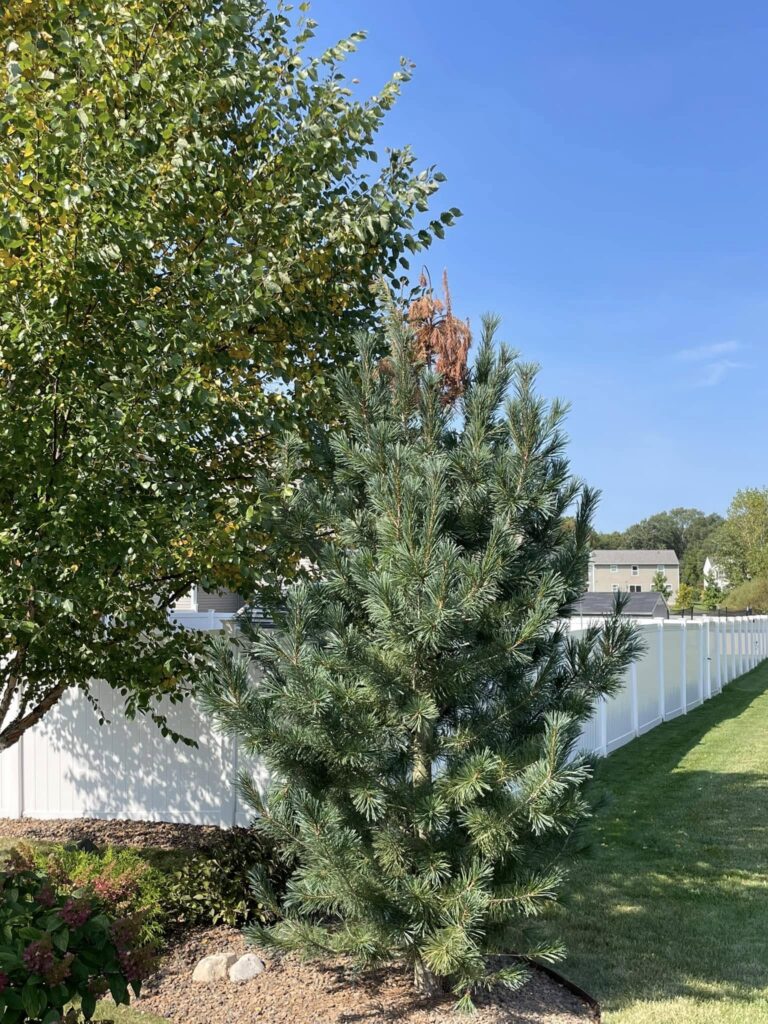
What makes the ‘Vanderwolf’s Pyramid’ cultivar so special is its superior ornamental form. While wild Limber Pines can be irregular and wind-sculpted in appearance, Vanderwolf’s Pyramid grows in a tight, symmetrical pyramid shape with dense, blue-silver foliage.
The Signature Look: Why This Tree Turns Heads
One of the most striking things about this tree is the color of its needles. The blue-green to silvery-blue foliage is not something you see in your average evergreen. It has a luminous quality — especially in morning or late afternoon light — that makes it stand out even in a garden full of other plants.
The needles grow in clusters of five, which is a defining characteristic of the Limber Pine group. Each needle is slightly twisted, and the bundles give the branches a soft, feathery texture that is pleasant both to look at and to touch.
As the tree matures, the lower branches remain intact and sweep outward gently, keeping that classic pyramid shape from base to tip. This natural, well-balanced form means you rarely need to prune for shape — the tree does the work on its own.
The bark is another underrated feature. On young trees, the bark is smooth and gray-green. As the tree ages, it becomes rougher and more deeply furrowed, adding interesting texture to the winter landscape when the garden is otherwise bare.
Growth Rate and What to Expect Over Time
Many gardeners ask about growth rate before committing to a tree. The honest answer for Vanderwolf Pine is: it is a slow to moderate grower, typically adding 6 to 10 inches per year under good conditions. That might sound slow compared to fast-growing privacy trees like Leyland Cypress, but there are real advantages to this pace.
Slow growth means:
- Stronger wood that resists breakage
- Less frequent maintenance because the tree does not outgrow its space quickly
- Longer lifespan — Limber Pines are known to live for centuries in the wild
Over 10 years, you can reasonably expect the tree to reach 6 to 10 feet. At maturity, most landscape specimens top out at around 20 to 25 feet tall with a spread of 8 to 12 feet. In very favorable conditions, some trees may slightly exceed this range.
If you plant a Vanderwolf Pine today, you are investing in a tree that will outlast you and provide beauty for generations. That is not a bad legacy.
Ideal Growing Conditions
Sunlight
Vanderwolf Pine needs full sun to thrive. This means a minimum of 6 hours of direct sunlight per day. It can tolerate some light afternoon shade, but anything less than full sun tends to result in open, sparse growth and a loss of that signature dense pyramid shape.
Do not plant this tree under large shade trees or in areas with consistent shadow. It will survive, but it will never look its best.
Soil Requirements
One of the most appealing qualities of this tree is its remarkable soil adaptability. Unlike many ornamental trees that demand rich, fertile soil, the Vanderwolf Pine thrives in:
- Sandy soils
- Rocky or gravelly soils
- Loamy soils
- Poor, nutrient-depleted soils
The single non-negotiable condition is drainage. This tree will not survive in waterlogged or heavy clay soils where water pools after rain. Root rot is the primary killer of Limber Pines in cultivation, and it is almost always caused by excessive soil moisture.
If your soil is heavy clay, amend it with coarse sand and organic matter, or consider building a raised planting bed before installing the tree.
pH Range
The Vanderwolf Pine is not very fussy about soil pH. It grows well in slightly acidic to slightly alkaline conditions — roughly a pH range of 6.0 to 7.5. If your soil is within this range, you are unlikely to encounter pH-related problems.
Water Requirements
Once established — which typically takes 1 to 2 growing seasons — the Vanderwolf Pine is highly drought tolerant. This is one of its greatest strengths in dry climates and water-restricted regions.
During the first year after planting, water deeply and regularly (once or twice a week, depending on heat and rainfall) to encourage deep root development. After establishment, natural rainfall is usually sufficient in most regions.
Supplemental watering during prolonged summer droughts is always beneficial, but it is rarely critical.
Overwatering is a far more common problem than underwatering with this species. Always allow the soil to partially dry between waterings.
Planting the Vanderwolf Pine: Step-by-Step
Getting the planting right sets up a lifetime of success. Follow these steps carefully.
Step 1 — Choose the right site. Select a location with full sun and good drainage. Avoid low spots, areas near downspouts, or places where water tends to collect.
Step 2 — Time your planting. Early spring or early fall are the best times to plant. Spring planting gives the tree a full growing season to establish roots. Fall planting takes advantage of cooler temperatures and natural rainfall, reducing transplant stress.
Step 3 — Dig the right hole. Make the hole 2 to 3 times as wide as the root ball but only as deep as the root ball is tall. Never plant too deep. The root flare (where the trunk widens at the base) should sit slightly above the soil line.
Step 4 — Backfill with native soil. Resist the temptation to fill the hole with rich potting mix. Backfilling with your native soil encourages roots to expand outward into the surrounding ground rather than staying confined to the planting hole.
Step 5 — Mulch the base. Apply a 2 to 4 inch layer of organic mulch (wood chips, pine bark, or shredded leaves) around the base of the tree, keeping mulch away from direct contact with the trunk. Mulch conserves moisture, moderates soil temperature, and suppresses weeds.
Step 6 — Water well after planting. Give the tree a deep, slow watering immediately after planting. This helps settle the soil and eliminates air pockets around the roots.
Fertilization: Less Is More
Vanderwolf Pine does not need heavy feeding. In fact, excessive nitrogen fertilization can do more harm than good, encouraging rapid, weak growth that is more susceptible to pests and environmental stress.
In nutrient-poor soils, a light application of a balanced, slow-release fertilizer (such as a 10-10-10 granular formula) in early spring can be helpful. Apply at the rate recommended on the product label.
In average to good soils, you may not need to fertilize at all. A healthy, established Vanderwolf Pine in appropriate soil is largely self-sufficient.
If you notice yellowing needles (not just natural inner needle drop, which is normal), it may indicate a micronutrient deficiency. A soil test from your local extension office will identify exactly what is lacking before you add anything.
Pruning: When and Why
Here is the good news: Vanderwolf Pine requires very little pruning. Its natural growth habit produces that beautiful pyramid shape without human intervention.
Do not shear this tree like a topiary. That approach damages the natural branching pattern and reduces the ornamental appeal.
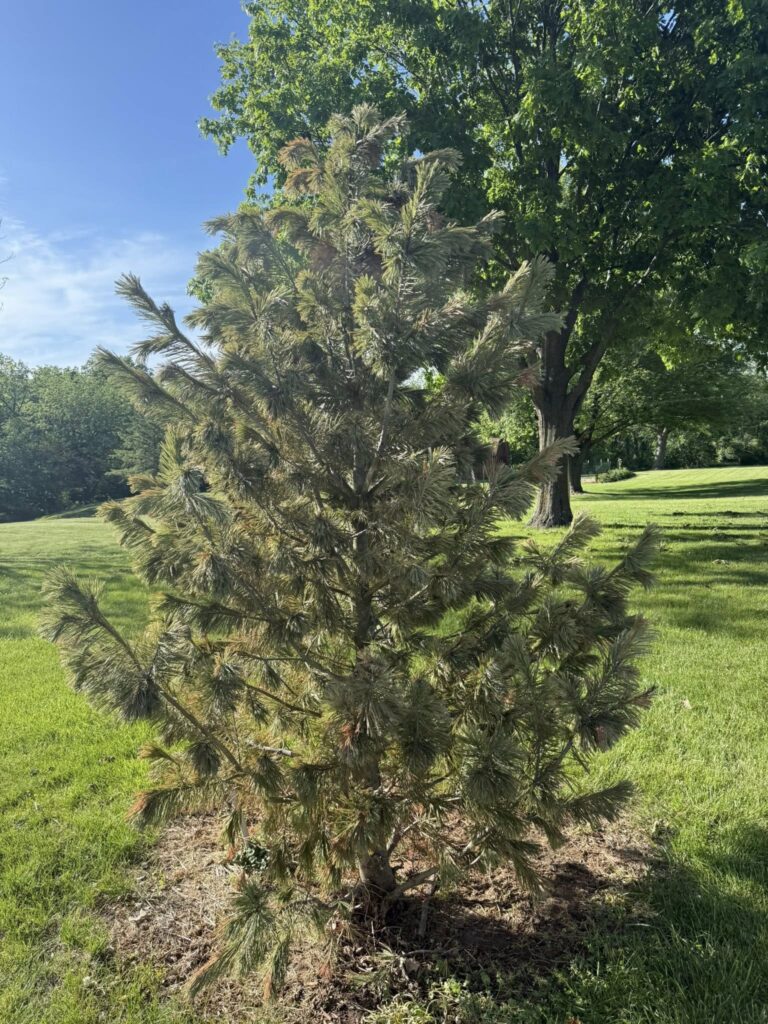
If you do need to prune — to remove dead, diseased, or broken branches — late winter or very early spring is the best time, just before new growth begins. This minimizes resin flow and reduces the risk of disease or insect entry through pruning wounds.
Candles (the new growth shoots that emerge in spring) can be partially cut back by half to slow the tree’s size increase and maintain density. This technique is known to experienced bonsai enthusiasts and conifer growers, but it is rarely necessary for landscape specimens.
Always use clean, sharp tools when pruning conifers. Wiping blades with isopropyl alcohol between cuts reduces the chance of spreading disease.
Common Pests and Diseases
The Vanderwolf Pine is generally a healthy and resilient tree, but it is not entirely without vulnerabilities. Here is what to watch for:
White Pine Weevil (Pissodes strobi)
This is arguably the most significant pest threat for five-needle pines in North America. The adult weevil feeds on the leader (the central, topmost shoot) in early spring, causing it to wilt, curl, and die — a symptom often called “shepherd’s crook.” If the leader dies repeatedly, the tree may develop a multi-stemmed, bushy form rather than its characteristic pyramid.
Management: Remove and destroy infested leaders promptly. A new leader can often be trained from a side branch. Preventive insecticide applications in early spring can reduce weevil damage in high-pressure areas.
Pine Needle Scale (Chionaspis pinifoliae)
Tiny white scales that appear on the needles, causing yellowing and needle drop. Heavy infestations can weaken the tree significantly.
Management: Horticultural oil sprays applied in early spring, when crawlers (the mobile juvenile stage) are active, are effective and low-impact.
White Pine Blister Rust (Cronartium ribicola)
This fungal disease affects all five-needle pines and requires an alternate host (currant or gooseberry plants, Ribes species) to complete its life cycle. Avoid planting Vanderwolf Pine near Ribes species if blister rust is present in your region.
Symptoms include orange to yellow blisters on the bark and cankers that can girdle and kill branches. There is no cure once infection is established; prevention through host avoidance and purchasing certified disease-resistant stock is the best strategy.
Root Rot (Phytophthora species)
As mentioned earlier, poorly drained soil is the primary risk factor. Root rot is almost entirely preventable through proper site selection and planting technique. Signs include wilting despite adequate moisture, yellowing foliage, and overall decline.
Landscape Uses and Design Ideas
The Vanderwolf Pine earns its place in the landscape not just as a background tree, but as a true design focal point. Here are some of the best ways to use it:
Specimen Planting
Plant one Vanderwolf Pine as a standalone specimen in a lawn or open bed. Its symmetrical form, striking color, and year-round presence make it an ideal centerpiece for a front yard or entry garden. Underplant with low-growing ornamental grasses or ground covers for a polished, layered look.
Privacy Screen and Windbreak
Space multiple trees 10 to 12 feet apart in a row to create a natural privacy screen or windbreak. Because the tree retains its lower branches and stays dense from the ground up, it creates effective visual and wind barriers even without additional fencing.
Foundation Planting
The Vanderwolf Pine’s relatively narrow spread (8 to 12 feet at maturity) makes it suitable for corner foundation plantings where other large trees might crowd or damage structures. Its slow growth means you will not outgrow the space for many years.
Rock Gardens and Xeriscapes
Because of its native habitat — rocky, exposed mountainsides — the Vanderwolf Pine is a natural fit for rock gardens and xeriscape designs. Pair it with ornamental rocks, drought-tolerant perennials like lavender, salvia, or sedum, and decomposed granite mulch for a water-wise, low-maintenance composition.
Mixed Evergreen Borders
Combine Vanderwolf Pine with other conifers of contrasting color and texture — such as gold-tipped junipers, dark green spruce, or bronze-colored arborvitae — to create a year-round border with visual depth and seasonal interest.
Regional Suitability and Climate Considerations
The Vanderwolf Pine is rated for USDA Hardiness Zones 4 through 7, which covers a broad swath of North America — from the Upper Midwest, the Rocky Mountain West, and the Northeast, through the mid-Atlantic states and parts of the Pacific Northwest.
It is especially well-suited to high-altitude and semi-arid climates where many other ornamental trees struggle. Gardeners in Colorado, Utah, Wyoming, Idaho, and Montana consistently report excellent results with this cultivar.
In Zone 7 climates, such as the mid-Atlantic region, the tree grows well but may experience more pest pressure and is less cold-adapted than in cooler zones. In Zone 8 and warmer, the tree typically struggles due to insufficient chilling hours and heat stress.
Wind exposure is generally not a problem. In fact, the natural habitat of the Limber Pine — high, exposed ridgelines — means the Vanderwolf Pine is one of the most wind-tolerant ornamental conifers you can plant.
The Vanderwolf Pine vs. Similar Trees
It is worth comparing the Vanderwolf Pine to a few similar trees so you can make the most informed choice for your landscape.
Vanderwolf Pine vs. Bosnian Pine (Pinus heldreichii): Bosnian Pine also has excellent form and adaptability, but its needles are darker green rather than silvery-blue. If you prefer the blue-silver color, Vanderwolf is the clear winner.
Vanderwolf Pine vs. Colorado Blue Spruce (Picea pungens): Both offer blue-toned foliage. Blue Spruce, however, grows faster and wider, is prone to Cytospora canker disease in the eastern U.S., and has stiff, sharp needles. Vanderwolf Pine has softer needles, a more refined form, and greater drought tolerance.
Vanderwolf Pine vs. Serbian Spruce (Picea omorika): Serbian Spruce is another elegant, narrow evergreen, but it prefers moister, cooler conditions and does not tolerate drought as well. Vanderwolf Pine wins on adaptability.
Vanderwolf Pine vs. Eastern White Pine (Pinus strobus): White Pine grows much faster but loses its lower branches as it matures, creating an open, leggy base — not ideal for screening. Vanderwolf Pine keeps its branches and form throughout its life.
Environmental and Wildlife Value
Beyond its ornamental appeal, the Vanderwolf Pine provides meaningful ecological benefits.
The seeds of Limber Pine are an important food source for the Clark’s Nutcracker (Nucifrax columbianus), a bird species that is so closely co-evolved with the Limber Pine that it actually plays a critical role in seed dispersal and forest regeneration in the Rocky Mountains.
In home landscapes, birds use the dense branching of the Vanderwolf Pine for shelter, nesting, and roosting. Small mammals may also seek refuge at the tree’s base.
The tree’s deep root system contributes to soil stabilization on slopes, and its needle litter gradually acidifies and enriches the soil beneath it.
Winter Interest and Four-Season Appeal
Many trees look bare and lifeless in winter. Not the Vanderwolf Pine. Its dense, blue-silver foliage holds through every season, providing a reliable visual anchor in the winter landscape when deciduous trees have shed their leaves.
Snow accumulation on the branches can create a breathtaking winter display — the blue-silver needles and white snow create a contrast that looks almost like a professionally composed photograph.
Even the structure of the tree in winter — with its perfectly symmetrical layered branches — has a quiet, architectural beauty that many gardeners grow to appreciate as much as the summer foliage.
Frequently Asked Questions
How fast does the Vanderwolf Pine grow?
Typically 6 to 10 inches per year under good conditions. Some well-established trees in optimal sites may push closer to 12 inches annually.
Is the Vanderwolf Pine deer resistant?
It has moderate deer resistance. White-tailed deer may browse young trees, especially in winter when food is scarce. Protecting young specimens with deer fencing or repellent sprays is advisable in high-deer areas.
Can I grow Vanderwolf Pine in a container?
It is not well-suited for long-term container growing. The tree’s root system needs space to develop, and container-grown specimens typically show stress after a few years. It is best planted in the ground.
How far from a house should I plant this tree?
Plant at least 8 to 10 feet from any structure, accounting for the mature spread of 8 to 12 feet. This prevents branch contact with rooflines and allows the tree to develop its full form.
Does Vanderwolf Pine produce cones?
Yes. Limber Pines produce cylindrical, resinous cones typically 3 to 6 inches long. The cones are not particularly ornamental but are an important wildlife food source.
Final Thoughts
The Vanderwolf Pine is one of those rare plants that truly delivers on every promise. It is beautiful in every season, tough enough to handle cold winters, summer droughts, and poor soils, and well-behaved enough to stay in its lane in the landscape without constant intervention.
Whether you are designing a water-wise front garden, adding a specimen tree to a lawn, or building a privacy screen that will last a lifetime, the Vanderwolf Pine deserves a serious look. I can say from experience and observation that once you plant one, you will find yourself walking past it often — just to appreciate it.
It earns that kind of attention. And it will keep earning it for decades to come.
References
- North Carolina State University Extension — Plant Toolbox: Pinus flexilis https://plants.ces.ncsu.edu/plants/pinus-flexilis/
- Pennsylvania State University Extension — Integrated Pest Management for Landscape Trees https://extension.psu.edu/pest-management

Tim M Dave is a gardening expert with a passion for houseplants, particularly cacti and succulents. With a degree in plant biology from the University of California, Berkeley, he has vast experience in gardening. Over the years, he has cultivated a vast collection of desert plants and learned a great deal about how to grow and care for these unique companions.