Understanding Umineko Cherry (Prunus ‘Umineko’): History, Features, Cultivation, Problems and More
Some ornamental trees are chosen for softness and romance. Others are chosen for architecture. The Umineko Cherry belongs firmly to the second category.
It grows tall and strongly upright — a clean, columnar to narrowly oval form that rises with a confidence rarely seen among ornamental cherries. In mid-spring, pure white single flowers open along the full length of its ascending branches, creating a vertical tower of white blossom that is striking in its precision and its scale.
Then in autumn, when most ornamental cherries quietly fade to yellow, Umineko delivers one of the finest autumn colour displays in the genus — deep orange, red, and crimson that burns with genuine intensity.
I find Umineko Cherry genuinely underappreciated. It offers more than almost any other upright ornamental cherry in cultivation, and it does so consistently, year after year. This guide aims to give it the full treatment it deserves.
What Is the Umineko Cherry?
Umineko Cherry, Prunus ‘Umineko’, is a deciduous ornamental flowering tree and one of the most distinctly upright ornamental cherry cultivars available in temperate horticulture. It is a hybrid between Prunus incisa (Fuji Cherry) and Prunus speciosa (Oshima Cherry), bred for landscape use with a specific emphasis on columnar form, white flowers, and outstanding autumn colour.
The name “Umineko” (海猫) is Japanese for “sea gull” — a reference to the white flowers that line the upright branches, suggesting the image of white birds perched along the arms of the tree. It is an evocative and accurate name: from a distance, a Umineko Cherry in full bloom does carry something of that quality — clean, white, and effortlessly elegant.
The cultivar was raised and introduced through horticultural selection in Britain, gaining particular recognition through its strong performance in trials at the Royal Horticultural Society’s Garden at Wisley and its subsequent Award of Garden Merit — one of the most rigorous endorsements in British horticulture.
It is now widely planted in parks, streets, and larger gardens across the United Kingdom and increasingly across Europe and North America.
Key Characteristics at a Glance
Mature Height: 25 to 35 feet (7.5 to 10.5 metres), occasionally taller in ideal conditions.
Mature Spread: 12 to 18 feet (3.5 to 5.5 metres). The canopy remains strongly upright and relatively narrow throughout the tree’s life — significantly more columnar than most ornamental cherries.
Growth Rate: Moderate to fast — typically 18 to 24 inches per year under good growing conditions, with strong vigour particularly in youth.
Bloom Time: Mid-spring — April to early May in most temperate climates, coinciding with the central period of the ornamental cherry season.
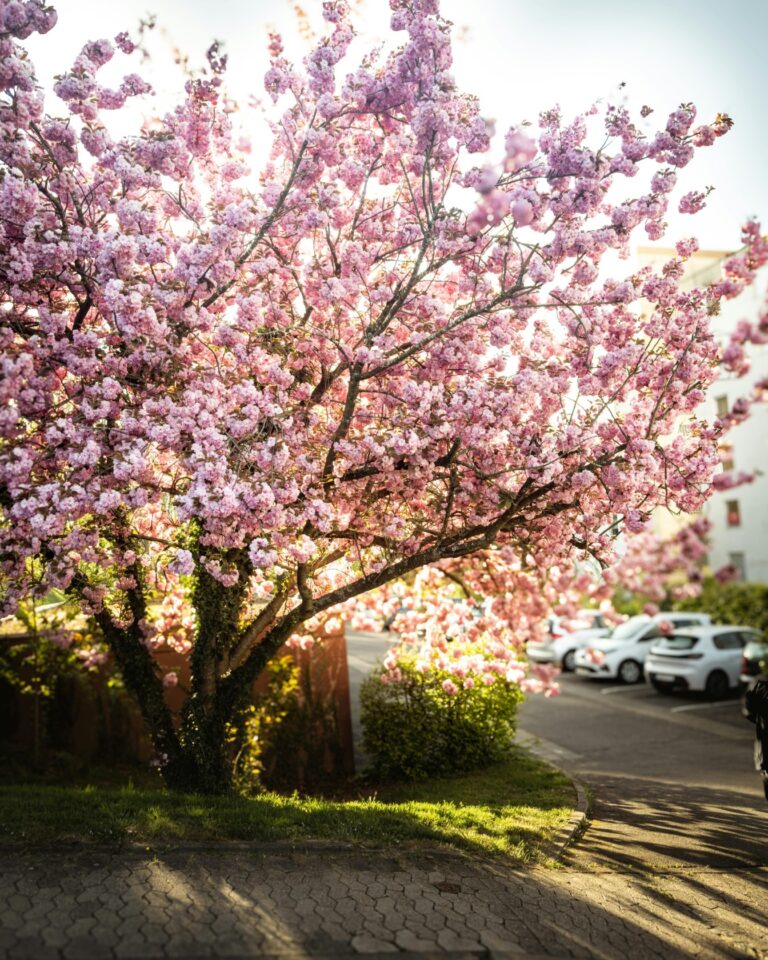
Flower Colour: Pure white, single, five-petalled flowers approximately 1.25 inches in diameter. The flowers open from pale pink buds, creating a brief two-tone effect as the display begins. They are carried in clusters along the ascending branches, distributed along the full length of the canopy rather than concentrated at the tips.
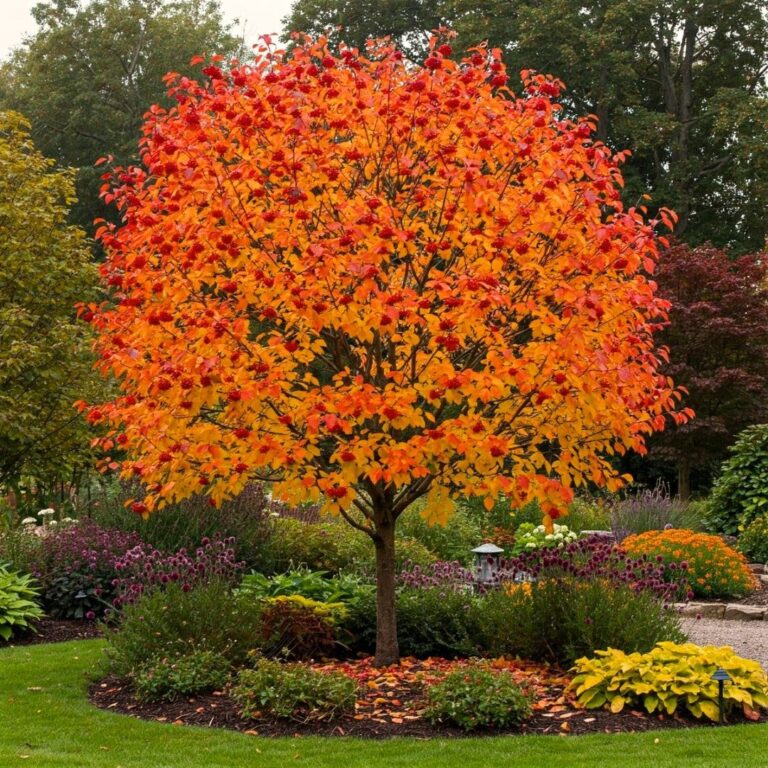
Foliage: Large, oval to elliptic leaves with sharply serrated margins. Young foliage emerges with a strong bronze-red flush that is particularly vivid in Umineko — more pronounced than in many other ornamental cherry cultivars. As the season advances, the leaves mature to a deep, lustrous green. Autumn colour is outstanding — intense shades of orange, crimson, and red that place this tree among the top ornamental cherries for late-season interest.
Bark: Smooth, grey-brown to reddish-brown with the characteristic horizontal lenticels of the cherry family. As the tree matures, the bark develops a warm, polished appearance that contributes positively to the winter garden.
Fruit: Small, dark purple to black cherries that develop after flowering and provide food for birds in summer.
USDA Hardiness Zones: 5 to 8, making it adaptable across a wide range of temperate climates.
Lifespan: Typically 20 to 40 years in landscape settings — somewhat longer-lived than many Japanese flowering cherry cultivars, reflecting the vigour inherited from its Prunus speciosa parentage.
Origins and Parentage
Understanding Umineko’s hybrid origins helps explain what makes it exceptional.
Parent one: Prunus incisa (Fuji Cherry). This small, cold-hardy Japanese species grows on the slopes of Mount Fuji and contributes early bloom potential, cold hardiness, strongly serrated leaf margins, and excellent autumn colour to its hybrid offspring. Prunus incisa is also a parent of the Okame Cherry and the dwarf Kojo-no-mai, both of which share its characteristic sharp-toothed leaves and reliable seasonal performance.
Parent two: Prunus speciosa (Oshima Cherry). The Oshima Cherry is a larger, more vigorous species native to the Izu Peninsula and Oshima Island in Japan. It contributes strong growth vigour, large leaves, white flowers, and the upright habit that defines Umineko’s distinctive form. Prunus speciosa is also an important parent in the development of many sato-zakura Japanese flowering cherry cultivars.
The hybrid ‘Umineko’ combines the best ornamental qualities of both parents: the upright form and vigour of speciosa with the cold hardiness, fine leaf detail, and brilliant autumn colour of incisa. It was selected specifically for landscape use — a tree large enough to make a structural statement, narrow enough to fit a range of planting situations, and ornamentally valuable across multiple seasons.
Why Choose Umineko Cherry?
For gardeners and landscape professionals evaluating upright ornamental cherries, the case for Umineko rests on several clear strengths.
The upright form is the most structural available among white-flowered cherries. The ‘Amanogawa’ cultivar (Prunus serrulata ‘Amanogawa’) is narrower but smaller — typically reaching 20 to 25 feet. Umineko is taller, more vigorous, and has a more naturally refined upright outline that does not require management to maintain. For situations requiring a tall, white-flowered, columnar tree, it is the primary choice.
The white flowers suit the widest range of garden palettes. Deep pink cherries — ‘Kanzan’, ‘Okame’ — demand careful colour coordination. White flowers are universally compatible, working equally well with cool and warm schemes, with pale bulb plantings, with silver foliage, and with the natural greens of grass and hedging.
The autumn colour is outstanding. This is Umineko’s most underreported quality. Among ornamental cherries grown primarily for spring blossom, autumn colour is often modest or unreliable. Umineko delivers consistently vivid orange-crimson-red autumn colour that ranks with the best in the genus — a quality directly inherited from its Prunus incisa parent.
The vigour supports faster establishment. In landscape planting, where trees are often expected to make an impact within three to five years, the moderate-to-fast growth rate of Umineko is a practical advantage. It reaches flowering maturity relatively quickly and develops its columnar profile clearly within the first decade.
It provides reliable wildlife value. Single white flowers — fully functional, with accessible pollen and nectar — support early-season pollinators including bees, hoverflies, and butterflies. The small fruits that follow feed birds in early summer.
Ideal Growing Conditions
Sunlight
Full sun is essential. Umineko Cherry requires a minimum of six hours of direct sunlight daily. Eight or more hours produces the strongest growth, the most prolific flowering, the most vivid bronze foliage emergence in spring, and the most intense autumn colour.
The naturally upright form of Umineko means it casts relatively little shade compared to broad-spreading trees — a practical advantage in restricted planting positions. However, the tree itself needs full sky exposure to perform at its best.
In shaded positions, flowering is reduced, the upright form may become loose and uneven, and autumn colour — which requires adequate summer sun to develop — is noticeably less intense.
Soil
Umineko performs best in moist, well-drained, moderately fertile soil with a slightly acidic to neutral pH (5.5 to 7.0). It adapts to loamy, sandy-loam, and well-drained clay-loam soils and shows reasonable tolerance of a range of soil conditions — a strength inherited from the adaptable Prunus speciosa parentage.
Waterlogged soil is the most serious threat. Root rot in poorly drained conditions leads to progressive canopy dieback and early tree death. This is the single most important soil consideration for any Prunus species, and Umineko is no exception. Confirm adequate drainage before planting.
The tree shows reasonable tolerance of urban soil conditions — modest compaction, variable pH, and reduced organic matter — making it a practical choice for streetscape and public realm planting in suitable climates.
Water
Consistent moisture is important during establishment — the first two to three growing seasons after planting. Water deeply and infrequently to encourage deep root development rather than shallow surface root dependence.
Once established, Umineko has good drought tolerance compared to many ornamental cherry cultivars — again reflecting the adaptability of its parent species. In periods of extended summer drought, supplemental irrigation maintains tree health and supports flower bud formation for the following spring.
Avoid overhead irrigation, which wets foliage and flowers and promotes the fungal diseases — particularly brown rot blossom blight — that affect ornamental cherries in cool, wet conditions.
Climate
Hardy in USDA Zones 5 to 8. The cold hardiness inherited from Prunus incisa makes it more robust in colder climates than many Prunus serrulata cultivars. In Zone 5, it tolerates winter temperatures to approximately -20°F (-29°C) reliably.
Late spring frosts can damage open flowers — a risk for mid-April-blooming trees in gardens with unpredictable late-season cold. The tree is not harmed; only the flowers are affected in frost years. A slightly sheltered or south-facing position reduces this risk without compromising the sunlight requirements.
Planting Instructions
Best planting time: Early spring before bud break, or autumn after leaf drop. Container-grown stock can be planted throughout the growing season with consistent irrigation.
Site planning: At maturity, Umineko reaches 25 to 35 feet in height with a spread of 12 to 18 feet. Confirm that overhead clearance — power lines, building eaves, overhanging structures — is adequate for this mature profile before selecting the planting position. The upright form makes it more forgiving than spreading trees in terms of lateral clearance, but vertical clearance matters.
Planting hole: Dig a hole two to three times wider than the root ball, and only as deep as the root ball height. Set the tree so the root flare — where the trunk base widens — sits at or very slightly above the surrounding soil grade. Never bury the root flare; deep planting is one of the most consistent and damaging mistakes in ornamental cherry establishment.
Backfill: Use the original excavated soil without fertiliser or rich compost in the hole. This prevents the “pot effect” and encourages the roots to explore the surrounding native soil.
Staking: Young Umineko trees, particularly in exposed or windy positions, benefit from temporary staking to prevent wind rocking during establishment. Use a single, low stake with flexible ties. Remove the stake after the first growing season — long-term staking weakens trunk wood and root anchorage.
Mulching: Apply 2 to 3 inches of organic mulch over the root zone, keeping a 6-inch clearance around the trunk. Mulch conserves soil moisture, suppresses competing vegetation, and moderates soil temperature — all particularly beneficial in the first years after planting.
Initial watering: Water thoroughly at planting. Maintain consistent moisture through the entire first growing season.
Fertilisation
Umineko does not require intensive or frequent feeding. In reasonably fertile garden soil, a single spring application of balanced slow-release fertiliser — a 10-10-10 formulation or a dedicated tree and shrub product — is adequate.
Avoid high-nitrogen fertilisers. Excess nitrogen promotes rapid, soft vegetative growth at the cost of flower production and makes the tree more attractive to aphids and more vulnerable to fungal diseases.
A late-summer low-nitrogen feed can support flower bud development and improve the following spring’s floral display and autumn colour intensity — particularly useful in the first few years while the tree is building its root system and energy reserves.
Pruning
Umineko Cherry develops its naturally upright, columnar form without intervention and requires minimal pruning when given adequate space. The primary objectives are health maintenance and structural integrity — not reshaping.
Prune immediately after flowering — late spring, as the last blossoms fade in May. This preserves next season’s flower buds, which develop on current-year growth through summer and autumn, and minimises wound exposure during the cooler, wetter months.
Begin with the three Ds: remove dead, damaged, and diseased wood, cutting cleanly just outside the branch collar. Then thin any crossing branches from the interior of the canopy to maintain airflow.
Do not cut back to restrict the upright form. The columnar habit is genetically determined and will reassert itself after any cutting. Heavy corrective pruning creates multiple large wounds that are entry points for silver leaf disease, bacterial canker, and borers — and ultimately produces a less healthy and less beautiful tree.
Monitor for basal suckers arising from the rootstock. These should be removed promptly at ground level to prevent competition with the grafted canopy and to maintain the tree’s intended form.
Pests and Diseases
Umineko Cherry shares the pest and disease profile of the Prunus genus. Its hybrid vigour provides reasonable resilience, but standard monitoring and preventive practices are valuable.
Common Pests
Aphids — particularly cherry blackfly — are the most routine spring pest, clustering on new growth and causing leaf curl and sticky deposits. Natural predators manage most infestations effectively; insecticidal soap or strong water sprays handle heavier populations.
Tent caterpillars build silk nests in branch forks in spring and can strip sections of the canopy. Manual removal or Bacillus thuringiensis (Bt) applications while larvae are young are the most effective controls.
Leafhoppers and scale insects can establish in warm, humid conditions. Horticultural oil applied during the dormant season controls scale effectively.
Common Diseases
Brown rot blossom blight (Monilinia spp.) is the most practically significant disease for the spring flowering display. Cool, damp conditions in April and May promote rapid browning and collapse of open flowers. Good air circulation, an open planting position, and avoidance of overhead irrigation are the primary preventive measures. Fungicide applications at pink bud stage can protect the display in high-pressure years.
Silver leaf disease (Chondrostereum purpureum) enters through pruning wounds and bark injuries. Prune only in dry weather, sterilise tools between cuts, and minimise bark wounding to reduce infection risk.
Bacterial canker (Pseudomonas syringae) causes dark, sunken lesions on bark and progressive branch dieback, most common after cold, wet spring conditions. Prune in dry weather and protect bark from mechanical damage.
Black knot (Apiosporina morbosa) produces hard, elongated black galls on branches. Remove infected material promptly, cutting at least 4 inches below visible symptoms, and destroy — do not compost — the affected wood.
Landscape Uses and Design Applications
The tall, upright form of Umineko Cherry opens design applications that few other ornamental cherries can serve.
As a tall vertical accent, Umineko provides the kind of upward emphasis that draws the eye, marks significant points in a garden, and creates depth in a planting composition. A single specimen at the end of a vista, at a garden entrance, or at the corner of a building creates a strong structural statement that persists across all four seasons.
In avenue and formal row plantings, the uniformly upright habit of Umineko creates a cleaner, more precise effect than broad-spreading cherries in formal allée settings. A double row along a path or driveway creates a vertical corridor of white spring blossom that is elegant, proportionate, and visually powerful without the sprawling footprint of wider-canopy cherries.
In urban streetscape plantings, the narrow upright profile makes Umineko one of the most practical ornamental flowering trees for street tree applications — fitting overhead utility clearances, pavement widths, and restricted planting strips that exclude broader trees. Its reasonable tolerance of urban soil conditions reinforces this suitability.
In mixed ornamental plantings, it serves as a tall structural element — providing height and vertical contrast against lower-growing shrubs, perennials, and ground covers. In spring, the white flower columns contrast effectively with the deeper pinks of companion flowering shrubs; in autumn, the orange-crimson foliage provides a warm backdrop to late-season plantings.
Combined with spring bulbs — white tulips, pale narcissus, blue camassia — beneath and around the base, the white flowers of Umineko create a vertically unified white and blue-white scheme that is one of the most refined combinations in spring planting design.
Seasonal Calendar
April–early May: Peak flowering. Pure white single flowers open from pale pink buds along the full length of the upright branches. Vivid bronze-red young foliage begins to emerge as the later flowers are open, creating the characteristic spring overlap of flower and coloured leaf.
Late May–September: Full summer canopy of large, deep green lustrous leaves. The upright form casts dappled shade in a defined vertical footprint. Small dark fruits ripen and attract birds in June and July.
October–November: Outstanding autumn colour — intense orange, crimson, and red tones develop across the canopy before leaf drop. This is the tree’s second major ornamental season, and it is genuinely spectacular in a good year.
December–March: Bare branches reveal the clean, upright branch architecture and the warm-toned reddish-brown bark with its horizontal lenticels. The structural winter silhouette is architecturally clear and distinctive.
Frequently Asked Questions
How does Umineko compare to ‘Amanogawa’ for narrow garden planting? ‘Amanogawa’ (Prunus serrulata ‘Amanogawa’) is narrower — typically 4 to 8 feet wide — and stays shorter at 20 to 25 feet. It has pale pink, semi-double, fragrant flowers.
Umineko is taller (25 to 35 feet), slightly wider (12 to 18 feet), and has pure white single flowers with better autumn colour. For very tight spaces, ‘Amanogawa’ is the more compact option; for larger, more structural situations requiring white flowers, Umineko is the stronger choice.
Is it suitable for small gardens? With a mature spread of 12 to 18 feet, it is not a tree for very small gardens. In medium-sized gardens with clear overhead space, a single specimen can be accommodated if given adequate vertical clearance. For genuinely small spaces, ‘Amanogawa’ or ‘Kojo-no-mai’ are more appropriate.
Why is the young foliage bronze-red? The bronze-red colouration of young leaves is caused by anthocyanin pigments — the same pigments responsible for autumn red and purple colours. In young leaves, anthocyanins protect delicate developing tissue from UV radiation. In Umineko, this colouration is particularly pronounced, a quality inherited from its Prunus incisa parent.
How long does the bloom last? Peak flowering typically lasts ten to fourteen days. Cool conditions extend the display; warm, dry conditions accelerate petal fall. The full flowering period from first bud to last petal spans approximately two to three weeks.
Does it produce edible fruit? The small dark cherries are edible but not cultivated for eating — they are small, tart, and stone-heavy. Their primary value is as wildlife food, attracting birds to the garden in early summer.
Final Thoughts
The Umineko Cherry is, to my mind, one of the most complete ornamental trees in temperate horticulture. It is structurally distinctive, seasonally generous, ecologically valuable, and practically adaptable — a combination that relatively few ornamental trees can genuinely claim.
It blooms white in spring. It colours vivid orange and red in autumn. It stands tall and clean through winter. And it does all of this in a footprint narrow enough to fit in planting situations that would exclude most comparable trees.
For designers and gardeners who want a white-flowered, upright ornamental cherry that performs across all four seasons and contributes genuinely to the garden year — not just the fortnight in April — the Umineko Cherry deserves serious consideration.
Plant it in full sun with good drainage, give it space to achieve its full height, and position it where both the spring flowers and the autumn colour can be appreciated at their best. Few trees will reward that investment more completely.
References
- University of Connecticut Plant Database – Prunus Hybrid Cultivars https://hort.uconn.edu/detail.php?pid=296
- Arnold Arboretum of Harvard University – Cherry Collection: Ornamental Cherry Hybrids and Cultivars https://arboretum.harvard.edu/plants/highlighted-plants-and-collections/cherry-collection/
- Virginia Tech Dendrology – Prunus incisa and Prunus speciosa Fact Sheets https://dendro.cnre.vt.edu/dendrology/syllabus/factsheet.cfm?ID=105
- Pennsylvania State University Extension – Ornamental Cherry Tree Selection, Planting, and Care https://extension.psu.edu/ornamental-cherry-trees

Tim M Dave is a gardening expert with a passion for houseplants, particularly cacti and succulents. With a degree in plant biology from the University of California, Berkeley, he has vast experience in gardening. Over the years, he has cultivated a vast collection of desert plants and learned a great deal about how to grow and care for these unique companions.