20 Types of Arborvitae Trees: Visual Identification,Sizes, and Uses
Arborvitae — Latin for “tree of life” — is one of the most versatile and widely planted groups of evergreen trees and shrubs in the world. Whether you are looking for a towering privacy screen, a compact foundation plant, or a dwarf accent shrub for a container, there is an arborvitae variety perfectly suited for your landscape.
I have spent years watching gardeners underestimate just how diverse this plant family truly is. Most people know one or two varieties. But once you explore the full range, you quickly realize that arborvitae offers solutions for nearly every landscaping challenge imaginable.
This guide covers 20 distinct types of arborvitae trees — their characteristics, sizes, ideal uses, and what makes each one unique.
Quick Overview: Why Arborvitae?
Before diving into each variety, it helps to understand what makes arborvitae such a cornerstone of residential and commercial landscaping.
Arborvitae belong to the genus Thuja, which includes five recognized species native to North America and East Asia.
Most garden varieties derive from either Thuja occidentalis (Eastern arborvitae) or Thuja plicata (Western red cedar), with a handful coming from hybrids or Thuja orientalis (now classified as Platycladus orientalis).
Their appeal comes down to a few key qualities:
- Year-round color — deep green foliage even in winter
- Dense growth habit — ideal for privacy and wind protection
- Relatively low maintenance once established
- Wide range of sizes — from 2-foot dwarfs to 70-foot giants
- Adaptability across a broad range of climates and soil types
| Variety | Mature Height | Mature Width | Hardiness Zone | Best Use | |
| 1 | Thuja Green Giant | 40–60 ft | 12–20 ft | 5–9 | Privacy screen, windbreak |
| 2 | Emerald Green (Smaragd) | 10–15 ft | 3–4 ft | 3–8 | Narrow hedge, foundation |
| 3 | Eastern Arborvitae | 20–40 ft | 10–15 ft | 3–8 | Specimen, wildlife habitat |
| 4 | Western Red Cedar | 50–70 ft | 15–25 ft | 5–9 | Large landscape, timber |
| 5 | American Pillar | 20–30 ft | 3–5 ft | 4–9 | Columnar screen |
| 6 | Techny (Mission) | 10–15 ft | 5–8 ft | 3–7 | Wind protection, hedge |
| 7 | Nigra (Dark American) | 20–30 ft | 4–6 ft | 3–7 | Winter color, screen |
| 8 | Rheingold | 3–5 ft | 3–5 ft | 3–7 | Accent, container |
| 9 | Mr. Bowling Ball | 2–3 ft | 2–3 ft | 3–8 | Border, rock garden |
| 10 | Holmstrup | 6–8 ft | 2–3 ft | 3–7 | Narrow formal hedge |
| 11 | Steeplechase | 30–35 ft | 8–10 ft | 5–9 | Fast privacy hedge |
| 12 | Spring Grove | 25–30 ft | 12–15 ft | 5–8 | Broad privacy screen |
| 13 | Degroot’s Spire | 10–15 ft | 2–3 ft | 3–8 | Tight columnar accent |
| 14 | Sunkist | 5–6 ft | 4–5 ft | 3–7 | Golden accent shrub |
| 15 | Yellow Ribbon | 8–10 ft | 2–3 ft | 3–7 | Gold columnar accent |
| 16 | Tiny Tim | 2–3 ft | 3–4 ft | 3–8 | Dwarf border shrub |
| 17 | Golden Globe | 3–4 ft | 3–4 ft | 3–7 | Gold globe accent |
| 18 | Aurea Nana | 3–5 ft | 2–3 ft | 6–11 | Warm-climate accent |
| 19 | North Pole | 10–15 ft | 3–4 ft | 3–7 | Small-space privacy |
| 20 | Filiformis (Whipcord) | 6–8 ft | 4–6 ft | 5–8 | Texture, unique accent |
Different Types of Arborvitae Trees
Now, let us explore each variety in detail.
1. Thuja Green Giant (Thuja standishii × plicata)
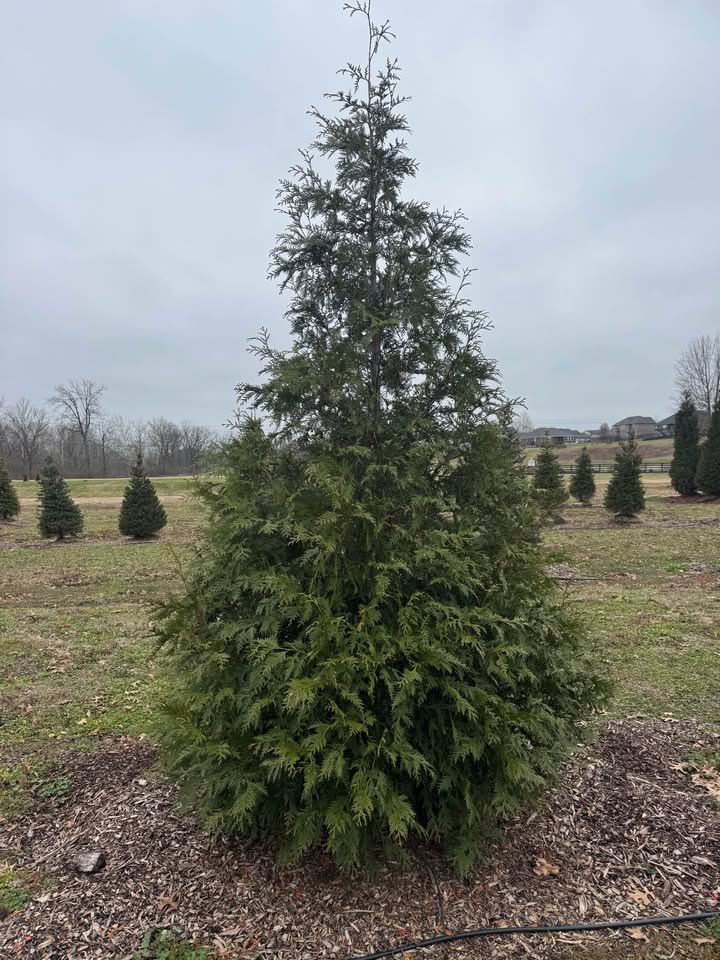
The undisputed champion of privacy trees. Thuja Green Giant is a hybrid between Japanese arborvitae and Western red cedar. It grows an impressive 3–5 feet per year under ideal conditions.
- Mature size: 40–60 feet tall, 12–20 feet wide
- Zones: 5–9
- Foliage: Rich, dark green with a slight glossy sheen; holds color well in winter
- Best use: Large privacy screens, windbreaks, noise barriers
What sets it apart from other tall varieties is its resistance to deer browsing, bagworms, and many common diseases. It tolerates a wide range of soils and is highly adaptable. If you are planting a large-scale privacy hedge, this is almost always the top recommendation.
2. Emerald Green Arborvitae (Thuja occidentalis ‘Smaragd’)
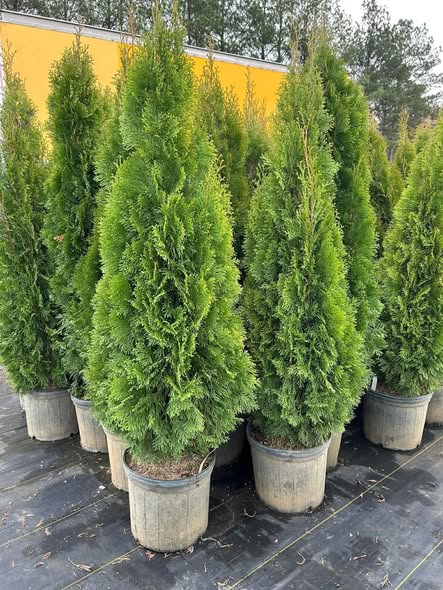
Originally bred in Denmark, Emerald Green (also called Smaragd) is one of the most popular landscaping plants sold in North America. And for good reason.
- Mature size: 10–15 feet tall, 3–4 feet wide
- Zones: 3–8
- Foliage: Bright emerald green, maintains color exceptionally well through winter
- Best use: Narrow hedges, foundation plantings, formal garden borders
Its tight, pyramidal form requires little to no pruning, which makes it a favorite for low-maintenance landscapes. Unlike some arborvitae varieties that turn bronze or yellow in winter, Emerald Green stays true to its name throughout all four seasons.
One word of caution: it is more susceptible to deer browsing than Green Giant, especially in northern regions.
3. Eastern Arborvitae (Thuja occidentalis)
This is the native species from which most cultivated varieties have been developed. It grows naturally across eastern North America, from Nova Scotia to the Appalachian Mountains.
- Mature size: 20–40 feet tall, 10–15 feet wide
- Zones: 3–8
- Foliage: Medium green, may bronze slightly in winter
- Best use: Naturalized settings, wildlife habitat, specimen planting
Eastern arborvitae is incredibly cold-hardy and adaptable. It thrives in wet, swampy soils where few other conifers survive. In fact, it is frequently found growing along stream banks and in boggy areas in its native range — a useful reminder that it tolerates moisture better than many evergreens.
4. Western Red Cedar (Thuja plicata)
Despite its common name, Western red cedar is a true arborvitae — not a cedar at all. It is one of the largest trees in the Pacific Northwest, where it can live for over 1,000 years in the wild.
- Mature size: 50–70 feet tall, 15–25 feet wide
- Zones: 5–9
- Foliage: Glossy, dark green with a distinctly aromatic, cedar-like scent
- Best use: Large landscapes, timber production, windbreaks, specimen trees
The foliage and wood of Western red cedar are naturally resistant to decay and insects, which has made it a prized timber species for centuries. In the landscape, it works beautifully as a large-scale screen or backdrop tree. It prefers moist, deep soils and does not tolerate prolonged drought well.
5. American Pillar Arborvitae (Thuja occidentalis ‘American Pillar’)
American Pillar was developed specifically to address one of the most common landscaping needs: a tall, narrow screen for tight spaces.
- Mature size: 20–30 feet tall, 3–5 feet wide
- Zones: 4–9
- Foliage: Dark green, dense, with a slightly formal appearance
- Best use: Columnar screens along fences, driveways, and property lines
It grows faster than Emerald Green and maintains a naturally columnar shape without much pruning. This variety handles cold and wind exceptionally well, making it an excellent choice for exposed sites in northern climates.
Many landscape architects favor it for urban settings where space is limited but height is needed.
6. Techny Arborvitae (Thuja occidentalis ‘Techny’ / ‘Mission’)
Techny (also called Mission arborvitae) was selected at a nursery in Techny, Illinois — a telling origin story that explains its exceptional cold-hardiness and wind tolerance.
- Mature size: 10–15 feet tall, 5–8 feet wide
- Zones: 3–7
- Foliage: Deep, dark green; holds color remarkably well in winter
- Best use: Windbreaks, wide hedges, cold and exposed locations
What makes Techny stand out is its broader, fuller form compared to most upright arborvitae. It is one of the best performers in the Upper Midwest, where harsh winters and strong prairie winds damage less resilient varieties.
The dark foliage color in winter is particularly attractive and rarely seen in other cold-hardy evergreens.
7. Nigra Arborvitae (Thuja occidentalis ‘Nigra’)
Nigra — Latin for “black” — gets its name from its exceptionally dark green winter foliage. It is one of the few arborvitae varieties that truly maintains a rich color throughout the coldest months.
- Mature size: 20–30 feet tall, 4–6 feet wide
- Zones: 3–7
- Foliage: Very dark green, densely packed, does not bronze in winter
- Best use: Privacy screens, windbreaks, northern gardens
Nigra grows in a naturally narrow pyramidal form and requires minimal maintenance. It is frequently planted as an alternative to Emerald Green where greater height is desired. For gardeners in Zones 3–5 who struggle with winter burn on arborvitae, Nigra is often the most reliable solution.
8. Rheingold Arborvitae (Thuja occidentalis ‘Rheingold’)
Rheingold is a slow-growing, compact arborvitae with some of the most striking foliage color in the entire genus.
- Mature size: 3–5 feet tall, 3–5 ft wide
- Zones: 3–7
- Foliage: Golden-amber in summer, deepening to rich copper-bronze in winter
- Best use: Accent planting, rock gardens, mixed borders, containers
It was introduced from Germany and has become a classic in landscape design for its year-round color interest. The rounded, slightly irregular form gives it a natural, almost cottage-garden quality. Rheingold is slow-growing enough that it rarely requires pruning and stays tidy with little intervention.
9. Mr. Bowling Ball Arborvitae (Thuja occidentalis ‘Bobazam’)
The name says it all. Mr. Bowling Ball is a perfectly round, naturally globe-shaped dwarf arborvitae that requires almost no pruning to maintain its form.
- Mature size: 2–3 feet tall, 2–3 feet wide
- Zones: 3–8
- Foliage: Fine-textured, medium green
- Best use: Low borders, edging, rock gardens, containers
This variety is beloved by landscape designers who want a low-maintenance, formally shaped plant without the labor of constant clipping. It is slower-growing than most arborvitae and stays genuinely small, which makes it suitable for urban gardens with limited space. It performs well even in partial shade.
10. Holmstrup Arborvitae (Thuja occidentalis ‘Holmstrup’)
Holmstrup is a refined, narrow, slow-growing columnar arborvitae originating from Denmark. It offers a more compact alternative to American Pillar where a moderate height is preferred.
- Mature size: 6–8 feet tall, 2–3 feet wide
- Zones: 3–7
- Foliage: Rich green with a slightly twisted, spiraling texture; good winter color
- Best use: Narrow formal hedges, flanking entryways, tight foundation beds
The foliage texture is notably attractive — slightly ruffled, giving it an almost sculptural quality. Holmstrup is an excellent choice for formal garden designs where clean lines and compact proportions are essential. It grows only about 6 inches per year, which is ideal when precise size control is important.
11. Steeplechase Arborvitae (Thuja plicata ‘Steeplechase’)
Steeplechase is a relatively newer introduction that offers faster growth than most other arborvitae while maintaining excellent disease resistance and deer tolerance.
- Mature size: 30–35 feet tall, 8–10 feet wide
- Zones: 5–9
- Foliage: Rich, glossy dark green; excellent winter color
- Best use: Fast privacy hedges, screening, large properties
It was developed as a more refined alternative to Thuja Green Giant, with a slightly narrower form and improved resistance to certain foliar diseases. For homeowners who need privacy quickly but want a cleaner, more uniform hedge than Green Giant, Steeplechase is an outstanding choice.
12. Spring Grove Arborvitae (Thuja plicata ‘Spring Grove’)
Spring Grove is a broad, pyramidal arborvitae with a fuller, more substantial form than most upright varieties. It was introduced by Spring Grove Cemetery and Arboretum in Cincinnati, Ohio.
- Mature size: 25–30 feet tall, 12–15 feet wide
- Zones: 5–8
- Foliage: Dark green, glossy, dense throughout the canopy
- Best use: Wide privacy screens, specimen trees, large foundation plantings
What distinguishes Spring Grove from other Thuja plicata selections is its exceptional fullness at the base. Many arborvitae tend to thin out near the lower branches as they mature. Spring Grove maintains dense foliage from crown to ground, which is an important quality for a privacy screen.
13. Degroot’s Spire Arborvitae (Thuja occidentalis ‘Degroot’s Spire’)
If you want maximum height with minimum width, Degroot’s Spire is perhaps the most columnar arborvitae available. It grows into a tight, spiraling spire with a distinctive twisted foliage texture unlike any other arborvitae.
- Mature size: 10–15 feet tall, 2–3 feet wide
- Zones: 3–8
- Foliage: Deep green with a unique spiraling twist; stays green in winter
- Best use: Tight columnar accents, flanking gates or doors, small-space screening
The spiraling foliage texture makes it a genuinely unique specimen plant. Many designers use Degroot’s Spire as a living architectural element — a vertical accent that adds structure and formality to a garden without consuming lateral space. Growth is moderate, reaching its mature form over 10–15 years.
14. Sunkist Arborvitae (Thuja occidentalis ‘Sunkist’)
Sunkist is a compact, golden-yellow arborvitae with a broad, rounded pyramidal form. It is one of the most colorful selections available in its size range.
- Mature size: 5–6 feet tall, 4–5 feet wide
- Zones: 3–7
- Foliage: Golden-yellow in full sun, especially vibrant in spring and early summer
- Best use: Golden accent shrub, mixed borders, foundation beds
The golden color intensifies with sun exposure and is most vivid in spring when new growth emerges. In partial shade, the color shifts toward a softer, lime-green tone. Sunkist holds its color better in winter than many golden arborvitae, making it one of the more reliable choices for year-round interest.
15. Yellow Ribbon Arborvitae (Thuja occidentalis ‘Yellow Ribbon’)
Yellow Ribbon takes the golden arborvitae concept and applies it to a taller, more columnar growing habit — making it useful for situations where vertical interest in a yellow-toned plant is desired.
- Mature size: 8–10 feet tall, 2–3 feet wide
- Zones: 3–7
- Foliage: Bright golden-yellow in spring and summer, softening in winter
- Best use: Golden columnar accent, narrow hedges with color interest
It grows more upright than Sunkist and is better suited for adding vertical color contrast along fence lines or in mixed shrub borders. The new growth each spring brings a particularly vivid flush of gold, making it a seasonal showstopper.
16. Tiny Tim Arborvitae (Thuja occidentalis ‘Tiny Tim’)
Tiny Tim lives up to its name. This is one of the smallest arborvitae varieties available, growing into a dense, nearly perfect ball with virtually no pruning required.
- Mature size: 2–3 feet tall, 3–4 feet wide
- Zones: 3–8
- Foliage: Fine-textured, bright to medium green
- Best use: Low borders, edging, front-of-border accents, containers
It is slightly wider than tall, giving it a flattened globe shape. Tiny Tim is exceptionally slow-growing, which is ideal for low-maintenance formal edging where consistent size and shape are priorities. It is also more tolerant of partial shade than many other arborvitae varieties.
17. Golden Globe Arborvitae (Thuja occidentalis ‘Golden Globe’)
Golden Globe combines compact, globe-shaped form with bright golden foliage — a combination that has made it one of the most popular dwarf arborvitae for four-season garden interest.
- Mature size: 3–4 feet tall, 3–4 feet wide
- Zones: 3–7
- Foliage: Bright golden-yellow in full sun; bronzes slightly in winter
- Best use: Golden accent, mass planting, containers, foundation beds
It is slightly larger and faster-growing than Mr. Bowling Ball, but still maintains a naturally rounded form with minimal intervention. In full sun, the golden color is genuinely eye-catching, particularly when used in contrast with dark green or blue-toned companion plantings.
18. Aurea Nana (Platycladus orientalis ‘Aurea Nana’)
Aurea Nana belongs to Platycladus orientalis — the Oriental arborvitae — rather than Thuja occidentalis. This distinction is important because Oriental arborvitae is more heat and drought-tolerant, making it better suited to southern and warm-climate gardens.
- Mature size: 3–5 feet tall, 2–3 feet wide
- Zones: 6–11
- Foliage: Golden-yellow, held in distinctive vertical, fan-like sprays
- Best use: Warm-climate accents, southern foundation beds, containers
The foliage arrangement is noticeably different from other arborvitae — the flat sprays are held vertically rather than horizontally, giving it a unique textural quality. For gardeners in the Deep South, Gulf Coast, or desert Southwest, Aurea Nana fills a niche that cold-hardier varieties cannot.
19. North Pole Arborvitae (Thuja occidentalis ‘Art Boe’)
North Pole is a relatively recent introduction that has quickly gained popularity for its exceptional cold-hardiness, narrow form, and reliable green winter color.
- Mature size: 10–15 feet tall, 3–4 feet wide
- Zones: 3–7
- Foliage: Rich green, maintains color well in winter with minimal browning
- Best use: Narrow privacy screens, small-property hedges, northern climates
It was developed specifically for northern gardens and has proven its reliability in USDA Zone 3 — one of the harshest growing environments in the continental United States. Unlike Emerald Green, which can brown significantly in exposed winter conditions, North Pole consistently holds its color even under heavy snow loads and freezing winds.
20. Filiformis (Whipcord) Arborvitae (Thuja plicata ‘Whipcord’)
Whipcord is one of the most architecturally unusual arborvitae varieties available. Rather than the typical flat, scaly sprays of foliage, Whipcord produces long, cord-like, pendulous branchlets that hang in dramatic, weeping cascades.
- Mature size: 6–8 feet tall, 4–6 feet wide
- Zones: 5–8
- Foliage: Dark green, thread-like, weeping habit; may bronze attractively in winter
- Best use: Unique textural accent, specimen planting, contemporary landscapes
This variety does not function as a privacy hedge or windbreak. It is purely a specimen plant — chosen for its dramatic, ornamental quality. It adds exceptional texture to modern and minimalist garden designs. Placed near boulders or alongside ornamental grasses, Whipcord creates striking visual contrast.
Choosing the Right Arborvitae for Your Landscape
With 20 varieties to choose from, it helps to narrow down your selection based on a few key factors:
1. Purpose
- Privacy hedge → Green Giant, Steeplechase, American Pillar, North Pole
- Accent plant → Rheingold, Sunkist, Golden Globe, Whipcord
- Dwarf border → Tiny Tim, Mr. Bowling Ball, Holmstrup
2. Size of your space
- Large property → Green Giant, Western Red Cedar, Spring Grove
- Medium garden → Techny, Nigra, American Pillar
- Small or urban garden → Emerald Green, Degroot’s Spire, Holmstrup
3. Climate zone
- Zones 3–4 (extreme cold) → North Pole, Techny, Nigra, Holmstrup
- Zones 5–8 (moderate) → Most varieties perform well
- Zones 8–11 (warm climates) → Aurea Nana, Green Giant, Steeplechase
4. Winter color retention
- Best color retention: Nigra, Techny, North Pole, Green Giant, Steeplechase
- Golden winter color: Rheingold (copper-bronze), Sunkist (gold)
General Care Principles for All Arborvitae Types
Regardless of the variety you select, a few core care principles apply across the board:
- Sunlight: Most arborvitae perform best in full sun (6+ hours daily). A few tolerate partial shade, but growth slows and density decreases.
- Soil: Well-drained, slightly acidic soil (pH 6.0–6.8) is ideal. Avoid planting in areas where water pools after rain.
- Watering: Deep, infrequent watering builds stronger root systems than frequent shallow watering. Newly planted trees need consistent moisture for the first 1–2 years.
- Fertilizing: A balanced, slow-release fertilizer in early spring is usually sufficient. Avoid over-fertilizing, which stimulates soft, disease-prone growth.
- Pruning: Prune lightly in late spring after new growth emerges. Never cut into old, brown, needle-free wood — arborvitae will not regenerate from bare wood.
- Spacing: Always give arborvitae room to grow to their mature width. Crowding leads to poor air circulation and increased disease pressure.
Final Thoughts
The sheer diversity within the arborvitae family is remarkable. From the towering Green Giant to the diminutive Tiny Tim, from rich emerald columns to golden globes and weeping cord-like specimens, there is genuinely an arborvitae for every garden and every purpose.
What I find most compelling about this plant group is its accessibility. These are not fussy, temperamental trees reserved for expert gardeners. With basic care and proper site selection, most arborvitae varieties will reward you with decades of beauty and function.
Take time to match the variety to your site conditions, your space, and your long-term goals. That single decision will matter more than anything you do afterward.
References
- NC State Extension — Thuja occidentalis (Eastern Arborvitae) https://plants.ces.ncsu.edu/plants/thuja-occidentalis/ (Detailed plant profile covering native range, growth habits, landscape uses, and cultivar notes for Eastern arborvitae.)
- University of Florida IFAS Extension — Thuja plicata: Western Red Cedar https://edis.ifas.ufl.edu/publication/ST621 (Authoritative fact sheet on Western red cedar covering site requirements, ornamental use, and ecological significance.)
- Penn State Extension — Selecting Trees and Shrubs for Windbreaks and Privacy Screens https://extension.psu.edu/selecting-trees-and-shrubs-for-windbreaks-and-privacy-screens (Practical guidance on selecting appropriate evergreen species including arborvitae for functional landscape uses.)
- Clemson Cooperative Extension — Arborvitae https://hgic.clemson.edu/factsheet/arborvitae/ (Comprehensive fact sheet on arborvitae culture, variety selection, pest management, and landscape design applications.)
- University of Connecticut Extension — Platycladus orientalis (Oriental Arborvitae) https://hort.uconn.edu/plants/p/plaori/plaori1.html (Plant profile covering the distinctive characteristics of Oriental arborvitae and its cultivation in warmer climates.)

Tim M Dave is a gardening expert with a passion for houseplants, particularly cacti and succulents. With a degree in plant biology from the University of California, Berkeley, he has vast experience in gardening. Over the years, he has cultivated a vast collection of desert plants and learned a great deal about how to grow and care for these unique companions.