Understanding Tulip Tree (Liriodendron tulipifera): Identification, Uses, Problems, and Full Growing Details
The first time most people truly notice a Tulip Tree, it is not because of the tree itself — it is because of the flowers. High up in the canopy, sometimes 60 or 70 feet above the ground, sit blooms that look almost too exotic to belong to a North American forest.
They are large, cup-shaped, and pale greenish-yellow with a band of orange at the base — remarkably similar, in both color and form, to a garden tulip. From a distance, they seem almost impossible. Up close, they are extraordinary.
The Tulip Tree (Liriodendron tulipifera), also known as the Yellow Poplar or Tulip Poplar, is not just beautiful. It is the tallest native hardwood tree in North America, a critical ecological species, and a historically important timber tree.
This guide covers everything you need to know — from identification and ecology to cultivation, timber use, and cultural history.
| Scientific Name | Liriodendron tulipifera L. |
| Common Names | Tulip Tree, Yellow Poplar, Tulip Poplar, Whitewood, Canoewood |
| Family | Magnoliaceae (Magnolia family) |
| Typical Height | 70–120 ft (21–37 m); exceptional specimens to 190 ft (58 m) |
| Trunk Diameter | 4–6 ft (1.2–1.8 m) on mature trees |
| Bark | Grayish-brown, deeply furrowed and interlaced on mature trees |
| Leaf Shape | Unique 4-lobed, saddle-shaped with flat or notched apex |
| Fall Color | Bright golden-yellow |
| Flowers | Tulip-like; greenish-yellow with orange band; 2–3 inches wide |
| Fruit | Cone-like aggregate of winged samaras |
| USDA Hardiness Zones | 4–9 |
| Soil Preference | Deep, moist, well-drained, slightly acidic loam |
| Light Requirement | Full sun to partial shade |
| Growth Rate | Fast — 2 to 3 ft (60–90 cm) per year when young |
| Lifespan | 200–500 years under ideal forest conditions |
What Is the Tulip Tree?
The Tulip Tree is a member of the Magnoliaceae — the magnolia family — one of the most ancient families of flowering plants on Earth.
This places it in distinguished botanical company. Its closest living relative is the Chinese Tulip Tree (Liriodendron chinense), found in China and Vietnam. The two species are remarkably similar, separated by millions of years and an ocean.
The genus name Liriodendron comes from the Greek words lirion (lily) and dendron (tree) — making it the “lily tree.” The species name tulipifera is Latin for “tulip-bearing.” Both names reference the same feature: those extraordinary flowers.
Despite the common names “Yellow Poplar” and “Tulip Poplar,” this tree is not a poplar at all. It belongs to an entirely different plant family. The name likely arose from the pale yellow color of its wood and possibly from a superficial resemblance to poplars in growth habit.
The name “Tulip Tree” is botanically more accurate and is increasingly preferred in both horticultural and scientific contexts.
Identification: How to Recognize the Tulip Tree
The Leaves — A Truly Unique Shape
The leaf of Liriodendron tulipifera is one of the most distinctive of any North American tree. It has four lobes arranged symmetrically, with the tip of the leaf cut flat across — or sometimes with a shallow notch — giving it a shape that resembles a cat’s face, a saddle, or an old-fashioned tuning fork. There is no other native North American tree with this leaf shape.
Leaves are 3 to 8 inches long and wide, bright green above and paler beneath. The petiole (leaf stem) is long — often 3 to 5 inches — which causes the leaves to flutter in light breezes, similar to aspen. In autumn, the foliage turns a clean, luminous golden-yellow — one of the finest autumn displays of any eastern forest tree.
Once you know this leaf shape, you will never misidentify a Tulip Tree again. It is unmistakable.
The Flowers
The flowers are borne in May to June, typically appearing after the leaves are fully open. Each bloom is 2 to 3 inches wide, cup-shaped, and held upright on the branch.
The petals are greenish-yellow with a distinctive orange or yellow-orange band near the base of each petal. There are usually six petals arranged in two whorls, with numerous stamens and pistils at the center.
The flowers are produced high in the canopy on mature trees, which means they are often unnoticed unless you are looking up at the right moment — or find fallen blooms on the ground beneath the tree in early summer.
On young, lower-branching specimens, however, the floral display can be genuinely spectacular.
The flowers produce abundant nectar and are an important resource for bees, hummingbirds, and butterflies.
The Fruit
After flowering, the tree produces a distinctive cone-like fruiting structure — technically an aggregate of winged seeds (samaras) arranged around a central axis. These fruiting cones are 3 to 4 inches long, light brown, and persist on the tree well into winter after the individual seeds have dispersed.
Their presence on bare winter branches is a reliable identification feature from a distance.
The Bark
On young trees, bark is smooth and grayish-green, developing distinct elongated lenticels. As the tree matures, the bark becomes deeply furrowed and interlaced in a diamond or ridge pattern, turning grayish-brown.
Old-growth Tulip Trees develop impressively thick, heavily textured bark that contributes to their majestic presence.
Overall Form
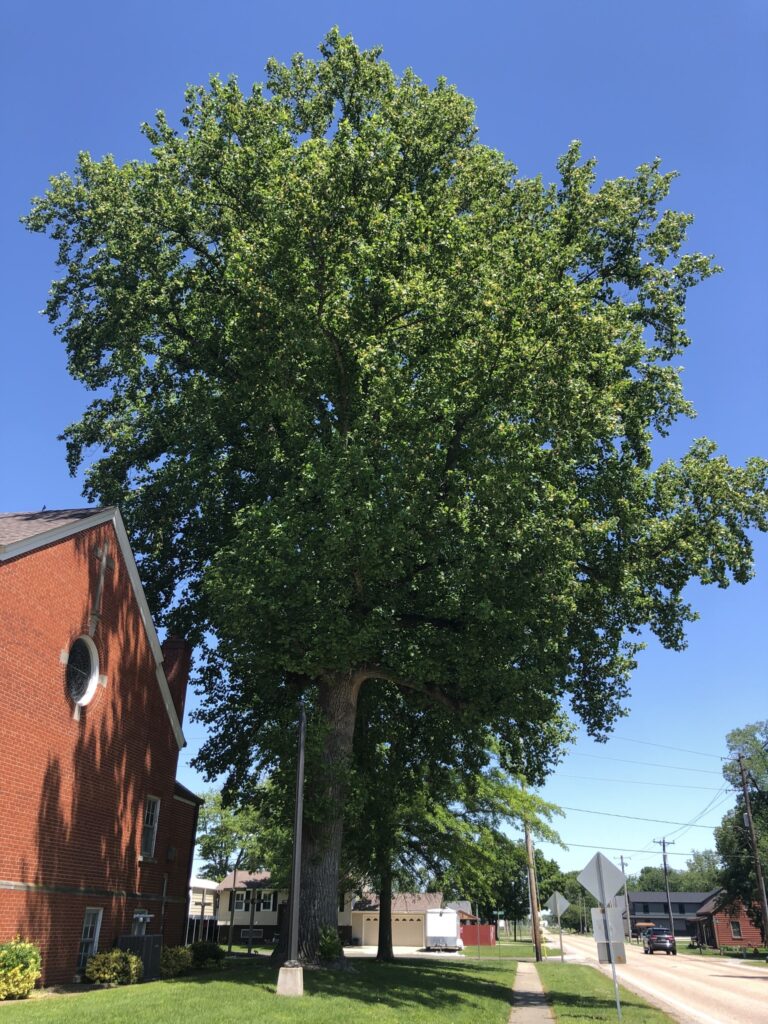
The Tulip Tree grows with a straight, columnar trunk — often clear of branches for 50 or more feet on forest-grown specimens — topped by an oblong to oval crown. This form is unusually geometric for a large deciduous tree, giving it an almost architectural quality in the landscape.
Open-grown trees develop a broader, more spreading crown, but the trunk typically remains impressively straight.
Native Range and Natural Habitat
Geographic Distribution
The Tulip Tree is native to eastern North America, with a range extending from:
- Southern Ontario (Canada) in the north
- Central Florida in the south
- Louisiana and Arkansas in the west
- The Atlantic Coast in the east
It reaches its greatest size and abundance in the southern Appalachian Mountains — particularly in the cove hardwood forests of Tennessee, North Carolina, and Virginia — where deep, rich, moist soils and high rainfall produce conditions close to ideal.
Some of the largest recorded specimens, including trees exceeding 150 feet in height, have been documented in these mountain coves.
Preferred Habitat
In the wild, Tulip Tree strongly prefers:
- Deep, rich, moist soils — particularly the well-drained alluvial and colluvial soils of slopes and coves
- Full sun to light shade in youth; full sun as a mature canopy tree
- Humid temperate climates with consistent rainfall
- Elevations from sea level to approximately 4,500 feet in the southern Appalachians
It is uncommon on poorly drained or very dry sites and does not naturally colonize wet, boggy ground. In the forest, it is primarily associated with mixed mesophytic forest — a complex, diverse forest type considered by many ecologists to be among the most species-rich in the temperate world.
Ecological Importance
Canopy Dominance and Forest Structure
In the forests of the central and southern Appalachians, Tulip Tree is a dominant canopy species — in some areas, the single most abundant large tree. Its height, its rapid growth, and its longevity allow it to define the upper canopy layer and shape the micro-environment for all species below it.
The straight, tall trunk and dense summer canopy of Tulip Tree create deep shade beneath mature trees, which significantly influences what grows in the forest understory. Its leaf litter decomposes relatively quickly, contributing to the nutrient cycling that makes these forests so productive.
Pollinator Value
The flowers of Liriodendron tulipifera are among the most important nectar sources in eastern North American forests. They produce large quantities of a high-sugar nectar that is eagerly sought by:
- Eastern Bumble Bees and other native bee species
- Ruby-throated Hummingbirds — Tulip Tree is one of their key nectar sources during the breeding season
- Swallowtail butterflies, particularly the Tiger Swallowtail (Papilio glaucus), which is often found nectaring at Tulip Tree flowers in May and June
Honey produced from Tulip Tree nectar — sometimes called “tulip poplar honey” — is dark amber, strongly flavored, and prized in southern Appalachian beekeeping traditions. It is one of the more distinctive regional honeys in North America.
Support for Invertebrates and Birds
The Tiger Swallowtail butterfly uses Tulip Tree as one of its primary larval host plants, laying eggs on the leaves whose caterpillars then feed on the foliage. This makes the Tulip Tree an important species for butterfly conservation in its native range.
Numerous wood-boring beetle species use dying or dead Tulip Tree wood, which in turn supports woodpeckers — including the Pileated Woodpecker (Dryocopus pileatus), one of North America’s largest and most impressive birds.
Cavity-nesting birds (owls, wood ducks, and small songbirds) use old Tulip Tree cavities as nesting sites.
Seeds are eaten by squirrels, finches, and small rodents, making the tree a multi-season food source in forest ecosystems.
Timber and Commercial Value
A Premium Native Hardwood
The wood of Liriodendron tulipifera — commercially known as “Yellow Poplar” — is one of the most economically important hardwoods in the eastern United States. It combines desirable properties that make it valuable across many applications:
- Lightweight yet strong: Among the lightest of the eastern hardwoods while retaining good workability and strength
- Fine, uniform texture: Machines, planes, and finishes well with clean edges
- Stability: Relatively low movement after drying, resisting warping and checking
- Color: Heartwood is typically pale greenish-yellow to brown, often with attractive mineral streaks of gray, green, or purple — sometimes marketed as “Rainbow Poplar” for decorative use
Historical Uses
The historical importance of Tulip Tree timber in North America is difficult to overstate. Native Americans used the straight trunks to carve dugout canoes — the tree’s original common name “Canoewood” reflects this use. European settlers quickly recognized the wood’s value and used it for:
- Log cabin construction — the straight, easily worked logs were ideal
- Furniture and cabinetry — particularly for secondary wood in fine furniture
- Musical instrument components — guitar bodies and backs, organ pipes
- Wooden ware — bowls, utensils, and containers
- Siding, flooring, and interior millwork
Daniel Boone reportedly used a large Tulip Tree as his campsite on at least one recorded occasion. George Washington planted Tulip Trees at Mount Vernon, where some of those original trees still stand today — living connections to the earliest years of the American republic.
Modern Commercial Use
Today, Yellow Poplar remains a commercially harvested timber species across the eastern United States. It is used for:
- Furniture frames and upholstered furniture components
- Doors, windows, and moulding
- Plywood and veneer
- Musical instruments (particularly guitar bodies)
- Pallets and crates
It is not typically used for outdoor structural applications, as it has limited natural durability against decay.
Cultivation and Landscape Use
Why Plant a Tulip Tree?
The Tulip Tree is one of the most rewarding large landscape trees available to gardeners in eastern North America and beyond. Its combination of features — distinctive leaves, spectacular flowers, superb autumn color, architectural form, fast growth, and ecological value — is unmatched by most comparable species.
It is best suited to large properties, parks, campuses, and naturalized areas where its eventual size (often 80 to 120 feet in cultivation) can be accommodated comfortably.
Climate and Hardiness
Rated for USDA Hardiness Zones 4 to 9, the Tulip Tree tolerates a wide climate range:
- Cold hardiness: Survives winters in Zone 4 (minimum around -30°F / -34°C)
- Heat tolerance: Performs well through the humid subtropics of Zone 9
- Humidity: Prefers humid conditions; performs less well in arid climates
- Wind: Best planted in sheltered or semi-sheltered positions — strong winds can cause branch breakage in large trees
Soil Requirements
For best performance, plant Tulip Tree in:
- Deep, moist, well-drained soil — it dislikes both drought and waterlogging
- Slightly acidic to neutral pH (5.5–7.0)
- Rich loamy soils with good organic matter content
The tree adapts to heavier clay soils if drainage is adequate, but consistently dry or shallow soils significantly limit its growth and longevity.
Planting and Care
- Position: Full sun is essential for best growth, flowering, and autumn color. Partial shade is tolerated when young.
- Spacing: Allow a minimum of 40 to 50 feet from structures, utilities, and other large trees.
- Watering: Deep, regular watering for the first three years is important. Established trees are reasonably drought-tolerant but show stress (early leaf drop) during severe dry spells.
- Mulching: A 3 to 4-inch layer of organic mulch over the root zone conserves moisture, moderates temperature, and reduces competition from grass — one of the most beneficial things you can do for a newly planted tree.
- Fertilizing: Minimal fertilization is typically needed. An application of balanced slow-release fertilizer in early spring can support young trees in poor soils.
- Pruning: Prune in late autumn or winter when dormant. The tree responds well to formative pruning when young. Avoid large pruning cuts on mature trees — wounds heal slowly and can invite decay.
Notable Cultivars
- ‘Aureomarginatum’ (also sold as ‘Flashlight’): Leaves edged with bright yellow margins — a striking variegated form that is slower-growing and more compact than the species. Excellent for smaller properties where a standard Tulip Tree would be too large.
- ‘Fastigiatum’ (Columnar Tulip Tree): A narrow, upright cultivar — ideal for formal plantings, avenues, and confined spaces. Retains the characteristic leaves and flowers in a more controlled form.
- ‘Arnold’: Selected for a consistently upright, columnar habit with good uniformity, widely used in street and institutional planting.
Common Pests and Diseases
Tulip Tree Aphid (Illinoia liriodendri)
This species-specific aphid feeds on the undersides of leaves, excreting large quantities of sticky honeydew. The honeydew drips onto surfaces below the tree and supports black sooty mold growth — a messy but generally harmless problem.
Aphid populations typically crash naturally in mid to late summer. Natural predators (ladybirds, lacewings, parasitic wasps) are usually sufficient for control without intervention.
Verticillium Wilt (Verticillium spp.)
This soil-borne fungal disease causes wilting, yellowing, and death of individual branches — progressing unpredictably through the canopy. There is no cure once a tree is infected. Affected branches should be removed promptly. Planting in well-drained soils and avoiding injury to roots reduces risk.
Fusarium Canker
Fungal cankers can develop on stems and branches, causing sunken, discolored areas that girdle and kill branches above the infection point. Trees stressed by drought, poor drainage, or mechanical damage are most vulnerable. Maintaining tree vigor through correct siting and care is the best prevention.
Powdery Mildew
A white powdery coating on leaves can occur during warm, dry periods, particularly in shaded or congested plantings. Rarely serious — improves naturally as weather conditions change.
Cultural and Historical Significance
Native American Uses
Several Native American nations valued the Tulip Tree extensively. The Cherokee used the bark medicinally — particularly the inner bark, which contains alkaloids with stimulant properties, used as a cardiac tonic.
The Creek, Iroquois, and Delaware peoples used different parts of the tree for medicinal preparations addressing fevers, rheumatism, and digestive conditions.
The straight, large-diameter trunks were prized above almost all other species for dugout canoe construction, in part because the tree’s large size meant that a single trunk could yield a wide, stable canoe without joints.
State Tree Status
The Tulip Tree holds the distinction of being the state tree of three U.S. states — Indiana, Kentucky, and Tennessee. This reflects its central importance to the culture, history, and landscape of the central and southern United States in a way that few other species can claim.
In American Garden History
Thomas Jefferson planted Tulip Trees at Monticello, and George Washington included them in the designed landscape at Mount Vernon. The tree was one of the first North American species introduced to European gardens in the late 17th century, where it was received with great enthusiasm.
European collectors and botanists considered it one of the finest ornamental trees from the New World — and that reputation has never really diminished.
Frequently Asked Questions
How fast does a Tulip Tree grow? Under good conditions, young Tulip Trees grow 2 to 3 feet per year — sometimes more on very rich, moist soils. Growth slows as the tree matures but remains steady throughout its long life.
When do Tulip Trees bloom? Flowers typically appear in May to June, after the leaves are fully open. On mature forest trees, the flowers are produced high in the canopy and may go unnoticed. Young, open-grown trees often flower at a lower height and produce a more visible display.
Is the Tulip Tree related to tulips? No. The name refers to the flower’s resemblance to a garden tulip, not any botanical relationship. Garden tulips are monocots in the family Liliaceae. The Tulip Tree is a dicot in the magnolia family (Magnoliaceae) — an entirely different lineage.
Does the Tulip Tree cause any problems in the landscape? The main landscape concerns are its large mature size, shallow surface roots that can lift paving over time, and significant aphid honeydew drop in midsummer. Planted with adequate space and in appropriate soil conditions, these issues are manageable.
Why do Tulip Tree leaves drop early in summer during dry years? The tree is sensitive to summer drought stress and responds by dropping a portion of its leaves early — sometimes as early as August — as a water conservation response. This is normal and not a sign of serious disease. Improved watering or mulching usually reduces this response.
Final Thoughts
There are trees that earn their place in the landscape, and there are trees that seem born to dominate it. The Tulip Tree is the latter. It grows tall, straight, and fast. It flowers in a way that makes you feel the forest is showing off.
It turns gold in autumn with a reliability and warmth that few species match. And it supports a web of ecological relationships — from Tiger Swallowtails to Ruby-throated Hummingbirds to Pileated Woodpeckers — that make it irreplaceable in the eastern North American forest.
If you have the space for a large tree and live within its climate range, the Tulip Tree is one of the finest planting decisions you can make. It will outlast you, shade your descendants, and feed the forest around it for centuries. That is not a small thing. It is, in fact, exactly what a great tree should do.
References
- Virginia Tech Dendrology — Liriodendron tulipifera Fact Sheet College of Natural Resources and Environment, Virginia Tech University https://dendro.cnre.vt.edu/dendrology/syllabus/factsheet.cfm?ID=325
- University of Florida IFAS Extension — Liriodendron tulipifera: Tulip Tree Environmental Horticulture Department, UF/IFAS https://edis.ifas.ufl.edu/publication/ST371
- North Carolina State University Extension — Liriodendron tulipifera Plant Profile NC State Extension Plants, College of Agriculture and Life Sciences https://plants.ces.ncsu.edu/plants/liriodendron-tulipifera/
- Missouri Botanical Garden Plant Finder — Liriodendron tulipifera Shaw Nature Reserve and Missouri Botanical Garden https://www.missouribotanicalgarden.org/PlantFinder/PlantFinderDetails.aspx?kempercode=c271
- University of Kentucky Cooperative Extension — Native Trees of Kentucky: Tulip Poplar College of Agriculture, Food and Environment, University of Kentucky https://www.uky.edu/hort/Tulip-Poplar

Tim M Dave is a gardening expert with a passion for houseplants, particularly cacti and succulents. With a degree in plant biology from the University of California, Berkeley, he has vast experience in gardening. Over the years, he has cultivated a vast collection of desert plants and learned a great deal about how to grow and care for these unique companions.