15 Stunning Trees with Yellow Flowers: Perfect Picks to Brighten Your Landscape
Yellow-flowering trees bring a burst of color to any garden. Their golden blooms stand out against green foliage, attracting pollinators like bees and butterflies. Whether you’re in a warm, tropical climate or a cooler region, there’s likely a variety that fits your yard.
Below, I’ve highlighted 15 standout trees known for their beautiful yellow flowers, with details on their key features to help you choose the right one.
1. Golden Chain Tree (Laburnum × watereri)
Scientific name: Laburnum × watereri (a hybrid, often ‘Vossii’ cultivar for the best blooms).
USDA Zones: 5–7 (it prefers cooler summers and can struggle in very hot, humid areas).
Color variation: Primarily bright golden-yellow; the flowers are pea-like and hang in dense, fragrant clusters.
Sun exposure: Full sun to partial shade— it needs at least 6 hours of direct sunlight for abundant flowering.
Mature size: Typically 15–30 feet tall and 10–20 feet wide, with a spreading, vase-shaped habit.
Lifespan: Around 30–50 years with good care, though it can live longer in ideal conditions.
Toxicity: Highly toxic— all parts, especially the seeds and pods, contain poisonous compounds. Keep it away from children, pets, and livestock, as ingestion can cause severe illness or even be fatal.
Imagine walking under an archway dripping with long chains of bright yellow flowers in late spring— that’s the magic of the golden chain tree. This deciduous tree puts on one of the most dramatic floral displays among flowering trees. Its pendulous clusters (called racemes) can reach up to 24 inches long, cascading like golden waterfalls from its branches.
This tree is often trained over arbors or pergolas to create a tunnel of blooms. Prune lightly after flowering to maintain shape, and protect young trees from strong winds. Soil should be well-drained and moderately fertile; it doesn’t tolerate wet feet.
While the flowers attract bees, the overall display is short-lived, often lasting 2–4 weeks. Pair it with evergreens for contrast, and you’ll have a spot that feels like a secret garden. Just remember the safety concerns— many admirers plant it in adult-only gardens or far away from play areas due to toxicity.
2. Caribbean Trumpet Tree (Tabebuia aurea, also known as Silver Trumpet Tree)
Scientific name: Tabebuia aurea (sometimes classified under Handroanthus).
USDA Zones: 9–11 (excellent for Florida, southern California, and similar warm areas).
Color variation: Rich golden-yellow trumpets, sometimes with a silvery sheen on emerging leaves.
Sun exposure: Full sun— it demands bright light to bloom profusely.
Mature size: 20–40 feet tall and 15–30 feet wide, with an upright, spreading form.
Lifespan: 50–100 years or more in frost-free environments.
Toxicity: Generally non-toxic to humans and pets, though not edible.
In tropical and subtropical landscapes, few trees announce spring quite like the Caribbean trumpet tree. When it blooms, the entire canopy turns into a mass of glowing yellow trumpets. This comes before new leaves emerge, creating a pure golden hue against the sky.
Caribbean Trumpet tree is a favorite in coastal gardens because it tolerates salt and wind. The trumpet-shaped flowers, about 3 inches long, appear in clusters and attract hummingbirds and butterflies. After blooming, interesting bean-like pods form.
This tree is deciduous in drier seasons, dropping leaves to conserve water, then exploding in color. Plant it as a street tree or focal point; it provides light shade once leafed out. Well-drained soil is key— it hates soggy roots. Minimal pruning needed, just to shape young trees.
In places like South Florida, it’s common to see neighborhoods lit up with these blooms in early spring. The contrast of yellow against blue skies or palm fronds is stunning, and it pairs well with tropical plants like hibiscus. Drought-tolerant once established, making it low-maintenance for busy gardeners.
3. Golden Trumpet Tree (Handroanthus chrysanthus, formerly Tabebuia chrysantha)
Scientific name: Handroanthus chrysanthus.
USDA Zones: 9b–11.
Color variation: Deep, vibrant golden-yellow with subtle orange throats in some blooms.
Sun exposure: Full sun for best flowering.
Mature size: 25–50 feet tall and wide, though dwarf varieties stay smaller.
Lifespan: 50+ years.
Toxicity: Non-toxic.
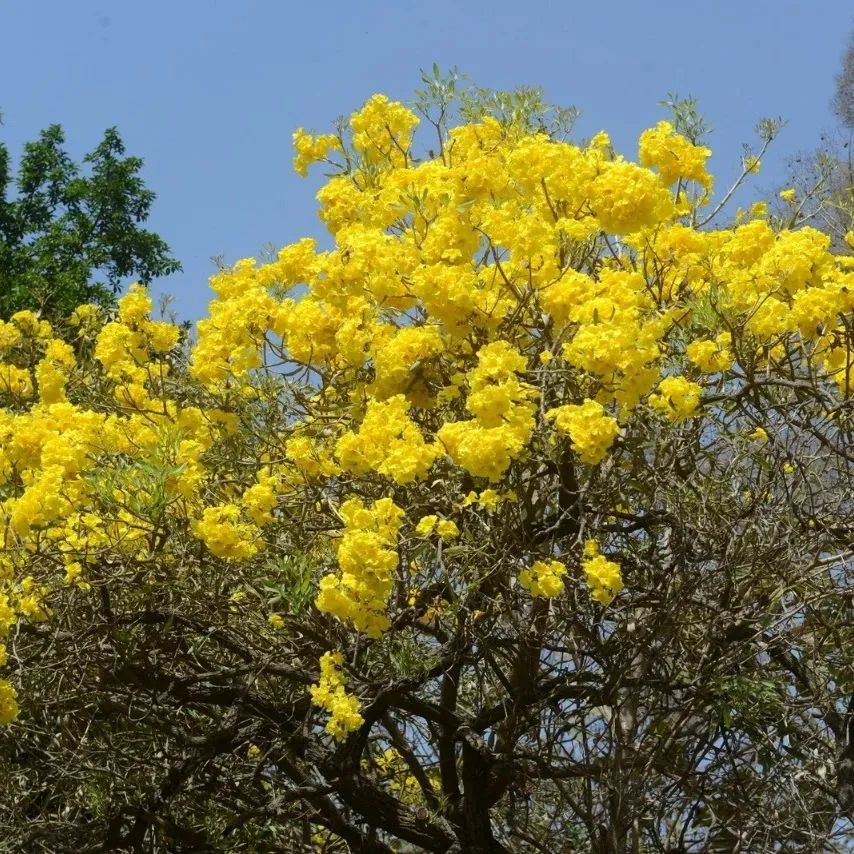
Similar to its Caribbean cousin but often more compact, the golden trumpet tree delivers an even more intense yellow show. It is known to turn bare branches into a blaze of color in late winter or early spring.
This tree is prized in arid and tropical regions for its drought tolerance and spectacular leafless bloom period. The flowers are slightly fuzzy, adding texture, and they draw in pollinators from afar. Great for urban planting as it handles pollution well.
In countries like Colombia and Venezuela, it’s a national symbol, lining avenues with golden splendor. The wood is durable, historically used for construction, but today it’s mostly admired for its beauty. Plant in sandy or loamy soil, and watch it thrive with little water once rooted.
Pruning is rarely needed beyond removing dead branches. The bloom cycle can repeat if conditions are right, giving bonus shows. Pair with succulents or cacti for a low-water landscape that still pops with color. Homeowners in warm zones often choose it for reliable, low-fuss drama.
4. Golden Shower Tree (Cassia fistula)
Scientific name: Cassia fistula.
USDA Zones: 9b–11.
Color variation: Bright buttery yellow, fragrant.
Sun exposure: Full sun.
Mature size: 30–50 feet tall.
Lifespan: 50–80 years.
Toxicity: Pods are purgative if ingested in quantity; generally safe otherwise.
Also known as the Indian laburnum or pudding-pipe tree, the Golden Shower Tree is renowned for its spectacular cascades of bright yellow flowers. Native to South Asia, it’s the national tree and flower of Thailand, where it’s celebrated during festivals for its golden beauty.
In late spring to summer, the tree produces long, pendulous racemes—often 1–2 feet in length—draped with clusters of fragrant, buttery-yellow blooms that hang like shimmering showers of gold. These pea-like flowers attract bees and butterflies, filling the air with a sweet scent.
After blooming, it develops distinctive, long, cylindrical pods (up to 2 feet) that turn dark brown and persist on the tree. This adds winter interest. Reaching 30–50 feet tall with a spreading canopy, it provides excellent shade in warm climates (USDA Zones 9b–11).
The Golden shower tree thrives in full sun and well-drained soil, tolerating drought once established but preferring regular water for best growth. The tree has historical medicinal uses in Ayurveda, with pods acting as a mild laxative.
While stunning, note that parts of the plant (especially seeds and pods) can be purgative or toxic if ingested in large quantities. So, keep away from children and pets.
5. Cootamundra Wattle (Acacia baileyana)
Scientific name: Acacia baileyana.
USDA Zones: 8–11.
Color variation: Bright yellow balls.
Sun exposure: Full sun.
Mature size: 20–30 feet.
Lifespan: 20–40 years.
Toxicity: Low toxicity.
The Cootamundra wattle bursts into a cloud of bright yellow, ball-shaped flowers in late winter to early spring, often when little else is blooming. Native to Australia, it’s celebrated for its profuse display that covers the entire tree in fluffy golden pom-poms, creating a cheerful sight that lifts the spirits during cooler months.
What makes this tree so special is its bipinnate foliage. Fine, feathery leaves that are silvery-blue or gray-green, provide year-round texture and a soft backdrop even when not in flower. The contrast between the delicate leaves and the bold yellow blooms is striking.
It’s fast-growing, often reaching 15 feet in just a few years, making it ideal for quickly filling space or creating a screen. Gardeners use it as a specimen tree, in mixed borders, or even in large containers when young.
However, a word of caution: in some regions like parts of California or Australia outside its native range, it can self-seed vigorously and become weedy or invasive—always check local guidelines before planting.
In suitable spots, it’s drought-tolerant once established, needing little water beyond natural rainfall in mild areas. Pruning is minimal; just remove any dead wood or shape lightly after flowering to encourage growth.
6. Golden Rain Tree (Koelreuteria paniculata)
Scientific name: Koelreuteria paniculata.
USDA Zones: 5–9.
Color variation: Clear yellow flowers in large sprays.
Sun exposure: Full sun to light shade.
Mature size: 30–40 feet tall and wide.
Lifespan: 50+ years.
Toxicity: Mildly toxic seeds; not a major concern.
Few trees offer such a complete package of summer flowers, fall color, and winter interest as the golden rain tree. In midsummer, it erupts in large panicles of small yellow flowers that truly resemble a golden shower raining down, followed by attractive papery seed pods that turn pinkish-bronze and hang like lanterns.
This Chinese native has become a favorite urban tree because it tolerates heat, drought, pollution, and poor soil. It’s therefore perfect for city lots or tough sites. The flowers attract bees, and the pods persist into winter, adding structure when leaves drop.
Fall foliage turns brilliant yellow to orange, extending the show. It’s relatively pest-free and easy to grow. Plant it as a lawn specimen or street tree; it’s one of the small trees with non-aggressive roots. Prune young trees for strong structure, but mature ones need little care.
7. Palo Verde (Parkinsonia florida)
Scientific name: Parkinsonia florida.
USDA Zones: 8–11.
Color variation: Pure yellow.
Sun exposure: Full sun.
Mature size: 20–30 feet.
Lifespan: 30–100 years.
Toxicity: Non-toxic.
Commonly known as the Blue Palo Verde, the Palo Verde (Parkinsonia florida),is a iconic desert tree native to the southwestern United States and Mexico. It proudly serves as Arizona’s state tree. Its name, “palo verde,” means “green stick” in Spanish, referring to its distinctive smooth, greenish-blue bark and trunks.
In spring, this tree explodes into a vibrant display of bright yellow, pea-like flowers that cover the branches in loose clusters. These blooms attract bees, butterflies, and other pollinators, bringing life to desert landscapes. The tiny, compound leaves are sparse, helping conserve water, while small thorns on branches add a protective edge.
Growing 20–30 feet tall and wide with a vase-shaped, open canopy, it provides light, dappled shade—perfect for hot climates (USDA Zones 8–11). Palo Verde is extremely drought-tolerant once established. It needs full sun and well-drained soil, making it ideal for xeriscapes and low-water gardens.
8. Tipu Tree (Tipuana tipu)
Scientific name: Tipuana tipu.
USDA Zones: 9–11.
Color variation: Soft yellow to orange-yellow.
Sun exposure: Full sun.
Mature size: 30–50 feet.
Lifespan: 50+ years.
Toxicity: Non-toxic.
Also known as Pride of Bolivia or Rosewood, the Tipu Tree (Tipuana tipu), is a fast-growing, semi-evergreen tree native to South America. It is widely planted in warm climates for its rapid shade and stunning floral display.
In summer, it bursts into profuse clusters of bright apricot-yellow to golden pea-like flowers at branch tips. This creates a vibrant canopy that attracts bees and butterflies. The blooms are followed by winged samara pods that can be messy when they drop, but they add interesting texture.
Reaching 30–50 feet tall with a broad, spreading crown (often wider than tall), it provides excellent, dense shade—ideal as a street or patio tree in regions like southern California, Arizona, Florida, and Australia (USDA Zones 9–11).
Tipu tree thrives in full sun, tolerates drought once established, and adapts to various soils, though it prefers good drainage. Known for vigorous growth (up to 5 feet per year when young), it’s popular for quick landscaping but can have invasive roots, so plant away from pipes or sidewalks.
9. Yellow Oleander (Cascabela thevetia)
Scientific name: Cascabela thevetia.
USDA Zones: 9–11.
Color variation: Yellow, sometimes peach.
Sun exposure: Full sun.
Mature size: 20–30 feet.
Lifespan: 30–50 years.
Toxicity: Extremely toxic—all parts deadly.
The Yellow Oleander, also known as Lucky Nut, Be-Still Tree, or Trumpet Flower, is a striking evergreen shrub or small tree native to tropical America. It’s widely grown in warm climates for its ornamental appeal.
This tree features clusters of funnel-shaped, bright yellow (sometimes apricot or peach-toned) flowers that bloom profusely throughout the year in frost-free areas, with a peak in warmer months. The waxy, fragrant trumpets attract butterflies and add a tropical flair to gardens.
Its glossy, narrow leaves provide dense foliage, and the plant often forms attractive, angled seeds resembling nuts.
Typically growing 20–30 feet tall (though pruned smaller as a shrub), it thrives in full sun to light shade and well-drained soil (USDA Zones 9–11). Drought-tolerant once established, it’s popular in coastal landscapes for hedges, screens, or accents.
However, extreme caution is advised: all parts of the plant are highly toxic, containing substances that can cause severe illness or death if ingested—even small amounts affect the heart. Keep away from children, pets, and livestock; wear gloves when handling.
10. Gold Medallion Tree (Cassia leptophylla)
Scientific name: Cassia leptophylla.
USDA Zones: 9–11.
Color variation: Golden yellow.
Sun exposure: Full sun.
Mature size: 20–25 feet.
Lifespan: 40–60 years.
Toxicity: Low.
The Gold Medallion Tree is a beautiful small tree native to southeastern Brazil. It’s prized for its spectacular summer displays and tidy habits compared to other Cassia species. Its standout feature is the profusion of deep golden-yellow flowers that appear in large, rounded clusters at branch ends.
Each cluster holds 30–50 fragrant, 2–3 inch blooms, creating a vibrant canopy from midsummer into early fall. Flowers attract pollinators like bees.
Growing 20–30 feet tall (sometimes up to 40 feet) with a broad, spreading crown often wider than tall, this tree offers light shade and a graceful, slightly weeping form. Pinnate leaves are bright green with slender leaflets, providing fine texture year-round in mild climates (USDA Zones 9b–11).
The Gold Medallion Tree thrives in full sun, well-drained soil, and is drought-tolerant once established. This makes it popular as a street, patio, or specimen tree in Southern California and similar subtropical areas. Unlike relatives, it produces fewer long pods, resulting in less litter.
11. Yellow Poinciana or Copperpod (Peltophorum pterocarpum)
Scientific name: Peltophorum pterocarpum.
USDA Zones: 10–11.
Color variation: Bright yellow.
Sun exposure: Full sun.
Mature size: 40–60 feet.
Lifespan: 50+ years.
Toxicity: Non-toxic.
The Yellow Poinciana or Copperpod is a majestic semi-evergreen tropical tree native to Southeast Asia, Sri Lanka, and northern Australia. It is widely planted worldwide for its brilliant floral show and reliable shade.
In summer, it produces upright, conical panicles of crinkled, bright yellow flowers with wavy petals. This creates a flamboyant display that earns it names like Yellow Flame Tree or Yellow Flamboyant. The mildly fragrant blooms attract bees and butterflies, carpeting the ground below when they fade.
Following the flowers, flat, coppery-red pods (up to 4 inches long) develop, turning dark brown and persisting for months. Growing 40–60 feet tall (sometimes more) with a broad, umbrella-shaped canopy, it provides dense shade in parks, avenues, and large gardens (USDA Zones 10–11).
The Yellow Poinciana prefers full sun, well-drained soil, and tolerates drought, salt, and wind. This makes it ideal for coastal and urban tropical landscapes. Fast-growing with fern-like, bipinnate leaves, it’s relatively low-maintenance and pest-resistant.
12. Cornelian Cherry (Cornus mas)
Scientific name: Cornus mas.
USDA Zones: 4–8.
Color variation: Soft yellow umbels.
Sun exposure: Full sun to part shade.
Mature size: 15–25 feet.
Lifespan: 50–100+ years.
Toxicity: Non-toxic, the fruit is edible.
Also known as European Cornel or Cornelian Cherry Dogwood, the Cornelian Cherry, is a hardy deciduous small tree or large shrub native to southern Europe and western Asia. It’s typically valued for its early spring display and edible fruit.
One of the first trees to bloom, it produces clusters of small, bright golden-yellow flowers on bare branches in late winter to early spring (often February–March). It provides vital nectar for bees and a cheerful promise of warmer days ahead. The tiny umbel-like blooms are followed by glossy green leaves.
In late summer, it bears oblong, cherry-like red fruits (drupes) that resemble large cranberries—tart when young but sweetening as they ripen. These are edible raw, or popularly used for jams, syrups, sauces, and liqueurs in traditional European cuisines.
Growing 15–25 feet tall and wide (often multi-stemmed), it forms an attractive rounded or vase-shaped canopy with exfoliating bark for winter interest and brilliant yellow-orange fall color (USDA Zones 4–8).
This tree thrives in full sun to partial shade, adapts to various soils, and is drought-tolerant once established. It’s also low-maintenance, pest-resistant, and non-toxic, making it excellent as a specimen, hedge, or in wildlife gardens.
13. Witch Hazel (Hamamelis spp., yellow varieties like H. intermedia ‘Arnold Promise’)
Scientific name: Hamamelis × intermedia or virginiana.
USDA Zones: 5–9.
Color variation: Yellow ribbons.
Sun exposure: Full sun to part shade.
Mature size: 10–20 feet.
Lifespan: 50+ years.
Toxicity: Non-toxic.
The Witch Hazel (Hamamelis spp.), particularly hybrid cultivars like Hamamelis × intermedia, is a deciduous shrub or small tree prized for its unique winter blooming. Its most magical feature is the clusters of spidery, ribbon-like yellow flowers (in varieties such as ‘Arnold Promise’ or ‘Pallida’) that unfurl along bare branches from late fall through winter.
These fragrant blooms release a spicy-sweet scent on mild days, attracting early pollinators. In autumn, the broad green leaves turn vibrant shades of yellow, orange, and red before dropping, revealing attractive vase-shaped growth and smooth gray bark.
Growing 10–20 feet tall and wide (USDA Zones 5–9), it prefers partial shade to full sun and moist, well-drained, slightly acidic soil. Low-maintenance and deer-resistant, it’s ideal as a specimen plant, in woodland gardens, or near patios to enjoy the fragrance.
Non-toxic and versatile, extracts from Hamamelis virginiana (American witch hazel) are used in astringent skincare products for soothing properties.
14. Tulip Poplar (Liriodendron tulipifera)
Scientific name: Liriodendron tulipifera.
USDA Zones: 4–9.
Color variation: Yellow with orange band.
Sun exposure: Full sun.
Mature size: 70–90 feet tall.
Lifespan: 200+ years.
Toxicity: Non-toxic.
The Tulip Poplar, also known as Yellow Poplar or Tulip Tree, is a towering tree native to North America. It is famous for its stately presence and unique flowers resembling tulips and providing abundant nectar for bees and hummingbirds.
In late spring to early summer, it produces tulip-shaped flowers high in the canopy—cup-like blooms 2–3 inches tall, greenish-yellow with orange bands at the base. Though often hidden among the leaves, they give the tree its name.
One of the fastest-growing eastern hardwoods, it reaches 70–90 feet tall (sometimes over 100 feet) with a straight trunk and pyramidal crown, making it a majestic shade tree (USDA Zones 4–9). Distinctive four-lobed leaves turn brilliant golden-yellow in fall, creating a stunning display.
The lightweight, straight-grained wood is valued for timber. This tree thrives in full sun and moist, well-drained soil. It’s low-maintenance, non-toxic, and supports wildlife. Ideal for large landscapes, parks, or avenues.
15. Yellow Magnolia ‘Butterflies’
Scientific name: Magnolia ‘Butterflies’.
USDA Zones: 5–9.
Color variation: Pure yellow.
Sun exposure: Full sun to part shade.
Mature size: 15–25 feet.
Lifespan: 50+ years.
Toxicity: Non-toxic.
The Yellow Magnolia ‘Butterflies’ is a stunning deciduous hybrid cultivar, developed at the Brooklyn Botanic Garden. It’s celebrated as one of the finest yellow-flowering magnolias for colder climates.
Its highlight is the profusion of clear, buttery-yellow flowers in early to mid-spring—up to 5 inches across, with 10–16 upright, cup-shaped tepals that open wide like butterflies perched on branches. Blooms appear before the leaves, creating a dramatic, non-fading golden display that lasts for weeks and attracts early pollinators.
Compact and pyramidal in habit, it grows 15–25 feet tall and 10–15 feet wide, making it suitable for smaller gardens (USDA Zones 5–9). Dark green leaves emerge after flowering, turning yellow in fall.
This tree thrives in full sun to partial shade, prefers moist, well-drained, slightly acidic soil, and is more cold-hardy and disease-resistant than many magnolias. Non-toxic and low-maintenance, ‘Butterflies’ brings rare yellow elegance to landscapes where traditional pink/white magnolias dominate.
Final thought
Trees with yellow flowers bring an unmatched sense of warmth and vitality to any landscape. Their golden hues not only attract pollinators like bees, butterflies, and hummingbirds but also lift the human spirit, evoking sunshine even on cloudy days.

Tim M Dave is a gardening expert with a passion for houseplants, particularly cacti and succulents. With a degree in plant biology from the University of California, Berkeley, he has vast experience in gardening. Over the years, he has cultivated a vast collection of desert plants and learned a great deal about how to grow and care for these unique companions.