Understanding Sweetgum (Liquidambar styraciflua): Identification, Uses, Problems, and Cultivation Details
Ask any child who has walked barefoot across a lawn in the American South what they think of the Sweetgum tree, and you will likely hear one word: “Ouch.” Those spiky, golf-ball-sized seed balls are infamous — a nuisance underfoot, a hazard on driveways, and the subject of frustration for homeowners who spend autumn weekends raking them up.
But ask a landscape architect, a wildlife ecologist, or a devoted native plant gardener the same question, and you will get an entirely different answer.
The Sweetgum (Liquidambar styraciflua) is, by almost any serious measure, one of the most beautiful, ecologically generous, and historically significant trees in eastern North America. Its star-shaped leaves, spectacular multi-color autumn display, corky-winged branches, and aromatic resin give it a character unlike any other native tree.
The spiky balls are real. So is everything else.
This guide covers everything to know about the Sweetgum completely — its biology, identification, ecology, history, landscape uses, cultural significance, and how to grow it successfully.
What Is the Sweetgum?
The Sweetgum belongs to the family Altingiaceae — a small family of resinous trees found in North America and Asia. In older botanical classifications, it was placed in the witch-hazel family (Hamamelidaceae).
Its genus, Liquidambar, comes from the Latin liquidus (liquid) and the Arabic ambar (amber) — a direct reference to the fragrant, amber-colored resin the tree produces when its bark is cut or wounded.
The species name, styraciflua, means “flowing with storax” — storax being the aromatic balsamic resin harvested from this tree for centuries.
The tree answers to several common names:
- Sweetgum — the universal standard, named for the sweet, aromatic gum it produces
- American Sweetgum — used to distinguish it from Asian relatives
- Redgum — a name common in the timber industry, referring to the reddish heartwood
- Bilsted — an older English name rarely used today
- Star-leaved Gum — occasionally used, referring to the star-shaped leaves
- Alligatorwood — for the corky, ridged bark of older trees
Each name illuminates a different face of this complex, multi-talented tree.
| Scientific Name | Liquidambar styraciflua |
| Family | Altingiaceae |
| Common Names | Sweetgum, Redgum, American Sweetgum, Bilsted |
| Native Range | Eastern North America (Zones 5–9) |
| Mature Height | 60–80 feet (occasionally 100+) |
| Crown Form | Pyramidal in youth; oval-rounded with age |
| Bark | Gray-brown, furrowed; corky winged branches |
| Leaf Shape | Star-shaped, 5–7 lobes, alternate |
| Fall Color | Multi-colored: yellow, orange, red, purple |
| Fruit | Spiky seed balls (1–1.5 inches) |
| Resin | Aromatic storax; historical medicinal use |
| Wildlife Value | High — seeds, caterpillars, pollinators |
| Wood Use | Veneer, furniture, flooring, pulp |
| Fruitless Cultivar | ‘Rotundiloba’ |
Native Range and Natural Habitat
The Sweetgum is native to a broad region of eastern and central North America, with its range extending from southwestern Connecticut and Long Island south through Florida and west through the Gulf states to central Texas, Oklahoma, and Missouri.
A disjunct population also exists in the highlands of Mexico and Central America — evidence of an ancient, wider distribution.
Within its range, Sweetgum is one of the most versatile and ecologically adaptable trees in the eastern forest. It grows primarily in moist to wet lowland forests — floodplains, bottomlands, stream margins, and poorly drained flat woods. But it also colonizes old fields, roadsides, forest edges, and disturbed upland sites with remarkable energy.
It is one of the most abundant and frequently encountered trees across the southeastern Coastal Plain — a dominant species in the wet bottomland forests of the Mississippi Alluvial Valley and the Atlantic and Gulf coastal plains.
In many parts of its range, Sweetgum is a pioneer species — one of the first trees to colonize abandoned agricultural fields, clear-cut forest, and disturbed roadsides. This successional role makes it ecologically important far beyond its presence in mature forests.
It grows alongside Red Maple, Tulip Poplar, Willow Oak, Water Oak, and various Ash species in moist lowland communities, and alongside Loblolly Pine, Virginia Pine, and various oaks as it colonizes upland disturbed sites.
Physical Characteristics
Size and Form
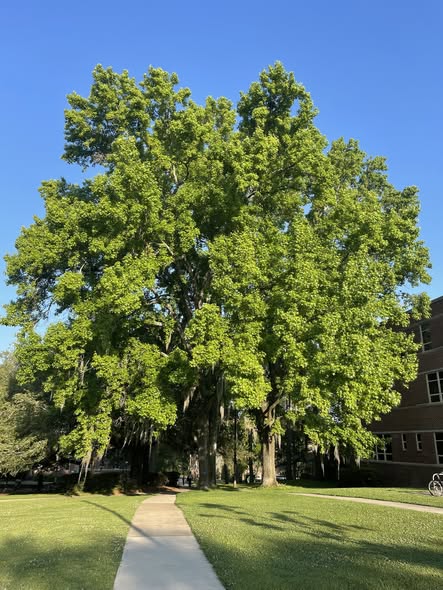
The Sweetgum is a large, impressive tree at maturity. Under good conditions, it typically reaches 60 to 80 feet (18–24 meters) in height, with some specimens exceeding 100 feet. Trunk diameters of 2 to 3 feet are common in mature forest trees, and old-growth specimens can reach considerably larger dimensions.
The crown is conical to broadly pyramidal in youth, becoming more oval to irregularly rounded with age. The overall form is upright and stately — a characteristic that makes young Sweetgum trees among the most architecturally pleasing of native species in the landscape.
The tree’s form is elegant without being fussy — tall enough to anchor a large space, symmetrical enough to satisfy a formal design, and interesting enough in bark and branching to hold visual attention through every season.
Bark and Corky Wings — A Distinctive Feature
Sweetgum bark is gray-brown, deeply furrowed, and scaly on mature trunks — not unlike some oaks in general texture, though the pattern is distinctively Sweetgum.
But the bark feature that most reliably identifies this tree is found not on the trunk but on the young branches and twigs. Many Sweetgum branches develop prominent corky, wing-like ridges running lengthwise along the stem — a phenomenon technically called suberized ridges or colloquially called “wings” or “corky flanges.”
These corky wings are not a disease, pest damage, or deformity. They are a completely normal developmental feature of the species. Not every tree develops them prominently — there is significant individual variation — but when present, they make a Sweetgum branch instantly identifiable even in winter.
In young trees and on young branches of mature trees, these wings can be surprisingly dramatic — creating angular, ridged stems that look almost architectural. I have seen individual branches where the corky flanges extended half an inch on either side of the stem, giving them the look of a gothic column in miniature.
Leaves — The Star Shape
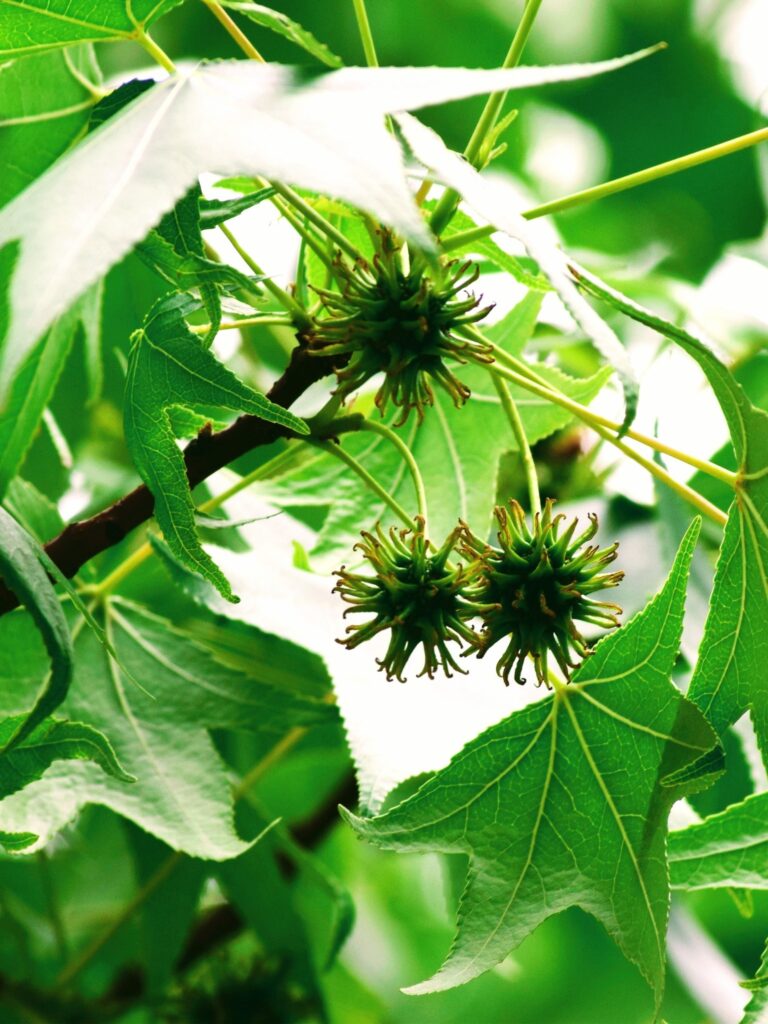
The leaves of the Sweetgum are one of its most distinctive and beloved features. They are star-shaped — palmately lobed with 5 to 7 pointed lobes radiating from a central point, measuring 4 to 7 inches (10–18 cm) across. The lobes are finely toothed along their margins.
The leaf shape is genuinely beautiful and immediately recognizable. It resembles a sugar maple leaf in overall geometry, but with sharper, more deeply cut lobes and a finer tooth pattern. The resemblance occasionally causes confusion, but the two are easily separated: Sweetgum leaves are alternate on the stem, while maple leaves are opposite.
In summer, the leaves are glossy, rich green on the upper surface and paler below. When crushed or bruised, they release a pleasant, spicy-sweet fragrance — one of the more agreeable scents in the native forest.
Autumn Color — The Multi-Hued Display
If there is a single quality that has made Sweetgum one of the most planted native trees in American landscapes, it is the autumn color — and it is genuinely extraordinary.
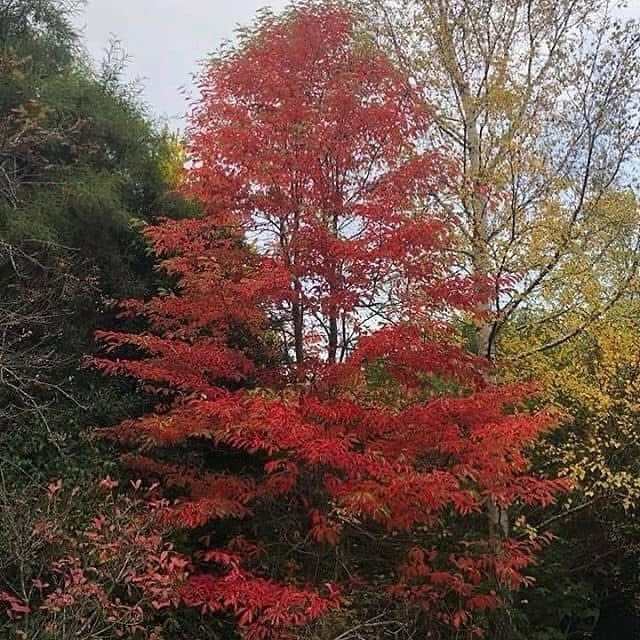
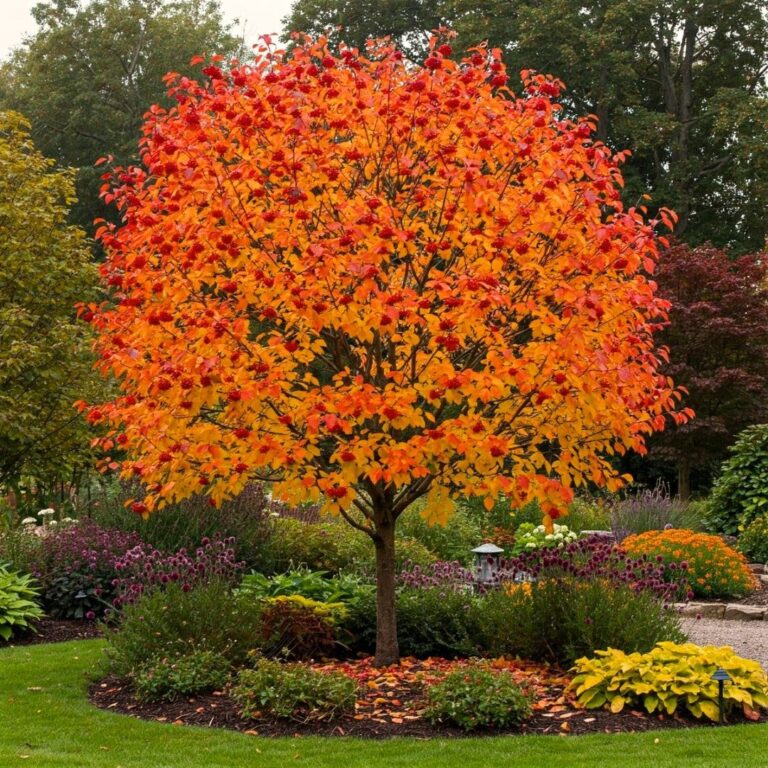
Sweetgum produces one of the most complex, multi-colored fall displays of any temperate tree. A single tree can simultaneously show yellow, orange, red, crimson, purple, and deep burgundy — often all present at once on different leaves or different parts of the crown.
This multi-tonal quality is what sets Sweetgum apart from most other fall-color trees, which tend toward a dominant single color. The effect of a Sweetgum in full autumn color is less like a single note and more like a full chord — rich, layered, and saturated.
Color develops in October through November across most of the range, making Sweetgum a mid to late-season fall color provider that extends the display after earlier species like Black Gum have already peaked and dropped.
The color varies by individual tree and by year — some trees trend toward red and purple, others toward yellow and orange — but the multi-color complexity is consistent and reliable. If you have ever seen a Sweetgum on a clear November day and wondered what tree could possibly produce that many colors at once, now you know.
The Seed Balls — The Famous Fruit
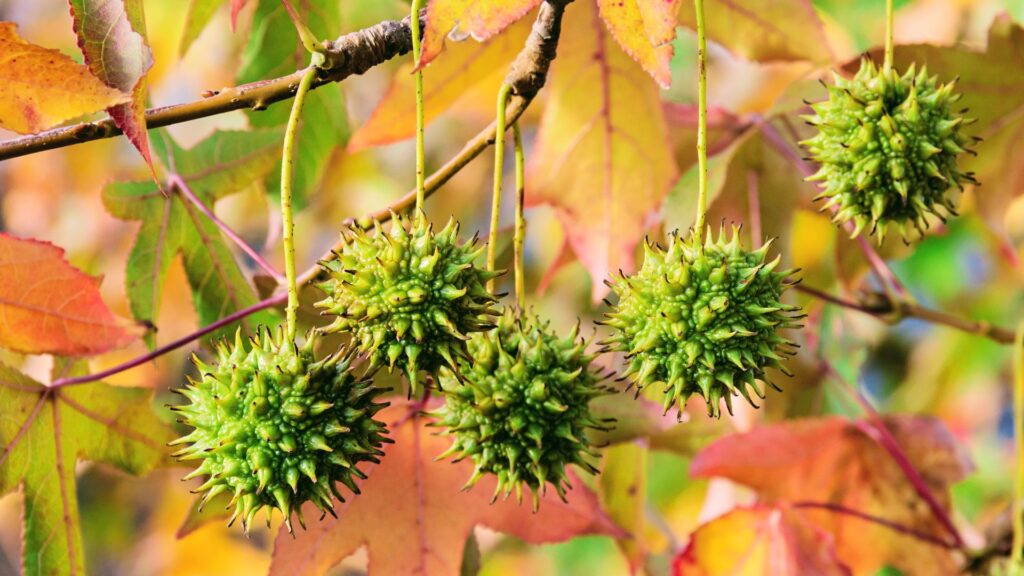
The fruit of the Sweetgum is what most people know best — and feel most acutely underfoot. Each fruit is a spiky, spherical aggregate ball approximately 1 to 1.5 inches (2.5–4 cm) in diameter, covered with woody, pointed projections (modified beak-like structures from each individual capsule).
These balls develop through summer as green, hard spheres hanging on long, pendulous stalks. By October they turn brown and woody, and they begin to fall — and continue falling and accumulating — from autumn through early spring.
Each ball contains multiple small, two-winged seeds that are released through openings in the capsules. The seeds are an important winter food source for birds — particularly goldfinches, pine siskins, and purple finches — as well as for squirrels and other small mammals.
The balls are persistent — they do not decompose quickly and will remain on the ground for a year or more if not removed. This is the primary practical complaint about Sweetgum in residential landscapes, and it is entirely legitimate.
Planning for seed ball management is a necessary part of growing Sweetgum near lawns, paths, or play areas.
Seedless cultivars exist — addressed in the cultivar section below — which have resolved this issue for many landscape applications.
The Resin: Storax and Its Historical Significance
The aromatic resin of the Sweetgum — called storax or copalm balsam — is among the tree’s oldest and most historically significant products. When the bark is wounded, it exudes a thick, fragrant, amber-colored balsam that has been used across cultures for centuries.
Indigenous Uses
Indigenous peoples throughout the tree’s range used Sweetgum resin extensively. The Aztecs reportedly chewed it as a gum and burned it as incense. Native peoples in the southeastern United States used it as a topical antiseptic for wounds and skin infections, as a chewing gum, and as a ceremonial incense.
The common name “Sweetgum” directly reflects this historical tradition of chewing the tree’s resin.
Colonial and Early American Uses
Early European colonists quickly adopted the resin’s uses from Indigenous peoples. Storax was valued as a fumigant, a fixative in perfumery, an ingredient in medicines, and a treatment for skin conditions including ringworm and scabies.
The resin contains styrene — the same compound that gives styrofoam its name. Sweetgum resin was, in fact, one of the early natural sources from which the chemistry of styrene was first studied in the nineteenth century.
Modern Medicinal and Industrial Uses
Today, Sweetgum storax is still used in the fragrance and pharmaceutical industries as a fixative and flavoring agent. It is listed as a generally recognized as safe (GRAS) flavoring substance by the U.S. Food and Drug Administration.
Compounds derived from Sweetgum resin have been studied for antiviral, antibacterial, and anti-inflammatory properties, and shikimic acid — a precursor compound in the synthesis of the antiviral drug Tamiflu (oseltamivir) — has been identified in Sweetgum seed pods and plant tissues.
This discovery attracted significant research interest and media attention in the early 2000s.
Ecological Value and Wildlife Benefits
Despite its reputation as a “junk tree” in some lawn-dominated suburban contexts, the Sweetgum is a highly productive ecological species that supports a wide range of native wildlife.
Birds
The seed balls are a critical winter food source for several bird species that depend heavily on small seeds during cold months:
- American Goldfinch — one of the most frequent Sweetgum seed consumers
- Purple Finch and House Finch
- Pine Siskin — particularly during irruption years
- Carolina Chickadee and Black-capped Chickadee
- Dark-eyed Junco
Beyond seeds, Sweetgum supports over 60 species of Lepidoptera as a larval host plant — caterpillars that feed on the leaves and in turn feed insectivorous birds and their nestlings. Host species include the Luna Moth (Actias luna) — one of North America’s most spectacular native moths — and the Sweetgum Slug Moth, along with numerous other species.
Mammals
White-tailed deer, squirrels, chipmunks, and wild turkeys all consume Sweetgum seeds. Beavers use the wood for dam construction in bottomland settings. White-footed mice cache seeds through winter.
Pollinators
Sweetgum’s small, inconspicuous spring flowers provide early-season nectar and pollen for native bees at a time when reliable sources can be scarce. Honeybees also visit the flowers, and Sweetgum honey is produced in parts of the Deep South.
Sweetgum Wood: A Commercially Valuable Hardwood
Sweetgum produces commercially important timber — one of the more economically significant hardwoods in the southeastern United States. The wood has distinctive characteristics that make it both valuable and challenging.
Wood Properties
The wood is moderately hard, heavy, and fine-grained, with a Janka hardness of approximately 850 lbf — somewhat softer than oak but harder than pine. A defining characteristic is the interlocked grain pattern, which causes the wood to warp and twist during drying if not carefully seasoned. This has historically limited its use in some applications.
The heartwood is reddish-brown (giving rise to the “Redgum” trade name), while the sapwood is pale creamy white — sometimes sold separately as “Sapgum.” The contrast between the two can be striking and decorative.
Commercial Applications
Today, Sweetgum timber is used for:
- Veneer and plywood — a primary commercial use
- Furniture and cabinetry — particularly when quarter-sawn to reveal attractive ray patterns
- Interior trim and millwork
- Flooring — especially in rustic and character-grade applications
- Pallets and crates — lower-grade material
- Paper pulp — significant volume goes to the pulp industry across the Southeast
Sweetgum is one of the most commercially harvested hardwoods in the southern United States, and its timber value makes it an economically important species for forestry as well as ecology.
Landscape and Garden Uses
For all the controversy around its seed balls, the Sweetgum remains one of the most widely planted native shade trees in North American landscapes — and for good reason.
Shade and Specimen Tree
Its tall, symmetrical form and exceptional fall color make it outstanding as a large shade tree or specimen planting in parks, large residential yards, golf courses, and institutional grounds. Few native trees provide as striking a visual impact across multiple seasons.
Street Tree
Several fruitless or reduced-fruit cultivars have made Sweetgum increasingly viable as a street tree in urban settings, where the seed balls were previously a limiting factor. Its tolerance of urban soils, air pollution, and periodic flooding makes it a strong candidate for boulevard plantings.
Naturalized and Riparian Plantings
In naturalized areas, floodplains, and along stream corridors, Sweetgum performs exceptionally well, tolerating periodic flooding and establishing readily from seed. It is an excellent choice for stream bank stabilization and riparian restoration plantings.
Rain Gardens
Its tolerance of wet, seasonally saturated soils makes it suitable for large-scale rain garden and stormwater management plantings, where standing water is temporary but periodic.
Hardiness Zones
Sweetgum is hardy in USDA Zones 5 through 9, covering the eastern and southern United States and Pacific Coast regions.
Sweetgum Notable Cultivars
The development of fruitless and ornamental cultivars has significantly expanded Sweetgum’s landscape applications:
- ‘Rotundiloba’ — the most important landscape cultivar; produces no seed balls (lobes are rounded, not pointed); excellent fall color; widely available
- ‘Worplesdon’ — European selection; narrow, upright form; outstanding fall color
- ‘Slender Silhouette’ — very narrow, columnar form; excellent for tight spaces; produces some fruit
- ‘Palo Alto’ — uniform orange-red fall color; popular street tree in California
- ‘Cherokee’ — strong form; reliable red fall color
- ‘Festival’ — columnar; yellow to peach fall color; good heat tolerance
‘Rotundiloba’ deserves particular attention for homeowners frustrated by seed ball litter. It is the single most practical solution to the Sweetgum’s most common complaint, and it delivers the same outstanding fall color as the straight species.
How to Plant and Grow Sweetgum
Site Selection
Sweetgum performs best in:
- Full sun — required for best form and fall color
- Moist to wet, well-drained soils — performs best with consistent moisture
- Acidic soils — pH 5.5 to 7.0; alkaline soils cause chlorosis
- Deep soils — develops a deep taproot; avoid shallow soils over hardpan
It tolerates periodic flooding, clay soils, and moderate drought once established — though it performs best with reliable moisture.
Planting Instructions
- Plant in spring or early autumn for best establishment.
- Start with container-grown stock — 1 to 5-gallon trees transplant readily.
- Dig the planting hole two to three times wider than the root ball but no deeper.
- Set the root flare at or slightly above grade — deep planting causes long-term decline.
- Backfill with native soil. Light organic amendment is acceptable.
- Mulch generously — 3 to 4 inches of organic mulch extending well beyond the drip line.
- Water consistently during the first two growing seasons.
Maintenance
Established Sweetgum is relatively low maintenance. It does not require regular fertilization. Prune in late winter to remove dead or crossing branches. Avoid heavy structural pruning, which disrupts the tree’s naturally attractive form.
Seed ball management — raking, mulching, or using a seed-ball vacuum — is the primary ongoing maintenance consideration for trees planted near lawns or paved surfaces.
Pests, Diseases, and Common Problems
Sweetgum is generally vigorous and pest-resistant, especially when planted in appropriate conditions.
Iron Chlorosis
On alkaline or poorly drained soils, Sweetgum frequently develops iron chlorosis — yellowing between veins while veins remain green. Correct soil pH as the primary treatment. Foliar iron applications provide temporary relief.
Sweetgum Borer and Other Borers
Borer insects occasionally attack stressed or recently transplanted trees. Maintaining tree vigor through proper planting depth, mulching, and irrigation is the best prevention.
Canker Diseases
Botryosphaeria and other canker fungi can infect stressed trees, causing dieback of branches. Prune out infected wood and maintain tree health to minimize impact.
Root Damage and Pavement Lifting
The surface roots of mature Sweetgum can lift sidewalks and pavement, making it a poor choice for planting in confined tree pits or immediately adjacent to paved surfaces. Allow adequate unpaved root space — at least 8 to 10 feet from pavement edges when possible.
Final Thoughts
The Sweetgum is a tree of genuine contradictions — celebrated and cursed, beautiful and frustrating, ancient in human use and still discovering new applications in modern chemistry. It is simultaneously one of the most admired fall-color trees in North America and one of the most complained-about trees in American suburbs.
Both reputations are earned. The seed balls are real. So is the blazing autumn display. So is the Luna Moth caterpillar feeding on its leaves on a summer night. So is the beekeeping tradition, the storax resin history, the timber value, and the goldfinch feeding in the seed balls on a cold January morning.
Understanding the Sweetgum fully — rather than reducing it to either its beauty or its inconvenience — reveals a tree of remarkable complexity and generosity. Plant it thoughtfully, in a space large enough for its roots and tall enough for its crown. Consider a fruitless cultivar if seed balls are a genuine concern. Give it sun and moisture and the right soil.
In return, it will give you decades of shade, a fall color display that stops conversation every October, and an ecological legacy that will outlast the garden that surrounds it.
That is, by any measure, a good trade.
References
- Virginia Tech Department of Forest Resources and Environmental Conservation — Dendrology Fact Sheet: Liquidambar styraciflua https://dendro.cnre.vt.edu/dendrology/syllabus/factsheet.cfm?ID=57
- North Carolina State University Cooperative Extension — Liquidambar styraciflua Plant Profile https://plants.ces.ncsu.edu/plants/liquidambar-styraciflua/
- University of Florida IFAS Extension — Liquidambar styraciflua: Sweetgum https://edis.ifas.ufl.edu/publication/ST371
- USDA Forest Service — Silvics of North America — Liquidambar styraciflua L. — Sweetgum https://www.srs.fs.usda.gov/pubs/misc/ag_654/volume_2/liquidambar/styraciflua.htm
- Clemson University Cooperative Extension — Sweetgum (Liquidambar styraciflua) https://hgic.clemson.edu/factsheet/sweetgum/

Tim M Dave is a gardening expert with a passion for houseplants, particularly cacti and succulents. With a degree in plant biology from the University of California, Berkeley, he has vast experience in gardening. Over the years, he has cultivated a vast collection of desert plants and learned a great deal about how to grow and care for these unique companions.