Sugar Maple (Acer saccharum): Identification, Growth Rate, Problems, and Full Cultivation Details
Some trees are useful. Some are beautiful. And some — rare as they are — manage to be both, profoundly and simultaneously. Sugar maple (Acer saccharum) belongs to that rare category. It clothes entire hillsides in gold and crimson each autumn.
This tree yields the sap that becomes genuine maple syrup. It provides one of the finest hardwoods in North America. And it has graced the national flag of Canada since 1965.
Whether you are a homeowner considering it as a shade tree, a landowner interested in maple syrup production, a student of ecology, or simply someone who has stood beneath a sugar maple in October and felt something, this guide is for you.
Here is everything you need to know about Acer saccharum — where it grows, how it grows, and how to grow it well.
What Is the Sugar Maple? Botanical Profile
Acer saccharum, commonly known as the sugar maple or hard maple, belongs to the family Sapindaceae (formerly Aceraceae). It is native to the hardwood forests of eastern North America, ranging from Nova Scotia and New Brunswick in the north, south through New England and the Appalachians, west through the Great Lakes region, and into the upper Midwest.
The species name saccharum means “sugar” in Latin — a direct reference to the high sucrose content of its sap, which distinguishes it from other maple species.
In the wild, mature sugar maples typically reach 18 to 27 meters (60 to 90 feet) in height, with a broadly rounded to oval crown spanning 12 to 15 meters (40 to 50 feet) in width. Their growth is slow to moderate — roughly 30 to 60 centimeters (1 to 2 feet) per year under good conditions — but the result, over decades, is a tree of extraordinary presence and permanence.
The bark is grey and smooth on young trees, becoming deeply furrowed and plated with age — a useful identification feature in winter.
The Iconic Leaves: Identification and Fall Colour
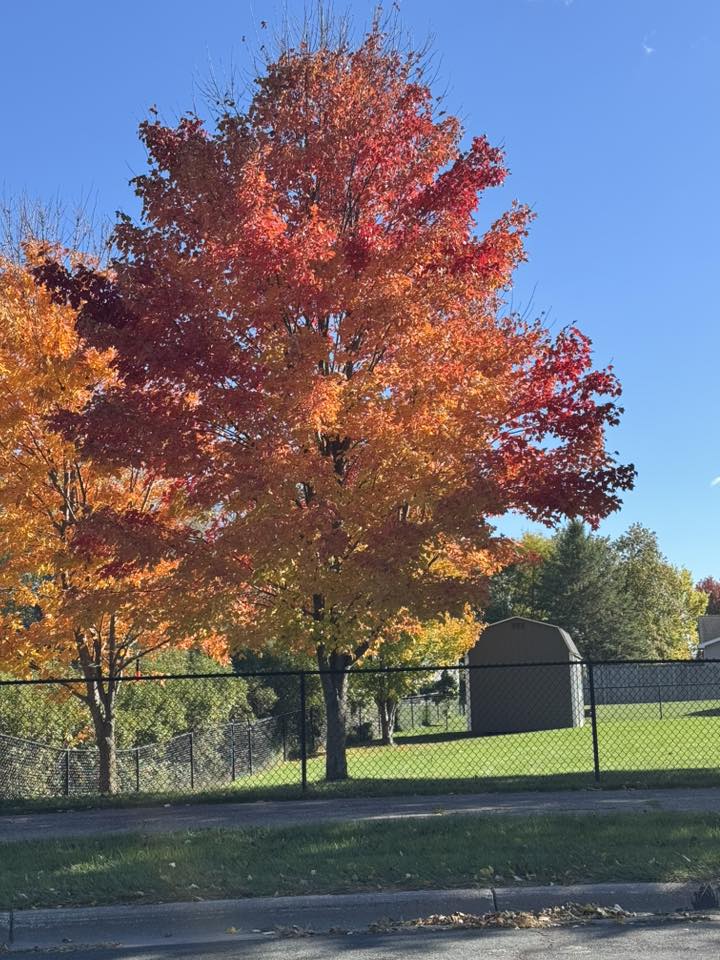
The leaves of Acer saccharum are the model for the maple leaf on the Canadian flag. They are palmately lobed with five lobes, separated by rounded sinuses, and typically measure 8 to 18 centimeters (3 to 7 inches) across. The upper surface is medium green and smooth; the underside is paler and slightly hairy along the veins.
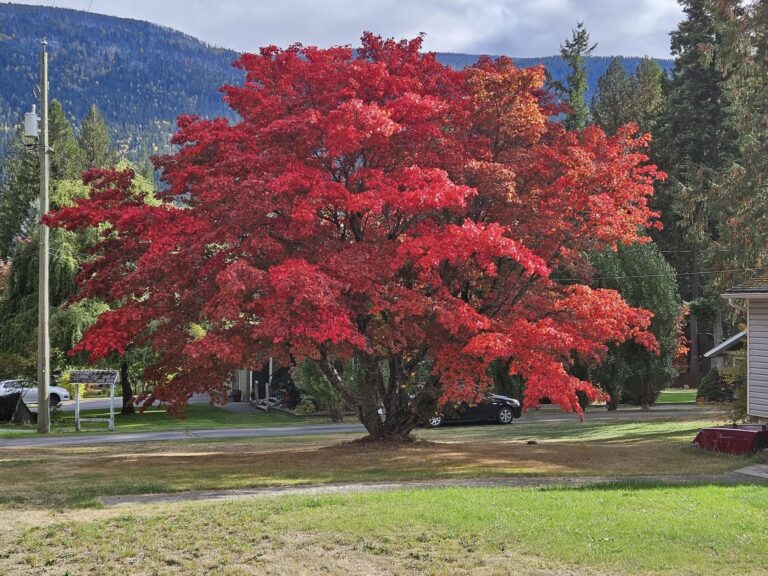
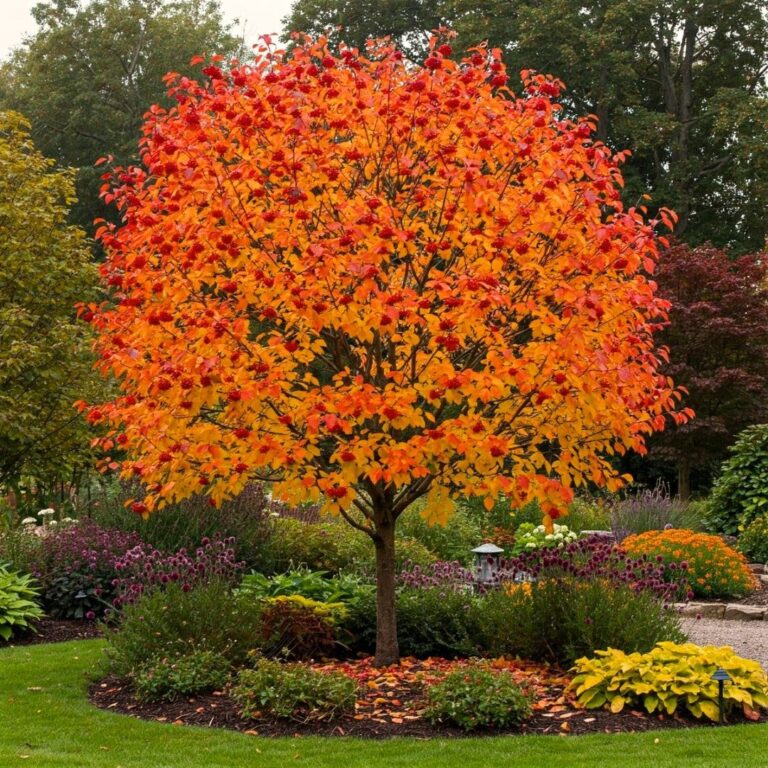
In spring and summer, the foliage is attractive but unremarkable. The true performance comes in autumn, when sugar maple delivers one of the most spectacular colour displays of any deciduous tree in the world.
Depending on the individual tree, local climate, and seasonal weather patterns, autumn colour ranges through:
- Brilliant yellow
- Rich orange
- Deep scarlet and red
- Occasionally purple
The best autumn colour develops when warm, sunny days follow cool but above-freezing nights — precisely the conditions of a classic northeastern North American autumn. This is why sugar maple foliage tourism — colloquially known as “leaf peeping” — is a significant economic driver in New England and eastern Canada each September and October.
I have seen sugar maples in Vermont at their peak colour, and no photograph ever fully captures the experience. You have to be there.
Natural Range and Ecological Role
Sugar maple is a dominant canopy species in the northeastern temperate forest — what ecologists call the Northern Hardwood Forest type. It co-dominates with American beech (Fagus grandifolia), yellow birch (Betula alleghaniensis), and eastern hemlock (Tsuga canadensis) across much of its range.
This forest type is among the most ecologically rich in North America. Sugar maple is central to its function.
Ecologically, Acer saccharum:
- Produces abundant mast (seed crops) that sustain squirrels, chipmunks, deer, and numerous bird species
- Its flowers, which appear in early spring before the leaves, are an important early nectar source for native bees and other pollinators
- The dense canopy moderates soil temperature and moisture, supporting a diverse understory plant community
- Fallen leaves, which are calcium-rich, contribute significantly to soil nutrient cycling
- Old trees develop cavities that provide nesting and denning habitat for woodpeckers, owls, flying squirrels, and bats
Sugar maple is also a climate-sensitive species. Research from multiple universities has documented its vulnerability to warming temperatures, particularly in the southern portions of its range. As winters warm and spring arrives earlier, the tree’s range is projected to shift northward — a subject of active conservation concern.
Climate and Hardiness: Where Sugar Maple Thrives
Acer saccharum is adapted to USDA Hardiness Zones 3 through 8, making it one of the more cold-tolerant large hardwood trees. However, it has a narrower comfort zone than this range might suggest.
It requires:
- Cold winters — extended dormancy below freezing is essential for vigour and sap flow
- Moderate summers — it performs poorly in prolonged heat above 35°C (95°F)
- Adequate moisture — it dislikes prolonged drought
- Clean air — it is notably sensitive to air pollution and road salt
This last point is critical for urban planting. Sugar maple does not tolerate road salt spray or soil salt accumulation well. Trees planted near salted roads frequently show marginal leaf scorch, dieback, and early decline. For those situations, alternative species like red maple (Acer rubrum) or silver maple (Acer saccharinum) are more appropriate.
The sugar maple performs best in the northeastern United States, the upper Midwest, and eastern and central Canada — places with the cold winters and moist, temperate summers it evolved within.
Soil Requirements: The Foundation of Good Growth
Sugar maple prefers deep, moist, well-drained, fertile soils with a slightly acidic to neutral pH — ideally between 5.5 and 7.3.
Key soil characteristics it needs:
- Good aeration — compacted soils restrict root growth and oxygen exchange
- Consistent moisture without waterlogging — brief wet periods are tolerated, but chronic flooding is harmful
- Loamy texture — clay-heavy or very sandy soils limit performance
- Adequate organic matter — naturally occurring in forest soils; can be supplemented in cultivation with regular mulching
Soil compaction is one of the leading causes of sugar maple decline in urban and suburban settings. When soil is compacted by foot traffic, construction, or vehicle movement, roots cannot penetrate, oxygen levels drop, and water infiltration slows.
The results — sparse canopy, dead branches, declining vigour — can take years to manifest, by which point damage is often difficult to reverse.
For newly planted trees or declining specimens in compacted urban soils, vertical mulching (drilling vertical holes in the root zone and filling them with compost or coarse grit) can meaningfully improve soil aeration and tree health.
Maple Syrup Production: The Sweet Science
For many people, the sugar maple is synonymous with one thing above all others: maple syrup. This association is entirely deserved, and the science behind it is fascinating.
How Sap Flow Works
During the late winter to early spring thaw — typically late February through March in most of the maple’s range — a unique combination of conditions drives sap flow through the tree. During this period:
- Daytime temperatures rise above freezing (ideally to around 4°C to 7°C / 40°F to 45°F)
- Nights remain below freezing (around -7°C to -1°C / 20°F to 30°F)
This temperature cycle creates pressure changes within the tree that force sap up through the sapwood. The sap collected during this period is thin and slightly sweet — about 2% to 3% sucrose — and must be boiled down to produce syrup.
Producing one litre (roughly one quart) of finished maple syrup requires approximately 40 litres (10 gallons) of raw sap — a ratio that explains why genuine maple syrup commands a premium price.
Tapping Sugar Maples
A healthy sugar maple can be tapped once it reaches 25 to 30 centimeters (10 to 12 inches) in diameter at breast height — typically after 30 to 40 years of growth.
Basic tapping process:
- Drill a 7 to 16mm (9/16 to 5/8 inch) hole at a slight upward angle, about 5 to 7 centimeters (2 to 3 inches) deep into the sapwood
- Insert a spile (tap) and hang a bucket, or connect to a tubing collection system
- Collect sap daily during the flow season
- Boil sap in an evaporator or large pan, removing water until the correct syrup density is reached (66° Brix, measured with a refractometer or hydrometer)
- After the season ends, remove taps and allow holes to seal naturally — healthy trees do this within two to three years
A single tap on a healthy tree yields around 40 to 80 litres of sap (10 to 20 gallons) in a good season.
Responsible tapping means limiting the number of taps per tree, never tapping trees that are already stressed or declining, and rotating tap hole placement each year to allow full healing.
Growing Sugar Maple in the Landscape
Sugar maple is one of the finest large shade trees for gardens, parks, and estate-scale landscapes in its hardiness range. When properly sited, it requires minimal intervention and improves with every passing decade.
Planting
The fundamentals of planting Acer saccharum correctly:
- Choose the right site from the start — this is a large tree that will eventually dominate its immediate surroundings; allow adequate space and avoid proximity to buildings, underground utilities, and roads
- Dig a wide, shallow hole — two to three times the width of the root ball, and no deeper than the root ball itself; planting too deep is a leading cause of long-term decline
- Set the root flare at or slightly above soil level — burying the root flare encourages bark decay and girdling roots
- Backfill with native soil — excessive compost in the backfill creates an overly rich “bathtub” effect that discourages roots from venturing into surrounding soil
- Water thoroughly at planting and weekly during the first growing season
- Apply 7 to 10 centimeters (3 to 4 inches) of organic mulch over the root zone, keeping it clear of the trunk
Best planting time: early spring or early autumn — avoiding the heat of summer and the hard freezes of deep winter.
Watering
Established sugar maples are relatively drought-tolerant in cooler climates, but they suffer in extended summer droughts — particularly in the southern parts of their range or during heat events.
During the first three to five years, consistent deep watering during dry spells is essential. Mature trees benefit from supplemental irrigation during prolonged droughts, applied slowly and deeply to the entire root zone.
Fertilising
In naturalistic or rural settings, sugar maples generally need no supplemental fertilisation. Annual leaf fall provides adequate organic matter and nutrients.
In urban and suburban settings with compacted or impoverished soils, an annual application of a slow-release, balanced granular fertiliser (such as 10-10-10) in early spring can support vigour. Soil testing every three to five years is the most reliable guide to what amendments are actually needed.
Pruning Sugar Maple: Less Is More
Sugar maple has a naturally pleasing form and requires minimal structural pruning in most settings. The primary goals of pruning are safety and the removal of dead or damaged wood.
Pruning guidelines:
- Prune in late winter to early spring, while the tree is still dormant — this minimises the risk of pest and disease entry through wounds
- Sugar maple bleeds sap profusely if pruned in late winter just before bud break; this is not harmful but can be messy; pruning in late autumn or early winter avoids this
- Remove dead, diseased, or crossing branches first
- Preserve the natural form — avoid heavy reductions that destroy the tree’s characteristic rounded silhouette
- Never remove more than 25% of the live canopy in a single season
Large-scale pruning on mature trees should be carried out by a certified arborist — improper cuts on large branches can create permanent structural weaknesses.
Common Pests and Diseases
Sugar maple is a robust species but faces several notable threats.
Pests
Asian longhorned beetle (Anoplophora glabripennis) — An invasive wood-boring beetle that attacks maple species, excavating tunnels through the heartwood. Trees with significant infestation cannot be saved and must be removed. Early detection and reporting is critical. Look for round exit holes, sawdust-like frass, and oozing sap on the trunk.
Maple bladder gall mite and spindle gall mite — Produce small, distinctive galls on leaf surfaces. Usually cosmetic; treatment is rarely necessary.
Forest tent caterpillar (Malacosoma disstria) — Periodically defoliates sugar maples over large areas during population outbreaks. Healthy trees typically recover without intervention.
Aphids — Various aphid species colonise the undersides of leaves, excreting sticky honeydew. Seldom a serious problem for established trees; natural predators usually control populations.
Diseases
Verticillium wilt — A soil-borne fungal disease that blocks the vascular system, causing sudden wilting and dieback of individual branches or entire sections of the crown. There is no cure; remove affected branches, maintain tree vigour, and avoid replanting susceptible species in infected soil.
Tar spot (Rhytisma acerinum) — Produces distinctive black, tar-like spots on leaves in late summer. Primarily cosmetic; rake and dispose of fallen leaves to reduce the overwintering inoculum.
Anthracnose — Causes irregular brown leaf lesions and early defoliation in cool, wet springs. Generally not serious for established trees.
Bacterial leaf scorch — Caused by the bacterium Xylella fastidiosa, producing marginal leaf scorch that progresses inward. No cure exists; manage tree stress and consult a certified arborist.
Notable Cultivars of Acer saccharum
Plant breeders have selected numerous cultivars of sugar maple to suit specific landscape needs — particularly for improved urban tolerance, consistent autumn colour, and compact form.
| Cultivar | Key Features | Mature Height |
| ‘Green Mountain’ | Heat-tolerant; consistent orange-red autumn colour; oval form | 12–15 m |
| ‘Legacy’ | Glossy leaves; excellent heat and drought tolerance; reliable colour | 12–15 m |
| ‘Fall Fiesta’ | Early, vibrant autumn colour; good wind resistance | 12–15 m |
| ‘Commemoration’ | Fast-growing; consistent orange-red colour; sturdy structure | 12–18 m |
| ‘Bonfire’ | Outstanding scarlet autumn colour; good salt tolerance | 9–12 m |
| ‘Caddo’ | Sourced from drought-tolerant Great Plains populations; excellent heat resistance | 9–12 m |
For urban street planting or gardens with exposure to road salt, ‘Green Mountain’ and ‘Legacy’ are among the most widely recommended.
Sugar Maple and Climate Change: A Conservation Concern
It would be incomplete to discuss Acer saccharum without acknowledging the serious conservation questions surrounding it in a warming climate.
Research from the University of Vermont, Harvard Forest, and other institutions has documented several concerning trends:
- Northward range shift — Models project that the sugar maple’s core habitat will move significantly northward by 2100 under most warming scenarios, contracting sharply in the southern parts of its current range
- Shorter, less reliable sap seasons — Warming winters produce fewer freeze-thaw cycles, reducing the duration and volume of sap flow; the maple syrup industry in many regions is already experiencing greater year-to-year variability
- Increased stress from drought — More frequent and intense summer droughts, particularly in the Midwest and southern range, are weakening trees and making them more susceptible to pests and diseases
- Phenological mismatch — Earlier spring leaf-out, driven by warming, can expose new growth to late frost events, reducing annual growth and seed production
These challenges underscore the importance of provenance-appropriate planting — using seed sources from populations naturally adapted to warmer or drier conditions (such as the ‘Caddo’ cultivar, sourced from Oklahoma) when planting in marginal climates.
Cultural and Economic Significance
Sugar maple is far more than a botanical specimen. It is deeply embedded in the culture, economy, and identity of northeastern North America.
Maple syrup is a multi-billion-dollar industry. Canada produces roughly 71% of the world’s maple syrup, with Quebec alone accounting for the vast majority of that production. Vermont is the leading maple syrup-producing state in the United States.
The maple leaf on the Canadian flag, adopted in 1965, is modelled on the sugar maple leaf — a deliberate choice to represent a species native to Canada and uniquely associated with its landscape and culture.
Hard maple lumber, commercially known as “hard rock maple,” is prized for furniture, flooring, cabinetry, and cutting boards. Its tight, even grain and exceptional hardness (1,450 lbf on the Janka hardness scale) make it one of the most durable domestic hardwoods available. It is the standard material for professional basketball court flooring.
Frequently Asked Questions
How long does sugar maple live? In forest conditions, sugar maple can live for 300 to 400 years. Open-grown landscape specimens typically live for 150 to 200 years under good conditions. Urban trees, facing compaction, pollution, and salt, often live significantly shorter lives.
Is sugar maple a good street tree? In most situations, it is not ideal for street planting due to its sensitivity to salt, compaction, and urban heat. Improved cultivars like ‘Green Mountain’ and ‘Legacy’ perform better in these conditions, but red maple is generally the more reliable urban choice.
When does sugar maple change colour? In most of its range, colour change begins in late September, peaking in mid to late October. The timing varies with latitude, elevation, and the local weather patterns of a given year.
Can I grow sugar maple outside its native range? It can be grown successfully in parts of the Pacific Northwest, higher elevations of the American West, and in similar cool-temperate climates in Europe and elsewhere. However, it struggles in hot, dry summers and mild winters, and will not produce the sap volumes needed for commercial syrup production outside its natural climate zone.
Final Thoughts
Acer saccharum is, in every meaningful sense, a landmark species — one that defines landscapes, supports ecosystems, feeds wildlife, sweetens tables, and graces flags. Planting one is not just a gardening decision. It is a long-term investment in beauty, ecology, and the kind of slow, patient richness that only a tree can provide.
Give it space, give it time, protect its roots, and keep salt away from it — and a sugar maple will reward every one of those efforts, season after season, for generations.
References
- University of Vermont Extension – Tapping Maple Trees: A Guide to Maple Syrup Production https://www.uvm.edu/extension/agriculture/maple
- North Carolina State University Extension – Acer saccharum: Sugar Maple Plant Profile https://plants.ces.ncsu.edu/plants/acer-saccharum/
- University of Minnesota Extension – Sugar Maple in the Landscape https://extension.umn.edu/trees-and-shrubs/sugar-maple
- Cornell University, College of Agriculture and Life Sciences – Sugar Maple Ecology and Silvics https://www.dnr.cornell.edu/ext/info/pubs/forestry/sugarmaple.pdf
- Virginia Cooperative Extension, Virginia Tech – Acer saccharum Fact Sheet https://dendro.cnre.vt.edu/dendrology/syllabus/factsheet.cfm?ID=2

Tim M Dave is a gardening expert with a passion for houseplants, particularly cacti and succulents. With a degree in plant biology from the University of California, Berkeley, he has vast experience in gardening. Over the years, he has cultivated a vast collection of desert plants and learned a great deal about how to grow and care for these unique companions.