Southern Magnolia (Magnolia grandiflora): Identification, Growth Rate, Problems and More
There are trees you admire, and then there are trees that stop you in your tracks. Magnolia grandiflora — the Southern magnolia — belongs firmly in the second category. Its enormous white blossoms, glossy evergreen leaves, and commanding stature have made it one of the most celebrated trees in American horticulture.
It is the official state tree and flower of Mississippi, and the state flower of Louisiana — a quiet testament to how deeply this tree is woven into the identity of the American South.
But the Southern magnolia is not just a regional icon. It is increasingly grown across the world — from the United Kingdom to Japan, New Zealand to South Africa — wherever the climate allows. And with the rise of compact cultivars, even gardeners with modest spaces can now enjoy it.
This guide covers everything you need to know about Magnolia grandiflora — its origins, growth habits, landscape uses, care requirements, and the best varieties available today.
What Is the Southern Magnolia? Botanical Identity and Background
Magnolia grandiflora belongs to the family Magnoliaceae, one of the most ancient flowering plant families on Earth. Fossil evidence suggests that magnolias existed before bees evolved — their flowers were originally pollinated by beetles, which is why the blooms are so large and robust.
The species is native to the coastal plain and Piedmont regions of the southeastern United States, from North Carolina south to central Florida and west to eastern Texas. In its natural range, it grows in rich, moist, well-drained soils along streams, forest edges, and slopes.
In ideal conditions, Magnolia grandiflora can reach heights of 24 to 37 meters (80 to 120 feet) with a spread of up to 15 meters (50 feet). In cultivated landscapes, it is typically smaller — 12 to 24 meters (40 to 80 feet) — depending on the cultivar and growing conditions.
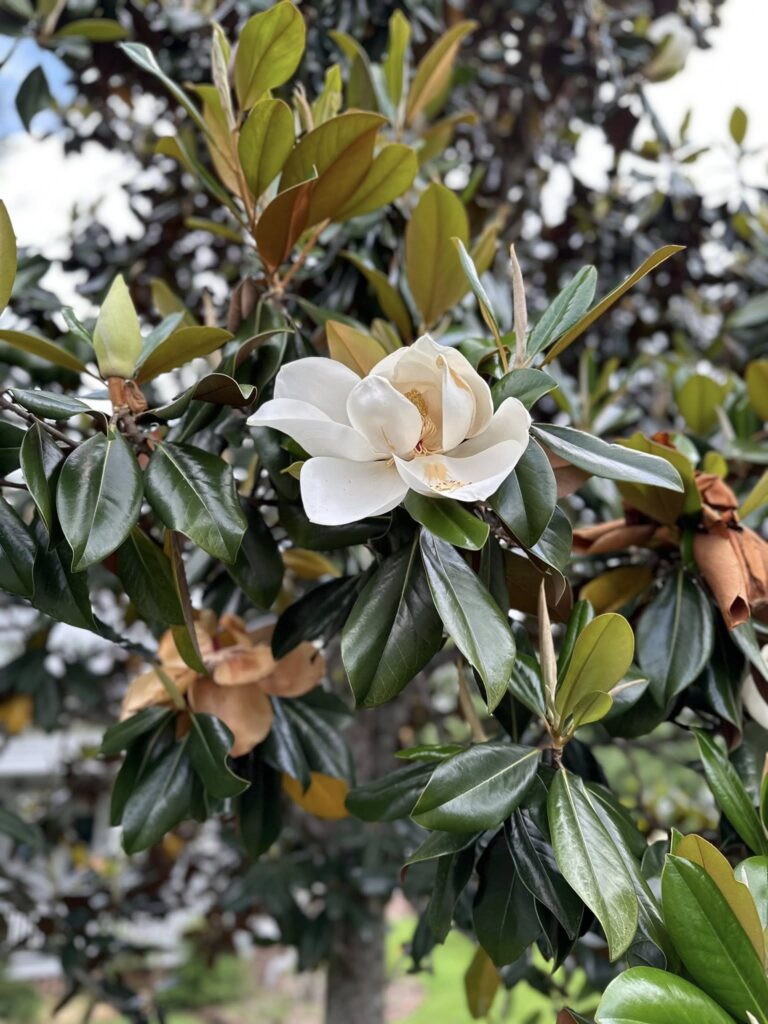
The name grandiflora means “large-flowered” in Latin, and the flowers certainly justify that name. Individual blooms can measure 20 to 30 centimeters (8 to 12 inches) across. They are creamy white, heavily fragrant, and appear from late spring through summer — sometimes with a second flush in early autumn.
Why Gardeners and Landscapers Love Southern Magnolia
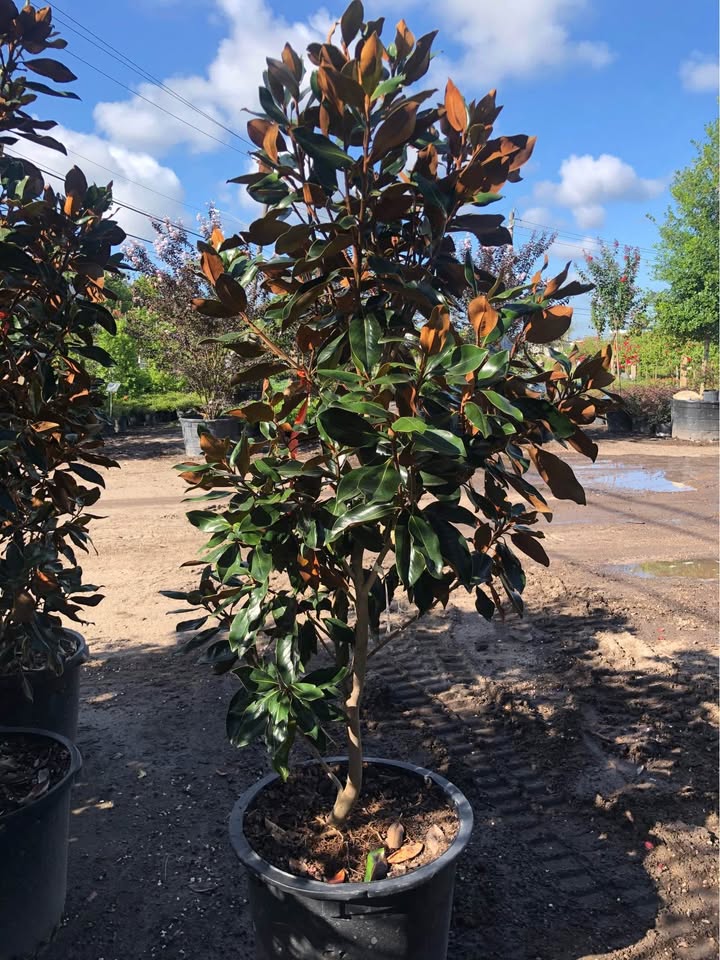
Few trees offer the same year-round visual interest as Magnolia grandiflora. Even in winter, when many deciduous trees stand bare, the Southern magnolia holds its glossy, deep green leaves — often with a striking rusty-brown or bronze underside called indumentum.
The key attractions:
- Spectacular flowers — among the largest of any hardy tree
- Fragrance — a rich, lemony-sweet scent that fills the surrounding air
- Evergreen foliage — provides structure and privacy in all seasons
- Wildlife value — seeds attract birds, particularly cardinals and mockingbirds
- Longevity — well-established trees can live for 100 years or more
- Architectural presence — few trees make a stronger landscape statement
I have stood beneath a mature Southern magnolia in full bloom, and I can honestly say it is one of those rare gardening experiences that stays with you. The scent alone is extraordinary.
Native Range and Climate Preferences
Understanding where Magnolia grandiflora comes from helps you grow it successfully — whether you are in its native range or far beyond it.
In the wild, it favours USDA Hardiness Zones 7 through 10 — warm temperate to subtropical climates with mild winters and hot, humid summers. Most cultivars are hardy to about -15°C to -18°C (0°F to 5°F) under Zone 7 conditions, though established trees often exceed these limits once their root systems are well-developed.
Beyond the American South, Southern magnolia is grown successfully in:
- Southern Europe (Spain, Italy, Portugal, parts of France)
- The United Kingdom (sheltered positions in Zones 8–9)
- New Zealand and eastern Australia
- Parts of East Asia, particularly China and Japan
In cooler regions, wall training — growing the tree flat against a south- or west-facing wall — is a traditional technique that uses reflected heat to protect the tree and encourage flowering. Some of the most impressive specimens in the UK are found trained against old stone walls in this way.
Soil Requirements: What Southern Magnolia Needs Underground
Soil quality has a profound effect on the health and longevity of Magnolia grandiflora. Getting this right from the moment of planting is far easier than trying to correct problems later.
Ideal soil characteristics:
- Slightly acidic to neutral pH: 5.0 to 7.0 is the target range; below 5.0 or above 7.5 causes nutrient lock-up
- Well-draining: Although the Southern magnolia tolerates brief periods of wet soil, prolonged waterlogging causes root rot and decline
- Deep and loamy: The tree develops a substantial root system; shallow, compacted soils restrict growth
- Organically rich: Regular mulching and organic matter incorporation improve structure and fertility
In alkaline soils — common in many urban environments and areas with limestone bedrock — chlorosis (yellowing of leaves between the veins) is a frequent problem. Iron chelate treatments or soil acidification with sulfur can help, but the best long-term solution is amending the soil before planting.
Southern magnolia has a reputation for surface roots. In lawn settings, these can eventually heave paving and compete with grass. Planning adequate clearance from hard surfaces at the time of planting saves significant trouble later.
Sunlight Needs: Full Sun for Best Performance
Magnolia grandiflora is a full-sun tree. It flowers best and develops the most attractive, compact growth when it receives at least six hours of direct sunlight daily.
In hotter climates — particularly in USDA Zones 9 and 10 — afternoon shade can be beneficial, especially for young trees, as intense summer heat and reflected sunlight from buildings can stress newly planted specimens.
In cooler climates, prioritise the warmest, most sheltered position available. A south-facing aspect, ideally backed by a wall that absorbs and radiates heat, gives the tree the best chance of flowering prolifically and withstanding winter cold.
Young trees in shade will grow slowly, flower poorly, and develop a lax, open form. If your planting site is significantly shaded, Southern magnolia is not the right choice — there are better-suited magnolias for shadier conditions.
Watering: Establishing and Maintaining a Southern Magnolia
The most critical watering period for Magnolia grandiflora is the first three to five years after planting. During this time, the root system is still establishing, and the tree is vulnerable to drought stress.
Establishment watering guidelines:
- Water deeply and thoroughly once or twice a week during dry periods in the first year
- Reduce frequency in year two and three, but maintain depth — shallow, frequent watering encourages shallow roots
- Once established, Southern magnolia is considerably drought-tolerant, though it performs best with consistent moisture during summer
Mulching is essential. Apply a 7 to 10 centimeter (3 to 4 inch) layer of organic mulch — wood chips, shredded bark, or compost — around the base of the tree, keeping it clear of the trunk. Mulch conserves moisture, moderates soil temperature, suppresses weeds, and gradually improves soil structure as it decomposes.
In its native range, the Southern magnolia is considered moderately drought-tolerant once mature. However, prolonged drought during bloom time shortens flower duration and may cause early leaf drop.
Feeding and Fertilising: Supporting Healthy Growth
Young and newly planted Southern magnolias benefit from annual fertilisation to support vigorous establishment. Established, mature trees in good soils often need little supplemental feeding at all.
Recommended approach:
- Apply a slow-release, acidifying granular fertiliser formulated for acid-loving plants (azaleas, camellias, and rhododendrons share similar requirements) in early spring
- A second, lighter application in early summer supports continued growth
- Never fertilise in late summer or autumn — this encourages tender new growth that is vulnerable to frost damage
Avoid high-nitrogen fertilisers in isolation. They promote lush, fast growth at the expense of flowering and may make the tree more susceptible to pests and disease.
If chlorosis is present, supplement with chelated iron or a micronutrient blend suited to acidic soil conditions.
Planting a Southern Magnolia: Step-by-Step
Planting Magnolia grandiflora correctly from the start dramatically improves its long-term success. The roots are fleshy and easily damaged, which is why magnolias in general resent transplantation. The younger and smaller the tree at planting, the better it typically establishes.
Step-by-step planting guide:
- Choose the right location — allow for the tree’s mature size; plant away from buildings, power lines, and paved surfaces
- Dig a wide, shallow hole — three times the width of the root ball and no deeper than the root ball itself; planting too deep is a leading cause of establishment failure
- Loosen the root ball gently — if container-grown, tease out any circling roots before planting
- Set the tree at the correct depth — the root flare (where the trunk widens at the base) should sit at or just above soil level
- Backfill with the original soil — do not add excessive compost to the backfill; it creates a “sump effect” that concentrates water around roots
- Water deeply immediately after planting
- Apply mulch over the root zone, keeping it away from the trunk
Best planting time: spring in cooler climates; autumn planting is also effective in warmer regions, allowing the root system to develop before summer heat arrives.
Pruning: How Much and When
Southern magnolias have a naturally attractive pyramidal to broadly conical form. In most landscape settings, minimal pruning is required.
What to prune:
- Remove dead, damaged, or crossing branches in late winter or early spring, before new growth begins
- Remove lower branches gradually if a clear trunk is desired — do this over several years, not all at once
- For wall-trained specimens, tie in new growth in spring and remove outward-facing shoots in summer
What to avoid:
- Heavy pruning in late summer or autumn — this removes next year’s flower buds and stimulates new growth vulnerable to frost
- Removing large branches unnecessarily — magnolias do not heal large wounds well, and decay can set in
The milky white sap in magnolia stems is not as irritating as that of ficus, but gloves are still recommended for extended pruning sessions.
Best Cultivars of Magnolia grandiflora
One of the great developments in modern horticulture has been the selection of compact, cold-hardy, and prolific-flowering cultivars of Magnolia grandiflora. This has made the tree accessible to a far wider range of gardeners.
Top cultivars to consider:
| Cultivar | Key Features | Mature Size |
| ‘Little Gem’ | Compact; flowers from young age; bronze leaf undersides | 3–5 m tall |
| ‘Kay Parris’ | Glossy leaves; extremely floriferous; cold-hardy | 6–9 m tall |
| ‘Bracken’s Brown Beauty’ | Striking brown leaf indumentum; very cold-hardy to Zone 6b | 9–12 m tall |
| ‘Edith Bogue’ | Exceptional cold-hardiness; good for northern limits | 12–15 m tall |
| ‘D.D. Blanchard’ | Rich orange-brown leaf backs; strong grower | 12–18 m tall |
| ‘Claudia Wannamaker’ | Fast-growing; excellent symmetry; popular street tree | 15–20 m tall |
‘Little Gem’ deserves special mention for small gardens. It flowers at a young age — sometimes within two to three years of planting — and its compact size makes it suitable even for large containers or courtyard gardens.
Wildlife and Ecological Value
Southern magnolia is more than a garden ornament. It plays a meaningful role in local ecosystems.
The flowers are attractive to pollinators, particularly beetles, which were its original pollinators long before bees. In late summer and autumn, the distinctive red seed cones split open to reveal bright red or orange-red seeds. These are eagerly consumed by birds including cardinals, mockingbirds, wood thrushes, towhees, and wild turkeys. Small mammals, including squirrels, also feed on the seeds.
The dense, evergreen canopy provides year-round shelter for birds, making it a valuable nesting and roosting site.
The thick layer of shed leaves beneath the tree — often a concern for gardeners — creates habitat for beneficial insects, ground beetles, and other invertebrates that form part of the broader garden food web.
Common Problems: Identification and Solutions
Magnolia grandiflora is relatively resilient, but several issues can affect it.
Chlorosis (yellowing leaves) Caused by iron or magnesium deficiency in alkaline soils. Treat with chelated iron and lower soil pH gradually using sulfur.
Scale insects Small, shield-like or waxy insects on stems and leaf undersides. Treat with horticultural oil in late winter or early spring when crawlers are active.
Magnolia scale The largest scale insect in North America, Neolecanium cornuparvum, is occasionally found on magnolias. It produces sticky honeydew that encourages sooty mould growth. Treat with dormant oil spray.
Leaf spots Fungal leaf spots occasionally appear in humid conditions. Improve air circulation and rake up fallen debris. Chemical treatment is rarely necessary for established trees.
Frost damage on young plants New growth in spring can be damaged by late frosts. Protect young trees with horticultural fleece if a hard frost is forecast after growth has begun.
Dieback in wet soils Prolonged waterlogging causes root rot and progressive branch dieback. Improve drainage, and if severe, consider replanting in a raised bed or better-drained location.
Southern Magnolia in Landscape Design
Few trees make as commanding a landscape statement as Magnolia grandiflora. Its uses in garden and urban design are wide-ranging.
- As a specimen tree: planted in isolation on a lawn, it becomes the centrepiece of the entire garden — particularly impressive in summer bloom.
- As a screen or windbreak: the dense, evergreen canopy makes it an effective privacy screen or shelter belt when planted in groups or lines.
- As a street tree: cultivars like ‘Claudia Wannamaker’ and ‘Alta’ are increasingly used in urban streetscaping for their tolerance of compacted soils, pollution, and heat.
- As a wall-trained specimen: in cooler climates, fan-training against a warm wall creates a dramatic, structured feature while providing the extra warmth the tree needs to flower reliably.
- Companion planting: Southern magnolia pairs beautifully with underplantings of shade-tolerant species such as hostas, ferns, camellias, and azaleas, which share its preference for moist, acidic soils and thrive beneath the canopy.
Cultural and Historical Significance
The Southern magnolia carries deep cultural weight, particularly in the American South. It appears in literature, music, and visual art as a symbol of the South’s landscape and identity.
Margaret Mitchell’s Gone with the Wind features the magnolia prominently as part of the plantation setting. The tree features on the Mississippi state flag. Military cemeteries across the South were planted with magnolias as symbols of dignity and endurance.
Beyond the United States, Magnolia grandiflora was introduced to Europe in the early 18th century. Pierre Magnol, the French botanist after whom the genus is named, was a contemporary of the tree’s introduction to European horticulture. Some of the oldest cultivated specimens in Europe — in France, Italy, and the UK — are over 200 years old and have become heritage landmarks in their own right.
Frequently Asked Questions
How quickly does Southern magnolia grow? Growth rate varies by cultivar. Standard species trees grow at a moderate to fast rate — around 30 to 60 centimeters (1 to 2 feet) per year in good conditions. Compact cultivars like ‘Little Gem’ grow more slowly.
When does Southern magnolia flower? The main flowering period is late spring to mid-summer (typically May to July in the Northern Hemisphere). Some cultivars produce sporadic blooms through early autumn.
Can I grow Southern magnolia in a container? Compact cultivars, particularly ‘Little Gem’, can be grown in large containers for several years. Use a large, sturdy pot with excellent drainage, acidic potting mix, and commit to regular watering and feeding.
How do I stop the leaves from making a mess? Southern magnolia is evergreen but does shed older leaves — typically in spring as new growth emerges. This is natural and unavoidable. Mulching the area beneath the canopy reduces the visible impact and allows leaves to break down naturally.
Is Southern magnolia toxic to pets? Magnolia grandiflora is not listed as toxic to dogs or cats by the ASPCA. However, the seeds and flower parts can cause mild gastrointestinal upset if consumed in large quantities.
Final Thoughts
Magnolia grandiflora is a tree that repays investment with decades of beauty, fragrance, and ecological value. It asks for a thoughtful start — the right location, proper planting depth, good soil, and adequate moisture during establishment. After that, it largely takes care of itself.
Choose the right cultivar for your space, plant it well, give it the sun and slightly acidic soil it needs, and you will have a tree that outlives you and enriches every season of your garden’s life.
In my experience, few planting decisions in the garden carry the same sense of permanence — and optimism — as choosing to plant a Southern magnolia.
References
- University of Florida IFAS Extension – Magnolia grandiflora: Southern Magnolia https://edis.ifas.ufl.edu/publication/ST401
- North Carolina State University Extension – Magnolia grandiflora Plant Profile https://plants.ces.ncsu.edu/plants/magnolia-grandiflora/
- Clemson University Cooperative Extension – Magnolia Diseases & Insect Pests https://hgic.clemson.edu/factsheet/magnolia-diseases-insect-pests/
- Mississippi State University Extension – Southern Magnolia as a Landscape Tree https://extension.msstate.edu/publications/information-sheets/southern-magnolia
- Virginia Cooperative Extension, Virginia Tech – Magnolia grandiflora Fact Sheet https://dendro.cnre.vt.edu/dendrology/syllabus/factsheet.cfm?ID=39

Tim M Dave is a gardening expert with a passion for houseplants, particularly cacti and succulents. With a degree in plant biology from the University of California, Berkeley, he has vast experience in gardening. Over the years, he has cultivated a vast collection of desert plants and learned a great deal about how to grow and care for these unique companions.